

|
시장보고서
상품코드
2122923
유럽의 연속 혈당 모니터링 시장 : 시장 점유율 분석, 업계 동향 및 통계, 성장 예측(2026-2031년)Europe Continuous Glucose Monitoring - Market Share Analysis, Industry Trends & Statistics, Growth Forecasts (2026 - 2031) |
||||||
 Mordor Intelligence
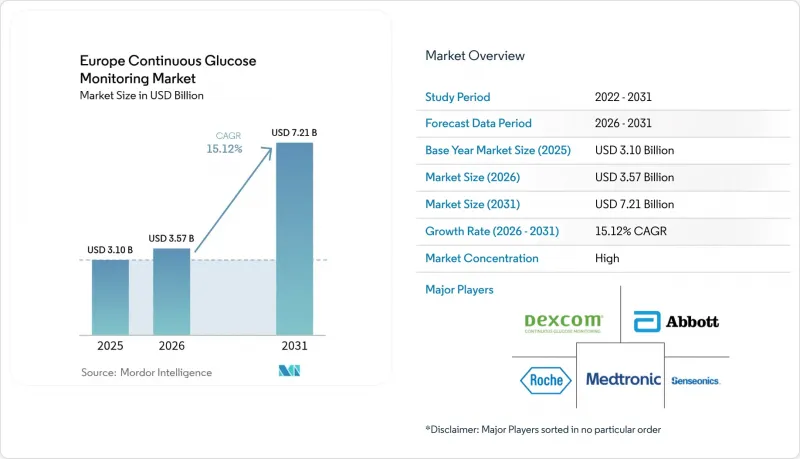
Mordor Intelligence에 의하면, 유럽의 연속 혈당 모니터링 시장 규모는 2025년 31억 달러로 평가되었고, 2026년에는 35억 7,000만 달러로 추정되고, 2026-2031년 CAGR 15.12%로 성장을 지속할 전망이며, 2031년에는 72억 1,000만 달러에 이를 것으로 예측됩니다.
본 보고서는 구성 부품별(센서, 송신기, 수신기), 최종 사용자별(병원 및 진료소, 가정·개인), 대상층별(성인, 소아), 지역별(독일, 영국, 프랑스, 이탈리아, 스페인, 러시아, 기타 유럽)로 분류되어 있습니다. 시장 예측은 금액(달러) 기준으로 제시되어 있습니다.
유럽의 연속 혈당 모니터링 시장 동향 및 인사이트
유럽 내 당뇨병 유병률 증가
유럽 연속 혈당 모니터링 시장의 성장세는 현재 당뇨병을 앓고 있는 6,560만 명의 성인에 의해 뒷받침되고 있으며, 이 수치는 2050년까지 7,240만 명에 달할 것으로 예측됩니다. 동유럽에서 2형 당뇨병 발병 연령이 낮아짐에 따라, 기존에는 1형 당뇨병에 중점을 두었던 대상 환자층이 확대되고 있습니다. 독일의 코호트 연구에 따르면, CGM 사용자의 HbA1c 수치는 7.13%로 개선된 반면, 비사용자는 7.66%에 그쳐, 이로 인해 의사들의 신뢰도가 높아지고 있습니다. 내분비 전문의들은 손가락 채혈을 통한 혈당 측정이 어려워진 후가 아니라, 진단 시점에 CGM을 처방하는 사례가 늘어나고 있으며, 이 기술이 1차 치료법으로 자리 잡아가고 있습니다. 이러한 역학적 호재 덕분에 경기 둔화기에도 유럽의 연속 혈당 모니터링 시장은 견조한 추세를 보이고 있습니다.
CGM 기기의 보험 적용 확대
2016년부터 독일에서 시작된 법정 보험 적용, 2024년 프랑스의 ‘아슈랑스 말라디(Assurance Maladie)’ 적용 범위 확대, 그리고 잉글랜드 국민건강서비스(NHS)의 ‘FreeStyle Libre’ 프로그램이 맞물리면서 초기 비용이라는 장벽이 제거되고 있습니다. 보험 적용을 받은 사용자는 하루 평균 16.3회 혈당을 측정하고 있는 반면, 손가락 채혈을 통한 측정은 4-6회에 그치고 있습니다. 예측 가능한 보험 지급은 제조업체의 파이프라인 투자와 생산 규모 확대를 촉진하고 있습니다. 이탈리아와 스페인도 지역별 입찰을 통해 유사한 정책 방향을 따르고 있어, 남유럽 전역에 도미노 효과를 일으키고 있습니다. 이러한 보험 적용 확대의 물결로 인해, 2030년까지 유럽의 연속 혈당 모니터링 시장에서 두 자릿수의 매출 성장이 예상됩니다.
기기의 고가와 부분적인 보험 적용 범위 격차
동유럽의 소득 격차로 인해 환자의 본인 부담금은 여전히 높은 수준을 유지하고 있습니다. 이탈리아 남부 일부 지역에서는 센서 비용의 70%만 환급되고 있어 보급이 정체되어 있습니다. 지역 지원 단체들은 전액 보상을 요구하며 로비 활동을 펼치고 있으나, 예산 제약으로 인해 협상이 장기화되고 있습니다. 각 제조업체들은 환자 지원 바우처를 도입하고 있으나, 합리적인 가격으로의 격차를 신속하게 해소하는 데는 어려움을 겪고 있습니다. 이러한 지역적 과제로 인해, 보다 광범위한 재정적 형평성이 확보될 때까지 유럽의 연속 혈당 모니터링 시장에서의 판매량 증가는 제한될 전망입니다.
부문 분석
2025년 유럽 연속 혈당 모니터링 시장의 매출액 중 81.74%를 센서가 차지했으며, 이는 센서가 소모품이라는 점과 14일마다 교체해야 하는 주기를 반영한 것입니다. 2024년에 승인된 Senseonics사의 6개월 지속형 ‘Eversense E3’와 같은 장기 착용형 제품이 보급됨에 따라, 이 부문의 성장률은 2031년까지 연평균 성장률(CAGR) 15.45%를 나타낼 것으로 예측됩니다. Dexcom사와 애보트사의 아일랜드 자동화 생산 라인 덕분에 2027년까지 연간 생산 능력은 1억 개에 달할 것으로 예상되며, 이에 따라 단가는 30유로 미만으로 떨어져 저소득 지역에서의 이용이 촉진될 것입니다. 수신기 및 송신기는 18.26%의 점유율을 차지했으나, 스마트폰 앱으로의 전환에 따라 전용 하드웨어 매출은 점차 감소하고 있습니다. CGM 데이터를 분석하는 소프트웨어 구독 서비스는 새로운 수익원으로 부상하고 있으며, 물리적 센서 이외의 수익원 다각화를 가져오고 있습니다. EU-MDR에 포함된 상호운용성 기준은 앱 중심의 생태계와 제3자 분석을 촉진하고 있으며, 이러한 추세는 유럽의 연속 혈당 모니터링 시장에서 플랫폼에 대한 종속성을 더욱 강화할 것입니다.
기타 혜택 :
- 엑셀 형식 시장 예측(ME) 시트
- 3개월간의 애널리스트 지원
자주 묻는 질문
목차
제1장 서론
제2장 조사 방법
제3장 주요 요약
제4장 시장 구도
제5장 시장 규모 및 성장 예측
제6장 경쟁 구도
제7장 시장 기회 및 향후 전망
AJY 26.09.07According to Mordor Intelligence, the Europe continuous glucose monitoring market size is expected to grow from USD 3.10 billion in 2025 to USD 3.57 billion in 2026 and is forecast to reach USD 7.21 billion by 2031 at 15.12% CAGR over 2026-2031.
This report is Segmented by Component (Sensors, Transmitters, Receivers), End User (Hospitals/Clinics, Home/Personal), Demography (Adult, Paediatric), and Geography (Germany, United Kingdom, France, Italy, Spain, Russia, Rest of Europe). The Market Forecasts are Provided in Terms of Value (USD).
Europe Continuous Glucose Monitoring Market Trends and Insights
Rising Diabetes Prevalence in Europe
Europe's continuous glucose monitoring market momentum is anchored by 65.6 million adults currently living with diabetes, a figure projected to climb to 72.4 million by 2050. Younger onset of Type 2 diabetes in Eastern Europe widens the addressable patient pool beyond the historical Type 1 focus. German cohort studies show HbA1c improvements to 7.13% among CGM users versus 7.66% for non-users, strengthening physician confidence. Endocrinologists increasingly prescribe CGM at diagnosis rather than after finger-stick failure, embedding the technology as first-line management. This epidemiological tailwind sustains the Europe continuous glucose monitoring market even during economic slowdowns.
Expansion of Reimbursement for CGM Devices
Statutory coverage in Germany since 2016, France's broadened Assurance Maladie listing in 2024, and NHS England's FreeStyle Libre program collectively remove upfront cost barriers. Reimbursed users scan glucose 16.3 times per day compared with 4-6 finger-stick tests. Predictable payouts foster manufacturer pipeline investment and scale production. Italy and Spain mirror the policy path through regional tenders, creating a domino effect across Southern Europe. The reimbursement wave underpins double-digit revenue visibility for the Europe continuous glucose monitoring market through 2030.
High Device Cost and Partial Reimbursement Gaps
Income disparities across Eastern Europe keep patient co-pays high. Some Italian southern regions still reimburse only 70% of sensor cost, stalling uptake. Local advocacy groups lobby for full coverage, but budget constraints prolong negotiations. Manufacturers deploy patient-assistance vouchers yet struggle to close affordability gaps quickly. These pockets temper volume growth within the Europe continuous glucose monitoring market until broader funding parity is secured.
Other drivers and restraints analyzed in the detailed report include:
- Advances in User-Friendly Wearable Sensors
- Telehealth-Driven Demand for Remote Monitoring
- Sensor Accuracy and Calibration Concerns
For complete list of drivers and restraints, kindly check the Table Of Contents.
Segment Analysis
Sensors accounted for 81.74% of 2025 revenue within the Europe continuous glucose monitoring market, reflecting their consumable nature and 14-day replacement cycles. Segment growth is forecast at a 15.45% CAGR through 2031 as extended-wear versions such as Senseonics' 6-month Eversense E3, approved in 2024, gain traction. Automated Irish production lines from Dexcom and Abbott are expected to lift annual capacity to 100 million units by 2027, pushing unit cost below EUR 30 and spurring use in lower-income regions. Receivers and transmitters held 18.26% share but shift toward smartphone apps is gradually eroding dedicated hardware sales. Software subscriptions that interpret CGM data emerge as a fresh margin pool, diversifying revenue beyond physical sensors. Interoperability standards embedded in the EU-MDR encourage app-centered ecosystems and third-party analytics, a trend that deepens platform lock-in for the Europe continuous glucose monitoring market.
Complete Report Scope:
- By Component
- Sensors
- Transmitters
- Receivers
- By End User
- Hospitals / Clinics
- Home / Personal
- By Demography
- Adult
- Paediatric
- By Geography
- Germany
- United Kingdom
- France
- Italy
- Spain
- Russia
- Rest of Europe
List of Companies Covered in this Report:
- Abbott Laboratories
- Medtronic
- Dexcom
- Senseonics
- Roche
- A. Menarini Diagnostics S.r.l.
- I-Sens
- Medtrum Technologies Inc.
- Nemaura Medical Inc.
- Zhejiang POCTech Co.,Ltd.
- MicroTech Medical
Additional Benefits:
- The market estimate (ME) sheet in Excel format
- 3 months of analyst support
TABLE OF CONTENTS
1 Introduction
- 1.1 Study Assumptions & Market Definition
- 1.2 Scope of the Study
2 Research Methodology
3 Executive Summary
4 Market Landscape
- 4.1 Market Overview
- 4.2 Market Drivers
- 4.2.1 Rising Diabetes Prevalence in Europe
- 4.2.2 Expansion of Reimbursement For CGM Devices
- 4.2.3 Advances in User-Friendly Wearable Sensors
- 4.2.4 Telehealth-Driven Demand for Remote Monitoring
- 4.2.5 National EHR Integration of CGM Data
- 4.2.6 Manufacturing Automation Lowering Sensor Cost
- 4.3 Market Restraints
- 4.3.1 High Device Cost and Partial Reimbursement Gaps
- 4.3.2 Sensor Accuracy / Calibration Concerns
- 4.3.3 GLP-1 Drugs Curbing Monitoring Frequency
- 4.3.4 EU-MDR Uncertainty for Next-Gen Non-Invasive CGM
- 4.4 Supply Chain Analysis
- 4.5 Regulatory Landscape
- 4.6 Technological Outlook
- 4.7 Porter's Five Forces Analysis
- 4.7.1 Bargaining Power of Suppliers
- 4.7.2 Bargaining Power of Consumers
- 4.7.3 Threat of New Entrants
- 4.7.4 Threat of Substitute Products and Services
- 4.7.5 Intensity of Competitive Rivalry
- 4.8 Market Indicators
- 4.8.1 Type-1 Diabetes Population
- 4.8.2 Type-2 Diabetes Population
5 Market Size & Growth Forecasts (Value)
- 5.1 By Component
- 5.1.1 Sensors
- 5.1.2 Transmitters
- 5.1.3 Receivers
- 5.2 By End User
- 5.2.1 Hospitals / Clinics
- 5.2.2 Home / Personal
- 5.3 By Demography
- 5.3.1 Adult
- 5.3.2 Paediatric
- 5.4 By Geography
- 5.4.1 Germany
- 5.4.2 United Kingdom
- 5.4.3 France
- 5.4.4 Italy
- 5.4.5 Spain
- 5.4.6 Russia
- 5.4.7 Rest of Europe
6 Competitive Landscape
- 6.1 Market Concentration
- 6.2 Market Share Analysis
- 6.3 Company Profiles (includes Global level Overview, Market level overview, Core Segments, Financials as available, Strategic Information, Market Rank/Share for key companies, Products & Services, and Recent Developments)
- 6.3.1 Abbott Laboratories
- 6.3.2 Medtronic plc
- 6.3.3 Dexcom Inc.
- 6.3.4 Senseonics Holdings Inc.
- 6.3.5 F. Hoffmann-La Roche Ltd
- 6.3.6 A. Menarini Diagnostics S.r.l.
- 6.3.7 i-SENS, Inc.
- 6.3.8 Medtrum Technologies Inc.
- 6.3.9 Nemaura Medical Inc.
- 6.3.10 Zhejiang POCTech Co.,Ltd.
- 6.3.11 MicroTech Medical
7 Market Opportunities & Future Outlook
- 7.1 White-space & Unmet-need Assessment


