

|
시장보고서
상품코드
2115231
인도의 연속 혈당 모니터링(CGM) 시장 : 점유율 분석, 업계 동향과 통계, 성장 예측(2026-2031년)India Continuous Glucose Monitoring (CGM) - Market Share Analysis, Industry Trends & Statistics, Growth Forecasts (2026 - 2031) |
||||||
 Mordor Intelligence
Mordor Intelligence에 의하면, 인도 연속 혈당 모니터링 시장 규모는 2025년에 2억 752만 달러로 평가되었고 2026년 2억 3,141만 달러에서 2031년까지 3억 9,969만 달러에 이를 것으로 예측되며, 예측 기간(2026-2031년) CAGR은 11.55%를 나타낼 전망입니다.
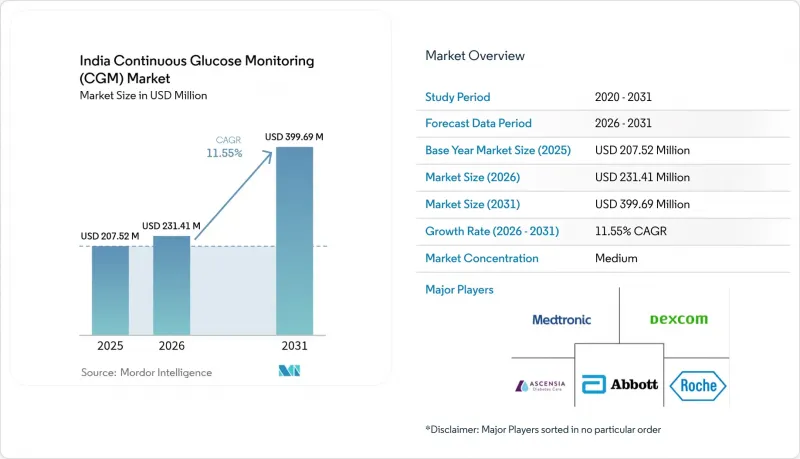
본 보고서는 구성 부품(센서, 송신기, 수신기), 기기 유형(실시간 CGM, 간헐적 스캔 방식 CGM), 당뇨병 유형(제1형, 제2형), 연령대(소아, 성인, 고령자), 최종 사용자(병원 및 진료소, 재택 간호 환경 등)별로 분류되어 있습니다. 시장 전망은 금액(달러) 기준으로 제시되어 있습니다.
인도 연속 혈당 모니터링(CGM) 시장 동향 및 인사이트
당뇨병 유병률의 급증과 조기 진단
2024년 기준, 인도의 성인 당뇨병 환자 수는 8,980만 명에 달했으며, 이 중 3,860만 명은 미진단 상태였습니다. 이에 따라 국가 비전염성 질환(NCD) 프로그램은 2025년 3월까지 7,500만 명의 시민을 추가로 선별 검사하기 위해 724개 지역 진료소의 체계를 확충하고 있습니다. 개정된 국가 지침에서는 ‘목표 범위 내 유지율(TIR) 70% 이상’이 치료 목표로 설정되었으며, 단편적인 모니터링이 아닌 지속적인 모니터링이 필수적입니다. 2025년에 실시된 다기관 공동 연구에서는 FreeStyle Libre를 사용함으로써 인슐린 비의존성 2형 당뇨병 환자의 TIR이 40.8%에서 64.5%로 상승한 것으로 나타났습니다. 보험사들은 2024년에 85억 달러의 당뇨병 관련 비용을 부담하게 되었으며, 합병증을 억제하는 예방 기술로의 전환이 가속화되고 있습니다. 그 결과, 2025년에는 공립 병원 및 대학 부속 병원에서 CGM 신규 처방전이 22% 증가하여, 인도의 연속 혈당 모니터링 시장에 새로운 수요 원천이 생겨났습니다.
원격 진료 및 디지털 헬스 프로그램의 급속한 확대
‘아유슈만 바라트 디지털 미션(Ayushman Bharat Digital Mission)’은 2024년까지 45.38 crore건의 의료 기록을 연계하여 실시간 CGM 데이터 공유를 위한 기술적 기반을 마련했습니다. 정부의 원격의료 플랫폼 ‘e-Sanjeevani’에서는 2억 7,000만 회의 세션이 기록되었으나, 혈당 데이터 스트림이 통합된 경우는 고작 2%에 그쳤습니다. 이러한 도입 격차를 BeatO와 같은 스타트업 기업들이 보험사와 제휴한 CGM 서비스를 통해 해소해 나가고 있습니다. 현재 내분비과 온라인 진료에서는 기존에 6-9개월이 걸리던 CGM 승인을 4-6주 만에 받을 수 있게 되어, 수요 처리 기간이 단축되었습니다. ‘2020년 원격의료 실천 지침’에 따라 원격의료 워크플로우에 통합된 사전 동의 모듈을 통해 처방에 관한 장벽이 완화되고 있습니다. 전반적으로, 디지털화된 치료 경로를 통해 인도 연속 혈당 모니터링 시장의 대상 환자 수는 연간 약 180만 명 증가할 것으로 예측됩니다.
고가의 초기 기기 비용 대 SMBG
애보트(Abbott)사의 센서는 14일 동안 5,000루피가 드는 반면, 혈당 측정기와 테스트 스트립 세트는 800-2,000루피이므로, CGM은 월간 비용이 최대 20배 더 많이 듭니다. 3급 도시의 연간 의료비 중앙값은 60-70달러로, CGM을 지속적으로 이용하기 위해 필요한 720달러보다 훨씬 낮습니다. 대도시권 이외의 지역에서는 할부 결제(EMI) 이용이 어렵고, 소도시 당뇨병 환자의 신용카드 보급률은 20% 미만입니다. 그 결과, 환자들은 CGM을 간헐적으로만 이용하게 되어, 인도의 연속 혈당 모니터링 시장에서 환자 1인당 수익을 낮추고 있습니다.
부문 분석
센서는 7-14일 주기의 교체 주기로 인해 2025년 매출의 59.1%를 차지했습니다. 개인 정보 보호를 중시하는 사용자나 배터리 용량에 제약이 있는 사용자가 독립형 디스플레이를 선택하게 됨에 따라, 수신기 수요는 연평균 성장률(CAGR) 12.34%로 확대되어 센서 매출에 타격을 주지 않으면서 인도 연속 혈당 모니터링 시장의 하드웨어 주변기기 시장 규모를 끌어올릴 것입니다. 송신기의 경우, 블루투스 무선 기능을 센서에 통합한 새로운 설계가 등장함에 따라 독립된 SKU가 불필요해지고 기기 총 수가 감소하여 대체 압력에 직면하고 있습니다.
이익률은 크게 다릅니다. 센서는 생산량이 많고 할인도 적용되기 때문에 매출총이익률은 20-25%인 반면, 수신기는 독자적인 소프트웨어와의 연동을 통해 35-40%를 확보하고 있습니다. 국내 조립은 수신기와 송신기의 외장에 집중되어 있으며, 고부가가치 전극은 아일랜드나 말레이시아에서 수입되고 있어 이러한 구조가 현지에서의 부가가치 창출을 제약하고 있습니다. 그렇지만 PLI 제도에 따른 기술 이전 협정에 따라 2028년까지 센서 BOM(부품 원가) 가치의 최소 15%를 현지화하고, 인도산 부품의 인도 연속 혈당 모니터링 시장 점유율은 점차 높아질 것으로 전망됩니다.
2025년에는 1형 당뇨병 인슐린 사용자에게 지속적인 경보가 필요하기 때문에 실시간 시스템이 매출의 60.2%를 차지했습니다. 한편, 가격이 30-40% 저렴한 ‘FreeStyle Libre’ 센서가 저혈당 경고보다 라이프스타일 피드백을 원하는 2형 당뇨병 환자들 사이에서 채택이 확대됨에 따라, 간헐적으로 스캔하는 기기는 연평균 성장률(CAGR) 12.11%로 급증할 것으로 예측됩니다. HbA1c에 관한 연구에 따르면, 90일 동안 isCGM을 사용한 2형 당뇨병 환자군에서 기저 인슐린 투여량이 0.5포인트 감소한 것으로 보고되어, 그 임상적 유용성이 입증되었습니다.
가격 동향은 isCGM의 판매량 확대를 뒷받침하고 있습니다. 14일치 Libre 센서의 가격은 5,000루피이며, 지속적으로 착용할 경우월비용은 10,700루피가 됩니다. 이는 rtCGM의 월 비용보다 50-60% 낮은 수준입니다. 또한, 보험사는 피보험자 1인당 위험이 낮다고 인식하고 있어, 보험 환급 체계 역시 isCGM에 유리하게 작용하고 있습니다. 그 결과, isCGM은 rtCGM보다 훨씬 더 큰 비중으로 SMBG 시장을 잠식하고 있으며, 이러한 부상으로 인해 인도의 연속 혈당 모니터링 시장에서 중가대 제품 시장 규모가 확대될 가능성이 높다고 볼 수 있습니다.
기타 혜택:
- 엑셀 형식 시장 예측(ME) 시트
- 3개월간의 애널리스트 지원
자주 묻는 질문
목차
제1장 서론
제2장 조사 방법
제3장 주요 요약
제4장 시장 구도
제5장 시장 규모와 성장 예측
제6장 경쟁 구도
제7장 시장 기회와 향후 전망
JHS 26.08.26According to Mordor Intelligence, the India continuous glucose monitoring market size was valued at USD 207.52 million in 2025 and is estimated to grow from USD 231.41 million in 2026 to reach USD 399.69 million by 2031, at a CAGR of 11.55% during the forecast period (2026-2031).
This report is Segmented by Component (Sensors, Transmitters, Receivers), Device Type (Real-Time CGM, Intermittently Scanned CGM), Diabetes Type (Type-1, and Type-2), Age Group (Pediatrics, Adults, and Geriatrics), End-User (Hospitals & Clinics, Home-Care Settings, and More). Market Forecasts are Provided in Value (USD).
India Continuous Glucose Monitoring (CGM) Market Trends and Insights
Soaring Diabetes Prevalence & Earlier Diagnosis
India counted 89.8 million adults with diabetes in 2024, and 38.6 million remained undiagnosed, prompting the National NCD Program to scale 724 district clinics that will screen an additional 75 million citizens by March 2025 . Updated national guidelines elevate "time in range >= 70%" as a therapeutic goal, making continuous rather than episodic monitoring essential. Multicenter trials in 2025 showed FreeStyle Libre lifting TIR from 40.8% to 64.5% among non-insulin-dependent Type-2 patients. Payers face USD 8.5 billion in 2024 diabetes costs, accelerating a pivot toward preventive technologies that curb complications. As a result, new prescriptions for CGM in government and teaching hospitals climbed 22% in 2025, creating a pipeline for the India continuous glucose monitoring market.
Rapid Expansion of Tele-Consult & Digital-Health Programs
The Ayushman Bharat Digital Mission linked 45.38 crore health records by 2024, laying the technical rails for real-time CGM data sharing. Government telemedicine platform e-Sanjeevani logged 270 million sessions, yet only 2% incorporated glucose streams-an adoption gap that start-ups like BeatO are closing through insurer-bundled CGM services. Virtual endocrinology consults now authorize CGM within 4-6 weeks instead of the earlier 6-9 months cycle, compressing demand timelines. Informed-consent modules built into telemedicine workflows reduce prescription friction under the Telemedicine Practice Guidelines 2020. Overall, digitized care pathways increase addressable patients in the India continuous glucose monitoring market by an estimated 1.8 million annually.
High Upfront Device Cost vs SMBG
Abbott sensors cost INR 5,000 per 14 days versus INR 800-2,000 for a glucometer plus strips, making CGM up to 20 times dearer every month. Median annual health spend in Tier-3 cities is USD 60-70, far below the USD 720 needed for continuous isCGM use . EMI options are elusive outside large metros, and credit-card penetration among diabetics in small cities is less than 20%. Consequently, patients use CGM intermittently, dampening per-patient revenue in the India continuous glucose monitoring market.
Other drivers and restraints analyzed in the detailed report include:
- Growing Penetration of Insurance-Led RPM Contracts
- Domestic Sensor Assembly Lowering ASPs
- Patchy Reimbursement Outside Tier-1 Cities
For complete list of drivers and restraints, kindly check the Table Of Contents.
Segment Analysis
Sensors delivered 59.1% of 2025 revenue thanks to their 7-14 day replacement cycle. Receiver demand will expand at 12.34% CAGR as privacy-minded or battery-constrained users choose standalone displays, lifting the India continuous glucose monitoring market size for hardware peripherals without eroding sensor sales. Transmitters face substitution pressure because new integrated designs fuse Bluetooth radio into sensors, eliminating a discrete SKU and trimming total device count.
Margins differ sharply: sensors yield 20-25% gross margins due to high output and discounting, whereas receivers secure 35-40% because of proprietary software tie-ins. Domestic assembly centers on receivers and transmitter shells, leaving high-value electrodes imported from Ireland and Malaysia, a pattern that constrains local value capture. Nonetheless, technology transfer arrangements under the PLI scheme are expected to localize at least 15% of sensor BOM value by 2028, gradually lifting the India continuous glucose monitoring market share of Made-in-India components.
Real-time systems controlled 60.2% of revenue in 2025 because Type-1 insulin users require continuous alerts. Intermittently-scanned devices are projected to surge at 12.11% CAGR as FreeStyle Libre sensors, priced 30-40% lower, win adoption among Type-2 patients seeking lifestyle feedback rather than hypoglycemia warnings. HbA1c studies report a 0.5 point reduction in basal-insulin Type-2 cohorts using isCGM over 90 days, validating its clinical utility.
Pricing dynamics favor isCGM for volume expansion: a 14-day Libre sensor costs INR 5,000, translating to INR 10,700 monthly for continuous wear, 50-60% below monthly rtCGM outlay. Reimbursement pathways also tilt toward isCGM because insurers perceive lower per-member risk. Consequently, isCGM is cannibalizing SMBG far more than rtCGM, and its ascendancy is likely to raise the India continuous glucose monitoring market size for mid-tier offerings
Complete Report Scope:
- By Component
- Sensors
- Transmitters
- Receivers
- By Device Type
- Real-time CGM (rtCGM)
- Intermittently-Scanned CGM
- By Diabetes Type
- Type-1 Diabetes
- Type-2 Diabetes
- By Age Group
- Paediatrics
- Adults
- Geriatrics
- By End-user
- Hospitals & Clinics
- Home-care Settings
- Sports & Fitness Centres
List of Companies Covered in this Report:
- Abbott Laboratories
- Ascensia
- BeatO (Health Arx)
- Dexcom
- HealthifyMe
- iSprit MedTech (ImageriCGM)
- Medtronic
- Roche
- Terumo India Pvt Ltd
- Truworth Wellness
Additional Benefits:
- The market estimate (ME) sheet in Excel format
- 3 months of analyst support
TABLE OF CONTENTS
1 Introduction
- 1.1 Study Assumptions & Market Definition
- 1.2 Scope of the Study
2 Research Methodology
3 Executive Summary
4 Market Landscape
- 4.1 Market Overview
- 4.2 Market Drivers
- 4.2.1 Soaring Diabetes Prevalence & Earlier Diagnosis
- 4.2.2 Rapid Expansion of Tele-Consult & Digital-Health Programs
- 4.2.3 Growing Penetration of Insurance-Led RPM Contracts
- 4.2.4 Domestic Sensor Assembly Lowering Asps
- 4.2.5 Integration With Indigenous Wellness Super-Apps
- 4.2.6 Rising Clinical Evidence for Type-2 Diabetes CGM Efficacy
- 4.3 Market Restraints
- 4.3.1 High Upfront Device Cost vs SMBG
- 4.3.2 Patchy Reimbursement Outside Tier-1 Cities
- 4.3.3 Data-Privacy Compliance Burden Under DPDP Act 2023
- 4.3.4 Limited Endocrinologist Networks Outside Metro Cities
- 4.4 Supply Chain Analysis
- 4.5 Regulatory Landscape
- 4.6 Technological Outlook
- 4.7 Porter's Five Forces Analysis
- 4.7.1 Bargaining Power of Suppliers
- 4.7.2 Bargaining Power of Consumers
- 4.7.3 Threat of New Entrants
- 4.7.4 Threat of Substitute Products & Services
- 4.7.5 Intensity of Competitive Rivalry
5 Market Size & Growth Forecasts (Value, USD)
- 5.1 By Component
- 5.1.1 Sensors
- 5.1.2 Transmitters
- 5.1.3 Receivers
- 5.2 By Device Type
- 5.2.1 Real-time CGM (rtCGM)
- 5.2.2 Intermittently-Scanned CGM
- 5.3 By Diabetes Type
- 5.3.1 Type-1 Diabetes
- 5.3.2 Type-2 Diabetes
- 5.4 By Age Group
- 5.4.1 Paediatrics
- 5.4.2 Adults
- 5.4.3 Geriatrics
- 5.5 By End-user
- 5.5.1 Hospitals & Clinics
- 5.5.2 Home-care Settings
- 5.5.3 Sports & Fitness Centres
6 Competitive Landscape
- 6.1 Market Concentration
- 6.2 Market Share Analysis
- 6.3 Company Profiles (includes Global-level Overview, Market-level Overview, Core Segments, Financials as available, Strategic Information, Market Rank/Share, Products & Services, Recent Developments)
- 6.3.1 Abbott Diabetes Care Inc.
- 6.3.2 Ascensia Diabetes Care
- 6.3.3 BeatO (Health Arx)
- 6.3.4 Dexcom Inc.
- 6.3.5 HealthifyMe
- 6.3.6 iSprit MedTech (ImageriCGM)
- 6.3.7 Medtronic plc
- 6.3.8 Roche Diagnostics
- 6.3.9 Terumo India Pvt Ltd
- 6.3.10 Truworth Wellness
7 Market Opportunities & Future Outlook
- 7.1 White-space & Unmet-Need Assessment


