

|
시장보고서
상품코드
2114364
개인용 혈당 측정기 : 시장 점유율 분석, 업계 동향과 통계, 성장 예측(2026-2031년)Personal-Use Glucometer Device - Market Share Analysis, Industry Trends & Statistics, Growth Forecasts (2026 - 2031) |
||||||
 Mordor Intelligence
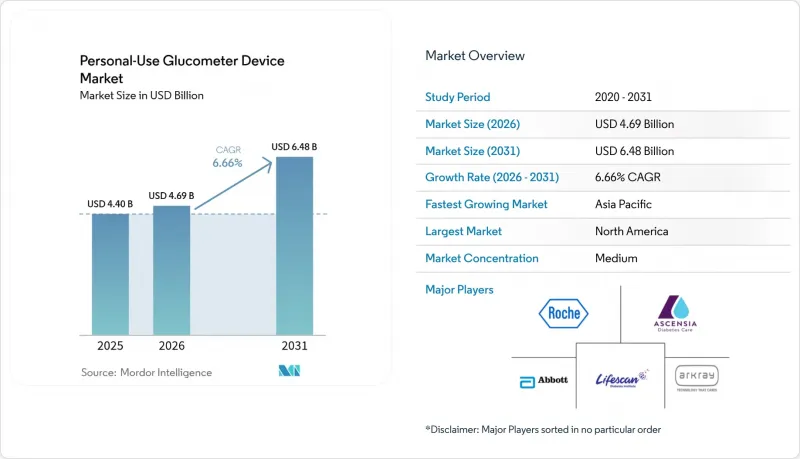
Mordor Intelligence에 따르면 2026년 개인용 혈당 측정기 시장의 규모는 46억 9,000만 달러로 추정되고 있으며, 2025년 44억 달러에서 확대하며, 2031년에는 64억 8,000만 달러에 달할 것으로 예측됩니다.
2026-2031년까지 연평균 성장률(CAGR) 6.66%로 성장할 것으로 전망됩니다.
이 보고서는 구성 요소(혈당 측정기, 테스트 스트립, 기타), 기술(SMBG(모세관식), 연속 혈당 모니터링(개인용), 기타), 연결성(유선/USB, NFC, 기타), 최종사용자(재택 관리/개인용, 기타),지역(북미, 유럽, 기타)별로 분류되어 있습니다. 시장 전망은 금액(달러) 기준으로 제시되어 있습니다.
전 세계 개인용 혈당 측정기 시장의 동향 및 인사이트
당뇨병 유병률 증가 및 고령화
2045년까지 전 세계 당뇨병 환자 수는 7억 8,320만 명을 넘어설 가능성이 있으며, 이로 인해 사용하기 쉬운 혈당 측정기에 대한 지속적인 수요가 발생하고 있습니다. 이러한 부담은 아시아태평양에서 두드러지며, 중국에서는 이미 13.67%의 유병률이 기록되었고, 2050년까지 29.1%에 달할 것으로 예측됩니다. 고령자들은 간소화된 인터페이스, 큰 디스플레이, 신뢰할 수 있는 연결성을 필요로 하고 있으며, 이에 따라 각 제조사들은 인체공학적 설계와 음성 안내 기능 개선을 추진하고 있습니다. 인구 동향과 질병이라는 두 가지 요인의 압박으로 인해 의료비 환급이 제한되는 환경에서도 개인용 혈당 측정기 시장은 계속 확대될 것으로 전망됩니다. 잠재적 사용자 수가 많기 때문에 가격 하락을 상쇄할 수 있는 장기적인 판매량 성장을 지원하고 있습니다.
스마트폰 연동형 스마트 미터의 보험 적용 확대
메디케어는 2023년, 보험 적용 규정을 ADA(미국당뇨병협회) 지침에 부합하도록 조정하여, 손가락 채혈을 통한 확인을 면제하고, 기초 인슐린만 투여받는 제2형 당뇨병 환자를 대상으로 추가함으로써, 승인된 CGM 시스템 비용의 80%를 지원하게 되었습니다. 민간 보험사들도 HbA1c 수치 감소 및 저혈당 발작 감소와 같은 입증된 데이터를 근거로 이에 신속하게 뒤따랐습니다. 유럽에서는 노르웨이와 벨기에가 센서식 모니터에 대한 국가 차원의 지원 제도를 도입했으며, 다른 시장에서도 유사한 조치가 검토되고 있습니다. 보험 적용으로 본인 부담금이 줄어들면서 대중에게 널리 보급되고, 공급업체는 스마트폰, 앱, 클라우드 포털을 세트로 판매할 수 있게 되었습니다. 보험사가 센서 데이터를 집단 건강 분석과 연계하는 가운데, 보험 적용은 개인용 혈당 측정기 시장에 여전히 결정적인 촉진요인으로 작용하고 있습니다.
소모품(테스트 스트립/센서)의 높은 수명 주기 비용
CGM의 연간 소유 비용은 1,200-3,600달러 범위이며, 100매입 테스트 스트립의 소매 가격은 35-170달러로, 보험 미가입자나 저소득층의 부담을 가중시키고 있습니다. 덱스콤의 저가 모델인 ‘Stelo’조차 월 평균 100달러가 듭니다. 6개 개발도상국을 대상으로 한 조사에서는 지속적인 모니터링 준수를 방해하는 경제적 부담의 격차가 확인되었습니다. 제조사 측은 수명이 긴 센서를 제공하거나 세트 판매를 통한 할인을 통해 대응하고 있지만, 판매량 증가에 따른 비용 절감은 여전히 완만한 속도에 그치고 있습니다. 보다 광범위한 보조금이 도입되지 않는 한, 소모품 비용 부담은 개인용 혈당 측정기 시장의 가격에 민감한 부문에서의 보급을 계속해서 억제할 것으로 보입니다.
부문 분석
2025년, 개인용 혈당 측정기 시장에서 테스트 스트립은 64.62%의 점유율을 차지하며, 제조사의 현금 흐름을 지원하는 고수익률의 보충 수요를 유지하고 있습니다. 반면, 사용자들이 장기적으로 1회당 측정 비용을 절감할 수 있는 통합형 센서 탑재 플랫폼으로 전환함에 따라 측정기 부문은 8.96%라는 가장 높은 연평균 성장률(CAGR)을 기록하고 있습니다. Dexcom G7 15-Day와 같은 장기 착용형 센서는 하드웨어 업그레이드를 통해 월별 지출을 줄이고 편의성을 향상시킨다는 것을 입증하고 있습니다. 런셋 드럼에서 스마트폰용 크래들에 이르는 액세서리는 연결성과 편의성이 브랜드 선택에 영향을 미치면서, 소폭이지만 증가 추세를 보이는 수익을 창출하고 있습니다.
혈당 측정기의 혁신은 현재 독자적으로 개발된 센서와 AI 기반 앱을 결합한 단일 플랫폼 생태계를 목표로 하고 있습니다. 미국에서 최초로 자동 인슐린 투여 장치와 직접 연동되는 CGM인 애보트의 ‘FreeStyle Libre 2 Plus’는 개인용 혈당 측정기 시장을 재편하고 있는 하드웨어와 소프트웨어의 융합을 여실히 보여주고 있습니다. 또한 각 벤더는 테스트 스트립이 필요 없는 포토닉스 기술을 활용한 재사용 광학 리더기의 시범 운영을 진행하고 있으며, 이로 인해 소모품 수요가 감소할 가능성이 있습니다. 테스트 스트립이 여전히 주류를 이루고 있는 반면, 센서 기술의 점진적인 발전으로 인해 매출 구성은 내구성이 뛰어난 기기 및 클라우드 구독 서비스 쪽으로 꾸준히 이동하고 있습니다.
자가혈당측정(SMBG)은 저렴한 가격과 의료진의 익숙함을 배경으로 여전히 34.98%의 점유율을 차지하고 있습니다. 그럼에도 불구하고 실시간 동향 데이터가 저혈당 위험을 줄이고 투여량의 미세 조정을 지원하므로 CGM 센서는 연평균 성장률(CAGR) 12.06%의 속도로 시장 점유율을 확대하고 있습니다. 일차 진료에서 실시된 무작위 대조 시험에 따르면 CGM 사용자는 HbA1c 수치를 1.3% 포인트 낮춘 반면, 손가락 채혈 그룹은 0.8% 포인트 하락에 그쳤습니다. 비침습적 광학식 프로토타입은 기계학습을 활용한 분광 알고리즘의 도움으로 정확도 향상이 가속화되고 있습니다.
기술 공급업체들은 센서를 원격의료용 대시보드와 번들로 제공함으로써 임상 모니터링 범위를 확대하고, 보험사의 금액 기반 결제를 가능하게 하고 있습니다. 메드트로닉의 일회용 CGM ‘Simplera’는 이전 세대 제품의 절반 크기이며, 폼팩터의 소형화가 착용 편의성과 보급을 촉진한다는 것을 보여줍니다. 보상 범위의 확대와 부품 비용의 감소에 따라 CGM은 개인용 혈당 측정기 시장에서 SMBG의 우위를 서서히 잠식해 나갈 것으로 보입니다.
지역별 분석
북미는 보험사의 자금 지원, 기술의 조기 도입, 견고한 유통 네트워크를 배경으로 2025년에는 매출 점유율 42.10%를 기록하며 개인용 혈당 측정기 시장을 주도했습니다. 메디케어 적용 범위 확대와 민간 보험사의 잇따른 제도 개정에 따라 CGM 센서의 이용 대상이 확대되었으며, 판매 대수는 두 자릿수 성장을 기록하고 있습니다. 미국 FDA의 OTC(일반의약품) 승인에 대한 긍정적인 태도는 소비자의 유입 경로를 더욱 확대하고 시장 출시 주기를 단축시키고 있습니다. 캐나다도 유사한 추세를 보이고 있으며, 플래시 센서에 대한 전국적인 보험 적용 시범 사업을 추진하고 있습니다.
아시아태평양에서는 높은 유병률과 중산층의 가처분 소득 증가가 맞물려 2031년까지 연평균 성장률(CAGR) 12.28%를 기록할 것으로 예측됩니다. 중국의 디지털 헬스 프로그램에서는 통합 플랫폼을 활용함으로써, 적극적으로 이용하는 사용자의 공복 혈당 수치를 1.68%, HbA1c를 0.45포인트 낮출 수 있음이 입증되었습니다. 인도에서 현장 진단(Point-of-Care) HbA1c 선별 검사의 보급은 농촌 지역의 ICUR이 불과 185.10달러/QALY에 불과하다는 점에서 그 경제적 실현 가능성을 지원하고 있습니다. 센서 조립을 현지화하려는 정부의 노력도 최종사용자 가격 인하로 이어져, 개인용 혈당 측정기 시장의 추가적인 확장을 지원할 전망입니다.
유럽에서는 노르웨이가 2023년에 센서식 혈당 측정기의 보험 급여를 결정한 것과 같은 각국의 재정 지원 정책에 힘입어, 안정적인 한 자릿수 중반대의 성장세를 유지하고 있습니다. EU의 의료기기 규정(MDR)은 안전 기준을 통일하고 있으며, 엄격한 품질관리 체계를 갖춘 기업에 유리하게 작용하고 있습니다. 한편, 라틴아메리카와 중동 및 아프리카에서는 유병률이 증가 추세에 있지만, 비용 및 보험 적용 범위 제한으로 인해 도입이 지연되고 있습니다. 걸프협력회의(GCC) 회원국에서의 자선 목적 조달 및 원격의료 시범 사업은 향후 추가적인 성장 가능성을 시사하고 있습니다.
기타 혜택
- 엑셀 형식의 시장 예측(ME) 시트
- 3개월간의 애널리스트 지원
자주 묻는 질문
목차
제1장 서론
제2장 조사 방법
제3장 개요
제4장 시장 구도
제5장 시장 규모와 성장 예측
제6장 경쟁 구도
제7장 시장 기회와 향후 전망
KSA 26.08.26According to Mordor Intelligence, the personal-use glucometer devices market size in 2026 is estimated at USD 4.69 billion, growing from 2025 value of USD 4.40 billion with 2031 projections showing USD 6.48 billion, growing at 6.66% CAGR over 2026-2031.
This report is Segmented by Component (Glucometer Devices, Test Strips, and More), Technology (SMBG (Capillary), Continuous Glucose Monitoring (Personal), and More), Connectivity (Wired / USB, NFC, and More), End-User (Home-Care / Personal and More), and Geography (North America, Europe, and More). The Market Forecasts are Provided in Terms of Value (USD).
Global Personal-Use Glucometer Device Market Trends and Insights
Rising Diabetes Prevalence & Ageing Population
Global diabetes prevalence could exceed 783.2 million by 2045, creating sustained demand for easy-to-use monitors. The burden is pronounced in Asia-Pacific, where China already records a 13.67% prevalence and faces a projected 29.1% rate by 2050. Older adults need simplified interfaces, larger displays, and dependable connectivity, prompting manufacturers to refine ergonomy and voice-guided prompts. Combined demographic and disease pressures ensure that the personal-use glucometer devices marketcontinues expanding even in reimbursement-constrained settings. The sheer volume of potential users underpins long-run volume growth that can absorb price erosion.
Smartphone-Linked Smart Meters Gain Reimbursement Traction
Medicare aligned coverage rules with ADA guidance in 2023, waiving finger-stick confirmation and adding basal-only Type 2 patients, thereby subsidizing 80% of approved CGM system costs. Commercial payers quickly followed, citing documented A1c reductions and reduced hypoglycemia events. In Europe, Norway and Belgium introduced national funding for sensor-based monitors, while additional markets evaluate similar moves. Reimbursement cuts out-of-pocket cost, fostering mainstream adoption and enabling vendors to bundle smartphones, apps, and cloud portals. As insurers link sensor data with population-health analytics, reimbursement remains a decisive pull factor for the personal-use glucometer devices market.
High Lifetime Cost of Consumables (Strips / Sensors)
Annual CGM ownership ranges between USD 1,200 and USD 3,600, while 100-count strip boxes retail from USD 35 to USD 170, squeezing uninsured and low-income users. Even Dexcom's value-priced Stelo still averages USD 100 per month. Surveys across six developing countries confirm affordability gaps that dampen sustained monitoring adherence. Manufacturers respond with longer-life sensors and bundle discounts, yet volume-driven cost declines remain gradual. Without broader subsidies, consumable burden continues to temper uptake in price-sensitive segments of the personal-use glucometer devices market.
Other drivers and restraints analyzed in the detailed report include:
- Expansion of Continuous & Flash GM Into Type-2 Pre-Diabetes
- OTC Approval of Non-Invasive Optical Meters
- Accuracy Gaps vs. Lab Reference in Tropical Climates
For complete list of drivers and restraints, kindly check the Table Of Contents.
Segment Analysis
Test strips captured 64.62% of the personal-use glucometer devices market in 2025, preserving a high-margin replenishment stream that underwrites manufacturer cash flows. Devices, however, are registering the quickest 8.96% CAGR as users pivot to integrated, sensor-rich platforms that lower per-reading cost over time. Longer wear sensors such as Dexcom G7 15-Day demonstrate how hardware upgrades decrease monthly spend and improve convenience. Accessories-from lancet drums to smartphone cradles-command modest but rising revenue as connectivity and comfort influence brand choice.
Glucometer innovation now targets single-platform ecosystems that pair proprietary sensors with AI-driven apps. Abbott's FreeStyle Libre 2 Plus, the first U.S. CGM to link directly with automated insulin delivery, illustrates the hardware-software convergence reshaping the personal-use glucometer devices market. Vendors also trial reusable optical readers designed to leverage strip-free photonics, potentially compressing consumable demand. While strips remain dominant, incremental sensor advances steadily shift revenue weight toward durable equipment and cloud subscriptions.
Self-monitoring blood glucose still holds 34.98% share, anchored by affordability and clinician familiarity. Nevertheless, continuous sensors are outpacing at 12.06% CAGR because real-time trend data reduce hypoglycemia risk and support dose titration. Randomized studies in primary care show CGM users achieving HbA1c drops of 1.3 percentage points versus 0.8 points for finger-stick cohorts. Non-invasive optical prototypes demonstrate accelerating accuracy gains, aided by machine-learning spectroscopic algorithms.
Technology suppliers bundle sensors with telehealth dashboards, broadening clinical oversight and unlocking insurer value-based payments. Medtronic's Simplera disposable CGM, half the size of its predecessor, shows how form-factor reductions drive comfort and adoption. As reimbursement spreads and component costs fall, CGM looks set to erode SMBG leadership across the personal-use glucometer devices market.
Complete Report Scope:
- By Component
- Glucometer Devices
- Test Strips
- Lancets
- Accessories
- By Technology
- SMBG (Capillary)
- Continuous Glucose Monitoring (Personal)
- Non-Invasive Optical Monitoring
- By Connectivity
- Wired / USB
- Bluetooth / BLE
- NFC
- By End-User
- Home-Care / Personal
- Sports & Wellness Users
- Geography
- North America
- United States
- Canada
- Mexico
- Europe
- Germany
- United Kingdom
- France
- Italy
- Spain
- Rest of Europe
- Asia-Pacific
- China
- Japan
- India
- South Korea
- Australia
- Rest of Asia-Pacific
- Middle East and Africa
- GCC
- South Africa
- Rest of Middle East and Africa
- South America
- Brazil
- Argentina
- Rest of South America
- North America
Geography Analysis
North America led the personal-use glucometer devices market with 42.10% revenue share in 2025 on the back of payer funding, early tech uptake, and robust distribution networks. Medicare's expanded coverage and successive private-payer updates have widened eligibility for continuous sensors, spurring double-digit unit growth. The U.S. FDA's friendly stance toward OTC clearances further enlarges the consumer funnel and shortens go-to-market cycles. Canada mirrors these trends, advancing national reimbursement pilots for flash sensors.
Asia-Pacific is projected to log a 12.28% CAGR through 2031 as high prevalence converges with rising middle-class disposable income. China's digital health programs demonstrate that integrated platforms can trim fasting glucose by 1.68% and HbA1c by 0.45 points among engaged users. India's uptake of point-of-care HbA1c screening, with an ICUR of just USD 185.10/QALY in rural settings, underscores economic viability. Government initiatives to localize sensor assembly are also likely to shrink end-user prices, fuelling further expansion of the personal-use glucometer devices market.
Europe maintains stable mid-single-digit growth, underpinned by national funding steps such as Norway's 2023 decision to reimburse sensor-based monitors. The EU's Medical Device Regulation harmonizes safety benchmarks, favoring firms with rigorous quality systems. Meanwhile, Latin America and Middle East-Africa show rising incidence but adoption lags due to cost and limited payer coverage. Nevertheless, philanthropic procurement and telehealth pilots in Gulf Cooperation Council states foreshadow incremental upside.
- Abbott Laboratories
- Roche
- LifeScan Inc
- Arkray
- Ascensia
- AgaMatrix
- Bionime
- Acon Laboratories
- Medisana
- Rossmax
- Dexcom
- Medtronic
- Insulet
- Senseonics
- OMRON
- i-SENS
- Ypsomed
- Terumo
- Nova Biomedical
- ForaCare
- DarioHealth
- Trividia Health
- Beckton Dickinson
- iHealth Labs
Additional Benefits:
- The market estimate (ME) sheet in Excel format
- 3 months of analyst support
TABLE OF CONTENTS
1 Introduction
- 1.1 Study Assumptions & Market Definition
- 1.2 Scope of the Study
2 Research Methodology
3 Executive Summary
4 Market Landscape
- 4.1 Market Overview
- 4.2 Market Drivers
- 4.2.1 Rising Diabetes Prevalence & Ageing Population
- 4.2.2 Smartphone-Linked Smart Meters Gain Reimbursement Traction
- 4.2.3 Expansion Of Continuous & Flash GM Into Type-2 Pre-Diabetes
- 4.2.4 OTC Approval Of Non-Invasive Optical Meters
- 4.2.5 Wellness Wearables Drive Adoption By Non-Diabetics
- 4.3 Market Restraints
- 4.3.1 High Lifetime Cost Of Consumables (Strips / Sensors)
- 4.3.2 Accuracy Gaps Vs. Lab Reference In Tropical Climates
- 4.3.3 Cyber-Security & Data-Privacy Regulations Tighten
- 4.4 Supply-Chain Analysis
- 4.5 Technological Outlook
- 4.6 Porter's Five Forces
- 4.6.1 Bargaining Power of Suppliers
- 4.6.2 Bargaining Power of Buyers
- 4.6.3 Threat of New Entrants
- 4.6.4 Threat of Substitutes
- 4.6.5 Intensity of Rivalry
5 Market Size & Growth Forecasts (Value, USD)
- 5.1 By Component
- 5.1.1 Glucometer Devices
- 5.1.2 Test Strips
- 5.1.3 Lancets
- 5.1.4 Accessories
- 5.2 By Technology
- 5.2.1 SMBG (Capillary)
- 5.2.2 Continuous Glucose Monitoring (Personal)
- 5.2.3 Non-Invasive Optical Monitoring
- 5.3 By Connectivity
- 5.3.1 Wired / USB
- 5.3.2 Bluetooth / BLE
- 5.3.3 NFC
- 5.4 By End-User
- 5.4.1 Home-Care / Personal
- 5.4.2 Sports & Wellness Users
- 5.5 Geography
- 5.5.1 North America
- 5.5.1.1 United States
- 5.5.1.2 Canada
- 5.5.1.3 Mexico
- 5.5.2 Europe
- 5.5.2.1 Germany
- 5.5.2.2 United Kingdom
- 5.5.2.3 France
- 5.5.2.4 Italy
- 5.5.2.5 Spain
- 5.5.2.6 Rest of Europe
- 5.5.3 Asia-Pacific
- 5.5.3.1 China
- 5.5.3.2 Japan
- 5.5.3.3 India
- 5.5.3.4 South Korea
- 5.5.3.5 Australia
- 5.5.3.6 Rest of Asia-Pacific
- 5.5.4 Middle East and Africa
- 5.5.4.1 GCC
- 5.5.4.2 South Africa
- 5.5.4.3 Rest of Middle East and Africa
- 5.5.5 South America
- 5.5.5.1 Brazil
- 5.5.5.2 Argentina
- 5.5.5.3 Rest of South America
- 5.5.1 North America
6 Competitive Landscape
- 6.1 Market Concentration
- 6.2 Market Share Analysis
- 6.3 Company Profiles (includes Global level Overview, Market level overview, Core Business Segments, Financials, Headcount, Key Information, Market Rank, Market Share, Products and Services, and analysis of Recent Developments)
- 6.3.1 Abbott Laboratories
- 6.3.2 F. Hoffmann-La Roche
- 6.3.3 LifeScan Inc
- 6.3.4 Arkray
- 6.3.5 Ascensia Diabetes Care
- 6.3.6 AgaMatrix
- 6.3.7 Bionime
- 6.3.8 ACON Laboratories
- 6.3.9 Medisana
- 6.3.10 Rossmax
- 6.3.11 Dexcom, Inc.
- 6.3.12 Medtronic plc
- 6.3.13 Insulet
- 6.3.14 Senseonics
- 6.3.15 Omron Healthcare
- 6.3.16 i-SENS
- 6.3.17 Ypsomed AG
- 6.3.18 Terumo Corporation
- 6.3.19 Nova Biomedical
- 6.3.20 ForaCare
- 6.3.21 DarioHealth
- 6.3.22 Trividia Health
- 6.3.23 Becton Dickinson
- 6.3.24 iHealth Labs
7 Market Opportunities & Future Outlook
- 7.1 White-Space & Unmet-Need Assessment


