

|
시장보고서
상품코드
2114368
아크릴레이트 모노머 시장 : 시장 점유율 분석, 업계 동향 및 통계, 성장 예측(2026-2031년)Acrylate Monomers - Market Share Analysis, Industry Trends & Statistics, Growth Forecasts (2026 - 2031) |
||||||
 Mordor Intelligence
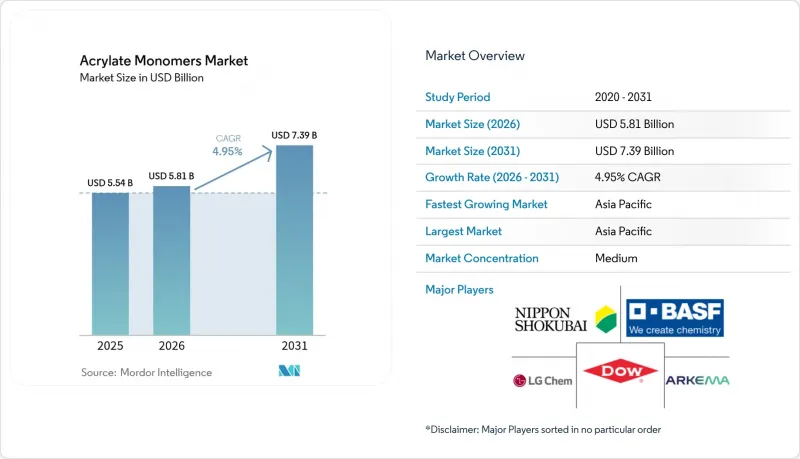
Mordor Intelligence에 의하면, 2026년 아크릴레이트 모노머 시장 규모는 58억 1,000만 달러로 추정되고, 2025년 55억 4,000만 달러에서 확대해, 2031년에는 73억 9,000만 달러에 이를 것으로 예측됩니다.
2026-2031년 연평균 성장률(CAGR) 4.95%로 성장할 것으로 전망됩니다.
본 보고서는 유형별(부틸 아크릴레이트, 에틸 아크릴레이트, 에틸헥실 아크릴레이트, 메틸 아크릴레이트), 용도별(페인트 및 코팅, 접착제 및 실란트, 플라스틱·폴리머,인쇄 잉크, 기타), 최종 사용자 분야별(건설, 포장 등), 지역별(아시아태평양, 북미 등)로 분류되어 있습니다. 시장 예측은 금액(달러) 기준으로 제시되어 있습니다.
세계의 아크릴레이트 모노머 시장 동향 및 인사이트
저VOC 건축용 코팅의 붐
부틸 아크릴레이트 공중합체는 개방 시간, 습식 스크럽 내구성 및 내알칼리성을 유지하면서 VOC 제로를 표방할 수 있게 해주며, 이에 따라 배합 제조업체들은 비닐 아세테이트의 단계적 폐지를 추진하고 있습니다. 중국의 ‘제14차 5개년 계획’에서는 2025년까지 많은 신규 주택 프로젝트에서 저배출 도료의 사용이 의무화되어 있으며, 이로 인해 현지 에멀젼 폴리머 생산이 가속화되고 있습니다. 인도에서는 중소 도료 제조업체들이 자체 중합 공정을 생략하고 지역별 색상 출시를 신속하게 진행하기 위해 미리 배합된 아크릴계 바인더를 채택하고 있습니다. ISO 11890 시험 및 LEED v4.1 크레딧에 따른 제3자 검증은 선진적인 아크릴 에멀젼을 우선시하는 조달 기준을 강화하고 있으며, 지속 가능한 건축 실천에 있어 그 적합성을 입증하고 있습니다.
감압 접착제 수요의 급속한 확대
전자상거래용 포장재, 의료용 테이프, 자동차 트림의 접착이 감압 접착제 분야에서 아크릴레이트 모노머 사용을 주도하고 있습니다. 에틸헥실아크릴레이트는 핫멜트 및 무용제 배합에서 저온에서의 접착력을 확보할 수 있기 때문에 감압 접착제(PSA)의 모노머 원료로 공급되고 있습니다. 동남아시아에서 골판지 상자 생산이 증가하고 있어, 플렉서블 파우치용 광학적으로 투명한 접착 필름의 사용이 필요해지고 있습니다. 의료용 웨어러블 제품의 경우, ISO 10993의 피부 감작 역치를 충족하기 위해 잔류 모노머 농도가 100 ppm 미만인 아크릴계 PSA가 사용되고 있습니다. 추출물에 관한 FDA 지침에 따라, 의료기기 제조업체는 상처 관리용 패치에 고순도 에틸 아크릴레이트의 사용을 지정해야 합니다.
변동이 심한 프로파일렌 및 아크릴산 원료 비용
2024년, 정유시설의 유지보수, PDH 플랜트의 가동 개시, 그리고 폴리프로필렌 시장의 경쟁으로 인해 프로파일렌의 현물 가격이 변동했습니다. 복합 제조업체들은 글리세롤 및 젖산을 원료로 하는 바이오 유래 메틸 아크릴레이트를 시험적으로 도입하고 있습니다. EU의 탄소 국경 조정 메커니즘(CBAM)은 원료의 탄소 강도를 조달 프로세스에 반영하고 있으며, 장기적인 프로파일렌 공급 계약 체결을 촉진하고 있습니다.
부문 분석
부틸 아크릴레이트는 총 출하량의 76.02%를 차지하며, 2031년까지 연평균 성장률(CAGR) 5.18%로 확대될 것으로 예측됩니다. 연속 반응 장치의 개량으로 사이클 타임이 단축되어 에너지 소비가 절감될 뿐만 아니라, 현물 시장에서 신속한 판매가 가능해졌습니다. 에틸 아크릴레이트는 경화 속도가 빨라 프리미엄 가격을 정당화하는 고고형분 산업용 도료를 주된 용도로 합니다. 에틸헥실 아크릴레이트는 의료용 및 자동차용 테이프에서 저온에서의 접착력이 요구되는 감압 접착제의 주요 성분입니다. 메틸 아크릴레이트는 의약품 중간체 및 UV 경화성 올리고머라는 틈새 시장을 차지하고 있으며, 빠른 라디칼 중합 반응 속도를 특징으로 합니다.
다국적 도료·접착제 제조업체에 제품을 공급하는 공급업체에게 있어 ISO 9001 및 ISO 14001 인증에 대한 지속적인 투자는 이제 필수 사항이 되었으며, 이로 인해 지역 제조업체 시장 진입 장벽이 높아지고 있습니다. 아크릴레이트 모노머 시장에서는 배합 지원 및 잔류 모노머 농도 100 ppm 미만을 보장할 수 있는 통합형 기업이 계속해서 우위를 점하고 있습니다. 또한, 연속 공정을 통해 일관된 분자량 분포를 얻을 수 있습니다. 이는 건축용 도료의 저온 유연성에 있어 중요한 요건입니다. 정밀한 압력 제어 기능을 갖춘 반응 장비를 개조한 제조업체는 모노머 등급을 전환할 수 있어 설비의 가동률을 극대화할 수 있습니다.
지역별 분석
아시아태평양은 2025년 아크릴레이트 모노머 시장 규모의 44.80%를 차지했으며, 2026-2031년 연평균 성장률(CAGR) 5.28%를 나타낼 것으로 예측되어, 지역별로는 가장 높은 성장 속도를 보일 전망입니다. 중국에서는 신축 주택용 도료에 부틸 아크릴레이트 에멀전이 채택되고 있는 반면, 선전과 쑤저우의 전자 산업 클러스터에서는 폴더블 디스플레이용 UV 경화형 올리고머가 사용되고 있습니다. 인도에서는 고속도로, 공항, 저렴한 주택에 대한 국가 인프라 계획 지출이 수요를 끌어올리고 있습니다.
북미는 전 세계 소비량의 대부분을 차지하고 있습니다. 캐나다 시장 점유율은 전략적 혁신 기금(Strategic Innovation Fund)의 공동 보조금에 힘입어 전기차 배터리 바인더용 메틸 아크릴레이트에 집중되어 있습니다. 멕시코에서는 USMCA(미국·멕시코·캐나다 협정)의 원산지 규정에 따른 인센티브에 힘입어, 니어쇼어링이 자동차 및 전자기기 조립 분야에서 에틸헥실아크릴레이트의 채택을 촉진하고 있습니다.
유럽 수요를 주도하는 국가는 독일, 프랑스, 그리고 영국입니다. REACH 등록비 및 CBAM(탄소 국경 조정 조치)에 따른 탄소 과세로 인해 메틸아크릴레이트의 바이오 유래 대체품으로의 전환이 촉진되고 있습니다. 중동 및 아프리카 시장 점유율은 수출 지향적인 아크릴산을 목표로 하는 사우디아라비아와 UAE의 석유화학 허브에 집중되어 있습니다. ISO 9001 및 ISO 14001 준수는 다국적 공급망에 진입하는 공급업체에게 이제 필수적인 자격 요건이 되었습니다.
기타 혜택 :
- 엑셀 형식 시장 전망(ME) 시트
- 3개월간의 애널리스트 지원
자주 묻는 질문
목차
제1장 서론
제2장 조사 방법
제3장 주요 요약
제4장 시장 구도
제5장 시장 규모 및 성장 예측
제6장 경쟁 구도
제7장 시장 기회 및 향후 전망
AJY 26.08.26According to Mordor Intelligence, acrylate monomers market size in 2026 is estimated at USD 5.81 billion, growing from 2025 value of USD 5.54 billion with 2031 projections showing USD 7.39 billion, growing at 4.95% CAGR over 2026-2031.
This report is Segmented by Type (Butyl Acrylate, Ethyl Acrylate, Ethylhexyl Acrylate, and Methyl Acrylate), Application (Paints and Coatings, Adhesives and Sealants, Plastics and Polymers, Printing Inks, and Other Applications), End-User Sector (Construction, Packaging, and More), and Geography (Asia-Pacific, North America, and More). The Market Forecasts are Provided in Terms of Value (USD).
Global Acrylate Monomers Market Trends and Insights
Low-VOC Architectural Coating Boom
Butyl-acrylate copolymers enable zero-VOC claims while preserving open time, wet-scrub durability, and alkalinity resistance, driving formulators to phase out vinyl acetate. China's 14th Five-Year Plan mandates low-emission coatings in many of the new residential projects by 2025, accelerating local emulsion-polymer output. In India, small paint makers are adopting pre-compounded acrylic binders to bypass in-house polymerization and speed regional color launches. Third-party verification through ISO 11890 testing and LEED v4.1 credits reinforces procurement criteria that favor advanced acrylic emulsions, underscoring their suitability for use in sustainable building practices.
Rapid Expansion of Pressure-Sensitive Adhesive Demand
E-commerce packaging, medical tapes, and automotive trim bonding drive the use of acrylate monomer in pressure-sensitive adhesives. Ethylhexyl acrylate supplied the PSA monomer feedstock because it supports low-temperature tack in hot-melt and solvent-free formulations. Southeast Asian corrugated box production is increasing, necessitating the use of optically clear adhesive films for flexible pouches. Medical wearables rely on acrylic PSAs with residual-monomer levels under 100 ppm to meet ISO 10993 skin-sensitization thresholds. FDA guidance on extractables is pushing device makers to specify high-purity ethyl acrylate in wound-care patches.
Volatile Propylene and Acrylic-Acid Feedstock Costs
Propylene spot values fluctuated in 2024 due to refinery maintenance, PDH start-ups, and polypropylene market competition. Formulators are trialing bio-based methyl acrylate derived from glycerol or lactic acid. The EU's Carbon Border Adjustment Mechanism embeds feedstock carbon intensity into procurement, encouraging the development of long-term propylene supply contracts.
Other drivers and restraints analyzed in the detailed report include:
- Asia-Pacific Construction Super-Cycle
- Rise of UV-Curable Acrylate Formulations for Flexible Electronics
- Regulatory Squeeze on Residual Monomer Toxicity
For complete list of drivers and restraints, kindly check the Table Of Contents.
Segment Analysis
Butyl acrylate accounts for 76.02% of the total volume and is expected to advance at a 5.18% CAGR through 2031. Continuous-reactor upgrades shorten cycle times, reducing energy consumption and enabling responsive spot market sales. Ethyl acrylate targets high-solids industrial coatings where faster cure rates justify its premium pricing. Ethylhexyl acrylate is a key component in pressure-sensitive adhesives that require low-temperature tack in medical and automotive tapes. Methyl acrylate occupies a niche in pharmaceutical intermediates and UV-curable oligomers, benefiting from rapid radical-polymerization kinetics.
Sustained investment in ISO 9001 and ISO 14001 certification is now mandatory for suppliers serving multinational paint and adhesive firms, raising entry barriers for regional producers. The acrylate monomers market continues to favor integrated players that can offer formulation assistance and residual monomer guarantees under 100 ppm. Continuous processes also provide consistent molecular-weight distribution, a key requirement for low-temperature flexibility in architectural coatings. Producers that retrofit reactors with advanced pressure control can toggle between monomer grades, maximizing asset utilization.
Complete Report Scope:
- By Type
- Butyl Acrylate
- Ethyl Acrylate
- Ethylhexyl Acrylate
- Methyl Acrylate
- By Application
- Paints and Coatings
- Adhesives and Sealants
- Plastics and Polymers
- Printing Inks
- Other Applications
- By End-User Sector
- Construction
- Automotive and Transportation
- Packaging
- Electronics and Electrical
- Healthcare and Hygiene
- By Geography
- Asia-Pacifc
- China
- India
- Japan
- South Korea
- Malaysia
- Thailand
- Indonesia
- Vietnam
- Rest of Asia-Pacific
- North America
- United States
- Canada
- Mexico
- Europe
- Germany
- United Kingdom
- France
- Italy
- Spain
- Nordic Countries
- Turkey
- Russia
- Rest of Europe
- South America
- Brazil
- Argentina
- Colombia
- Middle-East and Africa
- Saudi Arabia
- Qatar
- United Arab Emirates
- Nigeria
- Egypt
- South Africa
- Rest of Middle-East and Africa
- Asia-Pacifc
Geography Analysis
The Asia-Pacific region held 44.80% of the acrylate monomers market volume in 2025 and is projected to grow at a 5.28% CAGR from 2026 to 2031, at the highest regional pace. China is channeling butyl-acrylate emulsions into coatings for new housing units, while the Shenzhen and Suzhou electronics clusters utilize UV-curable oligomers for foldable screens. The National Infrastructure Pipeline spending on highways, airports, and affordable housing lifts demand in India.
North America commands a significant portion of global consumption. Canada's share concentrates on methyl acrylate for EV battery binders, supported by Strategic Innovation Fund co-grants. Mexico contributes as near-shoring drives ethylhexyl-acrylate uptake in automotive and electronics assembly, backed by USMCA rule-of-origin incentives.
Germany, France, and the United Kingdom lead Europe's demand. REACH fees and CBAM carbon levies encourage the substitution of methyl acrylate with bio-based alternatives. The Middle East and Africa share is centered on Saudi Arabian and UAE petrochemical hubs targeting export-oriented acrylic acid. ISO 9001 and ISO 14001 compliance are now mandatory credentials for suppliers entering multinational supply chains.
- Arkema
- BASF SE
- Bharat Petroleum Corporation Limited
- Dow
- Jurong Group
- LG Chem
- LobaChemie Pvt. Ltd.
- Mitsubishi Chemical Holdings Corporation
- Nippon Shokubai Co., Ltd
- Prasol Chemicals Limited
- Sasol
- Satellite Chemical Co. Ltd
- Shenyang Chemical Co Ltd
- SIBUR Holding PJSC
- Synthomer PLC
- Tasnee (national Industrialization Company)
- TOAGOSEI CO.,LTD.
- Tokyo Chemical Industry Co., Ltd.
- Wanhua
Additional Benefits:
- The market estimate (ME) sheet in Excel format
- 3 months of analyst support
TABLE OF CONTENTS
1 Introduction
- 1.1 Study Assumptions and Market Definition
- 1.2 Scope of the Study
2 Research Methodology
3 Executive Summary
4 Market Landscape
- 4.1 Market Overview
- 4.2 Market Drivers
- 4.2.1 Low-VOC architectural coating boom
- 4.2.2 Rapid expansion of pressure-sensitive adhesive demand
- 4.2.3 Asia-pacific construction super-cycle
- 4.2.4 Rise of UV-curable acrylate formulations for flexible electronics
- 4.2.5 On-shoring incentives and antidumping tariffs driving North America capacity adds
- 4.3 Market Restraints
- 4.3.1 Volatile propylene and acrylic-acid feedstock costs
- 4.3.2 Regulatory squeeze on residual monomer toxicity
- 4.3.3 Competition from next-gen polyurethane dispersions in coatings
- 4.4 Value Chain Analysis
- 4.5 Porter's Five Forces
- 4.5.1 Threat of New Entrants
- 4.5.2 Bargaining Power of Suppliers
- 4.5.3 Bargaining Power of Buyers
- 4.5.4 Threat of Substitutes
- 4.5.5 Degree of Competition
5 Market Size and Growth Forecasts (Value)
- 5.1 By Type
- 5.1.1 Butyl Acrylate
- 5.1.2 Ethyl Acrylate
- 5.1.3 Ethylhexyl Acrylate
- 5.1.4 Methyl Acrylate
- 5.2 By Application
- 5.2.1 Paints and Coatings
- 5.2.2 Adhesives and Sealants
- 5.2.3 Plastics and Polymers
- 5.2.4 Printing Inks
- 5.2.5 Other Applications
- 5.3 By End-User Sector
- 5.3.1 Construction
- 5.3.2 Automotive and Transportation
- 5.3.3 Packaging
- 5.3.4 Electronics and Electrical
- 5.3.5 Healthcare and Hygiene
- 5.4 By Geography
- 5.4.1 Asia-Pacifc
- 5.4.1.1 China
- 5.4.1.2 India
- 5.4.1.3 Japan
- 5.4.1.4 South Korea
- 5.4.1.5 Malaysia
- 5.4.1.6 Thailand
- 5.4.1.7 Indonesia
- 5.4.1.8 Vietnam
- 5.4.1.9 Rest of Asia-Pacific
- 5.4.2 North America
- 5.4.2.1 United States
- 5.4.2.2 Canada
- 5.4.2.3 Mexico
- 5.4.3 Europe
- 5.4.3.1 Germany
- 5.4.3.2 United Kingdom
- 5.4.3.3 France
- 5.4.3.4 Italy
- 5.4.3.5 Spain
- 5.4.3.6 Nordic Countries
- 5.4.3.7 Turkey
- 5.4.3.8 Russia
- 5.4.3.9 Rest of Europe
- 5.4.4 South America
- 5.4.4.1 Brazil
- 5.4.4.2 Argentina
- 5.4.4.3 Colombia
- 5.4.5 Middle-East and Africa
- 5.4.5.1 Saudi Arabia
- 5.4.5.2 Qatar
- 5.4.5.3 United Arab Emirates
- 5.4.5.4 Nigeria
- 5.4.5.5 Egypt
- 5.4.5.6 South Africa
- 5.4.5.7 Rest of Middle-East and Africa
- 5.4.1 Asia-Pacifc
6 Competitive Landscape
- 6.1 Market Concentration
- 6.2 Strategic Moves
- 6.3 Market Share (%)/Ranking Analysis
- 6.4 Company Profiles (includes Global-level Overview, Market-level Overview, Core Segments, Financials, Strategic Info, Market Rank/Share, Products and Services, Recent Developments)
- 6.4.1 Arkema
- 6.4.2 BASF SE
- 6.4.3 Bharat Petroleum Corporation Limited
- 6.4.4 Dow
- 6.4.5 Jurong Group
- 6.4.6 LG Chem
- 6.4.7 LobaChemie Pvt. Ltd.
- 6.4.8 Mitsubishi Chemical Holdings Corporation
- 6.4.9 Nippon Shokubai Co., Ltd
- 6.4.10 Prasol Chemicals Limited
- 6.4.11 Sasol
- 6.4.12 Satellite Chemical Co. Ltd
- 6.4.13 Shenyang Chemical Co Ltd
- 6.4.14 SIBUR Holding PJSC
- 6.4.15 Synthomer PLC
- 6.4.16 Tasnee (national Industrialization Company)
- 6.4.17 TOAGOSEI CO.,LTD.
- 6.4.18 Tokyo Chemical Industry Co., Ltd.
- 6.4.19 Wanhua
7 Market Opportunities and Future Outlook
- 7.1 White-space and Unmet-need Assessment


