

|
시장보고서
상품코드
2114376
미국의 위험물 물류 시장 : 시장 점유율 분석, 업계 동향 및 통계, 성장 예측(2026-2031년)United States Hazardous Goods Logistics - Market Share Analysis, Industry Trends & Statistics, Growth Forecasts (2026 - 2031) |
||||||
 Mordor Intelligence
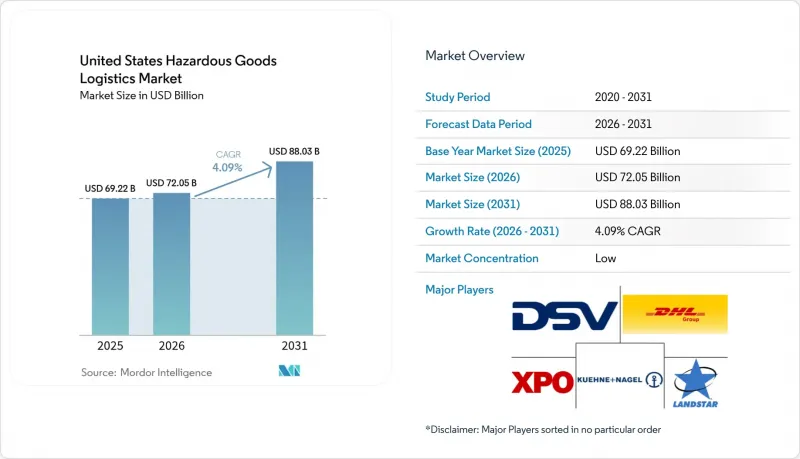
Mordor Intelligence에 의하면, 미국의 위험물 물류 시장 규모는 2025년에 692억 2,000만 달러로 평가되었고, 2026년 720억 5,000만 달러에서 2031년까지 880억 3,000만 달러에 이를 것으로 예측되며, 예측 기간(2026-2031년) CAGR은 4.09%를 나타낼 전망입니다.
본 보고서는 기능별(운송, 창고·유통, 부가가치 서비스), 목적지별(국내, 국제), 최종 이용 산업별(화학제품 및 석유화학제품, 석유 및 가스, 의료 및 제약, 농업·비료, 제조·산업, 기타), 그리고 지역별로 분류되어 있습니다. 시장 예측은 금액(달러) 기준으로 제시되어 있습니다.
미국의 위험물 물류 시장 동향 및 인사이트
견조한 국내 석유화학제품 생산량 증가
걸프 코스트 지역의 에탄 크래커 및 프로판 탈수소 설비는 계속 확장되고 있으며, 새로운 탱크로리, 철도, 파이프라인 수요를 뒷받침할 저비용 원료를 확보하고 있습니다. 휴스턴 및 루이지애나주 주변의 터미널 용량 확대 프로젝트로 인해 환적 병목 현상은 해소되고 있지만, 여전히 특수 장비와 운전자의 위험물 취급 자격이 필요합니다. 지역 내 생산이 호조를 보이면서 DOT-117 규격 인증을 받은 철도 화물차 수요가 증가하고 있으며, 해안 정유시설와 내륙 화학 허브 간 장거리 운송 수요가 더욱 강해지고 있습니다. 위험물 취급 자격을 갖춘 운전기사에게는 소규모 운송 회사에서는 감당할 수 없는 수준의 할증 임금이 지급되기 때문에 인력 부족 문제는 여전히 지속되고 있습니다. 따라서 석유화학 업계 화주들 수요가 미국 위험물 물류 시장의 장기적인 운송 물량을 지탱하는 기반이 되고 있습니다.
ORM-D 및 소비자용 위험물 전자상거래 발송 증가
현재 소비자 직접 판매 채널에서는 과거 B2B 경로로만 제한되었던 에어로졸, 가정용 세제, 배터리 구동 기기가 운송되고 있습니다. 소포 통합 사업자들은 분류 센터의 소화 설비를 업그레이드하고, PHMSA의 49 CFR Part 173 포장 규정을 준수하는 운송업자 대상 교육을 실시했습니다. 리튬 배터리 취급량 증가는 UN 3480 및 UN 3481 운송 시 위험물 신고가 필요한 반면, 고객들은 여전히 익일 배송을 요구하고 있어 물류 복잡성을 가중시키고 있습니다. 옴니채널 소매업체들이 규정 준수 업무를 외부에 위탁함에 따라, 창고 관리 시스템에 위험물 관리 모듈을 통합한 물류 제공업체들이 시장 점유율을 확대되고 있습니다. 이러한 변화로 인해 라스트 마일 수거 밀도가 높아지고 배송 중단 횟수는 증가하고 있지만, 미국 위험물 물류 시장 전체에서는 건당 수익이 향상되고 있습니다.
운전기사 및 설비 부족
위험물 취급 인증을 받은 CDL(상업용 운전면허) 소지 운전자는 은퇴자 수가 양성 학교 졸업생 수를 웃돌고 있어 여전히 부족합니다. DOT-117 탱크차의 제조 대기 기간은 2년 이상에 달하고, 벌크 화학물질의 철도 운송 성장을 억제하고 있습니다. 운송사는 임금을 인상하거나 입사 보너스를 제공하고 있지만, 그 비용이 화주에게 전가되면서 총비용이 상승하고 운송량이 둔화되고 있습니다. 이러한 부족 현상은 지방 운송 노선에 가장 심각한 타격을 주고 있으며, 석유화학제품 화주들은 자산을 재배치할 수밖에 없는 상황에 처해 있습니다. 그 결과, 미국 위험물 물류 시장에서 빈 차량 주행 거리가 증가하고 있습니다.
부문별 분석
2025년, 화주들이 정유시설, 화학 플랜트, 물류 센터를 연결하기 위해 도로와 철도를 결합한 복합 운송 자산에 의존한 결과, 운송 부문은 미국 위험물 물류 시장에서 77.10%의 점유율을 유지했습니다. 도로 운송 차량은 라스트 마일 운송에서 유연성을 제공하는 반면, DOT-117형 화차를 갖춘 철도 전용 열차는 톤당 비용 절감과 안전성 향상이 요구되는 벌크 운송 경로를 담당하고 있습니다. 해운 사업자들은 LNG 및 화학제품 수출을 위해 가압식 바지선에 대한 투자를 진행하고 있으며, 항공 화물은 의료용 동위원소 및 긴급 물자 운송이라는 틈새 분야에 국한되어 있습니다.
화주들이 안전 데이터 시트(SDS) 작성, 라벨 부착 및 화물의 실시간 원격 측정 업무를 외부에 위탁함에 따라 부가가치 서비스의 연평균 성장률(CAGR)은 3.72%를 기록하며, 각 기능 중 가장 높은 성장세를 보이고 있습니다. 창고 업무도 꾸준한 성장을 이어가고 있습니다. 이는 전략적인 입지에 위치한 위험물 전용 시설이 운송 거리를 단축하고 운전자의 근로 시간 제한을 완화하기 때문입니다. 진동 및 온도 센서 등의 IoT 통합으로 인해 보험 면책 한도가 낮아져 추가 수익이 확대되고 있습니다. 이러한 동향은 미국 위험물 물류 시장이 단순한 운송에서 벗어나, 규정 준수 관련 전문 지식을 수익화하는 통합형 서비스 제공으로 성숙해 가고 있음을 보여줍니다.
기타 혜택 :
- 엑셀 형식 시장 예측(ME) 시트
- 3개월간의 애널리스트 지원
자주 묻는 질문
목차
제1장 서론
제2장 조사 방법
제3장 주요 요약
제4장 시장 구도
제5장 시장 규모 및 성장 예측
제6장 경쟁 구도
제7장 시장 기회 및 향후 전망
AJY 26.08.26According to Mordor Intelligence, the United States hazardous goods logistics market size was valued at USD 69.22 billion in 2025 and estimated to grow from USD 72.05 billion in 2026 to reach USD 88.03 billion by 2031, at a CAGR of 4.09% during the forecast period (2026-2031).
This report is Segmented by Function (Transportation, Warehousing & Distribution, Value-Added Services), Destination (Domestic, International), End-Use Industry (Chemicals & Petrochemicals, Oil & Gas, Healthcare & Pharmaceuticals, Agriculture & Fertilizers, Manufacturing & Industrial, and More), and Geography. The Market Forecasts are Provided in Terms of Value (USD).
United States Hazardous Goods Logistics Market Trends and Insights
Robust Domestic Petrochemical Output Growth
Gulf Coast ethane crackers and propane dehydrogenation units continue to expand, securing low-cost feedstock that feeds new tank truck, rail, and pipeline demand. Terminal capacity projects around Houston and Louisiana reduce transfer bottlenecks yet require specialized equipment and driver endorsements. Strong regional production draws incremental railcars certified to DOT-117 standards, reinforcing long-haul demand between coastal refineries and inland chemical hubs. Hiring pressures persist because hazmat-endorsed drivers command wage premiums that smaller fleets cannot match. The pull from petrochemical shippers therefore anchors long-term volume in the United States hazardous goods logistics market.
Rise in E-commerce Shipment of ORM-D and Consumer Hazmat
Direct-to-consumer channels now move aerosols, household cleaners, and battery-powered devices once relegated to B2B lanes. Parcel integrators retrofit sorting centers with fire-suppression upgrades and implement carrier training that meets PHMSA's 49 CFR Part 173 packaging rules. Lithium battery volumes intensify complexity because UN 3480 and UN 3481 shipments need dangerous-goods declarations, yet customer expectations remain next-day delivery. Logistics providers embedding hazmat modules within warehouse management systems gain share as omnichannel retailers outsource compliance tasks. The shift enlarges last-mile density, adding incremental stops but raising revenue per shipment across the United States hazardous goods logistics market.
Driver and Equipment Shortages
Hazmat-certified CDL drivers remain scarce as retirements outpace training-school throughput. The DOT-117 tank-car manufacturing backlog extends beyond two years, curbing bulk chemical rail growth. Fleets bid up wages and offer sign-on bonuses, yet pass-through to shippers raises landed cost, dampening volume. Shortages hit rural lanes hardest, forcing petrochemical shippers to reposition assets, which inflates deadhead miles in the United States hazardous goods logistics market.
Other drivers and restraints analyzed in the detailed report include:
- Expansion of LNG and Hydrogen Fuel Supply Chains
- Lithium-ion Battery UN 3480/3481 Volumes Soaring
- Escalating Hazmat Insurance Premiums
For complete list of drivers and restraints, kindly check the Table Of Contents.
Segment Analysis
Transportation retained 77.10% United States hazardous goods logistics market share in 2025 as shippers relied on multi-modal road and rail assets to connect refineries, chemical plants, and distribution centers. Road fleets deliver flexibility for last-mile moves, whereas rail unit trains equipped with DOT-117 cars capture bulk lanes that demand lower per-ton cost and improved safety. Marine operators invest in pressurized barges for LNG and chemical exports, while air cargo remains a niche for medical isotopes and emergency supplies.
Value-added services register a 3.72% CAGR, the fastest among functions, as shippers outsource SDS authoring, labeling, and real-time cargo telemetry. Warehousing follows with steady growth because strategically located hazmat facilities shorten haul lengths and mitigate driver-hour constraints. IoT integrations such as vibration and temperature sensors lower insurance deductibles, propelling incremental revenue. These developments indicate the United States hazardous goods logistics market is maturing from pure transport toward integrated service offerings that monetize compliance expertise.
Complete Report Scope:
- By Function
- Transportation
- Road
- Rail
- Sea
- Air
- Warehousing and Distribution
- Value-added Services
- Transportation
- By Destination
- Domestic
- International
- By End-Use Industry
- Chemicals and Petrochemicals
- Oil and Gas
- Healthcare and Pharmaceuticals
- Agriculture and Fertilizers
- Manufacturing and Industrial
- Waste Management and Recycling
- Mining
- Others
- By US Region
- Northeast
- Midwest
- South
- West
List of Companies Covered in this Report:
- Deutsche Post DHL Group
- Kuehne + Nagel
- DSV
- XPO Logistics
- Landstar System Inc.
- GEODIS
- Schneider Logistics
- APL Logistics
- C.H. Robinson Worldwide
- Ryder System Inc.
- BDP International
- Expeditors International
- Hellmann Worldwide Logistics
- Bollore Logistics
- Matson Logistics
- Patriot Logistics
- Hub Group Inc.
- Kenan Advantage Group
- HMD Trucking
- Approved Freight Forwarder
Additional Benefits:
- The market estimate (ME) sheet in Excel format
- 3 months of analyst support
TABLE OF CONTENTS
1 Introduction
- 1.1 Study Assumptions and Market Definition
- 1.2 Scope of the Study
2 Research Methodology
3 Executive Summary
4 Market Landscape
- 4.1 Market Overview
- 4.2 Market Drivers
- 4.2.1 Robust domestic petrochemical output growth
- 4.2.2 Rise in e-commerce shipment of ORM-D and consumer hazmat
- 4.2.3 Expansion of LNG and hydrogen fuel supply chains
- 4.2.4 Lithium-ion battery UN 3480/3481 volumes soaring
- 4.2.5 Tightening OSHA/PHMSA compliance enforcement
- 4.2.6 DoD modernization driving explosive class shipments
- 4.3 Market Restraints
- 4.3.1 Driver and equipment shortages
- 4.3.2 Escalating hazmat insurance premiums
- 4.3.3 Limited public-sector bulk rail capacity
- 4.3.4 Community opposition to hazmat corridors
- 4.4 Value / Supply-Chain Analysis
- 4.5 Regulatory Landscape
- 4.6 Technological Outlook
- 4.7 Porter's Five Forces
- 4.7.1 Competitive Rivalry
- 4.7.2 Threat of New Entrants
- 4.7.3 Bargaining Power of Suppliers
- 4.7.4 Bargaining Power of Buyers
- 4.7.5 Threat of Substitutes
5 Market Size and Growth Forecasts (Value)
- 5.1 By Function
- 5.1.1 Transportation
- 5.1.1.1 Road
- 5.1.1.2 Rail
- 5.1.1.3 Sea
- 5.1.1.4 Air
- 5.1.2 Warehousing and Distribution
- 5.1.3 Value-added Services
- 5.1.1 Transportation
- 5.2 By Destination
- 5.2.1 Domestic
- 5.2.2 International
- 5.3 By End-Use Industry
- 5.3.1 Chemicals and Petrochemicals
- 5.3.2 Oil and Gas
- 5.3.3 Healthcare and Pharmaceuticals
- 5.3.4 Agriculture and Fertilizers
- 5.3.5 Manufacturing and Industrial
- 5.3.6 Waste Management and Recycling
- 5.3.7 Mining
- 5.3.8 Others
- 5.4 By US Region
- 5.4.1 Northeast
- 5.4.2 Midwest
- 5.4.3 South
- 5.4.4 West
6 Competitive Landscape
- 6.1 Market Concentration
- 6.2 Strategic Moves
- 6.3 Market Share Analysis
- 6.4 Company Profiles (includes Global level Overview, Market level overview, Core Segments, Financials as available, Strategic Information, Market Rank/Share for key companies, Products and Services, and Recent Developments)
- 6.4.1 Deutsche Post DHL Group
- 6.4.2 Kuehne + Nagel
- 6.4.3 DSV
- 6.4.4 XPO Logistics
- 6.4.5 Landstar System Inc.
- 6.4.6 GEODIS
- 6.4.7 Schneider Logistics
- 6.4.8 APL Logistics
- 6.4.9 C.H. Robinson Worldwide
- 6.4.10 Ryder System Inc.
- 6.4.11 BDP International
- 6.4.12 Expeditors International
- 6.4.13 Hellmann Worldwide Logistics
- 6.4.14 Bollore Logistics
- 6.4.15 Matson Logistics
- 6.4.16 Patriot Logistics
- 6.4.17 Hub Group Inc.
- 6.4.18 Kenan Advantage Group
- 6.4.19 HMD Trucking
- 6.4.20 Approved Freight Forwarder
7 Market Opportunities and Future Outlook
- 7.1 White-space and Unmet-need Assessment


