
|
시장보고서
상품코드
2114377
천식 및 COPD용 의료기기 : 시장 점유율 분석, 업계 동향 및 통계, 성장 예측(2026-2031년)Asthma And COPD Devices - Market Share Analysis, Industry Trends & Statistics, Growth Forecasts (2026 - 2031) |
||||||
 Mordor Intelligence
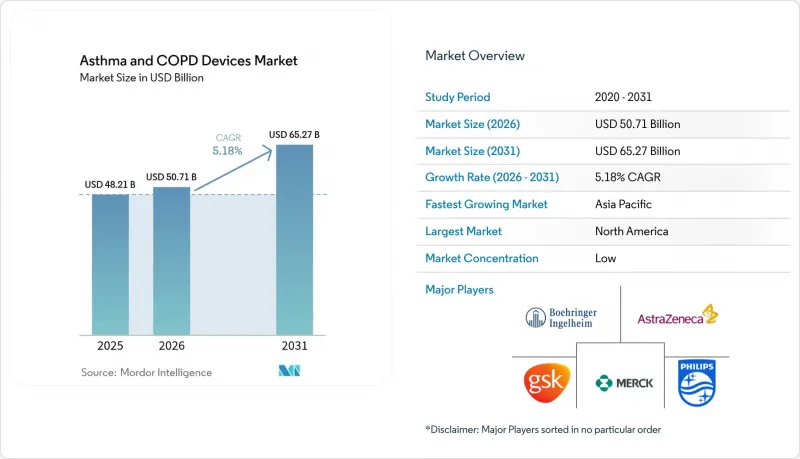
Mordor Intelligence에 의하면, 천식 및 COPD용 의료기기 시장 규모는 2025년에 482억 1,000만 달러, 2026년 507억 1,000만 달러에서 2031년까지 652억 7,000만 달러에 이를 것으로 예측되며, 예측 기간(2026-2031년) CAGR은 5.18%를 기록할 전망입니다.
본 보고서는 제품별(흡입기(정량 분무식 흡입기 등), 네뷸라이저(압축기식 네뷸라이저 등)), 적응증별(천식, 만성 폐쇄성 폐질환), 연령대(소아, 성인, 고령자), 작동 방식(기존 기기, 기타),지역(북미, 유럽, 기타)별로 분류되어 있습니다. 시장 규모와 전망은 금액(달러) 기준으로 제시되어 있습니다.
전 세계 천식 및 COPD용 의료기기 시장 동향 및 인사이트
천식·COPD 유병률 증가
현재 5억 4,500만 명 이상이 스마트 흡입기 기술의 혜택을 받을 수 있는 만성 호흡기 질환을 앓고 있습니다. 도시로의 인구 이동, 산업 배출 가스, 생활 방식의 변화로 인해 환자 수는 진료소의 수용 능력을 훨씬 뛰어넘는 속도로 증가하고 있습니다. 아시아태평양의 의료 시스템이 가장 큰 부담을 겪고 있지만, 선진국에서도 고령화에 따른 발병률의 급증 현상이 나타나고 있습니다. 그 결과, 합리적인 가격의 정량 분무식 흡입기, 고품질 메쉬 네뷸라이저, 가정이나 가상 진료 채널을 통해 도입 가능한 데이터 연동형 복약 순응도 지원 플랫폼에 대한 수요가 급증하고 있습니다. 피크 유량 수치의 저하를 임상의에게 알리는 연결 기기의 알림은 역학적 압력이 예측형 진료 모델을 어떻게 촉진하고 있는지를 보여주는 좋은 예입니다.
흡입 및 네뷸라이제이션 기술의 발전
메쉬식 네뷸라이저는 비침습적 인공호흡 중 제트식 장치의 3배 이상의 폐 침착률을 달성하고 있어, 후기 단계의 의약품 및 의료기기 공동 임상시험에서 선호되는 플랫폼이 되고 있습니다. HFA-152a와 같은 추진제의 재조성을 통해 치료적 동등성을 유지하면서 탄소 배출량을 90% 이상 감축할 수 있으므로, 기업들은 임상적 유효성과 지속가능성이라는 두 가지 요건을 모두 충족할 수 있게 됩니다. 친환경 추진제와 블루투스 지원 투여량 추적기를 결합한 초기 도입 기업들은 북미와 서유럽에서 프리미엄 가격을 실현하고 있습니다. 그 결과, 기기의 성능, 환경 고려, 디지털 연결성이 서로를 강화하는 혁신 사이클이 형성되고 있습니다.
엄격한 규제 승인 일정
미국 FDA는 현재 복합 흡입기의 승인을 앞두고 종합적인 인적 요인 연구와 디지털 구성 요소 검증을 의무화하고 있습니다. 유럽 의료기기 규정(MDR)에 따른 이와 유사한 엄격한 심사로 인해 심사 주기가 장기화되고, 연구개발 예산이 증가하며, 시판이 지연되고 있습니다. 대형 기존 기업들은 이러한 비용을 감당할 수 있지만, 스타트업 기업들은 장기화된 주요 임상시험 자금 조달에 어려움을 겪는 경우가 많아, 그 결과 신규 시장 진출기업이 감소하고 시장 집중도가 점차 높아지고 있습니다.
부문 분석
네뷸라이저는 2031년까지 연평균 성장률(CAGR)이 6.05%로 예측되어, 천식 및 COPD용 의료기기 시장 내에서 가장 높은 성장률을 보이고 있습니다. 한편, 흡입기는 2025년에도 62.90%라는 압도적인 점유율을 유지하고 있습니다. 메쉬 플랫폼은 약물 전달 효율을 향상시키고 치료 시간을 단축하며, 온라인 진료 중에도 사용할 수 있을 정도로 조용하게 작동합니다. 메쉬 챔버와 디지털 투여량 카운터를 결합한 업체는 표준 기기에 비해 천식 관리 테스트 점수가 3점 향상되었다고 보고하고 있습니다. 한편, 지구 온난화 지수가 낮은 추진제가 정량 분무식 흡입기 라인업을 새롭게 바꾸고 있으며, 소프트 미스트 흡입기는 차가운 가스 분출로 인한 불쾌감 없이 높은 폐 침착률을 실현하는 두 가지 장점을 모두 갖춘 대안으로 자리매김하고 있습니다.
2세대 네뷸라이저는 이러한 변화를 활용하여, 의료진을 위해 네뷸라이제이션 준수 동향을 시각화하는 스마트폰용 대시보드를 탑재하고 있습니다. 지속가능성에 대한 요구, 환자 경험의 중요성, 생물학적 제제와의 호환성이 맞물리면서 흡입기와 네뷸라이저는 공존하게 되겠지만, 수익의 흐름은 메쉬식 설계 쪽으로 기울고 있습니다. 고정 용량의 3제 병용 요법을 공동 개발하고 있는 각 제약 파트너사는 임상 프로토콜에서 메쉬식 장치를 지정하고 있으며, 이는 이 부문의 성장 궤도를 확고히 하고 있습니다.
2025년 매출에서 천식용 의료기기가 차지하는 비중은 65.30%였으나, COPD용 의료기기는 연평균 성장률(CAGR) 6.18%로 더 높은 성장이 예상되어 향후 5년간 천식 및 COPD용 의료기기 시장 내 점유율을 끌어올릴 것으로 전망됩니다. COPD의 진행성 병태로 인해 대부분의 경우 두 가지 유형의 기관지 확장제와 스테로이드 복합 흡입기가 필요하게 되어, 환자 1인당 지출액이 증가하고 있습니다. IL-5 억제제 등의 생물학적 제제의 후기 임상시험은 유망한 결과를 보여주고 있으며, 이를 투여하기 위해서는 마이크로그램 단위의 정밀한 투여와 내장형 오류 감지 기능을 갖춘 첨단 흡입기 플랫폼이 필요합니다.
천식 관리는 사용 현황을 기록하고 피크 유량 추이를 전송하는 커넥티드 흡입기를 활용하여, 표현형에 따른 치료 및 예방적 모니터링으로 전환되고 있습니다. 두 적응증 모두 디지털로 추적 가능한 치료 계획으로 수렴되고 있지만, COPD의 높은 입원 부담은 지불 주체의 비용 절감 목표와 완벽하게 부합하여 이 하위 부문에서 프리미엄 커넥티드 기기의 도입을 가속화하고 있습니다.
지역별 분석
북미는 체계적인 환급 제도와 커넥티드 흡입기의 조기 도입에 힘입어 2025년에는 전 세계 매출의 39.10%를 차지했습니다. 2025년에 시행될 연간 2,000달러의 약제 본인 부담 상한액은 보험사가 치료 성과 향상을 입증하는 실세계 데이터(RWD)를 요구하는 한편, 치료 강화 및 기기와 약제의 세트 판매 증가를 촉진할 것으로 예측됩니다. 주요 제조업체들은 주력 흡입기 제품 라인에 대해월35달러의 가격 상한선을 도입하고 있으며, 이는 합리적인 가격 확보를 요구하는 목소리에 대한 경쟁적인 대응을 보여줍니다.
아시아태평양은 성장의 견인차 역할을 하고 있으며, 2031년 연평균 성장률(CAGR)은 6.22%로 전망됩니다. 중국 의료기기 시장의 확대는 ‘중국 제조 2025’ 및 ‘건강 중국 2030’ 정책 방향과 일맥상통하며, 이는 첨단 호흡기 의료기기의 국내 생산을 장려하는 것입니다. 인도의 ‘2023년 신약·의료기기·화장품 법안’ 역시 승인 절차의 신속화와 철저한 품질 관리를 목표로 하고 있으며, 메쉬형 네뷸라이저 제품 라인에 대한 국내 기업과 다국적 기업의 투자를 촉진하고 있습니다. 베이징, 델리, 자카르타, 방콕 등 도시 지역의 대기 오염이 급증함에 따라 휴대용 친환경 흡입기에 대한 환자들 수요가 증가하고 있습니다.
유럽에서는 지속가능성 관련 규제로 인해 기존 CFC 추진제를 사용한 흡입기의 교체가 가속화되고 있어, 속도는 완만하지만 꾸준한 확대가 예상됩니다. EU의 ‘의료기기 규정(MDR)’에서는 수명 주기 전반에 걸친 탄소 배출량 산정이 중시되고 있으며, 커넥티드 기기를 전개할 때는 GDPR(EU 개인정보보호규정)이 정하는 엄격한 데이터 개인정보 보호 기준을 충족해야 합니다. 이러한 규정은 규정 준수 비용을 증가시키지만, 검증된 환경 성능과 안전한 데이터 아키텍처를 제공하는 기업에게는 이점을 가져다줍니다. 인구의 건강 지표와 연동된 새로운 보험 환급 제도에 따라 독일, 북유럽 국가, 네덜란드 등 시장에서 복약 순응도를 추적하는 흡입기에 대한 수요가 더욱 높아지고 있습니다.
기타 혜택
- 엑셀 형식 시장 예측(ME) 시트
- 3개월간의 애널리스트 지원
자주 묻는 질문
목차
제1장 서론
제2장 조사 방법
제3장 주요 요약
제4장 시장 구도
제5장 시장 규모와 성장 예측
제6장 경쟁 구도
제7장 시장 기회와 향후 전망
LSH 26.08.26According to Mordor Intelligence, the asthma and COPD devices market size was valued at USD 48.21 billion in 2025 and estimated to grow from USD 50.71 billion in 2026 to reach USD 65.27 billion by 2031, at a CAGR of 5.18% during the forecast period (2026-2031).
This report is Segmented by Product (Inhalers [Metered-Dose Inhalers and More] and Nebulizers [Compressor Nebulizers and More]), Indication (Asthma and Chronic Obstructive Pulmonary Disease), Age Group (Paediatric, Adult, and Geriatric), Mode of Operation (Conventional Devices and More), and Geography (North America, Europe, and More). The Market and Forecasts are Provided in Terms of Value (USD).
Global Asthma And COPD Devices Market Trends and Insights
Rising prevalence of asthma & COPD
More than 545 million people now live with chronic respiratory diseases that could benefit from smart-inhaler technology. Urban migration, industrial emissions, and lifestyle changes are broadening patient pools far faster than clinic capacity. Asia-Pacific health systems feel the biggest strain, yet developed economies also face aging-related prevalence spikes. As a result, demand is swelling for affordable metered-dose inhalers, premium mesh nebulizers, and data-enabled adherence platforms that can be deployed at home or in virtual-care pathways. Connected-device alerts notifying clinicians of declining peak-flow scores exemplify how epidemiological pressure is catalyzing predictive care models .
Technological advancements in inhalation & nebulization
Mesh nebulizers achieve lung deposition rates more than triple those of jet units during non-invasive ventilation, making them the preferred platform for late-stage drug-device trials. Propellant reformulations such as HFA-152a cut carbon impact by over 90% while preserving therapeutic equivalence, allowing firms to satisfy both clinical-efficacy and sustainability mandates. Early adopters pairing environment-friendly propellants with Bluetooth-enabled dose trackers are commanding premium pricing in North America and Western Europe. The result is an innovation cycle in which device performance, eco-credentials, and digital connectivity reinforce one another.
Stringent regulatory approval timelines
The United States FDA now requires comprehensive human-factor studies and digital-component validation before clearing combination inhalers . Similar scrutiny from Europe's Medical Device Regulation has elongated review cycles, lifting R&D budgets and delaying commercial launches. Large incumbents can absorb these costs, but start-ups often struggle to fund extended pivotal trials, leading to fewer novel entrants and a gradual up-tick in market concentration.
Other drivers and restraints analyzed in the detailed report include:
- Growing geriatric population base
- Increasing indoor-outdoor air-pollution levels
- Inadequate reimbursement in developing regions
For complete list of drivers and restraints, kindly check the Table Of Contents.
Segment Analysis
Nebulizers generated a 6.05% CAGR outlook through 2031, the fastest within the Asthma and COPD devices market, even though inhalers retained a commanding 62.90% share in 2025. Mesh platforms improve drug delivery efficiency, trim treatment times, and run quietly enough for use during virtual consultations. Vendors pairing mesh chambers with digital-dose counters report 3-point gains in Asthma Control Test scores versus standard devices. Meanwhile, low-global-warming-potential propellants are rebooting the metered-dose inhaler line-up, and soft-mist inhalers now serve as a middle ground, offering high lung deposition without cold-gas plume discomfort .
Second-generation nebulizers capitalize on these shifts by bundling smartphone dashboards that visualize nebulization adherence trends for clinicians. The interplay of sustainability mandates, patient-experience imperatives, and biologic-drug compatibility ensures that both inhalers and nebulizers will coexist, but revenue momentum tilts toward mesh-equipped designs. Pharmaceutical partners co-developing fixed-dose triple therapies are specifying mesh units in clinical protocols, anchoring the segment's growth runway.
Asthma represented 65.30% of 2025 revenue, yet COPD devices are projected to grow faster at 6.18% CAGR, lifting their slice of the Asthma and COPD devices market over the next five years. COPD's progressive pathology often necessitates dual-bronchodilator or steroid-combo inhalers, inflating per-patient spend. Late-stage trials of biologics such as IL-5 inhibitors show promise, and their delivery will require advanced inhaler platforms capable of precise microgram dosing and built-in error detection.
Asthma management is shifting toward phenotype-guided therapies and preventive monitoring, leveraging connected inhalers that record usage and transmit peak-flow trends. Both indications are converging on digitally tracked regimens, but COPD's higher hospitalization burden aligns squarely with payers' cost-offset goals, accelerating adoption of premium connected devices in that sub-segment.
Complete Report Scope:
- By Product
- Inhalers
- Metered-Dose Inhalers
- Dry-Powder Inhalers
- Soft-Mist Inhalers
- Nebulizers
- Compressor Nebulizers
- Ultrasonic Nebulizers
- Mesh Nebulizers
- Inhalers
- By Indication
- Asthma
- Chronic Obstructive Pulmonary Disease
- By Age Group
- Paediatric
- Adult
- Geriatric
- By Mode of Operation
- Digital / Connected Devices
- Conventional Devices
- By Geography
- North America
- United States
- Canada
- Mexico
- Europe
- Germany
- United Kingdom
- France
- Italy
- Spain
- Rest of Europe
- Asia-Pacific
- China
- Japan
- India
- Australia
- South Korea
- Rest of Asia-Pacific
- Middle East and Africa
- GCC
- South Africa
- Rest of Middle East and Africa
- South America
- Brazil
- Argentina
- Rest of South America
- North America
Geography Analysis
North America commanded 39.10% of global revenue in 2025, aided by structured reimbursement and early uptake of connected inhalers. A USD 2,000 annual out-of-pocket drug cap effective in 2025 is expected to encourage therapy intensification and higher device-drug bundling, even as insurers press for real-world evidence of outcome gains. Leading manufacturers have introduced monthly price ceilings of USD 35 for core inhaler lines, illustrating competitive responses to affordability mandates.
Asia-Pacific is the growth pacesetter with a 6.22% CAGR outlook to 2031. China's medical-device expansion aligns with Made in China 2025 and Healthy China 2030 agendas that incentivize domestic production of advanced respiratory devices. India's New Drugs, Medical Devices and Cosmetics Bill 2023 similarly targets faster approvals and quality enforcement, spurring local and multinational investments in mesh-nebulizer lines. Urban air-pollution spikes in Beijing, Delhi, Jakarta, and Bangkok amplify patient demand for portable, environment-aware inhalers.
Europe shows consistent, albeit slower, expansion as sustainability regulations accelerate turnover of legacy CFC-propellant inhalers. The bloc's Medical Device Regulation emphasizes lifecycle carbon accounting, and connected-device rollouts must satisfy stringent GDPR data-privacy thresholds. These rules raise compliance costs but reward firms delivering verified eco-performance and secure data architectures. New reimbursement paths tied to population-health metrics reinforce demand for adherence-tracking inhalers in markets such as Germany, the Nordics, and the Netherlands.
- GlaxoSmithKline
- AstraZeneca
- Boehringer Ingelheim
- Teva Pharmaceutical Industries
- Koninklijke Philips
- Merck
- PARI Pharma GmbH
- OMRON
- Drive DeVilbiss Healthcare
- Invacare
- Recipharm
- Cipla
- Sunovion Pharmaceuticals
- Resmed
- Chiesi Farmaceutici
- Vectura Group plc
- Mundipharma International Ltd.
- Aerogen Ltd.
- Propeller Health
- Adherium Ltd.
Additional Benefits:
- The market estimate (ME) sheet in Excel format
- 3 months of analyst support
TABLE OF CONTENTS
1 Introduction
- 1.1 Study Assumptions & Market Definition
- 1.2 Scope of the Study
2 Research Methodology
3 Executive Summary
4 Market Landscape
- 4.1 Market Overview
- 4.2 Market Drivers
- 4.2.1 Rising prevalence of asthma & COPD
- 4.2.2 Technological advancements in inhalation & nebulization
- 4.2.3 Growing geriatric population base
- 4.2.4 Increasing indoor-outdoor air-pollution levels
- 4.2.5 Payer-driven adherence programs in developed markets
- 4.2.6 AI-enabled smart inhalers integrated into tele-pulmonology
- 4.3 Market Restraints
- 4.3.1 Stringent regulatory approval timelines
- 4.3.2 Inadequate reimbursement in developing regions
- 4.3.3 Price sensitivity & generic competition
- 4.3.4 Data-privacy concerns around connected devices
- 4.4 Regulatory Landscape
- 4.5 Technological Outlook
- 4.6 Porters Five Forces Analysis
- 4.6.1 Threat of New Entrants
- 4.6.2 Bargaining Power of Buyers/Consumers
- 4.6.3 Bargaining Power of Suppliers
- 4.6.4 Threat of Substitute Products
- 4.6.5 Intensity of Competitive Rivalry
5 Market Size & Growth Forecasts (Value, USD)
- 5.1 By Product
- 5.1.1 Inhalers
- 5.1.1.1 Metered-Dose Inhalers
- 5.1.1.2 Dry-Powder Inhalers
- 5.1.1.3 Soft-Mist Inhalers
- 5.1.2 Nebulizers
- 5.1.2.1 Compressor Nebulizers
- 5.1.2.2 Ultrasonic Nebulizers
- 5.1.2.3 Mesh Nebulizers
- 5.1.1 Inhalers
- 5.2 By Indication
- 5.2.1 Asthma
- 5.2.2 Chronic Obstructive Pulmonary Disease
- 5.3 By Age Group
- 5.3.1 Paediatric
- 5.3.2 Adult
- 5.3.3 Geriatric
- 5.4 By Mode of Operation
- 5.4.1 Digital / Connected Devices
- 5.4.2 Conventional Devices
- 5.5 By Geography
- 5.5.1 North America
- 5.5.1.1 United States
- 5.5.1.2 Canada
- 5.5.1.3 Mexico
- 5.5.2 Europe
- 5.5.2.1 Germany
- 5.5.2.2 United Kingdom
- 5.5.2.3 France
- 5.5.2.4 Italy
- 5.5.2.5 Spain
- 5.5.2.6 Rest of Europe
- 5.5.3 Asia-Pacific
- 5.5.3.1 China
- 5.5.3.2 Japan
- 5.5.3.3 India
- 5.5.3.4 Australia
- 5.5.3.5 South Korea
- 5.5.3.6 Rest of Asia-Pacific
- 5.5.4 Middle East and Africa
- 5.5.4.1 GCC
- 5.5.4.2 South Africa
- 5.5.4.3 Rest of Middle East and Africa
- 5.5.5 South America
- 5.5.5.1 Brazil
- 5.5.5.2 Argentina
- 5.5.5.3 Rest of South America
- 5.5.1 North America
6 Competitive Landscape
- 6.1 Market Concentration
- 6.2 Market Share Analysis
- 6.3 Company Profiles (includes Global level Overview, Market level overview, Core Segments, Financials as available, Strategic Information, Market Rank/Share for key companies, Products & Services, and Recent Developments)
- 6.3.1 GlaxoSmithKline plc
- 6.3.2 AstraZeneca plc
- 6.3.3 Boehringer Ingelheim GmbH
- 6.3.4 Teva Pharmaceutical Industries Ltd.
- 6.3.5 Philips Healthcare
- 6.3.6 Merck & Co., Inc.
- 6.3.7 PARI Pharma GmbH
- 6.3.8 Omron Healthcare, Inc.
- 6.3.9 Drive DeVilbiss Healthcare
- 6.3.10 Invacare Corporation
- 6.3.11 Recipharm AB
- 6.3.12 Cipla Ltd.
- 6.3.13 Sunovion Pharmaceuticals Inc.
- 6.3.14 ResMed Inc.
- 6.3.15 Chiesi Farmaceutici S.p.A.
- 6.3.16 Vectura Group plc
- 6.3.17 Mundipharma International Ltd.
- 6.3.18 Aerogen Ltd.
- 6.3.19 Propeller Health
- 6.3.20 Adherium Ltd.
7 Market Opportunities & Future Outlook
- 7.1 White-space & Unmet-Need Assessment