|
시장보고서
상품코드
2114401
중국의 세라믹 타일 시장 : 시장 점유율 분석, 업계 동향 및 통계, 성장 예측(2026-2031년)China Ceramic Tiles - Market Share Analysis, Industry Trends & Statistics, Growth Forecasts (2026 - 2031) |
||||||
 Mordor Intelligence
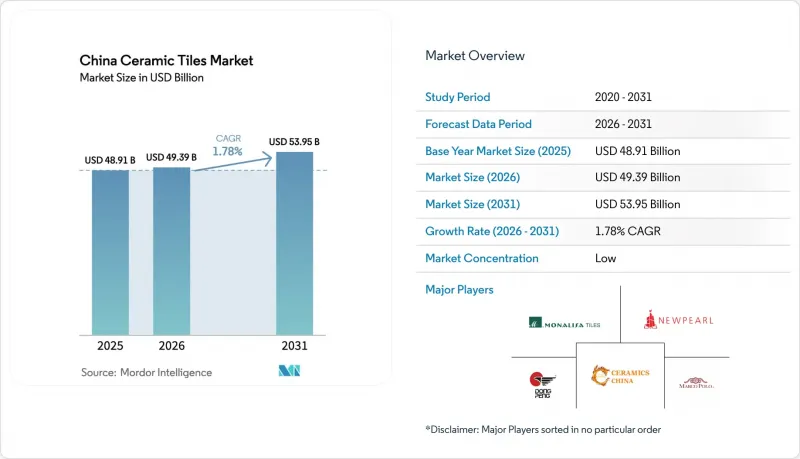
Mordor Intelligence에 의하면, 중국의 세라믹 타일 시장 규모는 2025년 489억 1,000만 달러로 평가되었고, 2026년에는 493억 9,000만 달러로 추정되고, 2031년까지 539억 5,000만 달러에 이를 것으로 예상되며, 2026-2031년 CAGR 1.78%로 성장할 전망입니다.
본 보고서는 제품 유형별(도자기 타일, 유약 처리 세라믹 타일 등), 용도별(바닥, 벽 등), 최종 사용자별(주택, 상업시설), 건설 유형별(신축, 개보수·교체), 유통 채널별(타일·석재 전문점 등), 지역별(중국 동부, 중국 남부 등)로 분류되어 있습니다. 시장 전망은 금액(달러) 기준으로 제시되어 있습니다.
중국의 세라믹 타일 시장 동향 및 인사이트
도시 지역의 주택 개보수·리모델링 붐
중국에서는 2025년 1월부터 11월까지 25,800곳의 구시가지 주택단지에서 개보수 프로젝트가 시작되어 연간 목표를 초과 달성했습니다. 이를 통해 가구의 생활 수준 향상을 안정적으로 견인하는 도시 재생에 대한 정책적 노력이 더욱 강화되었습니다. 2025년 하반기 정부 발표에서는 도시 재생이 도시 형태의 최적화, 성장 동력의 전환, 그리고 친환경적인 생활 수준 향상을 도모하기 위한 구조적 수단으로서 강조되었습니다. 이를 통해 주거 공간 및 위생 설비 영역에서 중급 및 고급 타일에 대한 수요가 향후 몇 년간 지속될 기반이 마련되었습니다. 배관 교체, 커뮤니티 시설 정비, 배리어프리화 등의 개보수 범위는 안전성, 청소 용이성, 수명 주기 비용에 대한 기대에 부응하는 내구성과 위생성이 뛰어난 바닥재 및 벽재에 대한 지출을 자연스럽게 촉진합니다. 또한, 개보수는 도시 지역 가구의 주방 및 욕실 리모델링 주기와 연동되어 있어, 신축 착공 건수가 저조한 상황에서도 벽·바닥용 타일의 안정적인 재주문량을 뒷받침하고 있습니다.
그린 빌딩용 타일에 대한 정부의 추진
『건축물의 에너지 절약 및 재생에너지 이용에 관한 일반 규칙』에서는 건축물의 탄소 강도 규제와 더욱 엄격한 에너지 절약 기준이 의무화되어 있으며, 이를 통해 환경 제품 선언(EPD)을 취득한 타일을 포함한 저탄소 자재가 프로젝트 사양으로 채택되도록 유도하고 있습니다. 중국건축자재연합회는 2024년 3월, 전국적인 탄소 라벨링 및 EPD 프로젝트를 출범시켰습니다. 이 프로젝트에서는 시범 운영 단계에서 세라믹 타일이 대상에 포함되어 있으며, ‘제14차 5개년 계획’ 기간 중에 라벨링 발급 범위를 확대하는 것을 목표로 하고 있어 표준화와 데이터 공개를 가속화하고 있습니다. 중국 동부 지역의 수명 주기 평가에 따르면, 크래들-투-게이트(제조 단계) 탄소 발자국 중 생산 단계가 대부분을 차지하며, 타일 제조업체의 경우 연료 전환, 저온 소성 및 폐열 회수 대책이 우선 과제가 됩니다. ‘제14차 5개년 종합 작업 계획’에 기반한 국가의 에너지 및 배출 목표는 세라믹 업계의 석탄 의존 탈피를 뒷받침하고 있으며, 이에 따라 천연가스 연소, 전력 기반 공정, 그리고 장래의 수소 이용에 대비하는 것의 중요성이 더욱 높아지고 있습니다. 조달 시스템이 탄소 배출량 기준치 및 관련 서류를 기준으로 삼기 시작함에 따라, 측정 가능한 배출 감축에 투자하는 제조업체는 관민을 불문하고 프로젝트 입찰에서 유리한 입지를 확보할 수 있습니다. 그 결과, 중국의 세라믹 타일 시장, 특히 친환경 건축물 도입이 가장 진전된 대도시권에서 더 높은 사양의 도자기 타일 및 친환경 제품으로의 전환이 촉진될 것입니다.
장기화되는 부동산 시장의 침체와 공급 과잉
2024년에는 국내 세라믹 타일 소비량이 감소한 반면, 생산 능력은 높은 수준을 유지하여 설비 가동률이 48% 전후에 그쳤고, 경쟁이 심화되었습니다. 2024년 세계 데이터는 생산량 감소를 뒷받침하고 있으며, 주택 판매 부진과 개발사의 자금 사정 악화가 건축자재 시장에 계속해서 무거운 부담으로 작용하고 있음을 여실히 보여주고 있습니다. 2022-2024년 생산자 수와 가동 중인 생산 라인 수는 감소했으나, 생산 라인의 갱신으로 인해 생산 능력 감축이 지연되면서 공급 과잉과 이익률 압박이 지속되었습니다. 2025년에는 자산 경매가 가속화되면서, 유력한 사업자들에게는 반복되는 입찰 끝에 생산 능력이나 허가를 할인된 가격에 확보할 기회가 생겼습니다. 2026년 이후 부동산 시장의 안정화와 도시 재생을 촉진하는 정책의 조짐이 보이지만, 시장 회복은 재고 소진과 프로젝트 자금 조달에 의존하고 있기 때문에 수요가 정상 수준으로 회복되기까지의 일정은 여전히 불투명합니다. 따라서 중국의 세라믹 타일 시장은 주택 판매 사이클이 정상화될 때까지의 과도기적 조치로서, 리모델링 수요와 공공 투자에 의존하는 상황에 놓여 있습니다.
부문 분석
2025년 매출액 중 포세린 타일이 54.45%를 차지했으며, 중국 세라믹 타일 시장에서 성능 면에서의 우위와 친환경 건축 규격에 대한 적합성이 확인되었습니다. 이러한 위상은 주요 도시의 주택 및 상업 건축물 실내·실외 용도에 대한 수요를 충족시키는 저흡수성, 고밀도, 내구성을 반영한 것입니다. 디지털 인쇄 및 유약 기술의 발전으로, 절단 유연성을 유지하면서 유약 소비량을 정밀하게 제어하고, 고급스러운 돌과 같은 마감을 대규모로 구현할 수 있게 되었습니다. 각 제조업체는 건축가와 디자이너를 지원하기 위해 색상 연구 및 마감재 선정에 투자하고, 포셀린 타일 제품군의 지각적 가치를 높이는 툴킷을 제공합니다. 이러한 제품 포트폴리오의 확충으로 브랜드는 공급 과잉 상황에서도 가격을 유지하기 쉬워졌으며, 중국 세라믹 타일 업계에서 기본 범용 제품 라인에 대한 의존도를 낮추고 있습니다.
모자이크 타일은 2031년까지 연평균 성장률(CAGR) 1.98%를 나타낼 것으로 예측되며, 중국 세라믹 타일 시장에서 가장 빠르게 성장하는 제품 유형이 될 전망입니다. 이러한 성장은 고급 호텔 및 럭셔리 주거 공간에서의 맞춤형 디자인 수요와 밀접한 관련이 있으며, 악센트 월이나 특징적인 시공을 통해 타원형에 패턴이 풍부한 디자인이 가능해졌습니다. 디지털 워크플로우를 통해 소량 생산이 효율화됨에 따라, 제조업체는 재고 위험을 감수하지 않고도 폭넓은 색상 변형을 제공하며 디자인 요구 사항에 신속하게 대응할 수 있게 됩니다. 위생 기능과 항균 기능 덕분에 습기가 많은 공간에서의 이용 사례가 더욱 확대되어, 욕실,스파, 상업용 주방에서 모자이크 타일의 역할이 강화되고 있습니다. 이러한 특징과 옴니채널 판매 전략이 결합되면서, 시각적인 스토리텔링과 촉각적 경험을 활용한 장식용 타일 시장 점유율이 꾸준히 확대되고 있습니다.
2025년 용도별 매출액 중 바닥 타일이 63.43%를 차지한 것으로 평가되었으며, 지붕용 타일은 2031년까지 연평균 성장률(CAGR) 1.86%를 나타낼 것으로 전망되어, 중국 세라믹 타일 시장에서 내구성이 뛰어난 바닥재가 계속해서 주류를 이루고 있음을 여실히 보여주고 있습니다. 내구성과 위생상의 장점이 최신 건축 기준 및 부동산 관리 기준과 부합하기 때문에 주거 공간, 소매점, 공공 장소에서는 여전히 바닥재가 표준적인 선택지로 자리 잡고 있습니다. 도시 재개발로 인해 노후 주택에서는 꾸준한 바닥재 교체 수요가 발생하고 있습니다. 이러한 주택에서는 삶의 질 향상을 위해 바닥과 주방 및 욕실 벽의 개보수가 핵심적인 역할을 하고 있습니다. 교통 기관 및 유틸리티 분야에서는 이음매 감소와 유지보수 부담을 줄이기 위해 대형 포셀린 슬래브가 계속해서 지정되고 있으며, 이는 상업 프로젝트의 평균 판매 가격을 끌어올리고 있습니다. 지자체에서는 수명 주기를 연장하고 도시 경관을 통일하기 위해 공공 건축물에서 실외용 자재 사용을 표준화하고 있어, 지붕 타일 시장이 확대되고 있습니다.
벽면 타일은 시장에서 중요한 2차 점유율을 차지하고 있으며, 중국 세라믹 타일 시장에서 3D 텍스처, 메탈릭 유약, 초대형 패널과 같은 디자인 주도형 업그레이드가 고급 호텔에서 일반 주택 시장으로 확산되고 있는 데서 혜택을 보고 있습니다. 디지털 인쇄 기술을 통해 높은 청결성을 유지하면서도 시각적 임팩트가 요구되는 욕실이나 로비의 액센트 벽면에 사실적인 석재나 나뭇결 무늬 마감이 가능해졌습니다. 지붕 용도에서도 자외선 저항성과 열 안정성을 높이는 소성 및 유약 기술이 활용되어, 퍼골라나 공공 쉼터에 내구성이 뛰어난 표면을 구현하고 있습니다. 수영장 내벽이나 외벽과 같은 특수 용도에서도 제품 다양성이 확대되고 있으며, 수요는 온난한 지역이나 방문객을 위한 시설을 업그레이드하는 상업시설에 집중되고 있습니다. 이러한 용도의 동향이 맞물려, 중국 세라믹 타일 업계에서 부가가치가 높은 사양으로의 꾸준한 전환을 뒷받침하고 있습니다.
기타 혜택 :
- 엑셀 형식 시장 예측(ME) 시트
- 3개월간의 애널리스트 지원
자주 묻는 질문
목차
제1장 서론
제2장 조사 방법
제3장 주요 요약
제4장 시장 구도
제5장 시장 규모 및 성장 예측
제6장 경쟁 구도
제7장 시장 기회 및 향후 전망
AJY 26.08.26According to Mordor Intelligence, the China ceramic tiles market size is expected to increase from USD 48.91 billion in 2025 to USD 49.39 billion in 2026 and reach USD 53.95 billion by 2031, growing at a CAGR of 1.78% over 2026-2031.
This report is Segmented by Product Type (Porcelain Tiles, Glazed Ceramic Tiles, and More), Application (floor, Wall, and More), End-User (Residential, Commercial), Construction Type (New Construction, Renovation and Replacement), Distribution Channel (Specialty Tile & Stone Stores, and More), and Geography (East China, South China, and More). The Market Forecasts are Provided in Terms of Value (USD).
China Ceramic Tiles Market Trends and Insights
Urban-Home Upgrade & Renovation Boom
China launched renovation projects at 25,800 old urban residential communities during January to November 2025, surpassing the annual target and reinforcing the policy commitment to urban renewal as a steady driver of household-quality improvements. Government communications in late 2025 emphasized urban renewal as a structural lever to optimize urban form, transform growth engines, and advance green living standards, which sets a multi-year demand runway for mid-grade and premium tiles in living spaces and sanitary areas. The scope of renovation, such as pipeline upgrades, community amenities, and accessibility improvements, naturally channels spend toward durable and hygienic surfaces that meet safety, ease-of-cleaning, and lifecycle cost expectations. Renovation aligns with kitchen and bathroom refresh cycles for urban households, which supports steady reorder volumes for wall and floor tiles even when new housing starts remain subdued.
Government Push for Green-Building Tiles
The General Code for Building Energy Conservation and Renewable Energy Utilization established mandatory carbon-intensity controls in buildings and tighter energy-saving thresholds, which steer project specifications toward low-emission materials, including tiles with environmental product declarations. The China Building Materials Federation launched a national carbon labelling and EPD project in March 2024 that includes ceramic tiles in trial operations and targets wider label issuance during the 14th Five-Year Plan, accelerating standardization and data disclosure. Lifecycle assessments for Eastern China show cradle-to-gate footprints dominated by the production phase, which prioritizes fuel switching, lower-temperature firing, and afterheat recovery interventions by tile producers. National energy and emission targets under the 14th Five-Year Comprehensive Work Plan reinforce a shift away from coal in ceramics, which raises the relevance of natural gas combustion, electricity-based processes, and eventual hydrogen readiness. As procurement systems start to reference carbon thresholds and documentation, manufacturers that invest in measurable reductions position themselves for bid advantages on public and private projects. The net effect is a nudge toward higher-spec porcelain and eco-aligned products in the China ceramic tiles market, especially in metro areas where green building adoption is most advanced.
Prolonged Real-Estate Slowdown and Oversupply
Domestic ceramic tile consumption declined in 2024 while installed capacity remained high, which kept utilization near 48% and intensified price competition. Global data for 2024 confirms output contraction and underscores how weak home sales and constrained developer liquidity continued to weigh on building materials. Producer counts and active production lines fell between 2022 and 2024, yet capacity reductions lagged due to line upgrades, so overhang and margin compression persisted. Asset auctions accelerated in 2025, creating opportunities for stronger players to acquire capacity and permits at discounts after repeated rounds. Despite policy signals to stabilize real estate and promote urban renewal from 2026, the timeline to normal absorption remains uncertain as market repair depends on inventory clearance and funding transmission to projects. The China ceramic tiles market, therefore, leans on renovation and public investment as bridges while residential sales cycles normalize.
Other drivers and restraints analyzed in the detailed report include:
- E-Commerce & Live-Stream Tile Retailing Growth
- Waste-Heat-Recovery Kilns Adoption
- Stricter Environmental Compliance Costs
For complete list of drivers and restraints, kindly check the Table Of Contents.
Segment Analysis
Porcelain tiles held 54.45% of 2025 revenues, confirming their leadership in performance attributes and alignment with green-building specifications in the China ceramic tiles market. This position reflects low water absorption, high density, and durability that meet indoor and outdoor application needs for residential and commercial builds in major cities. Digital printing and glazing advances are enabling premium, stone-like finishes at scale while preserving cutover flexibility and controlling glaze consumption at precise levels. Producers are investing in color research and finish curation to support architects and designers with toolkits that raise the perceived value of porcelain assortments. This portfolio depth helps brands defend pricing amid overcapacity and reduces reliance on basic commodity lines in the China ceramic tiles industry.
Mosaic tiles are forecast to post a 1.98% CAGR through 2031, making them the fastest-growing product type in the China ceramic tiles market. Growth is tied to customized design demand in high-end hospitality and luxury residential spaces, where accent walls and feature installations allow small-format and pattern-rich designs. As digital workflows streamline short-run production, manufacturers can offer broader palettes without inventory risk and respond faster to design briefs. Sanitary and antimicrobial features add further use cases in wet zones, reinforcing the role of mosaics in bathrooms, spas, and commercial kitchens. These attributes, combined with omnichannel merchandising, support steady share gains for decorative formats that benefit from visual storytelling and tactile experiences.
Floor tiles captured 63.43% of 2025 application revenues, and roofing applications are projected to record a 1.86% CAGR through 2031, highlighting the continued dominance of heavy-duty surfaces in the China ceramic tiles market. Floors remain the default in living areas, retail, and public spaces due to durability and hygiene benefits that align with updated codes and property-management standards. Urban renewal is adding steady replacement demand in older homes, where upgrading floors and wet-area walls is central to quality-of-life improvements. Transport and civic projects continue to specify large-format porcelain slabs to reduce grout lines and maintenance, which pushes up average selling prices in commercial jobs. Roofing tiles are expanding as municipalities standardize outdoor-rated materials on public structures to extend lifecycle value and unify urban aesthetics.
Wall tiles hold a significant secondary share and benefit from design-led upgrades as 3D textures, metallic glazes, and extra-large panels are migrating from high-end hospitality into mainstream residential formats in the China ceramic tiles market. Digital printing allows realistic stone and wood effects for feature walls in bathrooms and lobbies that require visual impact with high cleanability. Roof applications benefit from the same firing and glaze technologies that increase UV resistance and thermal stability, creating durable surfaces for pergolas and public shelters. Specialty uses like pool linings and exterior facades add variety, with demand skewed to warmer provinces and commercial complexes upgrading visitor amenities. Collectively, these application trends support a steady shift toward value-added specifications within the China ceramic tiles industry.
Complete Report Scope:
- By Product Type
- Porcelain Tiles
- Glazed Ceramic Tiles
- Unglazed Ceramic Tiles
- Mosaic Tiles
- Others (Decorative, Patterned, Handmade)
- By Application
- Floor
- Wall
- Roofing
- By End-User
- Residential
- Commercial
- Hospitality (Hotels, Resorts)
- Retail Spaces
- Offices & Institutions
- Healthcare
- Educational Facilities
- Transport Hubs (Airports, Metro, Bus Terminals)
- Other Commercial Users
- By Construction Type
- New Construction
- Renovation and Replacement
- By Distribution Channel
- Specialty Tile & Stone Stores
- Home Improvement & DIY Stores
- Online Retail
- Direct Sales to Contractors
- By Geography
- East China (Shanghai, Jiangsu, Zhejiang, Anhui)
- South China (Guangdong, Guangxi, Hainan)
- North China (Beijing, Tianjin, Hebei, Shanxi, Inner Mongolia)
- Central China (Henan, Hubei, Hunan)
- Rest of China (Northeast, Southwest,Northwest)
List of Companies Covered in this Report:
- Dongpeng Ceramic
- Marco Polo Holdings
- Monalisa Group
- New Pearl Ceramics
- Ceramics China
- Nabel (Kito)
- Xinzhongyuan (New Zhong Yuan)
- Champion Building Materials
- Eagle Brand Holdings
- Guangdong Overland
- Foshan Oceano
- Guangdong Marco Polo (JieSheng)
- Guangdong Haoshuo
- Guangdong Xinjincheng
- Guangxi Xinquan
- Foshan Gold Medal Ceramics
- Guangdong Xinmingzhu
- Guangdong Henglitai
- Huida Sanitary Ware & Tiles
- Shenghua Ceramics
Additional Benefits:
- The market estimate (ME) sheet in Excel format
- 3 months of analyst support
TABLE OF CONTENTS
1 Introduction
- 1.1 Study Assumptions & Market Definition
- 1.2 Scope of the Study
2 Research Methodology
3 Executive Summary
4 Market Landscape
- 4.1 Market Overview
- 4.2 Market Drivers
- 4.2.1 Urban-home upgrade & renovation boom
- 4.2.2 Government push for green-building tiles (14th Five-Year energy-benchmarks)
- 4.2.3 E-commerce & live-stream tile retailing explosion
- 4.2.4 Digital-printing enables mass-customised decor surfaces
- 4.2.5 Export recovery to Belt-and-Road construction markets
- 4.2.6 Waste-heat-recovery kilns cut costs & emissions
- 4.3 Market Restraints
- 4.3.1 Prolonged real-estate slowdown & oversupply
- 4.3.2 Stricter environmental compliance costs
- 4.3.3 Anti-dumping duties on Chinese tile exports
- 4.3.4 Rising competition from Indian & Vietnamese producers
- 4.4 Industry Value Chain Analysis
- 4.5 Regulatory Landscape
- 4.6 Technological Outlook
- 4.7 Porter's Five Forces Analysis
- 4.7.1 Bargaining Power of Suppliers
- 4.7.2 Bargaining Power of Buyers
- 4.7.3 Threat of New Entrants
- 4.7.4 Threat of Substitutes
- 4.7.5 Intensity of Competitive Rivalry
- 4.8 Insights into the Latest Trends and Innovations in the Market
- 4.9 Insights on Recent Developments (New Product Launches, Strategic Initiatives, Investments, Partnerships, JVs, Expansion, M&As, etc.) in the Industry
5 Market Size & Growth Forecasts
- 5.1 By Product Type
- 5.1.1 Porcelain Tiles
- 5.1.2 Glazed Ceramic Tiles
- 5.1.3 Unglazed Ceramic Tiles
- 5.1.4 Mosaic Tiles
- 5.1.5 Others (Decorative, Patterned, Handmade)
- 5.2 By Application
- 5.2.1 Floor
- 5.2.2 Wall
- 5.2.3 Roofing
- 5.3 By End-User
- 5.3.1 Residential
- 5.3.2 Commercial
- 5.3.2.1 Hospitality (Hotels, Resorts)
- 5.3.2.2 Retail Spaces
- 5.3.2.3 Offices & Institutions
- 5.3.2.4 Healthcare
- 5.3.2.5 Educational Facilities
- 5.3.2.6 Transport Hubs (Airports, Metro, Bus Terminals)
- 5.3.2.7 Other Commercial Users
- 5.4 By Construction Type
- 5.4.1 New Construction
- 5.4.2 Renovation and Replacement
- 5.5 By Distribution Channel
- 5.5.1 Specialty Tile & Stone Stores
- 5.5.2 Home Improvement & DIY Stores
- 5.5.3 Online Retail
- 5.5.4 Direct Sales to Contractors
- 5.6 By Geography
- 5.6.1 East China (Shanghai, Jiangsu, Zhejiang, Anhui)
- 5.6.2 South China (Guangdong, Guangxi, Hainan)
- 5.6.3 North China (Beijing, Tianjin, Hebei, Shanxi, Inner Mongolia)
- 5.6.4 Central China (Henan, Hubei, Hunan)
- 5.6.5 Rest of China (Northeast, Southwest,Northwest)
6 Competitive Landscape
- 6.1 Market Concentration
- 6.2 Strategic Moves
- 6.3 Market Share Analysis
- 6.4 Company Profiles {(includes Global level Overview, Market level overview, Core Segments, Financials as available, Strategic Information, Market Rank/Share for key companies, Products & Services, and Recent Developments)}
- 6.4.1 Dongpeng Ceramic
- 6.4.2 Marco Polo Holdings
- 6.4.3 Monalisa Group
- 6.4.4 New Pearl Ceramics
- 6.4.5 Ceramics China
- 6.4.6 Nabel (Kito)
- 6.4.7 Xinzhongyuan (New Zhong Yuan)
- 6.4.8 Champion Building Materials
- 6.4.9 Eagle Brand Holdings
- 6.4.10 Guangdong Overland
- 6.4.11 Foshan Oceano
- 6.4.12 Guangdong Marco Polo (JieSheng)
- 6.4.13 Guangdong Haoshuo
- 6.4.14 Guangdong Xinjincheng
- 6.4.15 Guangxi Xinquan
- 6.4.16 Foshan Gold Medal Ceramics
- 6.4.17 Guangdong Xinmingzhu
- 6.4.18 Guangdong Henglitai
- 6.4.19 Huida Sanitary Ware & Tiles
- 6.4.20 Shenghua Ceramics
7 Market Opportunities & Future Outlook
- 7.1 Demand surge for large-format thin porcelain slabs
- 7.2 Smart & antimicrobial tiles for public-health infrastructure