
|
시장보고서
상품코드
2115102
영국의 세라믹 타일 시장 : 점유율 분석, 업계 동향과 통계, 성장 예측(2026-2031년)United Kingdom Ceramic Tiles - Market Share Analysis, Industry Trends & Statistics, Growth Forecasts (2026 - 2031) |
||||||
 Mordor Intelligence
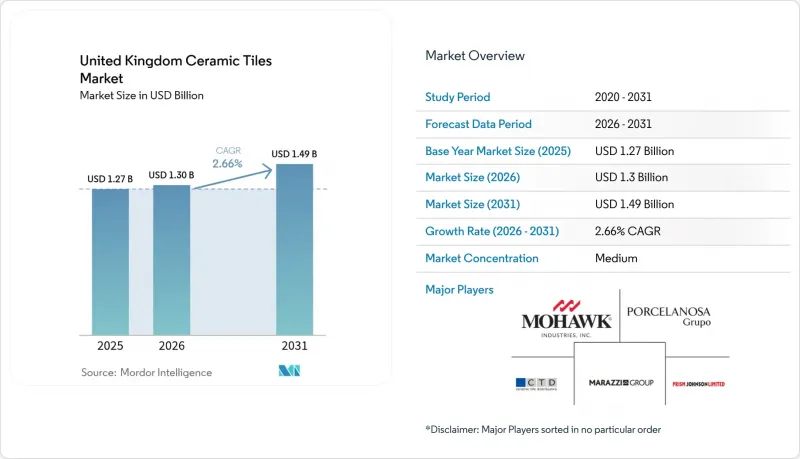
Mordor Intelligence에 의하면, 영국 세라믹 타일 시장 규모는 2025년 12억 7,000만 달러에서 2026년에는 13억 달러로 확대되어 2026년부터 2031년까지 CAGR 2.66%로 성장을 지속하여, 2031년까지 14억 9,000만 달러에 이를 것으로 예측됩니다.
본 보고서는 제품 유형(도자기 타일, 유약 처리된 세라믹 타일 등), 용도(바닥, 벽, 지붕), 최종 사용자(주택, 상업시설), 건설 유형(신축, 개보수·교체), 유통 채널(전문점, DIY 매장, 온라인 소매, 직접 판매), 지역별로 분류되어 있습니다. 시장 전망은 금액(달러) 기준으로 제시되어 있습니다.
영국 세라믹 타일 시장 동향 및 인사이트
팬데믹 이후의 주택 리모델링 붐이 타일 소매 수요를 뒷받침하고 있습니다.
2020년부터 2022년에 걸친 장기적인 재택 생활로 인해 가계 지출은 리모델링으로 이동했습니다. 이러한 추세는 거시경제의 불확실성에도 불구하고 2025년까지 지속되고 있습니다. 2024년 하반기에는 주택 리모델링과 관련된 비식품 소매 판매량이 전년 대비 1.9% 증가했으며, 전자상거래 사이트를 개편한 세라믹 타일 소매업체들이 그 성장의 대부분을 차지했습니다. 소비자들은 재판매 가치를 높여주는 내구성이 뛰어나고 유지 관리가 간편한 바닥재를 점점 더 중요하게 여기게 되었으며, 주방 및 욕실 리모델링에서는 수명이 짧은 라미네이트 소재보다 세라믹 타일이 우선적으로 선택되고 있습니다. Johnson Tiles 및 British Ceramic Tile에서 가동을 시작한 HD 잉크젯 생산 라인 덕분에 맞춤형 인테리어 테마에 맞춘 대리석 무늬나 나뭇결 무늬 컬렉션을 신속하게 출시할 수 있게 되었습니다. 이러한 요소들이 결합되어 신축 건설 활동의 경기 변동을 완화하는 안정적인 주택 수요 기반을 뒷받침하고 있습니다.
고급 상업시설 인테리어에 대형 포세린 타일 채택 급증
플래그십 스토어의 리모델링 공사, 공항, 고급 소매 체인점에서는 유지보수 비용을 절감하면서도 일체감 있는 미관을 실현하기 위해 1,200×600 mm 이상의 대형 포세린 패널이 표준으로 채택되고 있습니다. 가트윅 공항역 재개발 프로젝트에서는 대형 타일이 끊임없는 인파를 견디면서도 청소 작업을 간소화할 수 있음이 입증되어, 건축가와 시설 관리자들 사이에서 신뢰도가 높아지고 있습니다. 로비나 스파를 리모델링하는 호텔에서는 천연석을 모방하면서도 실링 처리가 필요 없고, 위생 기준 및 미끄럼 방지 기준을 충족하는 대형 슬래브가 선호되고 있습니다. 정밀하게 절단된 가장자리와 최소한의 이음매는 영업 중단 기간이 제한된 고부가가치 프로젝트에서 시공 기간 단축에도 기여하고 있습니다. 기업 부동산 소유주들이 직원들을 사무실로 복귀시키기 위해 인상적인 인테리어를 추구하는 가운데, 프리미엄 도자기 타일에 대한 수요는 향후 10년 동안 계속해서 확대될 것으로 예측됩니다.
천연가스 가격 변동이 소성 비용을 상승시켜
2021년 말부터 2023년 중반까지 천연가스 현물 가격이 2배 이상 급등하면서, 1,200°C에서의 소성이 공장 운영비의 약 35%를 차지하기 때문에 세라믹 타일의 생산 비용을 끌어올렸습니다. 그 결과, 유리 및 세라믹·석재 부문의 조부가치액은 2021년 1분기 수준 대비 46.5% 감소했으며, 설비 투자를 위한 운전 자금이 압박받고 있습니다. 각 생산 기업들은 가스에 대한 의존도를 낮추기 위해 바이오메탄이나 수소를 혼합하는 하이브리드 가마의 시범 운영을 추진하고 있으나, 인프라 미비와 자금 조달의 장벽으로 인해 본격적인 도입은 여전히 지체되고 있습니다. 에너지 비용의 불확실성으로 인해 일부 구매자들은 수입품으로 전환하고 있지만, 중국산 타일에 대한 반덤핑 관세가 대체 효과를 제한하고 있어 국내 생산 능력의 중요성은 여전히 유지되고 있습니다. 가격 변동이 지속될 경우, 차세대 프레스 기계에 대한 투자가 지연되고 제품 혁신이 둔화되어 영국 세라믹 타일 시장의 성장세가 소폭 둔화될 가능성이 있습니다.
부문 분석
도자기질 타일은 수분 흡수율이 0.5% 미만이며, 내동결성과 높은 파단 강도를 갖추고 있어 외장뿐만 아니라 유동 인구가 많은 실내에도 적합하기 때문에 2025년에는 영국 세라믹 타일 시장에서 38.12%의 점유율을 확보했습니다. 영국 도자기 타일 시장 규모는 2025년에 4억 8,410만 달러에 달하고, 크기가 커짐에 따라 평방미터당 가치가 상승함에 따라 2031년까지 연평균 성장률(CAGR) 2.78%로 확대될 것으로 전망됩니다. 모자이크 타일은 수량 기준으로는 고작 4.6%에 불과하지만, 욕실 및 주방 디자이너들이 지속가능성 요건을 충족하는 재생 유리로 만든 모자이크를 활용한 개성 있는 악센트 벽을 선호함에 따라 3.04%라는 가장 높은 연평균 성장률(CAGR)을 기록하고 있습니다. 유약을 입힌 세라믹 타일은 주거용 벽면 마감의 주력 제품으로 자리 잡고 있는 반면, 유약을 입히지 않은 타일은 의료시설이나 교통 허브 등 EN 16165의 미끄럼 저항 등급이 의무화되어 안전성이 특히 중시되는 바닥재 시장을 독점하고 있습니다.
이러한 수요 차이는 단가 그 자체보다 유지 관리에 대한 기대나 시공의 경제성에 기인합니다. 천연 대리석에 비해 수명 주기 비용 측면에서 우위를 차지하는 포세린은 장기 임대 계약을 통해 인테리어 비용을 상각하는 상업용 부동산 소유주들 사이에서 그 매력을 높이고 있습니다. 모자이크 수입업체들은 이탈리아 제조업체의 적시(JIT) 발주에 의존하고 있지만, 최근 물류 병목 현상으로 인해 리드 타임을 40% 단축할 수 있는 영국산 유리 모자이크에 대한 관심이 높아지고 있습니다. 유약을 입힌 벽용 타일의 소비량은 여전히 유행 주기의 영향을 받기 쉬우므로, 각 제조업체는 유연성이 높은 잉크젯 생산 라인을 활용하여 6개월마다 계절별 색상 변형을 선보일 수밖에 없습니다.
2025년, 영국 세라믹 타일 시장에서 바닥재가 62.54%의 점유율을 차지했습니다. 이는 동일한 보행량 조건에서 타일이 비닐 소재보다 최대 20년 더 오래 지속되어 시설 관리의 총비용을 절감할 수 있기 때문입니다. 벽면 자재는 4억 860만 달러로 규모는 작지만, 구역을 구분하기 위한 악센트 월을 도입한 개방형 주거 공간의 확대로 인해 연평균 성장률(CAGR) 2.94%로 성장하고 있습니다. 지붕용 타일은 역사적 건축물이나 건축물 복원 프로젝트를 위한 전통적인 점토 기와에 초점을 맞춘 전문적인 틈새 시장이지만, 이 부문은 현대적인 지붕 자재 대체품으로부터의 압박에 직면해 있습니다. 바닥재 부문의 우위는 상업용 세라믹 타일의 기술적 우위를 반영하고 있으며, 수명 주기 비용의 관점에서 미관을 유지하면서도 가혹한 사용 조건을 견딜 수 있는 소재가 선호되고 있습니다. 주거용 바닥재의 경우, 세라믹 타일이 바닥 난방 시스템과 호환된다는 점이 장점으로 작용하며, 이는 열전도율과 보온성을 중시하는 에너지 효율 트렌드와 부합합니다.
상업시설의 리모델링에서는 시설 관리자들이 팬데믹 기간 동안 중요성이 부각된 위생 관리의 용이성을 이유로, 카펫이 깔린 로비를 대형 포세린 타일로 교체하는 사례가 늘고 있습니다. 주거용 바닥재 시장은 바닥 난방의 보급으로 인해 더욱 탄력을 받고 있습니다. 세라믹 소재의 신속한 열전도 덕분에 EPC 평가에서 쾌적성 점수가 향상되고 있기 때문입니다. 벽용 타일의 성장은 대리석 무늬 슬래브로 마감된 풀하이츠 샤워 부스를 소개하는 디지털 인플루언서들에 의해 뒷받침되고 있으며, 밀레니얼 세대 주택 소유자들의 소매점 구매를 촉진하고 있습니다. 경량 벌집 구조 패널과 같은 시공 기술의 혁신으로 구조적 하중이 경감됨에 따라, 이전에는 무게 제약으로 인해 기피되던 리모델링 공사에서도 세라믹 소재의 사용이 확대되고 있습니다.
기타 혜택:
- 엑셀 형식 시장 예측(ME) 시트
- 3개월간 애널리스트 지원
자주 묻는 질문
목차
제1장 서론
제2장 조사 방법
제3장 주요 요약
제4장 시장 구도
제5장 시장 규모와 성장 예측
제6장 경쟁 구도
제7장 시장 기회와 향후 전망
JHS 26.08.26According to Mordor Intelligence, the United Kingdom ceramic tiles market size is expected to grow from USD 1.27 billion in 2025 to USD 1.3 billion in 2026 and is forecast to reach USD 1.49 billion by 2031 at 2.66% CAGR over 2026-2031.
This report is Segmented by Product Type (Porcelain Tiles, Glazed Ceramic Tiles, and More), Application (Floor, Wall, Roofing), End-User (Residential, Commercial), Construction Type (New Construction, Renovation and Replacement), Distribution Channel (Specialty Stores, DIY Stores, Online Retail, Direct Sales), and Geography. The Market Forecasts are Provided in Terms of Value (USD).
United Kingdom Ceramic Tiles Market Trends and Insights
Post-pandemic home-improvement boom sustains retail tile demand
Extended periods of home occupancy during 2020-2022 recalibrated household spending toward renovation, a pattern that has endured through 2025 despite macroeconomic uncertainty. Non-food retail volumes tied to home improvement rose 1.9% year-on-year in late 2024, and ceramic retailers with upgraded e-commerce sites captured a disproportionate share of that growth. Consumers increasingly prioritize durable, low-maintenance surfaces that add resale value, positioning ceramic tiles ahead of short-lived laminates in kitchen and bathroom upgrades. HD ink-jet lines commissioned at Johnson Tiles and British Ceramic Tile enable rapid roll-outs of marble- and wood-look collections that cater to bespoke interior themes. Together, these elements underpin a stable residential demand base that cushions cyclical swings in new-build activity.
Surge in large-format porcelain adoption for upscale commercial fit-outs
Flagship commercial refurbishments, airports, and premium retail chains now routinely specify 1,200 X 600 mm or larger porcelain panels to achieve monolithic aesthetics with lower maintenance outlays. The Gatwick Airport Station redevelopment demonstrated large-format tiles' ability to handle continuous footfall while simplifying cleaning regimes, reinforcing confidence among architects and facility managers. Hotels upgrading lobbies and spas prefer expansive slabs that emulate natural stone yet comply with hygiene and slip-resistance standards without sealing treatments. Precision-cut edges and minimal grout lines also shorten installation times on high-value projects where shutdown windows are tight. As corporate real-estate owners pursue statement interiors to lure employees back on-site, demand for premium porcelain is forecast to extend well into the next decade.
Volatile natural-gas prices inflating kiln firing costs
Spot natural-gas quotations more than doubled between late 2021 and mid-2023, inflating ceramic tile production costs because firing at 1,200 °C accounts for roughly 35% of factory operating expenses. The glass, ceramics, and stone sector's gross value added consequently sank 46.5% from Q1 2021 levels, eroding working capital for capex upgrades. Producers are piloting hybrid kilns that blend biomethane or hydrogen to curb gas dependency, yet commercial deployment remains hampered by infrastructure gaps and funding hurdles. Energy-cost uncertainty steers some buyers toward import sourcing, though anti-dumping duties on Chinese tiles limit substitution effects and keep domestic capacity relevant. Persistent volatility could delay investment in next-generation presses, slowing product innovation and marginally tempering the United Kingdom ceramic tiles market trajectory.
Other drivers and restraints analyzed in the detailed report include:
- UK-wide push for energy-efficient under-floor heating compatible tiles
- Digital ink-jet printing cuts design cycle and cost for niche producers
- Shortage of HGV drivers disrupting imports from Spain and Italy
For complete list of drivers and restraints, kindly check the Table Of Contents.
Segment Analysis
Porcelain tiles secured 38.12% United Kingdom ceramic tiles market share in 2025 owing to less than 0.5% water absorption, frost resistance, and high breaking strength that suit both external facades and heavy-traffic interiors. The United Kingdom ceramic tiles market size for porcelain reached USD 484.1 million in 2025 and is projected to expand at a 2.78% CAGR through 2031 as format enlargement drives value per square meter. Mosaic tiles, although only 4.6% of volume, register the fastest 3.04% CAGR as bathroom and kitchen designers favor personalized accent walls with recycled-glass mosaics that satisfy sustainability briefs. Glazed ceramic remains the workhorse for residential wall cladding, while unglazed variants dominate safety-critical floors where EN 16165 slip ratings are mandatory in healthcare and transport hubs.
Demand differentials reflect maintenance expectations and installation economics rather than unit price alone. Porcelain's life-cycle cost advantage over natural marble strengthens its appeal among commercial landlords who amortize interiors across long leases. Mosaic importers lean on just-in-time ordering from Italian producers; however, recent logistics bottlenecks spur interest in UK-made glass mosaics that cut lead times by 40%. Glazed wall tile consumption remains sensitive to fashion cycles, compelling manufacturers to roll out seasonal colorways every six months using agile ink-jet lines.
Flooring represented 62.54% United Kingdom ceramic tiles market share in 2025 because tiles outlast vinyl by up to 20 years under comparable foot traffic, reducing total facilities-management expense. Wall cladding, while smaller at USD 408.6 million, outpaces with a 2.94% CAGR due to expansion of open-plan living spaces that employ feature walls for zoning purposes. Roofing applications represent a specialized niche focused on traditional clay tiles for heritage and architectural restoration projects, though this segment faces pressure from modern roofing alternatives. The floor segment's dominance reflects ceramic tiles' technical advantages in commercial applications, where lifecycle cost considerations favor materials that withstand heavy use while maintaining aesthetic appeal. Residential floor applications benefit from ceramic tiles' compatibility with underfloor heating systems, aligning with energy efficiency trends that prioritize thermal conductivity and heat retention properties.
Within commercial refurbishments, facility managers increasingly convert carpeted lobbies into large-format porcelain for easier sanitation, a priority highlighted during the pandemic. Residential floors gain additional momentum from the under-floor heating boom, where ceramic rapid heat transfer improves comfort ratings in EPC assessments. Wall tile growth is bolstered by digital influencers showcasing full-height shower enclosures clad in marble-look slabs, spurring retail pickups among millennial homeowners. Installation innovations such as lightweight honeycomb-backed panels reduce structural loads, extending ceramic use to refurbishments previously deterred by weight constraints.
Complete Report Scope:
- By Product Type
- Porcelain Tiles
- Glazed Ceramic Tiles
- Unglazed Ceramic Tiles
- Mosaic Tiles
- Others (Decorative, Patterned, Handmade)
- By Application
- Floor
- Wall
- Roofing
- By End-User
- Residential
- Commercial
- Hospitality (Hotels, Resorts)
- Retail Spaces
- Offices & Institutions
- Healthcare
- Educational Facilities
- Transport Hubs (Airports, Metro, Bus Terminals)
- Other Commercial Users
- By Construction Type
- New Construction
- Renovation and Replacement
- By Distribution Channel
- Specialty Tile & Stone Stores
- Home Improvement & DIY Stores
- Online Retail
- Direct Sales to Contractors
- By Geography
- England
- Scotland
- Wales
- Northern Ireland
List of Companies Covered in this Report:
- Atlas Concorde
- Ceramica Marazzi
- Ceramica Saloni
- Craven Dunnill
- CTD Tiles
- Domus Tiles
- Grupo STN
- Interceramic UK
- Keraben Grupo
- Mohawk Industries
- Pamesa Ceramica
- Porcelanosa Grupo
- Porcelanosa Grupo
- Prism Johnson Limited (Johnson Tiles)
- RAK Ceramics
- Roca Tile
- Tile Giant
Additional Benefits:
- The market estimate (ME) sheet in Excel format
- 3 months of analyst support
TABLE OF CONTENTS
1 Introduction
- 1.1 Study Assumptions & Market Definition
- 1.2 Scope of the Study
2 Research Methodology
3 Executive Summary
4 Market Landscape
- 4.1 Market Overview
- 4.2 Market Drivers
- 4.2.1 Post-Pandemic Home-Improvement Boom Sustains Retail Tile Demand
- 4.2.2 Surge In Large-Format Porcelain Adoption For Upscale Commercial Fit-Outs
- 4.2.3 UK-Wide Push For Energy-Efficient Under-Floor Heating Compatible Tiles
- 4.2.4 Digital Ink-Jet Printing Cuts Design Cycle & Cost For Niche Producers
- 4.2.5 Growth Of Modular Off-Site Construction Using Lightweight Tile Panels
- 4.2.6 Mandatory Slip-Resistance Norms In Healthcare & Transport Hubs
- 4.3 Market Restraints
- 4.3.1 Volatile Natural-Gas Prices Inflating Kiln Firing Costs
- 4.3.2 Shortage Of HGV Drivers Disrupting Imports From Spain & Italy
- 4.3.3 Competition From LVT & Spc Rigid-Core Flooring Alternatives
- 4.3.4 Limited Domestic Clay Reserves Restricting Scale-Up Of Local Production
- 4.4 Industry Value Chain Analysis
- 4.5 Porter's Five Forces Analysis
- 4.5.1 Threat of New Entrants
- 4.5.2 Bargaining Power of Suppliers
- 4.5.3 Bargaining Power of Buyers
- 4.5.4 Threat of Substitutes
- 4.5.5 Competitive Rivalry
- 4.6 Insights into the Latest Trends and Innovations in the Market
- 4.7 Insights on Recent Developments (New Product Launches, Strategic Initiatives, Investments, Partnerships, JVs, Expansion, M&As, etc.) in the Industry
5 Market Size & Growth Forecasts (Value in USD)
- 5.1 By Product Type
- 5.1.1 Porcelain Tiles
- 5.1.2 Glazed Ceramic Tiles
- 5.1.3 Unglazed Ceramic Tiles
- 5.1.4 Mosaic Tiles
- 5.1.5 Others (Decorative, Patterned, Handmade)
- 5.2 By Application
- 5.2.1 Floor
- 5.2.2 Wall
- 5.2.3 Roofing
- 5.3 By End-User
- 5.3.1 Residential
- 5.3.2 Commercial
- 5.3.2.1 Hospitality (Hotels, Resorts)
- 5.3.2.2 Retail Spaces
- 5.3.2.3 Offices & Institutions
- 5.3.2.4 Healthcare
- 5.3.2.5 Educational Facilities
- 5.3.2.6 Transport Hubs (Airports, Metro, Bus Terminals)
- 5.3.2.7 Other Commercial Users
- 5.4 By Construction Type
- 5.4.1 New Construction
- 5.4.2 Renovation and Replacement
- 5.5 By Distribution Channel
- 5.5.1 Specialty Tile & Stone Stores
- 5.5.2 Home Improvement & DIY Stores
- 5.5.3 Online Retail
- 5.5.4 Direct Sales to Contractors
- 5.6 By Geography
- 5.6.1 England
- 5.6.2 Scotland
- 5.6.3 Wales
- 5.6.4 Northern Ireland
6 Competitive Landscape
- 6.1 Market Concentration
- 6.2 Strategic Moves
- 6.3 Market Share Analysis
- 6.4 Company Profiles (includes Global level Overview, Market level overview, Core Segments, Financials as available, Strategic Information, Market Rank/Share for key companies, Products & Services, and Recent Developments)
- 6.4.1 Atlas Concorde
- 6.4.2 Ceramica Marazzi
- 6.4.3 Ceramica Saloni
- 6.4.4 Craven Dunnill
- 6.4.5 CTD Tiles
- 6.4.6 Domus Tiles
- 6.4.7 Grupo STN
- 6.4.8 Interceramic UK
- 6.4.9 Keraben Grupo
- 6.4.10 Mohawk Industries
- 6.4.11 Pamesa Ceramica
- 6.4.12 Porcelanosa Grupo
- 6.4.13 Porcelanosa Grupo
- 6.4.14 Prism Johnson Limited (Johnson Tiles)
- 6.4.15 RAK Ceramics
- 6.4.16 Roca Tile
- 6.4.17 Tile Giant
7 Market Opportunities & Future Outlook
- 7.1 Increased Use of Sustainable and Recycled Materials
- 7.2 Expansion of Oversized and Slim-Slab Tiles