

|
시장보고서
상품코드
2114512
가금류 사료 시장 : 시장 점유율 분석, 업계 동향 및 통계, 성장 예측(2026-2031년)Poultry Feed - Market Share Analysis, Industry Trends & Statistics, Growth Forecasts (2026 - 2031) |
||||||
 Mordor Intelligence
Mordor Intelligence에 의하면, 가금류 사료 시장 규모는 2026년에 2,375억 달러로 추정되고, 2031년까지 2,788억 달러로 확대될 것으로 예측되며, 이것은 예측 기간 중 CAGR 3.3%로 성장할 것으로 전망되고 있습니다.
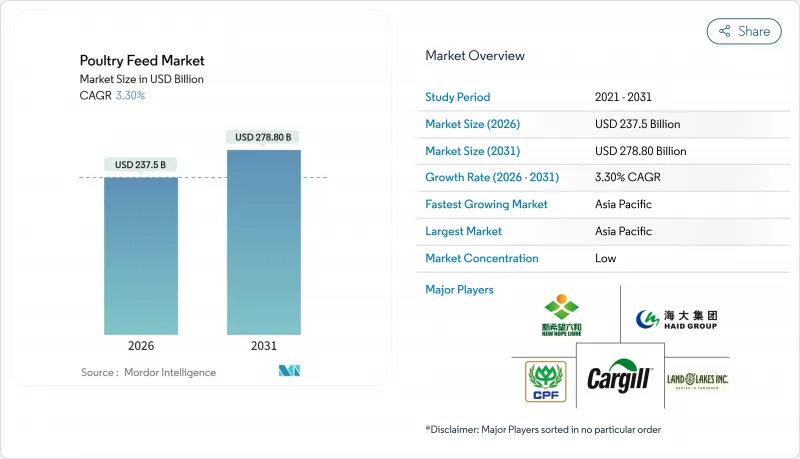
본 보고서는 사료 유형별(산란용 사료, 육계용 사료 등), 형태별(펠렛, 크럼블 등), 원료 유형별(곡물, 유지종자박, 당밀, 어유 및 어분, 첨가제 등), 그리고 지역별(북미, 유럽,아시아태평양, 남미, 중동 등)로 분류되어 있습니다. 시장 전망은 금액(달러) 기준으로 제시되어 있습니다.
세계의 가금류 사료 시장 동향 및 인사이트
전 세계 가금류 육류 소비량 증가
2024년, 전 세계 1인당 가금류 육류 소비량은 17.9kg에 달했으며, 동남아시아, 사하라 이남 아프리카, 중동에서 가장 두드러진 성장세를 보였습니다. 나이지리아, 이집트, 베트남 등 시장에서는 배합 사료 생산량이 가금 사육 두수 증가를 따라가지 못하고 있어, 적시 공급을 실현하기 위해 통합형 가금 복합 시설 근처에 사료 공장 건설이 진행되고 있습니다. 도시 지역의 콜드체인 확대로 인해 생닭 시장이 점차 사라지고 있으며, 냉장육 공급을 뒷받침하기 위해 안정적인 품질의 사료에 대한 수요가 증가하고 있습니다. 경제협력개발기구(OECD)는 2030년까지 전 세계 육류 소비량의 41%를 가금육이 차지할 것으로 예측했습니다. 이러한 수요의 펀더멘털이 원료 비용 변동에도 불구하고 가금류 사료 시장의 지속적인 확장을 뒷받침하고 있습니다.
신흥 경제국에서의 양계 산업화
2025년에는 10만 마리 이상의 통합형 양계장이 중국 내 육계 생산량의 68%, 인도에서는 54%를 차지하며, 2020년 수준에서 대폭 증가했습니다. 이러한 규모에서는 균일한 배합이 생물 보안과 예측 가능한 생산 실적을 뒷받침하기 때문에 배합 사료가 선호됩니다. 유사한 모델은 현재 남아프리카공화국과 나이지리아로도 확산되고 있으며, 이들 국가에서는 통합형 양계 사업자들이 생산 능력 20만 메트르톤을 초과하는 자동 사료 공장을 도입하고 있습니다. 소매업체들이 추적성을 요구하는 가운데, 과거 농장에서 사료를 배합하던 소규모 농가의 존재감은 점차 희미해지고 있습니다. 세계은행은 2030년까지 신흥 시장의 생산량 중 75%가 산업형 양계에서 나올 것으로 예측하고 있으며, 이로 인해 수요는 전문 구매자에게 더욱 집중될 것입니다.
원자재 가격 변동
2024-2025년 옥수수 가격은 부셸당 4.20달러에서 5.80달러 사이에서 거래되었으며, 대두박은 기상 조건이나 수요의 급격한 변동에 영향을 받아 메트르톤당 380달러에서 520달러로 크게 변동했습니다. 이집트나 필리핀 등 수입에 의존하는 시장의 경우, 자국 통화가 달러 대비 하락하면 비용 부담이 더욱 커집니다. 3-6개월 후를 목표로 고정 가격 계약을 체결한 제분업자는 현물 가격이 급등할 경우 마진 압박 위험에 노출됩니다. 옥수수의 최대 30%를 밀이나 보리로 대체함으로써 어느 정도 완화할 수는 있지만, 아시아의 이러한 곡물 선물 시장은 여전히 거래량이 적은 상황입니다. 변동성이 심한 시기에는 운전 자본 수요 증가가 대차대조표에 추가적인 압박을 가합니다. 아프리카와 아시아 일부 지역에서는 정교한 헤지 수단이 부족하기 때문에 생산자들은 위험에 노출된 채로 남아 있으며, 이로 인해 가금류 사료 시장의 단기적인 성장이 억제되고 있습니다.
부문별 분석
육계용 사료는 육계 생산량이 1억 1,000만 미터톤으로 증가함에 따라 2025년 시장 규모의 42%를 차지했으며, 가금류 사료 시장에서 육계가 중심적인 역할을 하고 있음을 뒷받침하고 있습니다. 북미와 유럽의 성장은 정체되어 있지만, 남아시아와 사하라 이남 아프리카의 두 자릿수 출하량 증가로 인해 세계 수요는 계속 확대되고 있습니다. 튀르키예용 사료의 점유율은 낮지만, 미국 및 수출 시장에서 단백질 함량 증가와 계절적 수요 증가를 반영하여 연평균 성장률(CAGR) 6.2%로 성장할 전망입니다. 산란계용 사료는 식용란에 대한 안정적인 수요와 제빵 용도의 확대에 힘입어 큰 점유율을 차지하고 있습니다. 한편, 오리나 메추라기 등 기타 종은 틈새 시장을 형성하고 있습니다. 모든 하위 부문에서 항생제를 사용하지 않는 사료 배합으로의 전환에 따라 첨가제 사용량이 증가하여 전문 공급업체의 이익률이 향상되고 있습니다.
튀르키예용 사료는 스타터 사료에 24-28%의 조단백질이 필요한 반면, 육계용은 21-23%에 불과하기 때문에 가격이 다소 높게 책정되어 있습니다. 이로 인해 배합 설계자들은 곤충 분말이나 유기 미량 미네랄을 배합할 여지가 생겼습니다. 선진국의 프리미엄화 추세는 튀르키예의 건강 지향적 포지셔닝을 뒷받침하고 있으며, 한편 중동 및 멕시코로부터의 수입을 통해 지리적 진출 범위가 확대되고 있습니다. 산란계 및 특수 가금류용 배합 사료에서도 계란의 품질을 향상시키기 위해 장 건강에 배려한 첨가제가 중시되고 있어, 부문 간의 시너지 효과가 발생하고 있습니다. 수직 통합형 생산으로의 지속적인 전환에 따라 대형 통합 기업이 사료 사양을 결정하게 되었으며, 가금류 사료 시장에서는 기술적으로 선진적인 소수의 제분 업체에 생산량이 집중되는 경향이 강해지고 있습니다.
지역별 분석
아시아태평양은 2025년에 가금류 사료 시장 매출의 32%를 차지한 것으로 평가되었으며, 중국의 생산 능력과 인도의 조직화된 양계로의 급속한 전환에 힘입어 2031년까지 연평균 성장률(CAGR) 4.6%를 기록할 전망입니다. 중국의 상위 10개 생산업체는 국내 생산량에서 차지하는 점유율을 2020년 22%에서 2025년 35%로 확대하여, 대규모 배합 사료 공장에 유리한 상황이 되고 있습니다. 인도의 사료 소비량은 2,800만 메트르톤에 달했으나, 해당 부문은 여전히 5,000개의 공장으로 세분화되어 있고 가격 경쟁이 치열해짐에 따라 업계 재편의 여지가 있습니다. 일본과 한국은 항생제 무첨가 사료 도입에서 지역을 선도하고 있으며, 이로 인해 특수 첨가제 수입이 증가하고 있습니다. 한편, 태국, 베트남, 인도네시아에서는 50만 메트르톤을 초과하는 대용량 사료 공장에 대한 투자가 진행되고 있습니다.
아프리카에서는 나이지리아 수요와 이집트의 급성장하는 가금류 부문에 힘입어 상당한 연평균 성장률(CAGR)을 기록했습니다. 나이지리아의 해당 부문은 현대화가 진행되고 있으나, 전력 및 물류 인프라의 격차가 효율성을 저해하고 있습니다. 남아프리카공화국은 사료 전환율 향상과 수직 통합을 추진함으로써 저렴한 브라질산 수입품에 대응하고 있습니다. 중동 역시 사우디아라비아와 아랍에미리트의 원료 수입에 대한 보조금 및 일관된 농업 경영에 힘입어 성장을 이어가고 있습니다. 남미는 성장세를 보이고 있지만, 수출 수익성에 영향을 미치는 환율 변동에 취약한 상황이 지속되고 있습니다.
유럽과 북미는 시장이 성숙 단계에 있으며, 가금류 사육 두수 확대를 제한하는 엄격한 환경 규제가 부과되고 있습니다. 유럽연합(EU)의 ‘팜 투 포크(Farm to Fork)’ 전략은 2030년까지 항균제 사용량을 절반으로 줄이는 것을 목표로 하고 있으며, 이는 효소 사용을 촉진하고 있습니다. 주요 가금류 사료 생산국인 미국은 성장 속도가 느린 품종이나 케이지 프리 산란계로의 전환을 추진하고 있으며, 이에 따라 사료 사양이 변경되고 있습니다. 러시아는 수입 대체를 추진하고 있으며, 오세아니아는 아시아 수출 시장을 목표로 성장하고 있습니다. 이러한 성장 궤도의 차이는 신흥 지역이 가금류 사료 시장의 장기적인 확장을 지속적으로 뒷받침할 것임을 입증하고 있습니다.
기타 혜택 :
- 엑셀 형식 시장 예측(ME) 시트
- 3개월간의 애널리스트 지원
자주 묻는 질문
목차
제1장 서론
제2장 조사 방법
제3장 주요 요약
제4장 시장 구도
제5장 시장 규모 및 성장 예측
제6장 경쟁 구도
제7장 시장 기회 및 향후 전망
AJY 26.08.26According to Mordor Intelligence, the poultry feed market size reached USD 237.5 billion in 2026 and is projected to rise to USD 278.8 billion by 2031, reflecting a 3.3% CAGR during the forecast period.
This report is Segmented by Feed Type (Layer Feed, Broiler Feed, and More), by Form (Pellets, Crumbles, and More), by Ingredient Type (Cereals, Oilseed Meal, Molasses, Fish Oil and Fish Meal, Additives, and More), and by Geography (North America, Europe, Asia-Pacific, South America, Middle East, and More). The Market Forecasts are Provided in Terms of Value (USD).
Global Poultry Feed Market Trends and Insights
Rising Global Poultry Meat Consumption
The global per-capita poultry meat consumption reached 17.9 kg per person in 2024, with the sharpest gains in Southeast Asia, Sub-Saharan Africa, and the Middle East . In markets such as Nigeria, Egypt, and Vietnam, compound feed production lags flock growth, encouraging mill construction near integrated poultry complexes for just-in-time delivery. Urban cold-chain expansion is displacing live-bird markets and increasing demand for consistent feed quality to support chilled meat supply. The Organization for Economic Cooperation and Development projects poultry will account for 41% of global meat consumption by 2030. These demand fundamentals underpin sustained expansion of the poultry feed market, even as ingredient costs ebb and flow.
Industrialization of Poultry Farming in Emerging Economies
Integrated farms exceeding 100,000 birds represented 68% of broiler output in China and 54% in India during 2025, up sharply from 2020 levels. Such scale favors compound feed because uniform formulations support biosecurity and predictable performance. The same model is now spreading to South Africa and Nigeria, where integrators are adding automated mills with capacities above 200,000 metric tons. As retailers demand traceability, smallholders that once mixed on-farm rations lose ground. The World Bank anticipates industrial poultry to reach 75% of emerging-market production by 2030, further concentrating demand with professional buyers.
Volatile Raw Material Prices
Corn traded between USD 4.20 and USD 5.80 per bushel during 2024-2025, while soybean meal swung from USD 380 to USD 520 per metric ton, driven by weather and demand shocks . Import-dependent markets such as Egypt and the Philippines face amplified costs when local currencies weaken against the dollar. Millers that lock in fixed-price contracts three to six months ahead risk margin squeeze when spot prices spike. Substituting wheat and barley for up to 30% of corn offers some relief, but futures markets for these grains remain thin in Asia. Elevated working-capital needs further pressure balance sheets during volatile periods. The absence of sophisticated hedging tools in Africa and parts of Asia leaves producers exposed, tempering near-term growth in the poultry feed market.
Other drivers and restraints analyzed in the detailed report include:
- Advancements in Feed Additives Improving Feed Conversion Ratio
- Stringent Safety Regulations Pushing Adoption of Compound Feed
- Regulatory Scrutiny on Antimicrobial Resistance Restricting Antibiotic Growth Promoters
For complete list of drivers and restraints, kindly check the Table Of Contents.
Segment Analysis
Broiler feed generated 42% of 2025 value as broiler meat production climbed to 110 million metric tons, reinforcing the centrality of broilers to the poultry feed market size. Growth in North America and Europe has plateaued, yet double-digit volume gains in South Asia and Sub-Saharan Africa keep global demand expanding. Turkey feed contributed lower share but is set to grow at a 6.2% CAGR, reflecting higher protein inclusion and rising seasonal demand in the United States and export markets. Layer feed accounted for a significant share, benefiting from steady table-egg demand and bakery usage, while other species such as duck and quail formed a niche. Antibiotic-free reformulation across all sub-segments increases additive intensity, boosting margins for specialty suppliers.
Turkey feed commands higher prices because starter diets require 24-28% crude protein compared with 21-23% for broilers, giving formulators latitude to incorporate insect meal and organic trace minerals. Premiumization trends in developed economies support turkey's health positioning, while Middle Eastern and Mexican imports enlarge its geographic footprint. Layer and specialty bird formulations also emphasize gut-health additives to enhance egg quality, creating cross-segment synergies. The ongoing shift toward vertically integrated production ensures that large integrators dictate feed specifications, consolidating volume with fewer, technologically advanced mills within the poultry feed market.
Complete Report Scope:
- By Feed Type
- Broiler Feed
- Layer Feed
- Turkey Feed
- Other Poultry Feed
- By Form
- Pellets
- Crumbles
- Mash
- Others
- By Ingredient Type
- Cereals
- Oilseed Meal
- Molasses
- Fish Oil and Fish Meal
- Additives
- Other Ingredient Types
- By Geography
- North America
- United States
- Canada
- Mexico
- Rest of North America
- South America
- Brazil
- Argentina
- Chile
- Rest of South America
- Europe
- Germany
- United Kingdom
- France
- Italy
- Spain
- Russia
- Rest of Europe
- Asia-Pacific
- China
- India
- Japan
- Australia
- South Korea
- Rest of Asia-Pacific
- Middle East
- Saudi Arabia
- United Arab Emirates
- Rest of Middle East
- Africa
- South Africa
- Egypt
- Rest of Africa
- North America
Geography Analysis
Asia-Pacific generated 32% of poultry feed market revenue in 2025 and is on track for a 4.6% CAGR through 2031, powered by China's production capacity and India's rapid shift to organized poultry farming. China's top ten producers raised their share of national output to 35% in 2025 from 22% in 2020, favoring large compound mills. India consumed 28 million metric tons of feed, yet the sector remains fragmented among 5,000 mills that compete on price, creating scope for consolidation. Japan and South Korea lead regional adoption of antibiotic-free formulations, boosting specialty additive imports, while Thailand, Vietnam, and Indonesia invest in high-capacity mills exceeding 500,000 metric tons.
Africa recorded a significant CAGR, driven by the demand in Nigeria and Egypt's growing poultry sector. Nigeria's sector is modernizing, but infrastructure gaps in electricity and logistics constrain efficiency. South Africa counters cheap Brazilian imports by upgrading feed conversion and vertical integration. The Middle East is also growing, supported by Saudi and Emirati subsidies for ingredient imports and integrated farming. South America expands but remains exposed to currency swings that affect export profitability.
Europe and North America reflect maturity and stringent environmental caps that limit flock expansion. The European Union Farm to Fork strategy halves antimicrobial use by 2030, driving enzyme utilization. The United States, a major poultry feed producer, pivots to slower-growing genetics and cage-free layers, altering feed specs. Russia advances on import substitution, while Oceania grows by targeting Asian export markets. Diverging growth trajectories confirm that emerging regions will sustain long-term expansion of the poultry feed market.
- Cargill, Incorporated
- New Hope Liuhe Co. Ltd
- Charoen Pokphand Foods Public Co. Ltd
- Land O'Lakes Inc
- Guangdong HAID Group Co. Ltd
- Nutreco N.V. (SHV Holdings)
- Archer Daniels Midland Company
- Wen's Food Group
- ForFarmers N.V.
- De Heus Animal Nutrition
- BRF S.A. (Marfrig S.A.)
- Alltech Inc
- Novus International Inc (Mitsui & Co., Ltd.)
- Evonik Industries AG
- Kemin Industries, Inc.
Additional Benefits:
- The market estimate (ME) sheet in Excel format
- 3 months of analyst support
TABLE OF CONTENTS
1 Introduction
- 1.1 Study Assumptions and Market Definition
- 1.2 Scope of the Study
2 Research Methodology
3 Executive Summary
4 Market Landscape
- 4.1 Market Overview
- 4.2 Market Drivers
- 4.2.1 Rising global poultry meat consumption
- 4.2.2 Industrialization of poultry farming in emerging economies
- 4.2.3 Advancements in feed additives improving feed conversion ratio
- 4.2.4 Stringent safety regulations pushing adoption of compound feed
- 4.2.5 Growing interest in insect protein inclusion to mitigate soy volatility
- 4.2.6 Expansion of on-farm micro-encapsulation technology enabling precision nutrition
- 4.3 Market Restraints
- 4.3.1 Volatile raw material prices
- 4.3.2 Disease outbreaks
- 4.3.3 Regulatory scrutiny on antimicrobial resistance restricting antibiotic growth promoters
- 4.3.4 Competing alternative proteins dampening long-term demand
- 4.4 Regulatory Landscape
- 4.5 Technological Outlook
- 4.6 Porter's Five Forces Analysis
- 4.6.1 Intensity of Competitive Rivalry
- 4.6.2 Bargaining Power of Buyers
- 4.6.3 Bargaining Power of Suppliers
- 4.6.4 Threat of New Entrants
- 4.6.5 Threat of Substitutes
5 Market Size and Growth Forecasts (Value)
- 5.1 By Feed Type
- 5.1.1 Broiler Feed
- 5.1.2 Layer Feed
- 5.1.3 Turkey Feed
- 5.1.4 Other Poultry Feed
- 5.2 By Form
- 5.2.1 Pellets
- 5.2.2 Crumbles
- 5.2.3 Mash
- 5.2.4 Others
- 5.3 By Ingredient Type
- 5.3.1 Cereals
- 5.3.2 Oilseed Meal
- 5.3.3 Molasses
- 5.3.4 Fish Oil and Fish Meal
- 5.3.5 Additives
- 5.3.6 Other Ingredient Types
- 5.4 By Geography
- 5.4.1 North America
- 5.4.1.1 United States
- 5.4.1.2 Canada
- 5.4.1.3 Mexico
- 5.4.1.4 Rest of North America
- 5.4.2 South America
- 5.4.2.1 Brazil
- 5.4.2.2 Argentina
- 5.4.2.3 Chile
- 5.4.2.4 Rest of South America
- 5.4.3 Europe
- 5.4.3.1 Germany
- 5.4.3.2 United Kingdom
- 5.4.3.3 France
- 5.4.3.4 Italy
- 5.4.3.5 Spain
- 5.4.3.6 Russia
- 5.4.3.7 Rest of Europe
- 5.4.4 Asia-Pacific
- 5.4.4.1 China
- 5.4.4.2 India
- 5.4.4.3 Japan
- 5.4.4.4 Australia
- 5.4.4.5 South Korea
- 5.4.4.6 Rest of Asia-Pacific
- 5.4.5 Middle East
- 5.4.5.1 Saudi Arabia
- 5.4.5.2 United Arab Emirates
- 5.4.5.3 Rest of Middle East
- 5.4.6 Africa
- 5.4.6.1 South Africa
- 5.4.6.2 Egypt
- 5.4.6.3 Rest of Africa
- 5.4.1 North America
6 Competitive Landscape
- 6.1 Market Concentration
- 6.2 Strategic Moves
- 6.3 Market Share Analysis
- 6.4 Company Profiles (includes Global Level Overview, Market Level Overview, Core Segments, Financials as Available, Strategic Information, Market Rank/Share for Key Companies, Products and Services, and Recent Developments)
- 6.4.1 Cargill, Incorporated
- 6.4.2 New Hope Liuhe Co. Ltd
- 6.4.3 Charoen Pokphand Foods Public Co. Ltd
- 6.4.4 Land O'Lakes Inc
- 6.4.5 Guangdong HAID Group Co. Ltd
- 6.4.6 Nutreco N.V. (SHV Holdings)
- 6.4.7 Archer Daniels Midland Company
- 6.4.8 Wen's Food Group
- 6.4.9 ForFarmers N.V.
- 6.4.10 De Heus Animal Nutrition
- 6.4.11 BRF S.A. (Marfrig S.A.)
- 6.4.12 Alltech Inc
- 6.4.13 Novus International Inc (Mitsui & Co., Ltd.)
- 6.4.14 Evonik Industries AG
- 6.4.15 Kemin Industries, Inc.


