|
시장보고서
상품코드
2114516
충돌 센서 시장 : 점유율 분석, 업계 동향과 통계, 성장 예측(2026-2031년)Collision Sensors - Market Share Analysis, Industry Trends & Statistics, Growth Forecasts (2026 - 2031) |
||||||
 Mordor Intelligence
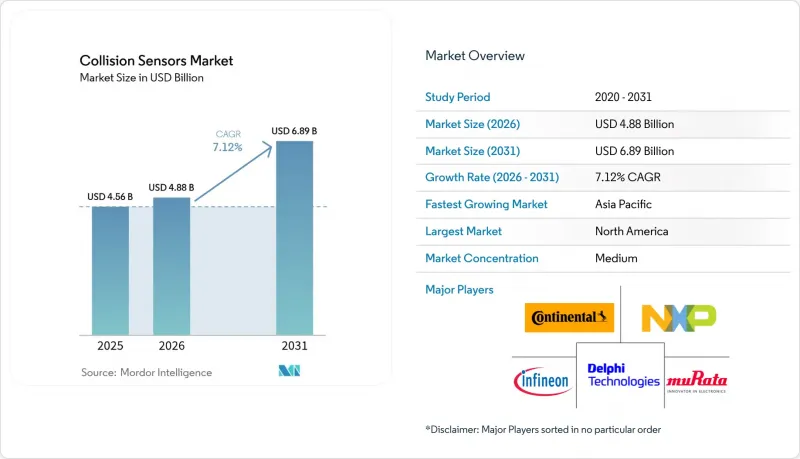
Mordor Intelligence에 의하면, 충돌 센서 시장 규모는 2025년 45억 6,000만 달러에서 2026년에는 48억 8,000만 달러로 확대되어 2026년부터 2031년까지 CAGR 7.12%로 성장을 지속하여, 2031년에는 68억 9,000만 달러에 이를 것으로 예측됩니다.
본 보고서는 용도(어댑티브 크루즈 컨트롤,전방 충돌 경고 등), 기술(초음파, 레이더 등), 최종 사용자(자동차, 항공우주 및 방위, 해양, 철도, 산업용 로봇, 기타 최종 사용자), 차량 자율주행 수준(레벨 0-1, 레벨 2-3, 레벨 4-5), 지역별로 분류되어 있습니다. 시장 예측은 금액(미 달러) 기준으로 제시됩니다.
세계 충돌 센서 시장 동향 및 인사이트
자동차 안전 규제 강화
미국 규제 당국은 2024년 및 2029년까지 신형 승용차에 보행자용 자동 긴급 제동(AEB) 장치의 탑재를 의무화하는 규정을 확정했습니다. 이로 인해 각 OEM 업체들은 열화상 카메라와 근적외선 카메라를 밀리파 레이더와 통합해야 할 필요성이 생겨, 부품 원가(BOM)에 120-180달러의 추가 비용이 발생하고 있습니다. 보험사들은 이러한 투자에 대해 보험료를 8-12% 할인해 주는 방식으로 보상하고 있습니다. Euro NCAP의 2024년 프로토콜에 따르면, 도심 교차로에서 자전거 이용자 보호 기능을 갖추지 않은 모델에는 5성급 평가를 부여하지 않기로 하여, 코너 레이더 도입이 가속화되고 있습니다. 중국의 C-NCAP은 2024년에 ‘취약한 도로 이용자’에 대한 평가 항목을 추가했습니다. 이에 따라 국내 공급업체들은 세단의 가격을 엄격한 상한선 내에 맞추기 위해 저비용 초음파 센서와 레이더를 조합하여 사용하고 있습니다. 인도는 2028년까지 120만 대의 대형 트럭에 전방 충돌 경고 시스템을 사후 장착하도록 의무화하는 방안을 마련한 반면, 일본은 차령 10년 이상인 차량용 애프터마켓 키트에 대해 보조금을 제공합니다.
ADAS 및 자율주행의 급속한 보급
Waymo는 2024년 하반기 로스앤젤레스와 오스틴으로 사업을 확장한 후, 유료 로보택시 탑승 횟수가 200만 회를 돌파했습니다. 이는 센서 군이 장거리 LiDAR와 이미징 레이더를 결합함으로써 레벨 4의 확장성이 입증되었음을 보여줍니다. 테슬라는 카메라에만 의존하는 FSD v12.5를 180만 대의 차량에 탑재했으나, 복잡한 에지 케이스에서의 중복성에 대한 비판이 제기되고 있습니다. 메르세데스-벤츠는 스테레오 카메라와 라이다를 결합해 시속 40마일까지의 속도 범위에서 캘리포니아주 및 네바다주에서 레벨 3 승인을 획득함으로써, 책임 소재를 운전자로부터 자동차 제조업체(OEM)로 이전시켰습니다. 2026년 중국에서 레벨 2 ADAS 의무화로 인해 연간 약 2,800만 대의 차량에 탑재될 예정이며, 이는 화웨이와 데사이에게 독점적인 센서 시장을 확고히 다져줄 것입니다. GM은 2025년에 Mobileye EyeQ6 Lite를 통합하고, 테슬라의 ‘비전 전용’ 전략에 대항하기 위해 200달러 미만의 카메라·레이더 융합 시스템을 목표로 하고 있습니다.
다중 센서 융합으로 인한 높은 부품 원가
레이더·카메라·라이더(LiDAR)의 풀스택은 차량 비용을 600-1,200달러까지 끌어올리기 때문에 가격에 민감한 시장에서의 보급이 제한되고 있습니다. Tier 1 ECU는 고성능 SoC가 필요하기 때문에 ADAS 하드웨어 비용의 최대 45%를 차지하고 있습니다. 마루티 스즈키는 주요 가격 기준을 초과하지 않기 위해 2024년 소형 세단에 레벨 2 ADAS 도입을 연기했습니다. 플릿 구매자들은 적재량이나 연비를 우선시하여 핸즈프리 옵션을 포기하는 경우가 많으며, 스텔란티스에 따르면 남유럽 및 남미 전역의 ADAS 도입률은 15% 미만입니다.
부문 분석
2025년에는 어댑티브 크루즈 컨트롤이 충돌 센서 시장에서 38.35%라는 압도적인 점유율을 차지했지만, 자동 긴급 제동(AEB)은 2031년까지 연평균 성장률(CAGR) 7.71%를 나타낼 것으로 예측됩니다. 보험료의 8-12%에 해당하는 보험 인센티브와 미국 연방 정부의 규제가 도입을 뒷받침하고 있는 반면, 전방 충돌 경고 기능은 대부분의 지역에서 AEB와 함께 계속 제공되고 있습니다. 사각지대 모니터링은 북미 및 유럽에서 이미 60%가 넘는 탑재율을 달성했으나, 이 기능이 기본 사양으로 채택됨에 따라 성장은 둔화되고 있습니다. 초음파식 주차 센서는 서라운드 뷰 카메라의 압박에 직면해 있으며, 공급업체들은 부가가치를 유지하기 위해 자동 주차 소프트웨어를 추가하는 방식으로 대응하고 있습니다.
보행자 및 자전거 이용자 감지를 포함한 기타 첨단 기능들은 인구 밀도가 높은 도시 시장에서 빠르게 보급되고 있습니다. 유로 NCAP의 이륜차 교차로 보호에 관한 평가 기준에 따라, 각 OEM 업체들은 코너 레이더 및 광각 카메라 탑재를 피할 수 없게 되었습니다. 볼보의 ‘시티 세이프티(City Safety)’ 시스템은 보험 청구 건수를 28% 감소시켜, 취약한 도로 이용자를 보호하는 솔루션의 투자 수익률(ROI)을 입증했습니다. 덴소의 소형 레이더 모듈은 인도의 거대한 이륜차 시장을 겨냥하여 새로운 인접 시장을 개척하고 있습니다.
레이더는 연중 내내 유지되는 신뢰성과 성숙한 공급 체계를 바탕으로 2025년에도 매출의 62.15%를 차지했으나, 500달러 미만의 솔리드 스테이트형 LiDAR 유닛이 양산차 등급에서도 도입 가능해짐에 따라,라이더(LiDAR)의 예상 연평균 성장률(CAGR) 8.45%가 점차 시장 점유율을 빼앗아 갈 것으로 전망됩니다. 카메라는 고해상도 CMOS 센서의 혜택을 받고 있지만, 저조도 환경에 대한 내성이 여전히 낮아 레벨 2를 초과하는 단독 사용에는 한계가 있습니다. 초음파 센서는 저렴한 비용 덕분에 저속 주행 시 조작에서 여전히 주류를 이루고 있습니다. 야간 보행자 감지용 적외선 모듈과 수동 안전 및 능동 안전 간의 격차를 메우는 MEMS 압력 센서가 틈새 시장의 성장을 견인하고 있습니다.
보쉬는 SiGe 트랜시버와 AIP(Antenna-in-Package) 설계를 활용하여 2024년에 1억 대 이상의 레이더 유닛을 출하했습니다. 콘티넨탈의 5세대 단거리 레이더는 2026년까지 4도 방위 분해능을 40달러 미만의 가격대로 실현할 것으로 예측됩니다. 옴니비전은 140dB의 다이나믹 레인지를 갖춘 5MP 센서를 출시하여 터널 출구에서의 성능을 향상시켰습니다. 무라타 제작소는 중국 전기차 시장에 대응하기 위해 초음파 출력을 40% 향상시켰습니다.
지역별 분석
북미는 2025년 매출의 45.20%를 차지했습니다. 이는 AEB(자동 긴급 제동)의 의무화와 고급차의 보급으로 인해 세계 최대의 충돌 센서 시장이 형성되었기 때문입니다. 소비자들은 레벨 2 플러스 기능 패키지에 대해 1,500-2,500달러를 지불할 의향이 있으며, 보험사들도 전방 충돌 경고 시스템을 도입한 차량에 대해 보험료를 할인해 주고 있습니다. 캐나다는 2028년 도입 기한을 앞두고 NHTSA(미국 도로교통안전국)의 기준에 자국의 기준을 맞추고 있는 반면, 멕시코에서는 안전 의식이 높아짐에 따라 국내 판매가 증가하고 있습니다. 반도체 부족이 지속되는 가운데, 공급 할당량은 계속해서 해당 지역의 프리미엄 자동차 제조업체에 우선적으로 배분되고 있으며, 이를 통해 공급 회복력이 강화되고 있습니다.
아시아태평양은 연평균 성장률(CAGR) 8.16%를 나타낼 것으로 예측되며, 지역별로는 가장 높은 성장률을 보일 것입니다. 중국에서 2026년에 시행될 레벨 2 의무화는 연간 2,800만 대의 차량에 영향을 미치며, 국내 레이더 및 카메라 공급업체들에게 대규모 고정 고객 기반을 확보해 줄 것입니다. 인도는 2028년까지 120만 대의 대형 트럭에 전방 충돌 경고 시스템을 사후 장착할 계획이며, 6개의 에어백을 장착해야 한다는 규정에 따라 이미 차량당 센서 탑재 수는 증가하고 있습니다. 일본, 한국, 대만은 광학 및 패키징 기술 노하우를 활용해 라이더(LiDAR) 모듈 수출을 확대되고 있습니다. 한편, 아세안(ASEAN) 국가들은 초음파식 주차 센서부터 도입을 시작해, 이후 기술 수준을 단계적으로 높여갈 전망입니다.
유럽은 유로 NCAP의 영향력 있는 5성급 평가 기준과 2024년 이후 모든 신차에 AEB(자동 긴급 제동) 및 차선 유지 보조 시스템의 탑재를 의무화하는 EU 일반 안전 규정을 배경으로, 2025년에는 약 27%의 점유율을 확보했습니다. 독일의 주요 공급업체인 보쉬, 콘티넨탈, ZF 3사는 수직 통합을 통해 지역 내 부가가치를 유지하고 있습니다. 네덜란드에서는 2,000km에 달하는 고속도로에서 V2X 협업 지각의 시범 운영이 진행되고 있는 반면, 프랑스와 이탈리아에서는 첨단 안전 기능의 탑재를 의무화하는 전기차 인센티브 제도를 확충하고 있습니다.
남미에 더해 중동 및 아프리카는 매출의 10% 미만을 차지하는 신흥 시장을 형성하고 있습니다. 브라질에서는 전자식 안정성 제어(ESC)와 후방 카메라의 탑재가 의무화되어 있어, 향후 충돌 센서의 보급을 위한 기반이 마련되어 있습니다. 걸프 국가들에서는 스마트 시티 시범 사업에 프리미엄 센서 제품군이 도입되고 있으며, 남아프리카공화국에서는 주로 유럽 수출용 모델에 센서가 탑재되고 있습니다.
기타 혜택:
- 엑셀 형식 시장 예측(ME) 시트
- 3개월간의 애널리스트 지원
자주 묻는 질문
목차
제1장 서론
제2장 조사 방법
제3장 주요 요약
제4장 시장 구도
제5장 시장 규모와 성장 예측
제6장 경쟁 구도
제7장 시장 기회와 향후 전망
JHS 26.09.03According to Mordor Intelligence, the collision sensors market size is expected to grow from USD 4.56 billion in 2025 to USD 4.88 billion in 2026 and is forecast to reach USD 6.89 billion by 2031 at 7.12% CAGR over 2026-2031.
This report is Segmented by Application (Adaptive Cruise Control, Forward Collision Warning, and More), Technology (Ultrasonic, Radar, and More), End-User (Automotive, Aerospace and Defense, Maritime, Rail, Industrial Robotics, and Other End-Users), Vehicle Autonomy Level (Level 0-1, Level 2-3, and Level 4-5), and Geography. The Market Forecasts are Provided in Terms of Value (USD).
Global Collision Sensors Market Trends and Insights
Enhanced Automotive Safety Regulations
Regulators in the United States finalized a rule in 2024 that requires pedestrian AEB on new passenger vehicles by 2029, prompting OEMs to integrate thermal or near-infrared cameras with millimeter-wave radar, incurring an additional USD 120-180 in bill-of-materials costs. Insurers reward this investment through 8-12% premium discounts. Euro NCAP's 2024 protocol withholds five-star ratings from models lacking cyclist protection at urban intersections, accelerating the rollout of corner radar. China's C-NCAP added vulnerable-road-user scoring in 2024, prompting domestic suppliers to combine low-cost ultrasonic sensors with radar to keep sedans under strict price ceilings. India drafted mandates that retrofit 1.2 million heavy trucks with forward-collision warning by 2028, while Japan subsidizes aftermarket kits for vehicles older than 10 years.
Rapid ADAS and Autonomous-Driving Rollout
Waymo surpassed 2 million paid robotaxi rides after expanding to Los Angeles and Austin in late 2024, proving Level 4 scalability once sensor suites marry long-range LiDAR with imaging radar. Tesla shipped FSD v12.5 to 1.8 million cars, relying on cameras only, but critics question redundancy during complex edge cases. Mercedes-Benz secured Level 3 approval in California and Nevada using stereo cameras plus LiDAR at speeds up to 40 mph, shifting liability from driver to OEM. China's 2026 Level 2 ADAS mandate equips roughly 28 million vehicles annually, solidifying a captive sensor market for Huawei and Desay. GM's 2025 integration of Mobileye EyeQ6 Lite targets sub-USD 200 camera-radar fusion to counter Tesla's vision-only path
High BOM Cost for Multi-Sensor Fusion
Full radar-camera-LiDAR stacks add USD 600-1,200 to vehicles, limiting penetration in price-sensitive markets. Tier-one ECUs account for up to 45% of ADAS hardware cost because they need high-performance SoCs. Maruti Suzuki postponed Level 2 ADAS on compact sedans in 2024 to avoid breaching key price thresholds. Fleet buyers often forgo hands-free options in favor of payload and fuel economy, and Stellantis reported sub-15% ADAS take-up across Southern Europe and South America.
Other drivers and restraints analyzed in the detailed report include:
- Falling Solid-State LiDAR Cost Curve
- V2X-Enabled Predictive Collision Alert
- Reliability Limits in Snow, Fog and Debris
For complete list of drivers and restraints, kindly check the Table Of Contents.
Segment Analysis
In 2025, adaptive cruise control commanded a dominant 38.35% share of the collision sensors market, while automatic emergency braking is projected to grow at an 7.71% CAGR, continuing through 2031. Insurance incentives worth 8-12% of premiums and U.S. federal mandates catalyze uptake, while forward-collision warning remains bundled with AEB in most regions. Blind-spot monitoring already exceeds a 60% fitment rate in North America and Europe, but growth is slowing now that the feature is standard. Ultrasonic parking sensors face pressure from surround-view cameras, suppliers react by adding automated-parking software to preserve value.
Other advanced functions, including pedestrian and cyclist detection, are rapidly gaining popularity in dense urban markets. Euro NCAP credits for motorcycle intersection protection force OEMs to integrate corner radar and wide-angle cameras. Volvo's City Safety system cut insurance claims by 28%, validating ROI for vulnerable-road-user solutions. Denso's compact radar module targets India's vast two-wheeler market, opening up a new adjacency.
Radar retained 62.15% revenue in 2025 thanks to year-round reliability and supply maturity, but LiDAR's 8.45% forecast CAGR will chip away as sub-USD 500 solid-state units become attainable for mass-market trims. Cameras gain from high-resolution CMOS sensors yet remain sensitive to low light, limiting solo use beyond Level 2. Ultrasonic sensors continue to dominate low-speed maneuvers due to their low cost. Infrared modules for night pedestrian detection and MEMS pressure sensors, which bridge the gap between passive and active safety, drive niche growth.
Bosch shipped more than 100 million radar units in 2024, leveraging SiGe transceivers and antenna-in-package designs. Continental's fifth-generation short-range radar is expected to deliver 4-degree azimuth resolution at a sub-USD 40 price point by 2026. Omnivision launched a 5MP sensor with 140 dB dynamic range, improving tunnel-exit performance. Murata raised the ultrasonic output 40% to serve Chinese EVs
Complete Report Scope:
- By Application
- Adaptive Cruise Control
- Forward Collision Warning
- Blind Spot Monitoring
- Lane Departure Warning
- Parking Sensors
- Rear Cross-Traffic Alert
- Automatic Emergency Braking
- Other Applications
- By Technology
- Ultrasonic
- Radar
- Camera / Vision
- LiDAR
- Infra-red
- Pressure / MEMS
- By End-User
- Automotive
- Passenger Vehicles
- Light Commercial Vehicles
- Heavy Commercial Vehicles
- Aerospace and Defense
- Maritime
- Rail
- Industrial Robotics
- Other End-Users
- Automotive
- By Vehicle Autonomy Level
- Level 0-1
- Level 2-3
- Level 4-5
- By Geography
- North America
- United States
- Canada
- Mexico
- South America
- Brazil
- Argentina
- Rest of South America
- Europe
- Germany
- United Kingdom
- France
- Netherlands
- Rest of Europe
- Asia-Pacific
- China
- India
- Japan
- South Korea
- Rest of Asia-Pacific
- Middle East and Africa
- Middle East
- Saudi Arabia
- United Arab Emirates
- Rest of Middle East
- Africa
- South Africa
- Nigeria
- Rest of Africa
- Middle East
- North America
Geography Analysis
North America contributed 45.20% of the 2025 revenue, as AEB mandates and premium-vehicle penetration created the world's largest collision sensor market. Consumers are willing to pay USD 1,500-2,500 for Level 2-plus bundles, and insurers reward forward-collision warning systems with lower premiums. Canada aligns its standards with those of the NHTSA for a 2028 deadline, while Mexico's domestic sales grow as safety awareness increases. Semiconductor allocations continue to favor the region's premium OEMs during shortages, thereby reinforcing supply resilience.
The Asia-Pacific region is set for an 8.16% CAGR, the highest regional growth rate. China's 2026 Level 2 mandate affects 28 million annual vehicles, ensuring a large captive base for domestic radar and camera suppliers. India plans to retrofit 1.2 million heavy trucks with forward-collision warning systems by 2028, and the six-airbag rules have already lifted the sensor content per vehicle. Japan, South Korea and Taiwan exploit optics and packaging expertise to export LiDAR modules, while ASEAN nations start with ultrasonic parking sensors before ascending the technology ladder.
Europe captured roughly 27% share in 2025 on the back of Euro NCAP's influential five-star criteria and the EU General Safety Regulation that requires AEB and lane-keeping assist on all new models from 2024 onward. Germany's supplier triad, Bosch, Continental and ZF, keeps value in-region through vertical integration. The Netherlands pilots V2X cooperative perception across 2,000 km of highways, while France and Italy expand electric-vehicle incentives that also mandate advanced safety functions.
South America plus the Middle East and Africa form a nascent market below 10% revenue. Brazil enforces electronic stability control and rear cameras, positioning for future collision-sensor uptake. Gulf states deploy premium sensor suites in smart-city pilots, and South Africa installs sensors mainly for export models bound for Europe.
- Continental AG
- Bosch GmbH
- Denso Corp.
- ZF Friedrichshafen AG
- Aptiv plc
- NXP Semiconductors N.V.
- Infineon Technologies AG
- Texas Instruments Inc.
- Murata Manufacturing Co.
- Aisin Corporation
- Delphi Automotive LLP
- Analog Devices Inc.
- Mobileye Global Inc.
- Velodyne LiDAR Inc.
- Hesai Technology
- Magna International Inc.
- Valeo SA
- Renesas Electronics
- Panasonic Corp.
- Omnivision Technologies
Additional Benefits:
- The market estimate (ME) sheet in Excel format
- 3 months of analyst support
TABLE OF CONTENTS
1 INTRODUCTION
- 1.1 Study Assumptions and Market Definition
- 1.2 Scope of the Study
2 RESEARCH METHODOLOGY
3 EXECUTIVE SUMMARY
4 MARKET LANDSCAPE
- 4.1 Market Overview
- 4.2 Market Drivers
- 4.2.1 Enhanced Automotive Safety Regulations
- 4.2.2 Rapid ADAS And Autonomous-Driving Rollout
- 4.2.3 Falling Solid-State Lidar Cost Curve
- 4.2.4 V2X-Enabled Predictive Collision Alert
- 4.2.5 Electrified-Vehicle Production Surge
- 4.2.6 Military Retro-Fit Programs For Legacy Fleets
- 4.3 Market Restraints
- 4.3.1 High BOM Cost For Multi-Sensor Fusion
- 4.3.2 Reliability Limits In Snow, Fog and Debris
- 4.3.3 Semiconductor Supply-Chain Volatility
- 4.3.4 Cyber-Security Exposure Of Sensor Networks
- 4.4 Value Chain Analysis
- 4.5 Regulatory Landscape
- 4.6 Technological Outlook
- 4.7 Porter's Five Forces Analysis
- 4.7.1 Threat of New Entrants
- 4.7.2 Bargaining Power of Buyers
- 4.7.3 Bargaining Power of Suppliers
- 4.7.4 Threat of Substitutes
- 4.7.5 Intensity of Competitive Rivalry
- 4.8 Investment Analysis
5 MARKET SIZE AND GROWTH FORECASTS (VALUE)
- 5.1 By Application
- 5.1.1 Adaptive Cruise Control
- 5.1.2 Forward Collision Warning
- 5.1.3 Blind Spot Monitoring
- 5.1.4 Lane Departure Warning
- 5.1.5 Parking Sensors
- 5.1.6 Rear Cross-Traffic Alert
- 5.1.7 Automatic Emergency Braking
- 5.1.8 Other Applications
- 5.2 By Technology
- 5.2.1 Ultrasonic
- 5.2.2 Radar
- 5.2.3 Camera / Vision
- 5.2.4 LiDAR
- 5.2.5 Infra-red
- 5.2.6 Pressure / MEMS
- 5.3 By End-User
- 5.3.1 Automotive
- 5.3.1.1 Passenger Vehicles
- 5.3.1.2 Light Commercial Vehicles
- 5.3.1.3 Heavy Commercial Vehicles
- 5.3.2 Aerospace and Defense
- 5.3.3 Maritime
- 5.3.4 Rail
- 5.3.5 Industrial Robotics
- 5.3.6 Other End-Users
- 5.3.1 Automotive
- 5.4 By Vehicle Autonomy Level
- 5.4.1 Level 0-1
- 5.4.2 Level 2-3
- 5.4.3 Level 4-5
- 5.5 By Geography
- 5.5.1 North America
- 5.5.1.1 United States
- 5.5.1.2 Canada
- 5.5.1.3 Mexico
- 5.5.2 South America
- 5.5.2.1 Brazil
- 5.5.2.2 Argentina
- 5.5.2.3 Rest of South America
- 5.5.3 Europe
- 5.5.3.1 Germany
- 5.5.3.2 United Kingdom
- 5.5.3.3 France
- 5.5.3.4 Netherlands
- 5.5.3.5 Rest of Europe
- 5.5.4 Asia-Pacific
- 5.5.4.1 China
- 5.5.4.2 India
- 5.5.4.3 Japan
- 5.5.4.4 South Korea
- 5.5.4.5 Rest of Asia-Pacific
- 5.5.5 Middle East and Africa
- 5.5.5.1 Middle East
- 5.5.5.1.1 Saudi Arabia
- 5.5.5.1.2 United Arab Emirates
- 5.5.5.1.3 Rest of Middle East
- 5.5.5.2 Africa
- 5.5.5.2.1 South Africa
- 5.5.5.2.2 Nigeria
- 5.5.5.2.3 Rest of Africa
- 5.5.5.1 Middle East
- 5.5.1 North America
6 COMPETITIVE LANDSCAPE
- 6.1 Market Concentration
- 6.2 Strategic Moves
- 6.3 Market Share Analysis
- 6.4 Company Profiles (includes Global level Overview, Market level overview, Core Segments, Financials as available, Strategic Information, Market Rank/Share, Products and Services, Recent Developments)
- 6.4.1 Continental AG
- 6.4.2 Bosch GmbH
- 6.4.3 Denso Corp.
- 6.4.4 ZF Friedrichshafen AG
- 6.4.5 Aptiv plc
- 6.4.6 NXP Semiconductors N.V.
- 6.4.7 Infineon Technologies AG
- 6.4.8 Texas Instruments Inc.
- 6.4.9 Murata Manufacturing Co.
- 6.4.10 Aisin Corporation
- 6.4.11 Delphi Automotive LLP
- 6.4.12 Analog Devices Inc.
- 6.4.13 Mobileye Global Inc.
- 6.4.14 Velodyne LiDAR Inc.
- 6.4.15 Hesai Technology
- 6.4.16 Magna International Inc.
- 6.4.17 Valeo SA
- 6.4.18 Renesas Electronics
- 6.4.19 Panasonic Corp.
- 6.4.20 Omnivision Technologies
7 MARKET OPPORTUNITIES AND FUTURE OUTLOOK
- 7.1 White-space and Unmet-Need Assessment