

|
시장보고서
상품코드
2114553
단장증후군 : 시장 점유율 분석, 업계 동향 및 통계, 성장 예측(2026-2031년)Short Bowel Syndrome - Market Share Analysis, Industry Trends & Statistics, Growth Forecasts (2026 - 2031) |
||||||
 Mordor Intelligence
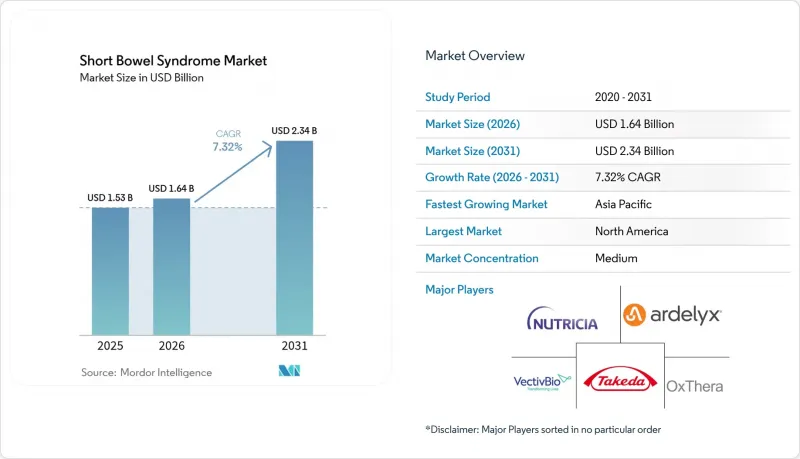
Mordor Intelligence에 의하면, 단장증후군 시장 규모는 2025년 15억 3,000만 달러로 평가되었습니다. 2026년에는 16억 4,000만 달러로 확대되어 2026년부터 2031년에 걸쳐 CAGR 7.32%로 성장을 지속하여, 2031년까지 23억 4,000만 달러에 이를 것으로 예측됩니다.
본 보고서는 약물 분류별(GLP-2 아날로그, 성장 호르몬, 글루타민, 기타), 유통 채널별(병원 약국, 소매 약국, 온라인 및 기타), 환자 연령대별(성인, 소아), 그리고 지역별로 분류되어 있습니다. 본 보고서에서는 상기 각 부문 시장 규모를 제시하고 있습니다.
세계의 단장증후군 시장 동향 및 인사이트
SBS 유병률 증가와 복잡한 소화기 외과 수술
신생아 외과 의료의 발전으로 극저체중아의 생존율은 향상되었지만, 한편으로 최근 코호트에서는 NICU(신생아 중환자실) 입원 1,000건당 22.1건의 신생아 SBS 발생률을 보이고 있습니다. 성인의 발병률도 같은 이유로 증가하고 있습니다. 암 및 염증성 장 질환에 대한 절제술은 현재 더 근치적인 방식으로 이루어지고 있어 생명을 구할 수는 있지만, 장의 길이가 짧아지고 있습니다. 2023년 CMS(미국 의료보험서비스센터)의 코딩 변경으로 인해 이러한 추가 사례가 가시화되었고, 조기 의뢰가 촉진되며 신규 치료제에 대한 수요가 자극받고 있습니다.
GLP-2 아날로그의 신속 승인 및 보급
FDA는 테두글루티드의 적응증을 1세 이상 소아로 확대하고, 아프라글루티드나 소네프페글루티드와 같은 신규 분자에 패스트트랙 지정을 부여함으로써, 혁신과 접근성이 선순환을 만들어내고 있습니다. 다케다(Takeda)의 가텍스(Gatex)/레베스티브(Revestive)는 2024 회계연도에 전년 대비 28.1% 증가한 1,193억 엔의 매출을 기록했습니다. 한편, Zealand Pharma사의 그레파글루티드는 2024년 12월에 완전 답변서(CRL)를 수령하여, 시장 규제 측면에서의 변동성이 극심함을 여실히 드러냈습니다.
저·중소득국(LMIC)의 고액 치료비와 제한된 접근성
정맥영양(PN), 모니터링, 합병증 관리를 고려하면 환자 1인당 연간 총 치료비는 4만 3,000달러를 초과합니다. 많은 저·중소득국(LMIC)의 의료 제도에서는 GLP-2 아날로그에 대한 보험 급여 체계나 콜드체인 물류가 정비되어 있지 않습니다. 제약사들은 단계적 가격 책정을 시도하고 있지만, 인프라 측면의 제약은 여전히 존재하여 저비용 펩타이드 제제나 간소화된 경정맥영양(PN) 요법에 대한 관심이 높아지고 있습니다.
부문별 분석
2025년, GLP-2 아날로그는 단장증후군 시장의 95.72%를 차지했으며, 이는 테두글루티드의 탄탄한 증거 기반에 힘입은 결과입니다. 성장 호르몬 요법은 절대 매출 규모는 작지만, 소아과 전문의들이 점막 적응증을 촉진하기 위해 이를 채택하고 있기 때문에 2031년까지 연평균 성장률(CAGR) 7.94%로 성장할 전망입니다. 아프라글루티드나 소네프페글루티드와 같이 주 1회 또는 월 1회 투여가 가능한 GLP-2 후보 약물은 주사 투여의 부담을 줄이는 것을 목표로 하고 있습니다. 한편, OPKO Health와 Entera Bio는 최초의 경구용 GLP-2 펩타이드를 개발 중이며, 이러한 변화로 인해 유지 요법 분야의 단장증후군 시장 규모가 재편될 가능성이 있습니다. 현재 경쟁사와의 차별화는 투여 편의성, 안전성, 그리고 경장영양(PN)의 점진적 감축에 관한 데이터에 초점이 맞추어져 있으며, 이는 지불자의 수용을 확보하고 높은 가격 책정을 정당화하기 위해 필수적입니다.
향후 보급 여부는 지속적인 PN 감소와 관리 가능한 대장내시경 검사를 통한 경과 관찰을 보여주는 실세계 데이터에 달려 있습니다. 차세대 분자가 유사한 효능을 보임과 동시에 용종 발생을 감소시키는 것으로 확인된다면, 단장증후군 시장은 급격히 변화하여 현재 GLP-2에 의한 과점 상태가 무너질 가능성이 있습니다. 반대로, 이 계열 전체에 걸쳐 안전성 우려가 제기될 경우, 투자는 재생의학이나 유전자 편집 치료로 이동할 가능성이 있습니다.
지역별 분석
북미는 2025년 단장증후군 시장의 42.05%를 차지했습니다. 이는 전문 장 기능 부전 센터, 메디케어(Medicare)의 PN(정맥영양요법) 급여, 그리고 GLP-2 유사체에 대한 조기 접근이 뒷받침된 결과입니다. CMS의 코딩 업데이트와 민간 보험의 적용 범위 확대로 인해 치료의 가시성과 재정적 실행 가능성은 확보되었으나, 지급 기관의 기준은 여전히 엄격하며, 일부 보험 플랜에서는 12개월간의 PN 의존 증명을 요구하고 있습니다.
유럽에서는 통합된 치료 네트워크와 조화로운 지침을 통해 일정한 규모가 유지되고 있습니다. NICE의 테두글루티드에 대한 상업적 합의와 ESPEN의 다직종 협력 기준이 프레임워크를 제공하여 치료의 편차를 줄이고 있습니다. 또한, EU의 임상 컨소시엄은 인간을 대상으로 한 최초의 조직공학 임상시험을 추진하고 있어, 해당 지역의 혁신에 대한 기여도를 높이고 있습니다.
아시아태평양은 중국의 규제 현대화와 대장암 발병률 상승에 따른 절제 수술 건수 증가에 힘입어, 2031년까지 연평균 성장률(CAGR) 8.96%로 가장 빠르게 성장하는 지역입니다. 2023년 중국에서 시행된 특수 의료용 조제분유에 관한 규제로 인해 영양 균형이 뛰어난 경장영양제의 접근성이 확대되어, 정맥영양(PN) 및 약물 요법을 보완하는 형태로 자리 잡고 있습니다. 일본이 아프라글루티드의 세계 임상시험에 참여하고 있는 점은 해당 지역이 주요 임상시험에 포함되어 있음을 보여주는 대표적인 사례이며, 신약 승인까지의 기간을 단축시키고 있습니다.
기타 혜택 :
- 엑셀 형식 시장 예측(ME) 시트
- 3개월간의 애널리스트 지원
자주 묻는 질문
목차
제1장 서론
제2장 조사 방법
제3장 주요 요약
제4장 시장 구도
제5장 시장 규모 및 성장 예측
제6장 경쟁 구도
제7장 시장 기회 및 향후 전망
KTH 26.08.28According to Mordor Intelligence, the short bowel syndrome market size is expected to grow from USD 1.53 billion in 2025 to USD 1.64 billion in 2026 and is forecast to reach USD 2.34 billion by 2031 at 7.32% CAGR over 2026-2031.
This report is Segmented by Drug Class (GLP-2, Growth Hormone, Glutamine, Others), Distribution Channel (Hospital Pharmacies, Retail Pharmacies, Others), Patient Age Group (Adults and Pediatrics) and Geography. The Market Provides the Value (in USD Million) for the Above-Mentioned Segments.
Global Short Bowel Syndrome Market Trends and Insights
Rising Prevalence of SBS & Complex GI Surgeries
Neonatal surgical advances have lifted survival in very low birth-weight infants, yet they have also pushed neonatal SBS incidence to 22.1 per 1,000 NICU admissions in recent cohorts . Adult incidence is rising for similar reasons: oncologic and inflammatory bowel resections are now more radical, preserving life but shortening bowel length. CMS coding changes in 2023 created visibility for these additional cases, encouraging earlier referrals and stimulating demand for novel therapeutics.
Accelerated Approvals & Uptake of GLP-2 Analogs
The FDA expanded teduglutide to children aged >=1 year and granted fast-track status to newer molecules such as apraglutide and sonefpeglutide, creating a virtuous cycle of innovation and access. Takeda's Gattex/Revestive posted JPY 119.3 billion sales in fiscal 2024, up 28.1% year over year . Conversely, Zealand Pharma's glepaglutide received a Complete Response Letter in December 2024, highlighting the market's regulatory volatility.
High Therapy Cost & Limited Access in LMICs
Total annual therapy costs exceed USD 43,000 per patient when factoring PN, monitoring, and complication management. Many LMIC health systems lack reimbursement frameworks or the cold-chain logistics for GLP-2 analogs. Manufacturers are experimenting with tiered pricing, but infrastructure constraints persist, motivating interest in low-cost peptides or simplified PN regimens.
Other drivers and restraints analyzed in the detailed report include:
- Orphan-Drug Incentives & Favorable Reimbursement
- Global Patient-Registry & NGO Awareness Initiatives
- Tissue-Engineered Intestine R&D Breakthroughs
- Serious Long-Term Safety Concerns (e.g., Neoplasia)
For complete list of drivers and restraints, kindly check the Table Of Contents.
Segment Analysis
GLP-2 analogs accounted for 95.72% of the Short Bowel Syndrome market in 2025, propelled by teduglutide's robust evidence base. Growth hormone therapies, though smaller in absolute sales, are set for 7.94% CAGR through 2031 as pediatric specialists employ them to spur mucosal adaptation. Weekly and monthly GLP-2 candidates like apraglutide and sonefpeglutide seek to reduce injection burden, whereas OPKO Health and Entera Bio are developing the first oral GLP-2 peptide, a shift that could reposition the Short Bowel Syndrome market size for maintenance therapy. Competitive differentiation now centers on dosing convenience, safety, and incremental PN-reduction data to secure payer acceptance and justify premium prices.
Future uptake will hinge on real-world evidence showing durable PN reduction and manageable colonoscopic surveillance. If next-generation molecules confirm similar efficacy with fewer polyps, the Short Bowel Syndrome market could migrate quickly, fragmenting the current GLP-2 oligopoly. Conversely, any class-wide safety signal could redirect investment toward regenerative or gene-editing modalities.
Complete Report Scope:
- By Drug Class
- GLP-2 Analogues
- Growth Hormone
- Glutamine
- Others
- By Distribution Channel
- Hospital Pharmacies
- Retail Pharmacies
- Online & Others
- By Patient Age Group
- Adults (>=18 yrs)
- Pediatrics (<18 yrs)
- By Geography
- North America
- United States
- Canada
- Mexico
- Europe
- Germany
- United Kingdom
- France
- Italy
- Spain
- Rest of Europe
- Asia-Pacific
- China
- Japan
- India
- Australia
- South Korea
- Rest of Asia-Pacific
- Middle East & Africa
- GCC
- South Africa
- Rest of Middle East & Africa
- South America
- Brazil
- Argentina
- Rest of South America
- North America
Geography Analysis
North America generated 42.05% of the Short Bowel Syndrome market in 2025, supported by specialized intestinal-failure centers, Medicare PN reimbursement, and early access to GLP-2 analogs. CMS coding updates and commercial coverage expansions ensure treatment visibility and financial viability, yet payer criteria remain stringent and require documentation of 12-month PN dependence in some plans.
Europe retains critical mass through centralized care networks and harmonized guidelines. NICE's commercial arrangement for teduglutide and ESPEN's multidisciplinary standards provide structure and reduce therapeutic variability. EU clinical consortia also drive first-in-human tissue-engineering trials, strengthening the region's innovation footprint.
Asia-Pacific is the fastest-growing territory at 8.96% CAGR through 2031, driven by regulatory modernization in China and increased resection volumes tied to rising colorectal cancer incidence. China's 2023 regulations on special-medical-purpose formula expand access to nutritionally balanced enteral feeds, complementing PN and pharmacotherapy. Japan's inclusion in global apraglutide trials exemplifies the region's integration into pivotal studies, accelerating time-to-approval for novel agents.
- Takeda Pharmaceuticals
- Zealand Pharma
- VectivBio
- Ironwood Pharmaceuticals
- OxThera AB
- Nutrinia Ltd.
- Merck
- Ardelyx Inc.
- Nestle Health Science
- Hanmi Pharmaceutical
- 9 Meters Biopharma
- Opko Health
- Jaguar Health
- Pfizer
- Abbvie
- Kyowa Kirin
- Johnson & Johnson
Additional Benefits:
- The market estimate (ME) sheet in Excel format
- 3 months of analyst support
TABLE OF CONTENTS
1 Introduction
- 1.1 Study Assumptions & Market Definition
- 1.2 Scope of the Study
2 Research Methodology
3 Executive Summary
4 Market Landscape
- 4.1 Market Overview
- 4.2 Market Drivers
- 4.2.1 Rising prevalence of SBS & complex GI surgeries
- 4.2.2 Accelerated approvals & uptake of GLP-2 analogs
- 4.2.3 Orphan-drug incentives & favourable reimbursement
- 4.2.4 Global patient-registry & NGO awareness initiatives
- 4.2.5 Tissue-engineered intestine R&D breakthroughs
- 4.2.6 Remote PN-monitoring digital platforms
- 4.3 Market Restraints
- 4.3.1 High therapy cost & limited access in LMICs
- 4.3.2 Serious long-term safety concerns (e.g., neoplasia)
- 4.3.3 Peptide-manufacturing supply-chain bottlenecks
- 4.3.4 Disruptive competition from microbiome & surgical innovations
- 4.4 Value / Supply-Chain Analysis
- 4.5 Regulatory Landscape
- 4.6 Technological Outlook
- 4.7 Porter's Five Forces Analysis
- 4.7.1 Threat of New Entrants
- 4.7.2 Bargaining Power of Buyers
- 4.7.3 Bargaining Power of Suppliers
- 4.7.4 Threat of Substitutes
- 4.7.5 Competitive Rivalry
5 Market Size & Growth Forecasts (Value)
- 5.1 By Drug Class
- 5.1.1 GLP-2 Analogues
- 5.1.2 Growth Hormone
- 5.1.3 Glutamine
- 5.1.4 Others
- 5.2 By Distribution Channel
- 5.2.1 Hospital Pharmacies
- 5.2.2 Retail Pharmacies
- 5.2.3 Online & Others
- 5.3 By Patient Age Group
- 5.3.1 Adults (>=18 yrs)
- 5.3.2 Pediatrics (<18 yrs)
- 5.4 By Geography
- 5.4.1 North America
- 5.4.1.1 United States
- 5.4.1.2 Canada
- 5.4.1.3 Mexico
- 5.4.2 Europe
- 5.4.2.1 Germany
- 5.4.2.2 United Kingdom
- 5.4.2.3 France
- 5.4.2.4 Italy
- 5.4.2.5 Spain
- 5.4.2.6 Rest of Europe
- 5.4.3 Asia-Pacific
- 5.4.3.1 China
- 5.4.3.2 Japan
- 5.4.3.3 India
- 5.4.3.4 Australia
- 5.4.3.5 South Korea
- 5.4.3.6 Rest of Asia-Pacific
- 5.4.4 Middle East & Africa
- 5.4.4.1 GCC
- 5.4.4.2 South Africa
- 5.4.4.3 Rest of Middle East & Africa
- 5.4.5 South America
- 5.4.5.1 Brazil
- 5.4.5.2 Argentina
- 5.4.5.3 Rest of South America
- 5.4.1 North America
6 Competitive Landscape
- 6.1 Market Concentration
- 6.2 Market Share Analysis
- 6.3 Company Profiles (includes Global level Overview, Market level overview, Core Segments, Financials as available, Strategic Information, Market Rank/Share for key companies, Products & Services, and Recent Developments)
- 6.3.1 Takeda Pharmaceutical Co. Ltd.
- 6.3.2 Zealand Pharma
- 6.3.3 VectivBio AG
- 6.3.4 Ironwood Pharmaceuticals
- 6.3.5 OxThera AB
- 6.3.6 Nutrinia Ltd.
- 6.3.7 Merck KGaA
- 6.3.8 Ardelyx Inc.
- 6.3.9 Nestle Health Science
- 6.3.10 Hanmi Pharmaceutical
- 6.3.11 9 Meters Biopharma
- 6.3.12 OPKO Health Inc.
- 6.3.13 Jaguar Health
- 6.3.14 Pfizer Inc.
- 6.3.15 AbbVie Inc.
- 6.3.16 Kyowa Kirin
- 6.3.17 Johnson & Johnson (Janssen)
7 Market Opportunities & Future Outlook
- 7.1 White-space & Unmet-need Assessment


