

|
시장보고서
상품코드
2114559
뇌 체성 산소포화도 측정기 : 시장 점유율 분석, 업계 동향 및 통계, 성장 예측(2026-2031년)Cerebral Somatic Oximeters - Market Share Analysis, Industry Trends & Statistics, Growth Forecasts (2026 - 2031) |
||||||
 Mordor Intelligence
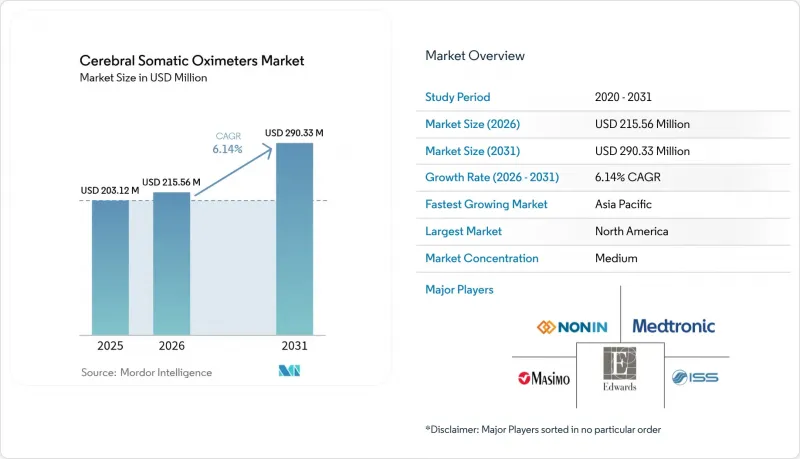
Mordor Intelligence에 의하면, 뇌 체성 산소포화도 측정기 시장 규모는 2025년에 2억 312만 달러로 평가되었습니다. 2026년 2억 1,556만 달러에서 2031년까지 2억 9,033만 달러에 이를 것으로 예상되며, 예측 기간(2026-2031년) CAGR은 6.14%를 나타낼 전망입니다.
본 보고서는 유형별(듀얼 이미터·듀얼 검출기, 싱글 이미터·듀얼 검출기, 기타), 용도별(심장 외과 수술 등), 환자 유형별(신생아, 소아, 성인),최종 사용자별(병원 및 클리닉 등), 지역별(북미, 유럽, 아시아태평양, 중동 및 아프리카, 남미)로 분류되어 있습니다. 시장 예측은 금액(달러)으로 표시되어 있습니다.
세계의 뇌 체성 산소포화도 측정기 시장 동향 및 인사이트
심혈관 질환 및 신경 질환 유병률 증가
심혈관 질환은 여전히 전 세계에서 가장 흔한 사망 원인이며, 심장 우회술 및 판막 수복술 시 수술 전후 기간의 뇌 산소화 모니터링에 대한 수요를 지속적으로 견인하고 있습니다. 뇌졸중과 외상성 뇌손상도 시장 규모를 더욱 확대시키고 있으며, 미국 질병통제예방센터(CDC)의 보고에 따르면 미국에서는 연간 280만 건의 뇌손상 사례와 79만 5,000건의 뇌졸중이 발생하고 있습니다. 고령 환자는 종종 여러 가지 동반 질환을 앓고 있는데, 이로 인해 뇌 저산소증의 위험이 높아지므로 복잡한 수술에서는 실시간 모니터링이 필수적입니다. 이중 파장 NIRS의 발전으로 두개외 간섭을 줄인, 깊이 분해능이 뛰어난 정량 데이터를 얻을 수 있게 되었습니다. 의료 시스템이 수술 후 인지 기능 장애 억제를 목표로 하는 가운데, 임상 지침에서는 뇌 산소 포화도 측정이 표준 치료법으로 자리 잡고 있습니다.
고도의 주술기 모니터링 기준의 보급 확대
임상 학회는 뇌 저산소 상태의 조기 발견이 합병증 발생률을 낮춘다는 근거를 바탕으로, 개정된 수술 전후 체크리스트에 뇌 산소 포화도 측정을 포함시켰습니다. 2024년 AHA/ACC 가이드라인에서는 고위험 심장 질환 환자에 대한 종합적인 신경 모니터링이 권장되고 있습니다. ELSO는 ECMO 관리에 NIRS를 권장하고 있으며, I-PROTECT 합의문에서는 병상에서 해석을 간소화하는 기준 범위가 제시되어 있습니다. FDA의 획기적 의료기기(Breakthrough Device) 및 안전성·성능 기반 승인 절차는 혁신적인 센서의 승인을 가속화하여 시장 출시까지의 시간을 단축시키고 있습니다. 스칸디나비아 국가의 병원들은 뇌 산소 포화도 측정을 BIS 및 처리된 EEG와 결합한 다중 모드 신경 모니터링 번들을 선도적으로 도입하여 전 세계적으로 재현 가능한 템플릿을 확립하고 있습니다.
높은 장비 도입 비용과 소모품 비용
고급 뇌 산소 포화도 측정 콘솔의 소매 가격은 1만 5,000-5만 달러로, 2차 의료 기관에게는 상당한 투자 부담이 됩니다. 일회용 센서는 1건당 25-75달러의 추가 비용이 발생하여, 환자 수가 많은 의료 기관의 예산에 부담을 주고 있습니다. 구매 위원회는 전문 모니터보다 다목적 영상 장비를 우선시하는 경우가 많아, 임상 팀이 뇌 산소 포화도 추적을 권장하더라도 도입이 지연되는 경우가 있습니다. 신흥 시장에서는 비용 장벽이 가장 심각하게 느껴지지만, 단계적으로 확장되는 센서 라인업과 재사용이 검증된 프로브 덕분에 운영 비용 절감이 점차 이루어지고 있습니다.
부문별 분석
2025년에는 듀얼 이미터·듀얼 검출기 시스템이 가장 큰 매출 점유율을 차지하여 뇌 체성 산소포화도 측정기 시장의 41.85%를 차지했습니다. 이러한 플랫폼은 신호 대 잡음 비율을 최적화하여, 환자의 움직임이나 전기 메스로 인한 간섭이 있더라도 외과의에게 안정적인 측정값을 제공합니다. 금액 기준으로 볼 때, 듀얼 이미터 기술을 활용한 시장 규모는 2031년까지 연평균 성장률(CAGR) 5.92%로 확대될 것으로 예측되며, 이는 3차 의료 기관의 꾸준한 장비 교체 주기를 반영한 것입니다. 무선 및 웨어러블형을 포함한 기타 새로운 아키텍처는 배터리 효율과 블루투스 개인정보 보호 프로토콜의 성숙에 따라 연평균 성장률(CAGR) 8.02%를 나타낼 것으로 전망됩니다.
이와 상호 보완적인 동향으로, Artinis Medical Systems의 TMSi 인수가 보여주듯이, NIRS와 EEG, 근전도를 융합한 통합형 멀티모달 솔루션이 있습니다. 시간 영역 NIRS 프로토타입은 상용화를 향해 진전되고 있으며, 두개외 간섭을 줄여주는 깊이 분해능을 갖춘 데이터를 제공합니다. FDA의 획기적 기술(Breakthrough) 지정에 따라 새로운 레이저 다이오드 어레이 시장 진입 기간이 단축되고, 광 결합 알고리즘을 둘러싼 지적 재산의 축적이 가속화되고 있습니다. 이러한 혁신이 결합되어 적용 가능한 이용 사례가 수술실을 넘어 신경 재활 및 스포츠 생리학으로 확대되면서, 뇌·신체 조직 산소 농도 측정기 시장이 성장하고 있습니다.
2025년에는 심폐 우회술 중 뇌 관류 모니터링이 의무화된 것을 배경으로, 심장 외과 분야가 매출의 44.90%를 계속 차지했습니다. 부문별로 보면, 심장 외과 수술 분야 시장 규모는 고령층을 대상으로 한 판막 수복술 및 대동맥 수술 증가에 따라 연평균 성장률(CAGR) 5.18%로 꾸준히 확대되어 2031년까지 1억 2,336만 달러에 달할 것으로 예측됩니다. 또한, 중환자실(ICU)에서 인공호흡기 및 혈관활성제 관리 지침으로 뇌 산소 포화도 측정이 채택됨에 따라, 뇌신경외과 및 외상성 뇌손상에 대한 적용은 연평균 성장률(CAGR) 7.63%로 가속화되고 있습니다.
이러한 주요 적응증 외에도, 혈관 중재술, 소아 심정지 소생술 및 ECMO 회로에서도 뇌 산소 포화도의 목표치가 관류 알고리즘에 통합되어 있습니다. ELSO 및 AHA의 가이드라인 승인이 임상 현장에서의 신뢰도를 높이는 한편, 소프트웨어 업데이트를 통해 실시간 동향 화면에 자동 조절 지수가 중첩되어 표시되게 되었습니다. 결과 등록부를 통한 비교 데이터 수집이 진행됨에 따라, 신경 분야를 중심으로 한 성장이 심장 분야에서의 사용과의 격차를 좁혀, 향후 10년이 끝날 무렵에는 용도 구성이 재편될 가능성이 있습니다.
지역별 분석
2025년, 북미는 매출의 41.10%를 차지했습니다. 이는 CMS(미국 의료보험의료서비스센터)의 추가 지급 제도와 신규 의료기기 승인을 신속화하는 FDA(미국 식품의약국)의 승인 절차가 뒷받침한 결과입니다. 심장·혈관 외과 분야의 높은 수술 건수가 센서의 안정적인 소비를 뒷받침하고 있으며, 대규모 통합 의료 네트워크에서는 일회용 소모품을 일괄 조달하는 전사적 계약이 채택되고 있습니다. 임상의들의 뇌 산소 포화도 측정 숙련도와 의료 과실 위험 감소가 맞물려 지속적인 구매를 뒷받침하고 있습니다.
유럽은 매출액 기준으로 2위를 차지하고 있으며, 성숙한 의료 시스템에서 환자 안전이 중시되고 있습니다. CE 마크를 취득한 멀티모달 플랫폼이 대학병원에서 주류를 이루고 있으며, 공공 조달에서는 중환자실(ICU) 체류 기간 단축으로 이어지는 비용 대비 효과 데이터를 제시하는 공급업체가 우대받는 경향이 있습니다. 북유럽 국가들은 마취 유도 시 및 수술 후 스텝다운 병동에서 뇌 산소 포화도의 목표치를 설정하는 등 선진적인 관행을 확립하고 있습니다. EuroNIRS와 같은 EU 전역에 걸친 연구 컨소시엄은 향후 보험 급여의 일관성을 이끌어낼 통일된 결과 지표를 개발하고 있습니다.
아시아태평양은 중국의 병원 수용 능력 확대와 일본의 광학 센서 연구개발 리더십에 힘입어 7.10%라는 가장 높은 연평균 성장률(CAGR)을 기록하고 있습니다. 각 지역의 제조업체들은 입찰 프로그램의 자격 요건을 충족하기 위해 생산의 현지화를 추진하고 있으며, 인도의 민간 심장 전문 병원 체인은 서비스 품질의 차별화를 꾀하기 위해 뇌 산소 포화도 측정을 도입하고 있습니다. 아세안(ASEAN) 국가들의 정부 보험 제도에서는 복잡한 수술에 대한 보상 범위가 확대되고 있어, 간접적으로 모니터 수요를 끌어올리고 있습니다. 이와 동시에, 국내 전자기기 기업과의 합작 투자를 통해 무선 센서의 상용화가 가속화되면서, 비용 최적화된 장비가 중규모 병원에도 도입되고 있습니다. 남미 및 중동 및 아프리카에서는 수술 전후 신경 모니터링 기준을 보급하기 위한 교육 프로그램이 실시됨에 따라 도입이 점차 확대되고 있습니다.
기타 혜택 :
- 엑셀 형식 시장 예측(ME) 시트
- 3개월간의 애널리스트 지원
자주 묻는 질문
목차
제1장 서론
제2장 조사 방법
제3장 주요 요약
제4장 시장 구도
제5장 시장 규모 및 성장 예측
제6장 경쟁 구도
제7장 시장 기회 및 향후 전망
KTH 26.08.28According to Mordor Intelligence, the cerebral somatic oximeters market size was valued at USD 203.12 million in 2025 and estimated to grow from USD 215.56 million in 2026 to reach USD 290.33 million by 2031, at a CAGR of 6.14% during the forecast period (2026-2031).
This report is Segmented by Type (Dual Emitter & Dual Detector, Single Emitter & Dual Detector, and Other Types), Application (Cardiac Surgery, and More), Patient Type (Neonates, Pediatrics, and Adults), End User (Hospitals and Clinics, and More), and Geography (North America, Europe, Asia-Pacific, Middle East & Africa, and South America). The Market Forecasts are Provided in Terms of Value (USD).
Global Cerebral Somatic Oximeters Market Trends and Insights
Growing Prevalence of Cardiovascular and Neurological Disorders
Cardiovascular disease remains the top global killer, driving consistent demand for perioperative brain oxygenation monitoring during cardiac bypass and valve repair. Stroke and traumatic brain injury add further volume, with the CDC reporting 2.8 million brain-injury cases and 795,000 strokes annually in the United States. Elderly patients often present multiple comorbidities that heighten the risk of cerebral hypoxia, making real-time monitoring indispensable in complex surgeries. Advances in dual-wavelength NIRS now provide depth-resolved quantitative data that reduce extracranial contamination. As health systems aim to curb postoperative cognitive dysfunction, clinical guidelines increasingly position cerebral oximetry as standard of care.
Increasing Adoption of Advanced Perioperative Monitoring Standards
Clinical societies embed brain oximetry in updated perioperative checklists, citing evidence that early detection of cerebral desaturation cuts complication rates. The 2024 AHA/ACC guidelines endorse comprehensive neuromonitoring for high-risk cardiac cases. ELSO recommends NIRS for ECMO management, while the I-PROTECT consensus supplies reference ranges that simplify bedside interpretation. The FDA's Breakthrough Devices and Safety & Performance Based Pathway accelerate clearances for innovative sensors, shrinking time-to-market. Hospitals in Scandinavia pioneer multimodal neuromonitoring bundles that pair cerebral oximetry with BIS and processed EEG, setting replicable global templates.
High Capital and Consumable Costs of Devices
Advanced cerebral oximetry consoles retail between USD 15,000 and USD 50,000, a sizeable investment for secondary hospitals. Single-use sensors add USD 25-75 per case, pressuring budgets in high-volume centers. Purchasing committees often favor multipurpose imaging gear over specialized monitors, delaying adoption even when clinical teams advocate for brain saturation tracking. Emerging markets feel cost barriers most acutely, although tiered sensor portfolios and re-use-validated probes begin to lower run-time expenses.
Other drivers and restraints analyzed in the detailed report include:
- Rising Demand for Minimally Invasive and Point-of-Care Devices
- Expanding Surgical Procedure Volumes in Emerging Economies
- Limited Clinical Evidence Linking Monitoring to Improved Outcomes
For complete list of drivers and restraints, kindly check the Table Of Contents.
Segment Analysis
Dual emitter and dual detector systems generated the largest revenue slice in 2025, reflecting 41.85% of the cerebral somatic oximeters market. These platforms optimize signal-to-noise ratio, granting surgeons stable readings despite patient motion and electrocautery interference. In value terms, the cerebral somatic oximeters market size for dual emitter technology is forecast to grow at 5.92% CAGR to 2031, mirroring steady capital refresh cycles in tertiary centers. Other emerging architectures, including wireless and wearable variants, post an 8.02% CAGR as battery efficiency and Bluetooth privacy protocols mature.
Complementary trends include integrated multimodal solutions that merge NIRS with EEG and electromyography, as demonstrated by Artinis Medical Systems' acquisition of TMSi. Time-domain NIRS prototypes progress toward commercial launch, offering depth-resolved data that mitigate extracranial contamination. FDA Breakthrough designations shorten market entry for novel laser-diode arrays, and intellectual property clustering intensifies around optical coupling algorithms. Collectively, such innovations expand addressable use cases beyond the operating room into neuro-rehab and sports physiology, broadening the cerebral somatic oximeters market.
Cardiac surgery retained 44.90% revenue in 2025, underpinned by mandated brain perfusion monitoring during cardiopulmonary bypass. At segment level, the cerebral somatic oximeters market size for cardiac surgery is projected to reach USD 123.36 million by 2031, with a steady 5.18% CAGR as valve repair and aortic procedures climb in older populations. Neuro-surgery and traumatic brain injury applications accelerate at 7.63% CAGR as ICUs adopt cerebral oximetry to guide ventilator and vasoactive management.
Beyond these core indications, vascular interventions, pediatric cardiac arrest resuscitation, and ECMO circuits integrate brain saturation targets into perfusion algorithms. Guideline endorsements from ELSO and the AHA bolster clinical confidence, while software updates overlay autoregulation indices on live trend screens. As outcome registries collect comparative data, neuro-focused growth may narrow the gap with cardiac usage, reshaping application mix by the decade's end.
Complete Report Scope:
- By Type
- Dual Emitter & Dual Detector
- Single Emitter & Dual Detector
- Other Types
- By Application
- Cardiac Surgery
- Vascular Surgery
- Neuro-Surgery & Traumatic Brain Injury
- Other Applications
- By Patient Type
- Neonates
- Pediatrics
- Adults
- By End User
- Hospitals and Clinics
- Ambulatory Surgical Centers
- Other End Users
- Geography
- North America
- United States
- Canada
- Mexico
- Europe
- Germany
- United Kingdom
- France
- Italy
- Spain
- Rest of Europe
- Asia-Pacific
- China
- Japan
- India
- Australia
- South Korea
- Rest of Asia-Pacific
- Middle East & Africa
- GCC
- South Africa
- Rest of Middle East & Africa
- South America
- Brazil
- Argentina
- Rest of South America
- North America
Geography Analysis
North America accounted for 41.10% of the revenue in 2025, supported by CMS add-on payments and FDA pathways that expedite the approval of novel devices. High procedural volumes in cardiac and vascular surgery sustain regular sensor consumption, and large integrated delivery networks adopt enterprise-wide contracts that bundle disposables at scale. Clinician familiarity with cerebral oximetry, combined with malpractice-risk mitigation, underpins continued purchasing.
Europe ranks second in value, with mature healthcare systems emphasizing patient safety. CE-marked multimodal platforms dominate university hospitals, and public procurement often rewards suppliers that present cost-effectiveness data tied to shortened ICU stays. Nordic countries set leading practice, using cerebral saturation targets during anesthesia induction and in post-operative step-down units. Pan-EU research consortia, such as EuroNIRS, develop uniform outcome metrics that guide further reimbursement alignment.
Asia-Pacific delivers the fastest 7.10% CAGR, propelled by China's hospital capacity expansion and Japan's optical sensor R&D leadership. Regional makers localize production to qualify for tender programs, and private cardiac specialty chains in India adopt brain oximetry to differentiate service quality. Government insurance schemes across ASEAN broaden coverage for complex surgeries, indirectly boosting monitor demand. In parallel, joint ventures with domestic electronics firms accelerate the commercialization of wireless sensors, bringing cost-optimized units to mid-tier hospitals. South America and the Middle East & Africa show incremental uptake as training programs disseminate perioperative neuromonitoring standards.
- Abbott Laboratories
- Artinis Medical Systems
- Boston Scientific
- Edward Lifesciences
- GE Healthcare
- Hamamatsu Photonics
- Honeywell Life Sciences
- HyperMed Imaging
- ISS
- Lepu Medical Tech
- Masimo Corp.
- Medtronic
- Mindray Medical
- Mespere LifeSciences
- Moor Instruments
- Natus Medical
- Nihon Kohden
- Nonin Medical
- Ornim Medical
- Koninklijke Philips
- Reflectance Medical
- Spacelabs Healthcare
Additional Benefits:
- The market estimate (ME) sheet in Excel format
- 3 months of analyst support
TABLE OF CONTENTS
1 Introduction
- 1.1 Study Assumptions & Market Definition
- 1.2 Scope Of The Study
2 Research Methodology
3 Executive Summary
4 Market Landscape
- 4.1 Market Overview
- 4.2 Market Drivers
- 4.2.1 Growing Prevalence of Cardiovascular and Neurological Disorders
- 4.2.2 Increasing Adoption of Advanced Perioperative Monitoring Standards
- 4.2.3 Rising Demand for Minimally Invasive and Point-Of-Care Devices
- 4.2.4 Expanding Surgical Procedure Volumes in Emerging Economies
- 4.2.5 Technological Advancements in Near-Infrared Spectroscopy Sensors
- 4.2.6 Favorable Government Initiatives and Reimbursement Policies
- 4.3 Market Restraints
- 4.3.1 High Capital and Consumable Costs Of Devices
- 4.3.2 Limited Clinical Evidence Linking Monitoring to Improved Outcomes
- 4.3.3 Reimbursement Gaps in Low- and Middle-Income Countries
- 4.3.4 Competitive Pressure from Alternative Neuro-Monitoring Modalities
- 4.4 Value / Supply-Chain Analysis
- 4.5 Regulatory Landscape
- 4.6 Technological Outlook
- 4.7 Porter's Five Forces Analysis
- 4.7.1 Threat Of New Entrants
- 4.7.2 Bargaining Power Of Buyers
- 4.7.3 Bargaining Power Of Suppliers
- 4.7.4 Threat Of Substitutes
- 4.7.5 Competitive Rivalry
5 Market Size & Growth Forecasts (Value, USD)
- 5.1 By Type
- 5.1.1 Dual Emitter & Dual Detector
- 5.1.2 Single Emitter & Dual Detector
- 5.1.3 Other Types
- 5.2 By Application
- 5.2.1 Cardiac Surgery
- 5.2.2 Vascular Surgery
- 5.2.3 Neuro-Surgery & Traumatic Brain Injury
- 5.2.4 Other Applications
- 5.3 By Patient Type
- 5.3.1 Neonates
- 5.3.2 Pediatrics
- 5.3.3 Adults
- 5.4 By End User
- 5.4.1 Hospitals and Clinics
- 5.4.2 Ambulatory Surgical Centers
- 5.4.3 Other End Users
- 5.5 Geography
- 5.5.1 North America
- 5.5.1.1 United States
- 5.5.1.2 Canada
- 5.5.1.3 Mexico
- 5.5.2 Europe
- 5.5.2.1 Germany
- 5.5.2.2 United Kingdom
- 5.5.2.3 France
- 5.5.2.4 Italy
- 5.5.2.5 Spain
- 5.5.2.6 Rest of Europe
- 5.5.3 Asia-Pacific
- 5.5.3.1 China
- 5.5.3.2 Japan
- 5.5.3.3 India
- 5.5.3.4 Australia
- 5.5.3.5 South Korea
- 5.5.3.6 Rest of Asia-Pacific
- 5.5.4 Middle East & Africa
- 5.5.4.1 GCC
- 5.5.4.2 South Africa
- 5.5.4.3 Rest of Middle East & Africa
- 5.5.5 South America
- 5.5.5.1 Brazil
- 5.5.5.2 Argentina
- 5.5.5.3 Rest of South America
- 5.5.1 North America
6 Competitive Landscape
- 6.1 Market Concentration
- 6.2 Market Share Analysis
- 6.3 Company Profiles (includes Global level Overview, Market level overview, Core Segments, Financials as available, Strategic Information, Market Rank/Share, Products & Services, Recent Developments)
- 6.3.1 Abbott Laboratories
- 6.3.2 Artinis Medical Systems
- 6.3.3 Boston Scientific
- 6.3.4 Edwards Lifesciences
- 6.3.5 GE Healthcare
- 6.3.6 Hamamatsu Photonics
- 6.3.7 Honeywell Life Sciences
- 6.3.8 HyperMed Imaging
- 6.3.9 ISS Inc.
- 6.3.10 Lepu Medical Tech
- 6.3.11 Masimo Corp.
- 6.3.12 Medtronic Plc
- 6.3.13 Mindray Medical
- 6.3.14 Mespere LifeSciences
- 6.3.15 Moor Instruments
- 6.3.16 Natus Medical
- 6.3.17 Nihon Kohden
- 6.3.18 Nonin Medical
- 6.3.19 Ornim Medical
- 6.3.20 Philips Healthcare
- 6.3.21 Reflectance Medical
- 6.3.22 Spacelabs Healthcare
7 Market Opportunities & Future Outlook
- 7.1 White-Space & Unmet-Need Assessment


