
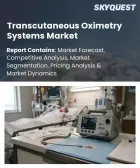
|
시장보고서
상품코드
2130887
경피 옥시메트리 시스템 시장 규모, 점유율 및 성장 분석 : 제품 유형별, 포터빌리티별, 용도별, 최종사용자별, 지역별 - 업계 예측(2026-2033년)Transcutaneous Oximetry Systems Market Size, Share, and Growth Analysis, By Product Type, By Portability, By Application, By End User, By Region - Industry Forecast 2026-2033 |
||||||

세계의 경피 옥시메트리 시스템 시장 규모는 2024년에 14억 2,000만 달러로 평가되며, 2025년 15억 3,000만 달러에서 2033년까지 28억 달러로 확대하며, 예측 기간(2026-2033년)에 CAGR 7.8%로 성장할 것으로 전망되고 있습니다.
전 세계 경피 산소포화도 측정 시스템 시장에는 말초 혈류의 지속적인 모니터링에 필수적인, 조직 산소 분압을 비침습적으로 측정하도록 설계된 기기가 포함됩니다. 이 기능은 특히 신생아 치료, 만성 상처 관리 및 말초동맥질환에서 저산소 상태의 조기 발견에 매우 중요한 역할을 하며, 궁극적으로 유병률 감소와 의료비 절감으로 이어집니다. 가열 프로브 및 무선 원격 측정과 같은 기술적 진보로 인해 기술 기반이 강화되어 다양한 지역에서 꾸준한 매출 성장에 기여하고 있습니다. 시장 확대는 주로 만성 상처 사례의 증가와 신흥 시장의 신생아 인구 증가에 의해 주도되고 있습니다. 또한 AI 통합을 통해 신호 처리가 정교해지고, 움직임으로 인한 아티팩트가 최소화됨으로써 시스템의 정확도가 향상되어 조기 발견을 촉진하고 임상 판단의 질을 높임으로써 도입률을 더욱 끌어올리고 있습니다.
전 세계 경피 산소 포화도 측정 시스템 시장의 성장 요인
경피 산소포화도 측정 시스템 시장은 고해상도 광학 센서의 발전에 힘입어 성장하고 있습니다. 이로 인해 다양한 환자군에서 조직 산소 측정 감도와 신뢰성이 크게 향상되었습니다. 이러한 센서의 내구성이 향상됨에 따라 빈번한 재교정의 필요성이 최소화되고, 장비 가동 중단 시간이 단축되어 중환자실에서 중단 없는 모니터링이 가능해졌습니다. 또한 사용자 친화적인 인터페이스 덕분에 의료진의 채택이 확대되고, 측정값의 정확성에 대한 신뢰도가 높아지고 있습니다. 이러한 신뢰도 향상과 광범위한 임상 검증 연구가 결합되어 이 기술의 신뢰성이 강화되었으며, 표준 치료 프로토콜에 대한 도입이 촉진되고 있습니다. 그 결과, 혁신적인 산소 포화도 측정 솔루션에 대한 전 세계적인 수요가 증가하고 있습니다.
전 세계 경피 산소 포화도 측정 시스템 시장의 제약 요인
첨단 경피 산소 포화도 측정 시스템과 관련된 높은 비용은, 특히 개발도상 지역이나 소규모 의료 기관에서 많은 의료 제공자들에게 큰 장벽이 되고 있습니다. 초기 투자 비용이 높기 때문에 예산 편성 절차에 오랜 시간이 소요되는 경우가 많으며, 그 결과 구매 결정이 지연될 수 있습니다. 또한 지속적인 유지 관리 비용과 전문적인 교육의 필요성이 전반적인 재정적 부담을 가중시켜, 일부 의료 기관에서는 투자를 미루거나 가격은 더 저렴하지만 효과는 떨어지는 모니터링 솔루션을 선택하는 사례도 볼 수 있습니다. 이러한 주저함은 궁극적으로 시장 성장을 저해하고, 다양한 임상 환경에서 이 기술의 광범위한 도입을 방해할 가능성이 있으며, 표준 의료 관행에 대한 통합에 영향을 미칠 우려가 있습니다.
전 세계 경피 산소 포화도 측정 시스템 시장의 동향
전 세계 경피 산소포화도 측정 시스템 시장에서는 원격 모니터링 기술과의 통합을 향한 뚜렷한 추세가 나타나고 있습니다. 의료 제공자들은 대면 진료 없이도 지속적인 조직 산소 평가를 가능하게 하기 위해, 원격 모니터링 플랫폼 내에서 경피 산소포화도 측정을 점점 더 많이 활용하고 있습니다. 이러한 진화는 예방적 상처 관리를 지원하고 재입원 건수를 줄이는 동시에, 환자의 편의성 향상과 비용 절감에 초점을 맞춘 확대되는 원격의료 흐름과도 부합합니다. 이에 대응하여 각 벤더사는 혈중 산소 포화도 측정 데이터를 전자 차트에 효율적으로 통합하는 클라우드 기반 분석 기능과 상호 운용 가능한 인터페이스 개발에 주력하고 있습니다. 이를 통해 실시간 임상 의사결정이 개선되고, 외래 및 재택 간호 환경으로의 시장 접근성이 확대됨에 따라 환자의 치료 성과와 업무 효율성이 향상되고 있습니다.
자주 묻는 질문
목차
서론
조사 방법
개요
시장 역학과 전망
주요 시장 인사이트
세계의 경피 옥시메트리 시스템 시장 규모 : 제품 유형별
세계의 경피 옥시메트리 시스템 시장 규모 : 포터빌리티별
세계의 경피 옥시메트리 시스템 시장 규모 : 용도별
세계의 경피 옥시메트리 시스템 시장 규모 : 최종사용자별
세계의 경피 옥시메트리 시스템 시장 규모 : 지역별
경쟁 정보
주요 기업 개요
결론과 제안
KSAGlobal Transcutaneous Oximetry Systems Market size was valued at USD 1.42 Billion in 2024 and is poised to grow from USD 1.53 Billion in 2025 to USD 2.8 Billion by 2033, growing at a CAGR of 7.8% during the forecast period (2026-2033).
The global transcutaneous oximetry systems market features devices designed for non-invasive measurement of tissue oxygen tension, essential for continuous monitoring of peripheral perfusion. This capability plays a crucial role in early hypoxia detection, particularly in neonatal care, chronic wound management, and peripheral arterial diseases, ultimately leading to reduced morbidity and lower healthcare costs. Advancements such as heated probes and wireless telemetry have enhanced the technological framework, contributing to consistent revenue growth across various regions. Market expansion is largely driven by increasing instances of chronic wounds and a growing neonatal demographic in emerging markets. Moreover, the integration of AI improves system accuracy by refining signal processing and minimizing motion artifacts, facilitating early detection and enhancing clinical decision-making, which further boosts adoption rates.
Top-down and bottom-up approaches were used to estimate and validate the size of the Global Transcutaneous Oximetry Systems market and to estimate the size of various other dependent submarkets. The research methodology used to estimate the market size includes the following details: The key players in the market were identified through secondary research, and their market shares in the respective regions were determined through primary and secondary research. This entire procedure includes the study of the annual and financial reports of the top market players and extensive interviews for key insights from industry leaders such as CEOs, VPs, directors, and marketing executives. All percentage shares split, and breakdowns were determined using secondary sources and verified through Primary sources. All possible parameters that affect the markets covered in this research study have been accounted for, viewed in extensive detail, verified through primary research, and analyzed to get the final quantitative and qualitative data.
Global Transcutaneous Oximetry Systems Market Segments Analysis
Global transcutaneous oximetry systems market is segmented by product type, portability, application, end user and region. Based on product type, the market is segmented into Transcutaneous Oxygen Monitoring Systems, Transcutaneous Carbon Dioxide Monitoring Systems, Combined Oxygen & Carbon Dioxide Monitoring Systems and Accessories & Sensors. Based on portability, the market is segmented into Portable Systems, Handheld Systems and Stationary Systems. Based on application, the market is segmented into Neonatal Care, Respiratory Care, Vascular & Wound Care, Sleep Monitoring, Critical Care and Others. Based on end user, the market is segmented into Hospitals, Clinics, Diagnostic & Sleep Centers, Home Healthcare, Research Institutions and Others. Based on region, the market is segmented into North America, Europe, Asia Pacific, Latin America and Middle East & Africa.
Driver of the Global Transcutaneous Oximetry Systems Market
The Transcutaneous Oximetry Systems market is being driven by advancements in high-resolution optical sensors, which significantly enhance both the sensitivity and reliability of tissue oxygen measurements across various patient demographics. The improved durability of these sensors minimizes the need for frequent recalibration and reduces device downtime, allowing for uninterrupted monitoring in intensive care settings. Additionally, user-friendly interfaces foster wider adoption among healthcare professionals, bolstering their confidence in the accuracy of the readings. This growing trust, paired with extensive clinical validation studies, reinforces the technology's credibility and promotes its incorporation into standard treatment protocols, thereby increasing global demand for innovative oximetry solutions.
Restraints in the Global Transcutaneous Oximetry Systems Market
The elevated costs linked to advanced transcutaneous oximetry systems create a significant obstacle for numerous healthcare providers, especially in developing regions and smaller facilities. The high initial investment often requires lengthy budgeting procedures, which can postpone purchasing decisions. Furthermore, the continuous maintenance costs and the requirement for specialized training contribute to the overall financial burden, leading some institutions to postpone investments or choose more affordable but less effective monitoring solutions. This hesitance ultimately restrains market growth and may restrict the widespread adoption of this technology in various clinical environments, impacting its integration into standard medical practices.
Market Trends of the Global Transcutaneous Oximetry Systems Market
The Global Transcutaneous Oximetry Systems market is witnessing a significant trend towards the integration of remote monitoring technologies. Healthcare providers are increasingly utilizing transcutaneous oximetry within remote monitoring platforms to facilitate ongoing tissue oxygen assessments without the necessity of in-person consultations. This evolution supports proactive wound management, mitigates the number of hospital readmissions, and aligns with the growing telehealth movement focused on enhancing patient convenience and reducing costs. In response, vendors are innovating with cloud-based analytics and interoperable interfaces that efficiently incorporate oximetry data into electronic health records, thereby improving real-time clinical decision-making and broadening market access into outpatient and home-care environments for superior patient outcomes and operational efficiency.
Table of Contents
Introduction
- Objectives of the Study
- Market Definition & Scope
Research Methodology
- Research Process
- Secondary & Primary Data Methods
- Market Size Estimation Methods
Executive Summary
- Global Market Outlook
- Key Market Highlights
- Segmental Overview
- Competition Overview
Market Dynamics & Outlook
- Macro-Economic Indicators
- Drivers & Opportunities
- Restraints & Challenges
- Supply Side Trends
- Demand Side Trends
- Porters Analysis & Impact
- Competitive Rivalry
- Threat of Substitute
- Bargaining Power of Buyers
- Threat of New Entrants
- Bargaining Power of Suppliers
Key Market Insights
- Key Success Factors
- Market Impacting Factors
- Top Investment Pockets
- Ecosystem Mapping
- Market Attractiveness Index 2025
- PESTEL Analysis
- Regulatory Landscape
Global Transcutaneous Oximetry Systems Market Size by Product Type & CAGR (2026-2033)
- Market Overview
- Transcutaneous Oxygen Monitoring Systems
- Transcutaneous Carbon Dioxide Monitoring Systems
- Combined Oxygen & Carbon Dioxide Monitoring Systems
- Accessories & Sensors
Global Transcutaneous Oximetry Systems Market Size by Portability & CAGR (2026-2033)
- Market Overview
- Portable Systems
- Handheld Systems
- Stationary Systems
Global Transcutaneous Oximetry Systems Market Size by Application & CAGR (2026-2033)
- Market Overview
- Neonatal Care
- Respiratory Care
- Vascular & Wound Care
- Sleep Monitoring
- Critical Care
- Others
Global Transcutaneous Oximetry Systems Market Size by End User & CAGR (2026-2033)
- Market Overview
- Hospitals
- Clinics
- Diagnostic & Sleep Centers
- Home Healthcare
- Research Institutions
- Others
Global Transcutaneous Oximetry Systems Market Size & CAGR (2026-2033)
- North America (Product Type, Portability, Application, End User)
- US
- Canada
- Europe (Product Type, Portability, Application, End User)
- Germany
- Spain
- France
- UK
- Italy
- Rest of Europe
- Asia Pacific (Product Type, Portability, Application, End User)
- China
- India
- Japan
- South Korea
- Rest of Asia-Pacific
- Latin America (Product Type, Portability, Application, End User)
- Mexico
- Brazil
- Rest of Latin America
- Middle East & Africa (Product Type, Portability, Application, End User)
- GCC Countries
- South Africa
- Rest of Middle East & Africa
Competitive Intelligence
- Top 5 Player Comparison
- Market Positioning of Key Players, 2025
- Strategies Adopted by Key Market Players
- Recent Developments in the Market
- Company Market Share Analysis, 2025
- Company Profiles of All Key Players
- Company Details
- Product Portfolio Analysis
- Company's Segmental Share Analysis
- Revenue Y-O-Y Comparison (2023-2025)
Key Company Profiles
- Radiometer Medical ApS
- Company Overview
- Business Segment Overview
- Financial Updates
- Key Developments
- Perimed AB
- Company Overview
- Business Segment Overview
- Financial Updates
- Key Developments
- Sentec AG
- Company Overview
- Business Segment Overview
- Financial Updates
- Key Developments
- Medicapte Inc.
- Company Overview
- Business Segment Overview
- Financial Updates
- Key Developments
- Radiometer America Inc.
- Company Overview
- Business Segment Overview
- Financial Updates
- Key Developments
- Medtronic plc
- Company Overview
- Business Segment Overview
- Financial Updates
- Key Developments
- Masimo Corporation
- Company Overview
- Business Segment Overview
- Financial Updates
- Key Developments
- Koninklijke Philips N.V.
- Company Overview
- Business Segment Overview
- Financial Updates
- Key Developments
- GE HealthCare Technologies Inc.
- Company Overview
- Business Segment Overview
- Financial Updates
- Key Developments
- Natus Medical Incorporated
- Company Overview
- Business Segment Overview
- Financial Updates
- Key Developments
- Nonin Medical, Inc.
- Company Overview
- Business Segment Overview
- Financial Updates
- Key Developments
- Smiths Medical International Ltd.
- Company Overview
- Business Segment Overview
- Financial Updates
- Key Developments
- Moor Instruments Limited
- Company Overview
- Business Segment Overview
- Financial Updates
- Key Developments
- ADInstruments Pty Ltd.
- Company Overview
- Business Segment Overview
- Financial Updates
- Key Developments
- Huntleigh Healthcare Limited
- Company Overview
- Business Segment Overview
- Financial Updates
- Key Developments
- Compumedics Limited
- Company Overview
- Business Segment Overview
- Financial Updates
- Key Developments
- SOMNOmedics GmbH
- Company Overview
- Business Segment Overview
- Financial Updates
- Key Developments
- Viasys Healthcare GmbH
- Company Overview
- Business Segment Overview
- Financial Updates
- Key Developments
- CareFusion Corporation
- Company Overview
- Business Segment Overview
- Financial Updates
- Key Developments
- Arjo AB
- Company Overview
- Business Segment Overview
- Financial Updates
- Key Developments


