|
시장보고서
상품코드
2114582
원격 무기 시스템 : 시장 점유율 분석, 업계 동향 및 통계, 성장 예측(2026-2031년)Remote Weapon Systems - Market Share Analysis, Industry Trends & Statistics, Growth Forecasts (2026 - 2031) |
||||||
 Mordor Intelligence
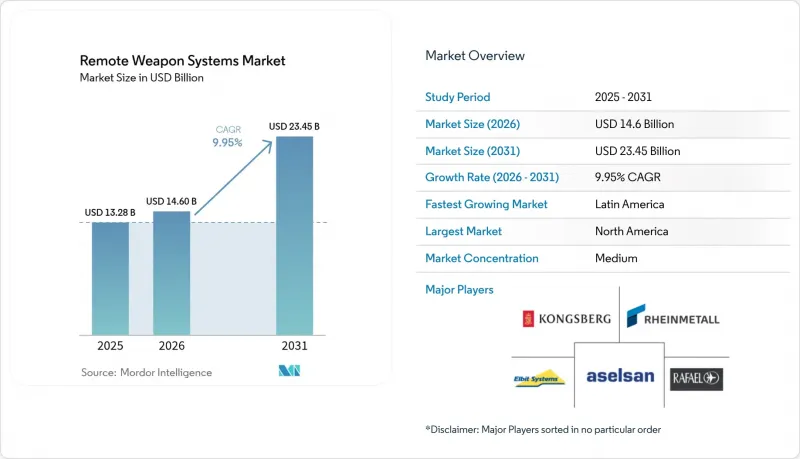
Mordor Intelligence에 의하면, 원격 무기 시스템 시장 규모는 2025년 132억 8,000만 달러로 평가되었습니다. 2026년에는 146억 달러로 확대되어 2026년부터 2031년에 걸쳐 CAGR 9.95%로 성장을 지속하여, 2031년에는 234억 5,000만 달러에 이를 것으로 예측됩니다.
본 보고서는 플랫폼(육상, 해상, 항공), 무기 유형(소구경, 중구경, 미사일 통합 스테이션, 비치명적 페이로드), 구성 요소(센서 및 EO/IR 스위트, 무기 및 무장, 인간-기계 인터페이스 등), 최종 사용자(군, 기타),및 지역(북미, 기타)별로 분류되어 있습니다. 시장 예측은 금액(미 달러) 기준으로 제시되어 있습니다.
세계의 원격 무기 시스템 시장 동향 및 인사이트
무인 지상 전투 차량에 대한 수요 급증
무인 지상 차량에 대한 투자 확대에 따라, 자율형 플랫폼을 위해 설계된 모듈식 무기 스테이션에 대한 수요가 증가하고 있습니다. 미 육군의 로봇 전투 차량(RCV) 프로그램, NATO의 다양한 실험 프로젝트, 그리고 우크라이나에서의 작전 경험을 통해 원격 무장형 UGV가 병사의 위험 노출을 최소화하면서 정찰 및 직접 화력 지원을 수행할 수 있음이 입증되었습니다. 유럽공급업체인 Milrem Robotics는 2024년에 자사의 THeMIS UGV 수주가 3자리 수 증가를 기록했다고 보고했으며, 해당 구성의 대부분에는 파트너사가 공급하는 RWS가 통합되어 있습니다. 이러한 노력을 통해 표준화된 인터페이스 요구 사항이 확립되었으며, 적응성이 높은 마운트 및 관련 센서 제품군의 양산이 가속화되고 있습니다. AI의 지속적인 진화는 무인화 개념과 더욱 부합하며, 끊임없이 변화하는 교전 규칙을 준수하는 반자율적 교전을 가능하게 하고 있습니다. 각 군이 조달 목표를 공식적으로 설정하고 여러 계층에 걸쳐 작전 부대를 배치함에 따라, 이러한 추세는 중기적인 수요를 뒷받침할 것으로 예측됩니다.
보병전투차(IFV) 및 연안순찰함(OPV)의 중구경 원격 무기 시스템(RWS)으로의 전환
세계 각국의 조달 팀은 경장갑 차량, 드론 및 요새화된 진지를 제압하기 위해 보병전투차(IFV) 및 연안 순찰함(OPV)에 20-40mm 무장을 선호하여 채택하고 있습니다. 폴란드가 Borsuk 보병전투차를 위해 7억 496만 달러를 투자해 구매한 ZSSW-30 포탑은 이러한 전환을 상징하는 사례입니다. 해상 분야에서는 레오나르도의 MARLIN-WS가 이탈리아 초계함에서 해상 시험을 완료하여, 안정화된 함재 마운트에 대한 수요가 확인되었습니다. 중구경 탄약은 미사일의 병참적 부담을 수반하지 않으면서도 높은 살상력을 발휘하며, 탄약의 호환성에 관한 NATO의 STANAG 규격도 준수하고 있습니다. 탄약의 범용성, 장갑 관통력, 그리고 비용 면에서의 우위가 결합되어, 특히 전장에서 신속한 효과를 추구하는 업그레이드 계획에서 단기적인 조달 결정을 뒷받침하고 있습니다.
저소득 지역에서의 도입을 가로막는 고액의 최종 비용
1기당 20만 달러에서 200만 달러에 달하는 단가는 아프리카, 라틴아메리카 및 소규모 아시아 국가 군에게 큰 장벽이 되고 있습니다. 제한된 예산 속에서 첨단 사격 통제 전자 장비보다 병력 수송 및 병참 지원이 우선시되고 있습니다. 훈련용 시뮬레이터, 정비용 예비 부품, 전용 탄약 등을 고려하면 수명 주기 비용은 더욱 부풀어 오르며, 부대 보호 측면에서 잠재적인 이점이 있음에도 불구하고 자금 사정에 어려움을 겪는 기관에게는 도입의 걸림돌이 되고 있습니다. 지역 제조업체들은 기능을 간소화한 변형 모델 개발을 시도하고 있지만, 성능 측면에서의 타협이 종종 수출 매력을 떨어뜨리고 있습니다. 국제 보조금이나 대외 군사 금융 프로그램을 통해 특정 경우에는 자본 지출이 경감되기도 하지만, 행정상의 지연이나 정치적 검토로 인해 조달 주기가 장기화되고 있습니다.
부문별 분석
2025년, 지상 플랫폼은 원격 무기 시스템 시장 점유율의 57.68%를 차지했습니다. 이는 NATO의 장갑차 현대화 및 신흥 무인 지상 전투 프로그램에 힘입은 결과입니다. 이 분야에서 보병 전투차용 원격 무기 시스템 시장 규모만으로도 2031년까지 연평균 성장률(CAGR) 10.12%로 확대될 것으로 추정됩니다. 수동 조준식 큐폴라 포를 안정화된 포탑으로 대체함으로써 생존성이 향상되고, 네트워크 중심의 전술 이념에도 부합합니다. 대부분의 경우, 대전차 유도 미사일과 결합되는 중구경 속사포대는 드론이나 경장갑 차량에 대한 다목적 작전을 가능하게 합니다. 공급업체의 계약 체계에서는 일반적으로 오프셋 할당량을 충족하기 위해 훈련, 예비 부품, 현지 조립이 패키지로 묶여 있어, 이를 통해 현지 산업의 참여와 정치적 지지가 강화되고 있습니다.
해상 플랫폼은 인도-태평양 함대의 확장에 힘입어 두 번째로 큰 수익원이 되었습니다. 초계함, 코르벳함, 상륙함에는 해상 조건 보정 기능과 360도 감시 범위를 갖춘 2축 포대가 탑재되어 있습니다. 이 시장 부문에서의 광범위한 채택은 해적 대응, 어업 보호, 연안 감시 임무에 대한 억지력 강화를 반영하고 있습니다. 항공기 통합은 여전히 틈새 시장이지만 미래성이 기대되고 있으며, 특수작전부대에 의해 헬리콥터 도어건 대체 및 UCAV용 포드 평가가 진행되고 있습니다. 경량 댐퍼의 사용으로 기체 진동 및 반동 문제가 완화됨에 따라, 이 부문은 소폭이지만 꾸준한 형태로 전체 성장에 기여할 것으로 전망됩니다.
2025년, 중구경 부문은 원격 무기 시스템 시장 점유율의 46.10%를 차지했습니다. 현재 진행 중인 분쟁은 드론 대응 임무에서 프로그래밍 가능한 공중 폭발 탄약과 더 높은 초속 에너지의 중요성을 부각시키고 있습니다. 20-40mm 구경과 관련된 원격 무기 시스템 시장 규모는 연평균 9.18%의 속도로 확대될 것으로 예측되며, 소구경 부문을 능가하는 성장이 예상됩니다. 운영자들은 기존 자동포와의 탄약 호환성과 뛰어난 원거리 살상 능력을 도입 이유로 꼽고 있습니다. 또한, NATO의 30mm 탄약 비축분과의 상호 운용성 덕분에 연합군 전개 시 물류 체인도 간소화됩니다.
현재 시장 점유율이 9.85%에 불과한 미사일 통합 스테이션은 다중 영역에서의 살상 능력에 대한 수요를 반영하여 연평균 성장률(CAGR) 10.06%라는 가장 빠른 성장 궤적을 보일 것으로 예측됩니다. 경량 동축 발사 장치로의 진화를 통해 차량은 전용 미사일 포탑 없이도 장갑 위협을 무력화할 수 있게 됩니다. 소구경(12.7mm 이하) 옵션은 특히 국경 경비용 감시탑에서 비용을 중시하는 구매자나 비군사 기관으로부터 계속해서 주목을 받고 있습니다. 비치명적 페이로드 스테이션은 눈부심 장치, 음향 장치, 페퍼볼 발사 장치를 결합함으로써, 특히 중요 인프라 주변에서 확대되는 국내 치안 분야의 요구를 충족시키고 있습니다.
지역별 분석
2025년, 유럽은 매출 점유율 42.20%로 원격 무기 시스템 시장을 주도했습니다. NATO의 방위비 지출 공약에 따른 자금 급증으로 인해 장갑차 개량 및 해군 초계함 조달이 진전되고 있습니다. 독일의 Puma 및 벨기에의 Jaguar 프로그램은 다자간 조달을 통한 시너지 효과를 부각시키고 있는 반면, 폴란드의 ZSSW-30 계약은 동유럽공급망을 재구축하고 있습니다. 지역 제조업체들은 연구개발 및 합작 공장 설립을 지원하는 수출신용기관과 유럽방위기금의 보조금 혜택을 받고 있습니다. 견고한 사후 서비스 네트워크, 통합된 훈련 센터, 그리고 공유된 탄약 비축량이 장기적인 고객 충성도를 강화하고 있습니다.
아시아태평양은 2031년까지 연평균 성장률(CAGR)이 10.02%로 가장 높은 성장률을 보였습니다. 해양 분쟁, 잠수함의 확산, 드론 침입으로 인해 지역 함대는 안정화된 무기 마운트의 도입을 서두르고 있습니다. 인도와 인도네시아의 국산화 의무는 기술 이전 협정을 촉진하고, 성능 기준을 희생하지 않으면서 현지 조달률을 높이고 있습니다. 중국의 막대한 수요는 전기광학 센서 어레이의 규모의 경제를 뒷받침하고 있으며, 서유럽 공급업체에 가격 면에서 압박을 가하고 있습니다. 그러나 미국의 대외 군사 판매(FMS) 경로는 대만, 한국, 필리핀에서 여전히 영향력을 유지하고 있어 시장 역학의 균형을 유지하고 있습니다.
북미는 미국의 현대화 프로그램을 통해 계속해서 전략적 거점으로서의 지위를 유지하고 있습니다. 해병대의 수륙양용 전투 차량 및 육군의 로봇 전투 차량 이니셔티브에는 AI 지원 포탑과 공통 제어 스테이션이 요구되고 있습니다. 캐나다의 장갑 지원 차량 업그레이드로 인해 수요는 점차 증가하고 있지만, 수출 규제의 제약으로 인해 생산은 주로 동맹국에 대한 공급으로 제한되고 있습니다. 중동에서는 국경 경비 필요성과 대-UAS(무인 항공기) 요건에 힘입어 선별적인 조달이 이루어지고 있지만, 아프리카와 라틴아메리카에서는 불법 거래라는 새로운 과제가 대두되고 있음에도 불구하고 여전히 비용 제약에 직면해 있습니다.
기타 혜택 :
- 엑셀 형식 시장 예측(ME) 시트
- 3개월간의 애널리스트 지원
자주 묻는 질문
목차
제1장 서론
제2장 조사 방법
제3장 주요 요약 및 주요 조사 결과
제4장 시장 구도
제5장 시장 규모 및 성장 예측
제6장 경쟁 구도
제7장 시장 기회 및 향후 전망
KTH 26.08.28According to Mordor Intelligence, the remote weapon systems market size is expected to grow from USD 13.28 billion in 2025 to USD 14.6 billion in 2026 and is forecast to reach USD 23.45 billion by 2031 at 9.95% CAGR over 2026-2031.
This report is Segmented by Platform (Land, Marine, Airborne), Weapon Type (Small-Caliber, Medium-Caliber, Missile-Integrated Stations, Non-Lethal Payloads), Component (Sensors and EO/IR Suites, Weapons and Armaments, Human-Machine Interface, and More), End-User (Military, and More), and Geography (North America, and More). The Market Forecasts are Provided in Terms of Value (USD).
Global Remote Weapon Systems Market Trends and Insights
Surging Demand for Unmanned Ground Combat Vehicles
Growing investment in unmanned ground vehicles elevates the need for modular weapon stations designed for autonomous platforms. The US Army Robotic Combat Vehicle program, various NATO experimentation projects, and operational lessons from Ukraine demonstrate how remotely armed UGVs can deliver reconnaissance and direct-fire support while minimizing troop exposure. European supplier Milrem Robotics reported triple-digit order growth for its THeMIS UGV in 2024, with most configurations integrating partner-supplied RWS. These initiatives create standardized interface requirements, accelerating volume production of adaptable mounts and associated sensor suites. Continuous AI improvements further align with unmanned concepts, enabling semi-autonomous engagements that comply with evolving rules of engagement. The trend is expected to sustain medium-term demand as forces formalize procurement objectives and field operational units across multiple echelons.
Shift toward Medium-Caliber RWS on IFVs and OPVs
Global procurement teams favor 20-40 mm armaments for infantry fighting vehicles and offshore patrol vessels to defeat lightly armored vehicles, drones, and fortified positions. Poland's USD 704.96 million ZSSW-30 turret purchase, destined for Borsuk IFVs, epitomizes this pivot. On the maritime side, Leonardo's MARLIN-WS has completed sea trials aboard Italian patrol ships, confirming demand for stabilized naval mounts. Medium-caliber ammunition delivers higher lethality without the logistical burdens of missile logistics, aligning with NATO STANAGs for ammunition interchangeability. The combination of versatile ammunition natures, armor penetration, and cost advantage drives short-term procurement decisions, especially for upgrade programs seeking rapid battlefield effect.
High Terminal Cost Hindering Adoption in Low-Income Regions
Unit prices ranging from USD 200,000 to USD 2 million create substantial barriers for African, Latin-American, and smaller Asian militaries. Limited budgets prioritize troop transport and sustainment over advanced fire-control electronics. Lifetime costs grow when factoring in training simulators, maintenance spares, and specialized ammunition, deterring cash-strapped agencies despite potential force-protection benefits. Regional manufacturers attempt stripped-down variants, but capability trade-offs often reduce export appeal. International grants and foreign military financing programs mitigate capital expenditure in select cases, yet administrative delays and political scrutiny prolong acquisition cycles.
Other drivers and restraints analyzed in the detailed report include:
- Integration of AI-enabled Auto-Tracking Fire-Control Suites
- Spiking Indo-Pacific Naval Modernization Programs
- Talent and Specialized-Component Supply-Chain Shortages
For complete list of drivers and restraints, kindly check the Table Of Contents.
Segment Analysis
Land systems accounted for 57.68% of the remote weapon systems market share in 2025, driven by NATO armored-vehicle upgrades and emerging unmanned ground combat programs. Within this domain, the remote weapon systems market size for infantry fighting vehicles alone is estimated to grow at a 10.12% CAGR to 2031. Replacement of manually aimed cupola guns with stabilized turrets enhances survivability and aligns with network-centric doctrine. Rapid-fire medium-caliber mounts, often combined with anti-tank guided missiles, allow multi-role employment against drones and light armor. Supplier frameworks typically bundle training, spares, and in-country assembly to satisfy offset quotas, reinforcing local industry participation and political buy-in.
Marine platforms represent the second-largest revenue pool, driven by the expansion of the Indo-Pacific fleet. Patrol craft, corvettes, and amphibious ships deploy twin-axis mounts offering sea-state compensation and 360-degree coverage. The market segment's broad adoption reflects increased deterrence against piracy, fisheries protection, and littoral surveillance tasks. Airborne integration remains a niche but promising area, with helicopter door-gun replacements and UCAV pods under evaluation by special operations units. As airframe vibration and recoil challenges are eased through the use of lightweight dampers, the segment expects steady, if modest, contributions to overall growth.
Medium-caliber cannons delivered 46.10% of the remote weapon systems market share in 2025. Ongoing conflicts underscore the value of programmable air-burst ammunition and higher muzzle energy in counter-drone roles. The remote weapon systems market size linked to 20-40 mm calibers is projected to expand at a 9.18% annual rate, outpacing the small-caliber segment. Operators cite ammunition commonality with legacy autocannons and superior standoff lethality as procurement rationales. Interoperability with NATO 30 mm stockpiles also simplifies logistical chains during coalition deployments.
Missile-integrated stations, which currently hold only a 9.85% share, are projected to record the fastest trajectory at a 10.06% CAGR, reflecting the demand for multi-domain lethality. Evolution toward lightweight coaxial launchers enables vehicles to neutralize armored threats without the need for dedicated missile turrets. Small-caliber options (<=12.7 mm) continue to attract cost-sensitive buyers and non-military agencies, particularly for border security surveillance towers. Non-lethal payload stations fill a growing homeland-security niche by combining dazzlers, acoustic devices, and pepper-ball launchers, particularly around critical-infrastructure perimeters.
Complete Report Scope:
- By Platform
- Land
- Armored Combat Vehicles
- Autonomous/UGV Platforms
- Stationary Ground Sites
- Marine
- Patrol and OPV Vessels
- Corvettes and Frigates
- Airborne
- Helicopters
- Fixed-Wing Aircraft
- UAVs/UCAVs
- Land
- By Weapon Type
- Small-Caliber (<=12.7 mm)
- Medium-Caliber (20-40 mm)
- Missile-Integrated Stations
- Non-Lethal Payloads
- By Component
- Sensors and EO/IR Suites
- Weapons and Armaments
- Human-Machine Interface (HMI)
- Fire-Control and Ballistic Computers
- Stabilization Units
- By End-User
- Military
- Homeland Security
- By Geography
- North America
- United States
- Canada
- Mexico
- South America
- Brazil
- Rest of South America
- Europe
- United Kingdom
- Germany
- France
- Russia
- Rest of Europe
- Asia-Pacific
- China
- India
- Japan
- South Korea
- Rest of Asia-Pacific
- Middle East and Africa
- Middle East
- Saudi Arabia
- United Arab Emirates
- Rest of Middle East
- Africa
- South Africa
- Middle East
- North America
Geography Analysis
Europe led the remote weapon systems market in 2025 with 42.20% revenue share. Funding surges under NATO's defense-spending pledges accelerate armored-vehicle retrofits and naval patrol-boat acquisitions. Germany's Puma and Belgium's Jaguar programs highlight multi-nation procurement synergies, while Poland's ZSSW-30 contract reshapes Eastern Europe's supply chain. Regional manufacturers benefit from export-credit agencies and European Defence Fund grants that subsidize R&D and joint-venture factories. Robust after-sales networks, centralized training centers, and shared munition stockpiles reinforce long-term customer lock-in.
Asia-Pacific exhibited the highest growth rate at 10.02% CAGR through 2031. Maritime disputes, submarine proliferation, and drone incursions motivate regional fleets to adopt stabilized weapon mounts. Domestic-production mandates in India and Indonesia encourage technology-transfer agreements, amplifying local content without sacrificing performance benchmarks. China's volume-driven demand supports economies of scale for electro-optic sensor arrays, placing pricing pressure on Western suppliers. Yet the US Foreign Military Sales pathways maintain influence in Taiwan, South Korea, and the Philippines, balancing market dynamics.
North America remains a strategic hub due to the US modernization programs. The Marine Corps amphibious combat vehicle and Army robotic-combat-vehicle initiatives require AI-ready turrets and common control stations. Canadian armored-support-vehicle upgrades add incremental demand, although export-control constraints channel production primarily to allied customers. The Middle East registers selective acquisitions driven by border-security imperatives and counter-UAS requirements, whereas Africa and Latin America stay cost-constrained despite emerging illicit-trafficking challenges.
- Kongsberg Gruppen ASA
- Elbit Systems Ltd.
- Rafael Advanced Defense Systems Ltd.
- RTX Corporation
- Saab AB
- Leonardo S.p.A
- Electro Optic Systems (EOS)
- ASELSAN
- General Dynamics Corporation
- BAE Systems plc
- Thales Group
- FN Browning Group
- Rheinmetall AG
- Hanwha Systems Co., Ltd.
- Singapore Technologies Engineering Ltd.
- Moog Inc.
- IAI
- KNDS N.V.
Additional Benefits:
- The market estimate (ME) sheet in Excel format
- 3 months of analyst support
TABLE OF CONTENTS
1 INTRODUCTION
- 1.1 Study Assumptions and Market Definition
- 1.2 Scope of the Study
2 RESEARCH METHODOLOGY
3 EXECUTIVE SUMMARY AND KEY FINDINGS
4 MARKET LANDSCAPE
- 4.1 Market Overview
- 4.2 Market Drivers
- 4.2.1 Surging demand for unmanned ground combat vehicles
- 4.2.2 Shift toward medium-caliber (20-40 mm) RWS on IFVs and OPVs
- 4.2.3 Integration of AI-enabled auto-tracking fire-control suites
- 4.2.4 Spiking Indo-Pacific naval modernization programs
- 4.2.5 Retrofit programs for legacy armored fleets in Europe
- 4.2.6 Miniaturized sensors enabling UAV-borne RWS
- 4.3 Market Restraints
- 4.3.1 Escalating space-debris collision risk and stricter disposal rules
- 4.3.2 Spectrum-sharing conflicts with terrestrial 5G/6G incumbents
- 4.3.3 High terminal cost hindering adoption in low-income regions
- 4.3.4 Talent and specialized-component supply-chain shortages
- 4.4 Value Chain Analysis
- 4.5 Regulatory Landscape
- 4.6 Technological Outlook
- 4.7 Porter's Five Forces Analysis
- 4.7.1 Bargaining Power of Suppliers
- 4.7.2 Bargaining Power of Buyers
- 4.7.3 Threat of New Entrants
- 4.7.4 Threat of Substitutes
- 4.7.5 Intensity of Competitive Rivalry
5 MARKET SIZE AND GROWTH FORECASTS (VALUE)
- 5.1 By Platform
- 5.1.1 Land
- 5.1.1.1 Armored Combat Vehicles
- 5.1.1.2 Autonomous/UGV Platforms
- 5.1.1.3 Stationary Ground Sites
- 5.1.2 Marine
- 5.1.2.1 Patrol and OPV Vessels
- 5.1.2.2 Corvettes and Frigates
- 5.1.3 Airborne
- 5.1.3.1 Helicopters
- 5.1.3.2 Fixed-Wing Aircraft
- 5.1.3.3 UAVs/UCAVs
- 5.1.1 Land
- 5.2 By Weapon Type
- 5.2.1 Small-Caliber (<=12.7 mm)
- 5.2.2 Medium-Caliber (20-40 mm)
- 5.2.3 Missile-Integrated Stations
- 5.2.4 Non-Lethal Payloads
- 5.3 By Component
- 5.3.1 Sensors and EO/IR Suites
- 5.3.2 Weapons and Armaments
- 5.3.3 Human-Machine Interface (HMI)
- 5.3.4 Fire-Control and Ballistic Computers
- 5.3.5 Stabilization Units
- 5.4 By End-User
- 5.4.1 Military
- 5.4.2 Homeland Security
- 5.5 By Geography
- 5.5.1 North America
- 5.5.1.1 United States
- 5.5.1.2 Canada
- 5.5.1.3 Mexico
- 5.5.2 South America
- 5.5.2.1 Brazil
- 5.5.2.2 Rest of South America
- 5.5.3 Europe
- 5.5.3.1 United Kingdom
- 5.5.3.2 Germany
- 5.5.3.3 France
- 5.5.3.4 Russia
- 5.5.3.5 Rest of Europe
- 5.5.4 Asia-Pacific
- 5.5.4.1 China
- 5.5.4.2 India
- 5.5.4.3 Japan
- 5.5.4.4 South Korea
- 5.5.4.5 Rest of Asia-Pacific
- 5.5.5 Middle East and Africa
- 5.5.5.1 Middle East
- 5.5.5.1.1 Saudi Arabia
- 5.5.5.1.2 United Arab Emirates
- 5.5.5.1.3 Rest of Middle East
- 5.5.5.2 Africa
- 5.5.5.2.1 South Africa
- 5.5.5.1 Middle East
- 5.5.1 North America
6 COMPETITIVE LANDSCAPE
- 6.1 Market Concentration
- 6.2 Strategic Moves
- 6.3 Market Share Analysis
- 6.4 Company Profiles (includes Global level Overview, Market level overview, Core Segments, Financials as available, Strategic Information, Market Rank/Share for key companies, Products and Services, and Recent Developments)
- 6.4.1 Kongsberg Gruppen ASA
- 6.4.2 Elbit Systems Ltd.
- 6.4.3 Rafael Advanced Defense Systems Ltd.
- 6.4.4 RTX Corporation
- 6.4.5 Saab AB
- 6.4.6 Leonardo S.p.A
- 6.4.7 Electro Optic Systems (EOS)
- 6.4.8 ASELSAN
- 6.4.9 General Dynamics Corporation
- 6.4.10 BAE Systems plc
- 6.4.11 Thales Group
- 6.4.12 FN Browning Group
- 6.4.13 Rheinmetall AG
- 6.4.14 Hanwha Systems Co., Ltd.
- 6.4.15 Singapore Technologies Engineering Ltd.
- 6.4.16 Moog Inc.
- 6.4.17 IAI
- 6.4.18 KNDS N.V.
7 MARKET OPPORTUNITIES AND FUTURE OUTLOOK
- 7.1 White-space and Unmet-need Assessment