

|
시장보고서
상품코드
2114672
희소 신경 질환 치료 시장 : 시장 점유율 분석, 업계 동향 및 통계, 성장 예측(2026-2031년)Rare Neurological Disease Treatment - Market Share Analysis, Industry Trends & Statistics, Growth Forecasts (2026 - 2031) |
||||||
 Mordor Intelligence
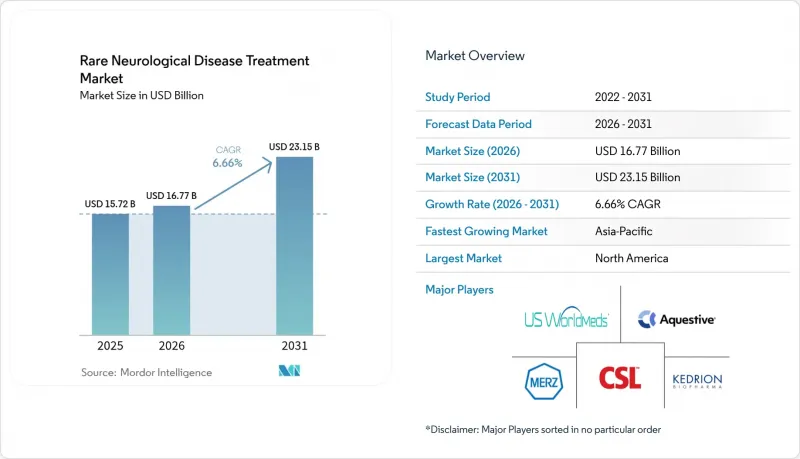
Mordor Intelligence에 의하면, 희소 신경 질환 치료 시장 규모는 2025년 157억 2,000만 달러로 평가되었고, 2026년에는 167억 7,000만 달러로 추정되고, 2026-2031년 CAGR 6.66%로 성장을 지속할 전망이며, 2031년까지 231억 5,000만 달러에 이를 것으로 예측됩니다.
본 보고서는 치료법별(저분자 의약품, 생물학적 제제 및 단일클론 항체, 유전자 치료, 효소 보충 요법 등), 적응증별(척수성 근위축증, 뒤쉔형 근이영양증 등), 투여 경로별(경구, 정맥 내, 기타), 지역별(북미, 유럽 등)로 분류되어 있습니다. 시장 예측은 금액(달러) 기준으로 제시되어 있습니다.
세계의 희귀 신경 질환 치료 시장 동향 및 인사이트
FDA의 패스트 트랙(Fast Track) 및 희귀 질환 치료제(오펀 드럭) 인센티브가 연구개발 투자를 촉진
FDA의 희귀 질환 혁신 허브에서는 현재 전문 심사관이 배정되어, 신청 서류를 우선 심사 주기로 처리함으로써 표준 심사 기간을 단축하고 있습니다. 희귀 신경 질환에 대한 ‘획기적 치료법(Breakthrough Therapy)’ 지정은 2024년 이후 전년 대비 34% 증가했으며, UniQure사의 AMT-130 및 PTC Therapeutics사의 PTC518 등의 승인이 헌팅턴병 분야에서 선례가 되고 있습니다. 7년간 시장 독점권, 수수료 면제, 세액 공제를 통해 틈새 적응증이라도 경제적 매력이 높아지면서, 과거 대형 제약사가 지배하던 이 분야에 중소 바이오테크 기업들이 진출하고 있습니다. 특정 프로그램의 유효성이 입증되면, 많은 경우 더 광범위한 플랫폼으로의 응용이 가능해져 희귀 신경 질환 치료 시장의 성장세를 유지하는 선순환이 만들어집니다. 또한 신속 승인 절차를 통해 대체 평가 지표를 수용하는 보다 현명한 임상시험 설계가 촉진되어, 개발 기업은 조기에 자원을 재배분할 수 있게 됩니다.
진단 기술의 발전에 따른 희귀 신경 질환 유병률 증가
현재 미국 전역에서 척수성 근위축증에 대한 보편적인 신생아 선별 검사가 실시되고 있어, 증상이 나타나기 전에 이 질환을 앓고 있는 영아를 식별할 수 있게 되었습니다. 이를 통해 Zolgensma나 Spinraza를 조기에 투여함으로써 평생 예후가 극적으로 개선되고 있습니다. 전체 유전체 시퀀싱 비용은 2001년 이후 99.9%나 급감하여, 지역 병원에서도 정밀한 진단이 가능해졌습니다. 원격 유전학 및 가상 상담을 통해 의료 서비스가 미치지 않는 지역에도 전문가의 감독이 확대되고 있으며, 한편 클라우드 기반 돌연변이 라이브러리를 통해 극히 드문 중추신경계(CNS) 돌연변이의 검출률이 높아지고 있습니다. 유병률 데이터가 풍부해짐에 따라, 추가적인 연구 개발을 뒷받침할 더 견고한 상업적 근거가 확보되고 있습니다. 아시아태평양에서는 정부 자금을 통한 시퀀싱 패널이 농촌 지역 주민들에게 제공되면서, 희귀 신경 질환 치료 시장의 세계 기반이 확대되어 큰 혜택을 보고 있습니다.
생물학적 제제 및 유전자 치료의 높은 비용이 경제적 부담을 제한
2024년 희귀질환에 대한 연간 평균 치료비는 3만 2,000달러에 달했으며, 졸젠스마(Zolgensma)와 같은 최상위 유전자 치료제의 가격은 210만 달러에 이릅니다. 보험사들은 사전 승인 단계적 도입, 치료 성과에 기반한 계약, 분할 납부 계약 등의 조치를 취하고 있지만, 이러한 조치들은 치료의 보급을 지연시키고 있습니다. 중소득 국가에서는 재정 상한선으로 인해 사실상 접근이 제한되고 있어, 일반 시장을 대상으로 한 치료법에서는 볼 수 없는 양극화된 세계적 상황이 발생하고 있습니다. 제약사들은 연금형 계약 도입을 시도하고 있지만, 소규모 의료 시스템의 경우 관리상의 부담이 이점을 상회하는 경우가 많습니다.
부문 분석
유전자 치료는 블록버스터 제품의 출시와 AAV 기반 구조물의 적응증 확대에 힘입어 2025년 매출의 35.78%를 차지했습니다. 차세대 벡터가 더 큰 유전자에 대응하고 재투여 과제를 해결해 나감에 따라, 유전자 치료와 관련된 희귀 신경 질환 시장 규모는 2031년까지 연평균 6.05% 성장할 전망입니다. RNA 기반 치료법은 7.12%의 연평균 성장률(CAGR)로 가장 빠른 성장세를 기록하고 있으며, 이는 적응증에 관계없이 화학적 기반을 재사용하는 안티센스 및 siRNA 플랫폼에 대한 투자자들의 높은 관심을 반영합니다. 저분자 화합물 프로그램은 여전히 혈액-뇌 장벽을 통과할 수 있는 분야에서 일정한 점유율을 유지하고 있으며, 단일클론 항체는 중추신경계(CNS) 전달 시스템의 개선에 따라 발전하고 있습니다. 효소 보충 요법은 리소좀 축적증의 주력 치료법으로서 안정적인 입지를 다지고 있습니다.
파이프라인 동향은 플랫폼 재사용이 자산당 비용을 얼마나 절감하는지를 여실히 보여주고 있습니다. 스핀라자, 에테프릴센, 부토리실란, 에프론텔센은 하나의 전달 플랫폼이 다양한 표적을 지원할 수 있음을 보여주고 있으며, 이러한 동향이 치료 분야 전반에 걸쳐 경쟁 압력을 강화하고 있습니다. 가격에 대한 감시가 강화되는 가운데, 각 개발사는 제조의 확장성과 신속한 기술 이전을 차별화 요인으로 내세우고 있습니다. 이러한 경쟁은 시판 후보 제품 포트폴리오의 확충을 촉진하며, 희귀 신경 질환 치료 시장의 장기적인 성장 궤도를 강화하고 있습니다.
지역별 분석
북미는 전문 클리닉, 통합된 보험자 시스템, 그리고 희귀질환에 대한 FDA의 배려적인 태도를 배경으로 2025년에는 전 세계 매출의 41.72%를 차지했습니다. 이 지역에서 나타나는 ‘승수 효과’-신속한 규제 승인이 조기 보험 적용 및 진료 지침 채택으로 이어지는 현상-은 순환적인 우위를 창출하여 그 주도적 지위를 공고히 하고 있습니다. 그러나 ‘인플레이션 억제법’에 따라 가격 협상이 격화되면서, 각 제약사는 순가격 하락과 조기 출시의 이점을 저울질해야 하는 상황에 직면해 있습니다.
유럽은 EMA에 의한 일원화된 승인 절차를 갖추고 있는 반면, 환급 제도는 복잡하게 세분화되어 있어 시장 점유율 2위를 차지하고 있습니다. 독일, 프랑스, 영국에서의 의료 기술 평가에서는 7자리 숫자의 비용이 드는 치료법의 비용 대비 효과가 엄격하게 검토되며, 경우에 따라 위험 분담 계약이 부과되어 시장 완전 진입이 지연되기도 합니다. 그럼에도 불구하고, 유럽의 학문적 깊이는 특히 유전자 치료의 중개 연구 분야에서 전 세계적 근거 기반을 강화하는 연구자 주도 임상시험을 뒷받침하고 있습니다.
아시아태평양은 희귀 신경 질환 치료 시장에서 연평균 성장률(CAGR) 9.58%라는 가장 빠른 성장을 기록하고 있으며, 일본의 ‘SAKIGAKE’, 중국의 획기적 치료법 지정, 호주의 신속 승인 제도의 혜택을 받고 있습니다. 각국의 희귀질환 목록을 통해 조기 접근 자금이 확보되는 한편, 인구 밀도가 높아 유병률은 낮지만 환자 수의 절대적 수는 증가하고 있습니다. 콜드체인 물류 및 비용 효율성 확보는 여전히 과제로 남아 있지만, 한국의 희귀질환 등록 네트워크로 대표되는 지역 간 협력을 통해 인프라 격차는 점차 줄어들고 있습니다.
기타 혜택 :
- 엑셀 형식 시장 예측(ME) 시트
- 3개월간의 애널리스트 지원
자주 묻는 질문
목차
제1장 서론
제2장 조사 방법
제3장 주요 요약
제4장 시장 구도
제5장 시장 규모 및 성장 예측
제6장 경쟁 구도
제7장 시장 기회 및 향후 전망
AJY 26.08.26According to Mordor Intelligence, the rare neurological disease treatment market size is expected to grow from USD 15.72 billion in 2025 to USD 16.77 billion in 2026 and is forecast to reach USD 23.15 billion by 2031 at 6.66% CAGR over 2026-2031.
This report is Segmented by Therapy Type (Small-Molecule Drugs, Biologics & Monoclonal Antibodies, Gene Therapy, Enzyme-Replacement Therapy, and More), Indication (Spinal Muscular Atrophy, Duchenne Muscular Dystrophy, and More), Route of Administration (Oral, Intravenous, Others), and Geography (North America, Europe, and More). The Market Forecasts are Provided in Terms of Value (USD).
Global Rare Neurological Disease Treatment Market Trends and Insights
FDA Fast-Track & Orphan-Drug Incentives Boosting R&D Investment
The FDA Rare Disease Innovation Hub now assigns specialist reviewers who move dossiers through priority cycles that shorten standard timelines. Breakthrough therapy designations for rare neurological conditions rose 34% year-over-year after 2024, with approvals such as UniQure's AMT-130 and PTC Therapeutics' PTC518 setting precedents for Huntington's disease. Seven-year market exclusivity, fee waivers, and tax credits make the economics attractive even for niche indications, inviting small biotechs into a space once ruled by large pharma. Validation of one program often unlocks broader platform applications, creating virtuous funding loops that keep the rare neurological disease treatment market momentum intact. Accelerated pathways also encourage smarter trial designs that accept surrogate endpoints, enabling developers to pivot resources early.
Rising Prevalence of Rare Neurological Disorders Due to Improved Diagnostics
Universal newborn screening for spinal muscular atrophy in all U.S. states now pinpoints affected infants before symptom onset, transforming lifetime outcomes with early Zolgensma or Spinraza dosing. Costs of whole-genome sequencing have plummeted 99.9% since 2001, bringing advanced diagnostics to community hospitals. Tele-genetics and virtual counseling extend expert oversight to underserved areas, while cloud-based variant libraries increase detection of ultra-rare CNS mutations. Enhanced prevalence data provides a sturdier commercial rationale that fuels additional R&D. Asia-Pacific gains materially as government-funded sequencing panels reach rural populations, broadening the global base for the rare neurological disease treatment market.
High Cost of Biologics and Gene Therapies Limiting Affordability
Average annual therapy spend for rare diseases hit USD 32,000 in 2024, and top-end gene therapies such as Zolgensma list at USD 2.1 million. Payers respond with prior-authorization layers, outcome-based deals, and installment contracts that slow rollout. In middle-income settings, fiscal ceilings effectively ration access, creating a bifurcated global landscape unseen in mass-market therapies. Manufacturers are experimenting with annuity-style arrangements, but the administrative burden often outweighs benefits for smaller health systems.
Other drivers and restraints analyzed in the detailed report include:
- Venture-Capital Funding Surge for Gene & RNA Therapies
- Increasing Newborn-Screening Programs for SMA & Others
- Clinical-Trial Recruitment Challenges Due to Ultra-Small Patient Pools
For complete list of drivers and restraints, kindly check the Table Of Contents.
Segment Analysis
Gene therapy contributed 35.78% to 2025 revenue, underpinned by blockbuster launches and label extensions of AAV-based constructs. The rare neurological disease market size tied to gene therapy will grow at 6.05% annually through 2031 as next-generation vectors tackle larger genes and re-dosing obstacles. RNA-based therapy records the swiftest climb at 7.12% CAGR, reflecting investor appetite for antisense and siRNA platforms that reuse chemistry across indications. Small-molecule programs keep residual share where blood-brain barrier penetration remains feasible, and monoclonal antibodies advance alongside improved CNS delivery systems. Enzyme-replacement therapy stabilizes as a workhorse for lysosomal storage disorders.
Pipeline activity highlights how platform reuse lowers per-asset cost. Spinraza, Eteplirsen, Vutrisiran, and Eplontersen illustrate that one delivery backbone can support diverse targets, a dynamic that intensifies competitive pressure across therapy classes. As price scrutiny mounts, developers tout manufacturing scalability and rapid tech-transfer as differentiators. This competition fosters a richer portfolio of launch candidates, reinforcing the long-term trajectory of the rare neurological disease treatment market.
Complete Report Scope:
- By Therapy Type (Value)
- Small-Molecule Drugs
- Biologics & Monoclonal Antibodies
- Gene Therapy
- Enzyme-Replacement Therapy
- RNA-based Therapy
- Others
- By Indication (Value)
- Spinal Muscular Atrophy
- Duchenne Muscular Dystrophy
- Batten Disease
- Amyotrophic Lateral Sclerosis (Rare Forms)
- Huntington's Disease
- Rare Epilepsy Syndromes
- Others
- By Route of Administration (Value)
- Oral
- Intravenous
- Others
- By Geography (Value)
- North America
- United States
- Canada
- Mexico
- Europe
- Germany
- United Kingdom
- France
- Italy
- Spain
- Rest of Europe
- Asia-Pacific
- China
- India
- Japan
- South Korea
- Australia
- Rest of Asia-Pacific
- South America
- Brazil
- Argentina
- Rest of South America
- Middle East and Africa
- GCC
- South Africa
- Rest of Middle East and Africa
- North America
Geography Analysis
North America generated 41.72% of global sales in 2025 on the back of specialized clinics, integrated payer systems, and the FDA's orphan-friendly stance. The region's multiplier effect-where rapid regulatory approval feeds early reimbursement and guideline adoption-creates a cyclical advantage that entrenches its leadership. Yet price negotiations intensify under the Inflation Reduction Act, prompting manufacturers to weigh net-price erosion against early-launch benefits.
Europe occupies the second-largest share with its centralized EMA approval route but fragmented reimbursement labyrinth. Health-technology assessments in Germany, France, and the United Kingdom scrutinize cost-effectiveness of seven-figure therapies, occasionally imposing risk-share deals that delay full market entry. Nonetheless, Europe's academic depth fuels investigator-sponsored trials that enrich global evidence bases, particularly in gene-therapy translational research.
Asia-Pacific is the rare neurological disease treatment market's fastest climber at a 9.58% CAGR, benefitting from Japan's SAKIGAKE, China's breakthrough therapy designation, and Australia's expedited schemes. National rare-disease catalogs unlock early access funding, while high population density magnifies absolute patient counts despite low prevalence. Cold-chain logistics and affordability remain hurdles, but regional collaborations-exemplified by South Korea's rare-disease registry network-are narrowing the infrastructure gap.
- Biogen
- Roche
- Novartis
- Pfizer
- Sarepta Therapeutics
- Ionis Pharmaceuticals
- UCB
- Argenx SE
- Reata Pharmaceuticals, Inc.
- Sanofi
- AstraZeneca
- Biomarin Pharmaceutical
- Jazz Pharmaceuticals plc
- Ultragenyx Pharmaceutical Inc.
- PTC Therapeutics, Inc.
- CSL Behring
- Ipsen
- Mitsubishi Tanabe Pharma Corp.
- Marinus Pharmaceuticals, Inc.
- Catalyst Pharmaceuticals, Inc.
Additional Benefits:
- The market estimate (ME) sheet in Excel format
- 3 months of analyst support
TABLE OF CONTENTS
1 Introduction
- 1.1 Study Assumptions & Market Definition
- 1.2 Scope of the Study
2 Research Methodology
3 Executive Summary
4 Market Landscape
- 4.1 Market Overview
- 4.2 Market Drivers
- 4.2.1 FDA fast-track & orphan-drug incentives boosting R&D investment
- 4.2.2 Rising prevalence of rare neurological disorders due to improved diagnostics
- 4.2.3 Venture-capital funding surge for gene & RNA therapies targeting rare CNS diseases
- 4.2.4 Increasing newborn-screening programs for spinal muscular atrophy & others
- 4.2.5 AI-powered drug-repurposing platforms identifying CNS orphan indications
- 4.2.6 Cross-border patient-advocacy consortiums accelerating compassionate-use access
- 4.3 Market Restraints
- 4.3.1 High cost of biologics and gene therapies limiting affordability
- 4.3.2 Clinical-trial recruitment challenges due to ultra-small patient pools
- 4.3.3 Stringent CNS safety requirements prolonging regulatory approval timelines
- 4.3.4 Cold-chain logistics gaps for intrathecal RNA drugs in emerging markets
- 4.4 Value / Supply-Chain Analysis
- 4.5 Regulatory Landscape
- 4.6 Technological Outlook
- 4.7 Porter's Five Forces
- 4.7.1 Bargaining Power of Buyers
- 4.7.2 Bargaining Power of Suppliers
- 4.7.3 Threat of New Entrants
- 4.7.4 Threat of Substitutes
- 4.7.5 Degree of Competition
5 Market Size & Growth Forecasts
- 5.1 By Therapy Type (Value)
- 5.1.1 Small-Molecule Drugs
- 5.1.2 Biologics & Monoclonal Antibodies
- 5.1.3 Gene Therapy
- 5.1.4 Enzyme-Replacement Therapy
- 5.1.5 RNA-based Therapy
- 5.1.6 Others
- 5.2 By Indication (Value)
- 5.2.1 Spinal Muscular Atrophy
- 5.2.2 Duchenne Muscular Dystrophy
- 5.2.3 Batten Disease
- 5.2.4 Amyotrophic Lateral Sclerosis (Rare Forms)
- 5.2.5 Huntington's Disease
- 5.2.6 Rare Epilepsy Syndromes
- 5.2.7 Others
- 5.3 By Route of Administration (Value)
- 5.3.1 Oral
- 5.3.2 Intravenous
- 5.3.3 Others
- 5.4 By Geography (Value)
- 5.4.1 North America
- 5.4.1.1 United States
- 5.4.1.2 Canada
- 5.4.1.3 Mexico
- 5.4.2 Europe
- 5.4.2.1 Germany
- 5.4.2.2 United Kingdom
- 5.4.2.3 France
- 5.4.2.4 Italy
- 5.4.2.5 Spain
- 5.4.2.6 Rest of Europe
- 5.4.3 Asia-Pacific
- 5.4.3.1 China
- 5.4.3.2 India
- 5.4.3.3 Japan
- 5.4.3.4 South Korea
- 5.4.3.5 Australia
- 5.4.3.6 Rest of Asia-Pacific
- 5.4.4 South America
- 5.4.4.1 Brazil
- 5.4.4.2 Argentina
- 5.4.4.3 Rest of South America
- 5.4.5 Middle East and Africa
- 5.4.5.1 GCC
- 5.4.5.2 South Africa
- 5.4.5.3 Rest of Middle East and Africa
- 5.4.1 North America
6 Competitive Landscape
- 6.1 Market Concentration
- 6.2 Market Share Analysis
- 6.3 Company Profiles {(includes Global level Overview, Market level overview, Core Segments, Financials as available, Strategic Information, Market Rank/Share for key companies, Products & Services, and Recent Developments)}
- 6.3.1 Biogen Inc.
- 6.3.2 Roche Holding AG
- 6.3.3 Novartis AG
- 6.3.4 Pfizer Inc.
- 6.3.5 Sarepta Therapeutics, Inc.
- 6.3.6 Ionis Pharmaceuticals, Inc.
- 6.3.7 UCB S.A.
- 6.3.8 Argenx SE
- 6.3.9 Reata Pharmaceuticals, Inc.
- 6.3.10 Sanofi S.A.
- 6.3.11 AstraZeneca PLC
- 6.3.12 BioMarin Pharmaceutical Inc.
- 6.3.13 Jazz Pharmaceuticals plc
- 6.3.14 Ultragenyx Pharmaceutical Inc.
- 6.3.15 PTC Therapeutics, Inc.
- 6.3.16 CSL Limited
- 6.3.17 Ipsen S.A.
- 6.3.18 Mitsubishi Tanabe Pharma Corp.
- 6.3.19 Marinus Pharmaceuticals, Inc.
- 6.3.20 Catalyst Pharmaceuticals, Inc.
7 Market Opportunities & Future Outlook
- 7.1 White-space & Unmet-Need Assessment


