|
시장보고서
상품코드
2114799
세포치료 : 시장 점유율 분석, 업계 동향 및 통계, 성장 예측(2026-2031년)Cell Therapy - Market Share Analysis, Industry Trends & Statistics, Growth Forecasts (2026 - 2031) |
||||||
 Mordor Intelligence
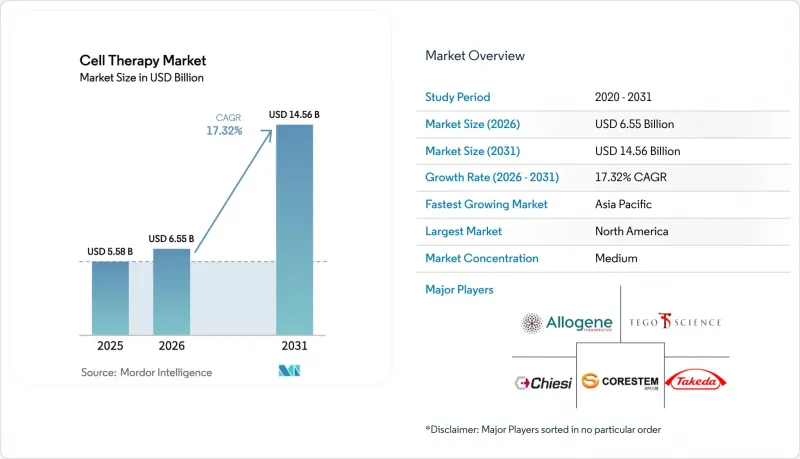
Mordor Intelligence에 의하면, 세포치료 시장 규모는 2025년 55억 8,000만 달러로 평가되었습니다. 2026년에는 65억 5,000만 달러로 확대되어 2031년까지 145억 6,000만 달러에 이를 것으로 예상되고 2026-2031년에 걸쳐 CAGR 17.32%로 성장할 전망입니다.
본 보고서는 치료 유형(자가 세포치료 및 동종 세포치료), 세포 유형(줄기세포치료, 기타), 용도(종양학, 심혈관 질환, 기타), 최종 사용자(병원 및 클리닉, 세포 및 유전자 치료 전문센터, 기타), 지역(북미, 유럽, 아시아태평양, 기타)별로 분류되어 있습니다. 시장 전망은 금액(달러) 기준으로 제시되어 있습니다.
세계의 세포치료 시장 동향 및 인사이트
자가 CAR-T 요법의 승인 및 상용화 증가
미국 식품의약국(FDA)과 유럽의약품청(EMA)은 2024년부터 2025년에 걸쳐 9개의 새로운 CAR-T 적응증을 승인하고, 심사 기간의 중앙값을 14개월에서 9개월로 단축했습니다. 노바티스는 여포성 림프종에 대한 적응증 확대에 따라 2025년 ‘킴리아(Kymriah)’의 매출이 6억 8,000만 달러에 달하고, 전년 대비 28% 성장을 기록했다고 보고했습니다. 2025년 유럽에서 3개의 자가 T세포 수용체 치료제가 조건부 승인을 받은 것은 고형암으로는 처음 있는 일이며, 이를 통해 2028년까지 21억 달러 규모의 잠재 시장이 열렸습니다. 2024년, 미국의 민간 보험사들은 5가지 CAR-T 제품에 대해 상환액의 30-50%를 6개월 시점의 완전 반응률에 연동시키는 방침을 제시하여 병원 측의 초기 위험을 완화했습니다. 일본 재생의학 분야의 패스트트랙 지정에 따라, 2상 임상시험 데이터에서 40% 이상의 객관적 반응이 확인된 후보 약물의 심사 기간이 절반으로 단축되었습니다.
동종 이식 파이프라인용 전 세계 CDMO 생산 능력 확충
각 CDMO 기업은 2024-2025년에 걸쳐 18만 리터의 동종 이식용 생산 능력을 신설했습니다. 여기에는 론자(Lonza)의 포츠머스 공장(5만 리터)과 찰스 리버(Charles River)의 라이덴 거점(4만 리터)이 포함됩니다. 기존 플랫폼을 통해 현재 치료용 배치를 48시간 이내에 제조할 수 있게 되었습니다. 이는 자가 유래 공정에서 소요되던 4-6주보다 대폭 단축된 것이며, 원가도 1회분당 35만 달러에서 7만 5,000달러로 하락했습니다. 알로젠 테라퓨틱스(Allogene Therapeutics)의 후보 약물 ‘ALPHA2’는 대세포형 B세포 림프종에서 67%의 완전 관해율을 달성했으며, 2026년 중반까지 미국에서 생물학적 제제 승인 신청을 목표로 하고 있습니다. Vertex와 CRISPR Therapeutics는 스위스의 베이스 편집 T세포 제조 시설에 4억 2,000만 달러를 투자하여 2028년까지 연간 10만 도즈 생산을 목표로 하고 있습니다. 삼성바이오로직스가 3억 달러를 투자한 인천 시설은 4건의 지역 계약을 확보했으며, 이는 아시아태평양공급망 현지화가 진행되고 있음을 보여줍니다.
부문별 분석
2025년, 자가 유래 제품은 성숙한 CAR-T 제품군과 확립된 상환 채널에 힘입어 세포치료 시장의 91.3% 점유율을 차지했습니다. 그러나 동종 이식 부문은 2031년까지 연평균 성장률(CAGR) 17.34%로 확대되고 있습니다. 이는 기성 제품 제공을 통해 4-6주의 제조 대기 시간이 해소되고, 제품 원가가 7만 5,000달러로 낮아지며, 물류가 효율화되기 때문입니다.
2025년, Vertex와 CRISPR Therapeutics가 연간 10만 회분 투여량을 생산할 수 있도록 설계된 스위스 제조 시설을 지원함에 따라 투자자들의 신뢰는 더욱 높아졌으며, 동종 이식 플랫폼의 확장성 측면에서 우위가 부각되었습니다. FDA의 비바이러스성 형질전환 승인 등 규제 측면의 유연성으로 인해 개발 기간이 단축된 반면, 성과 연동형 계약으로 인해 자가 유래 치료제 사업자의 이익률은 압박을 받고 있습니다. 따라서 동종 이식 후보 치료법은 이익률의 건전성을 훼손하지 않으면서도 경제적으로 소외된 지역에 비용 효율적으로 확산될 수 있는 기반을 세포치료 시장에 마련하고 있습니다.
2025년에는 면역 세포치료가 매출의 56.1%를 차지했으며, 그 대부분은 강력한 종양학 데이터로 뒷받침된 CAR-T 및 종양 침윤 림프구(TIL) 프로그램에서 비롯되었습니다. 중간엽 줄기세포와 유도 만능 줄기세포(iPSC) 후보 약물이 심혈관 질환 및 신경 질환에서 유효성을 보이고 있어, 줄기세포 플랫폼은 연평균 성장률(CAGR) 18.32%로 확대되고 있습니다.
메조블라스트(Mesoblast)사의 심부전을 대상으로 한 3상 임상시험에서는 주요 이상반응이 34% 감소했습니다. 한편, 다케다 제약(Takeda Pharmaceutical)의 iPSC 유래 심근 세포를 활용한 임상시험에서는 허혈성 심장 질환 환자 대상자 등록이 진행 중이며, 2026년에 첫 번째 시험 결과를 얻을 전망입니다. 스캐폴드 기술 및 3D 프린팅 기술 분야의 획기적인 발전이 줄기세포치료의 성장세를 더욱 가속화하고 있으며, 혈액 악성 종양 이외의 분야에서도 줄기세포치료가 세포치료 시장의 다변화를 주도하는 존재로 자리매김하고 있습니다.
지역별 분석
2025년, 북미는 54.2%의 점유율을 기록했으며, NTAP(국가 치료 지원 프로그램)는 1건당 8만-20만 달러를 지원했고, 5개의 민간 보험사가 결제 금액의 30-50%를 성과 연동형 모델로 전환했습니다. 2024-2025년에 걸쳐 CAR-T 요법의 승인 적응증은 9개로 증가했으며, 예스카르타(Yescarta)의 매출액은 22% 증가한 21억 달러에 달했습니다. 아페레시스실 이용률이 85%로 높은 수준을 기록함에 따라 6-8주의 대기 기간이 발생했고, 처리 능력의 한계가 부각되었습니다.
유럽 시장 점유율은 28%를 차지했습니다. 독일의 NUB(신규 용도 승인) 절차가 3건의 동종 이식 요법에 대한 승인을 가속화한 반면, NICE(영국 국립의료기술평가원)의 지침에 따라 영국에서 1억 2,000만 파운드의 자금이 조성되었습니다. 고형암을 표적으로 하는 T세포 수용체에 대한 조건부 승인으로 인해 유럽 시장에는 21억 달러 규모의 비즈니스 기회가 창출되었습니다. 그러나 2024년에 도입된 QALY(질 조정 생존 연수) 기준치에 따라 평균 35%의 가격 인하가 요구되면서 매출 확대의 기세가 둔화되고 있습니다.
아시아태평양은 17.89%라는 가장 높은 연평균 성장률(CAGR)을 기록했습니다. 중국에서 최초로 승인된 국산 CAR-T 치료제 ‘Carvykti’는 첫해에 2,500명의 다발성 골수종 환자를 대상으로 했습니다. 일본의 조건부 보험 급여 제도에서는 2상 임상 데이터가 승인되어야 하며, 7년간의 추적 조사가 의무화되어 있습니다. 한국에서는 2종의 국산 CAR-T 치료제가 40% 인하된 가격으로 보험 적용을 받아, 2025년에는 1,200명의 환자에게 제공되었습니다. 삼성바이오로직스공급망 현지화 및 CDMO(위탁 개발·제조) 역량 확대를 통해 이 지역은 세포치료 시장의 차세대 성장 동력으로서의 입지를 공고히 하고 있습니다.
기타 혜택
- 엑셀 형식 시장 예측(ME) 시트
- 3개월간 애널리스트 지원
자주 묻는 질문
목차
제1장 서론
제2장 조사 방법
제3장 주요 요약
제4장 시장 구도
제5장 시장 규모 및 성장 예측
제6장 경쟁 구도
제7장 시장 기회 및 향후 전망
KTH 26.08.28According to Mordor Intelligence, the cell therapy market size is expected to increase from USD 5.58 billion in 2025 to USD 6.55 billion in 2026 and reach USD 14.56 billion by 2031, growing at a CAGR of 17.32% over 2026-2031.
This report is Segmented by Therapy Type (Autologous Cell Therapy and Allogeneic Cell Therapy), by Cell Type (Stem Cell Therapy and More), Application (Oncology, Cardiovascular and More), End User (Hospitals & Clinics, Specialized Cell- & Gene-Therapy Centers, and More), and Geography (North America, Europe, Asia-Pacific, and More). The Market Forecasts are Provided in Terms of Value (USD).
Global Cell Therapy Market Trends and Insights
Rising Approvals and Commercial Launches of Autologous CAR-T Therapies
The United States Food and Drug Administration (FDA) and the European Medicines Agency (EMA) approved nine new CAR-T indications between 2024 and 2025, reducing median review time from 14 months to 9 months . Novartis reported USD 680 million in 2025 revenue for Kymriah, reflecting 28% growth following label expansion to follicular lymphoma. European conditional approvals for three autologous T-cell receptor therapies in 2025 were the first for solid tumors, unlocking a USD 2.1 billion addressable segment by 2028. United States commercial payers linked 30-50% of reimbursement to six-month complete response rates across five CAR-T products in 2024, lowering upfront risk for hospitals. Japan's regenerative-medicine fast-track designation halved review times for candidates with Phase 2 data showing >=40% objective responses.
Build-Out of Global CDMO Capacity for Allogeneic Pipelines
CDMOs installed 180,000 liters of allogeneic capacity from 2024 to 2025, including Lonza's 50,000-liter Portsmouth facility and Charles River's 40,000-liter Leiden site. Off-the-shelf platforms now generate a therapy batch within 48 hours, down from 4-6 weeks for autologous processes, and the cost-of-goods dropped from USD 350,000 to USD 75,000 per dose. Allogene Therapeutics' ALPHA2 candidate delivered 67% complete remission in large B-cell lymphoma and targets a U.S. biologics license filing by mid-2026. Vertex and CRISPR Therapeutics committed USD 420 million to a Swiss base-edited T-cell plant, aiming for 100,000 annual doses by 2028. Samsung Biologics' USD 300 million Incheon facility secured four regional contracts, signaling Asia-Pacific supply-chain localization.
Other drivers and restraints analyzed in the detailed report include:
- Expansion of National Reimbursement Pathways
- AI-Optimized Closed Bioreactor Systems Cutting COGs Greater Than 40%
- High Cost-of-Goods for Personalized Autologous Batches
- Viral-Vector and Plasmid Supply-Chain Bottlenecks
For complete list of drivers and restraints, kindly check the Table Of Contents.
Segment Analysis
Autologous products held 91.3% of the cell therapy market share in 2025, supported by mature CAR-T franchises and established reimbursement pathways. However, the allogeneic segment is advancing at a 17.34% CAGR through 2031 as off-the-shelf availability removes the 4-6 week manufacturing wait, lowers cost-of-goods to USD 75,000, and streamlines logistics.
Investor confidence intensified in 2025 when Vertex and CRISPR Therapeutics backed a Swiss plant designed for 100,000 doses annually, underscoring the scalability edge of allogeneic platforms. Regulatory flexibility, such as FDA acceptance of non-viral transfection, has shortened timelines, while outcomes-based contracting is tightening margins for autologous players. Allogeneic candidates, therefore, position the cell therapy market for cost-efficient penetration into less-affluent geographies without sacrificing margin integrity.
Immune-cell therapies dominated 56.1% revenue in 2025, largely from CAR-T and tumor-infiltrating lymphocyte programs endorsed by strong oncology data. Stem-cell platforms are expanding at an 18.32% CAGR as mesenchymal and induced pluripotent stem-cell (iPSC) candidates demonstrate efficacy in cardiovascular and neurological disorders.
Mesoblast's Phase 3 heart-failure trial cut major adverse events by 34%, while Takeda's iPSC cardiomyocytes are enrolling ischemic patients with the first readout expected in 2026. Breakthroughs in scaffold and 3D-printing technologies are further elevating stem-cell momentum, positioning them as the cell therapy market's diversification engine beyond hematologic malignancies.
Complete Report Scope:
- By Therapy Type
- Autologous Cell Therapy
- Allogeneic Cell Therapy
- By Cell Type
- Stem Cell Therapy
- Hematopoietic Stem Cells
- Mesenchymal Stem Cells
- Induced Pluripotent Stem Cells
- Immune Cell Therapy
- T-Cell Therapy (incl. CAR-T, TCR-T)
- NK-Cell Therapy
- Dendritic Cell Therapy
- Fibroblast & Chondrocyte-based Therapies
- Stem Cell Therapy
- By Application
- Oncology
- Autoimmune Disorders
- Cardiovascular Diseases
- Orthopedic & Musculoskeletal
- Neurological Disorders
- Wound Healing & Dermatology
- Ophthalmology
- By End User
- Hospitals & Clinics
- Specialized Cell- & Gene-Therapy Centers
- Academic & Research Institutes
- Contract Manufacturing & CRO Facilities
- By Geography
- North America
- United States
- Canada
- Mexico
- Europe
- Germany
- United Kingdom
- France
- Italy
- Spain
- Rest of Europe
- Asia-Pacific
- China
- Japan
- India
- South Korea
- Australia
- Rest of APAC
- Middle East & Africa
- GCC
- South Africa
- Rest of Middle East & Africa
- South America
- Brazil
- Argentina
- Rest of South America
- North America
Geography Analysis
North America recorded a 54.2% share in 2025, with NTAP covering USD 80,000-200,000 per case and five commercial insurers shifting 30-50% payment to outcome-based models. Approvals rose to nine indications for CAR-T therapy between 2024-2025, and Yescarta revenue grew 22% to USD 2.1 billion. High apheresis-suite utilization at 85% created 6-8-week waits, underscoring capacity constraints.
Europe held a 28% share as Germany's NUB pathway accelerated billing for three allogeneic therapies, while NICE guidance released GBP 120 million in U.K. funding. Conditional approvals for T-cell receptors targeting solid tumors opened a USD 2.1 billion European opportunity. However, QALY thresholds introduced in 2024 require an average of 35% discounts, tempering revenue expansion.
Asia-Pacific registered the fastest 17.89% CAGR; China's first domestic CAR-T approval, Carvykti, addressed 2,500 multiple-myeloma patients in year one. Japan's conditional reimbursement route accepted Phase 2 data with a mandatory seven-year follow-up. South Korea reimbursed two local CAR-Ts at 40% lower prices, serving 1,200 patients in 2025. Supply-chain localization via Samsung Biologics and growing CDMO capacity are consolidating the region as the cell therapy market's next growth engine.
- Novartis
- Gilead Sciences
- Bristol-Myers Squibb
- Johnson & Johnson (Janssen Biotech)
- Legend Biotech Corporation
- Fate Therapeutics Inc.
- Bluebird Bio
- Allogene Therapeutics
- Sangamo Therapeutics
- CRISPR Therapeutics AG
- Mesoblast Limited
- Vericel
- Glycostem Therapeutics BV
- Celyad Oncology SA
- Iovance Biotherapeutics Inc.
- CARsgen Therapeutics Holdings
- JW Therapeutics Co. Ltd.
- Takeda Pharmaceuticals
- Astellas Pharma
- Vertex Pharmaceuticals Inc.
- Sanofi
- Century Therapeutics Inc.
- Be The Match BioTherapies
- Lonza Group
- Charles River
Additional Benefits:
- The market estimate (ME) sheet in Excel format
- 3 months of analyst support
TABLE OF CONTENTS
1 Introduction
- 1.1 Study Assumptions & Market Definition
- 1.2 Scope of the Study
2 Research Methodology
3 Executive Summary
4 Market Landscape
- 4.1 Market Overview
- 4.2 Market Drivers
- 4.2.1 Rising Approvals & Commercial Launches of Autologous CAR-T Therapies
- 4.2.2 Build-out of Global CDMO Capacity for Allogeneic Pipelines
- 4.2.3 Expansion of National Reimbursement Pathways (e.g., Germany NUB, U.S. NTAP)
- 4.2.4 Indication Expansion Beyond Oncology into Autoimmune & Cardiovascular Diseases
- 4.2.5 AI-optimised Closed Bioreactor Systems Cutting COGs Above 40 %
- 4.2.6 Integration of 3-D Bioprinted Scaffolds Enabling Combination Implants
- 4.3 Market Restraints
- 4.3.1 High Cost-of-goods for Personalized Autologous Batches
- 4.3.2 Viral-vector & Plasmid Supply-chain Bottlenecks
- 4.3.3 Long-term Genomic-Integrity Data Gaps Post-editing
- 4.3.4 ESG Scrutiny of Donor-tissue Sourcing & Cryogenic-shipping Sustainability
- 4.4 Value Supply-Chain Analysis
- 4.5 Regulatory Landscape
- 4.6 Technological Outlook
- 4.7 Porter's Five Forces
- 4.7.1 Threat of New Entrants
- 4.7.2 Bargaining Power of Suppliers
- 4.7.3 Bargaining Power of Buyers
- 4.7.4 Threat of Substitutes
- 4.7.5 Competitive Rivalry
5 Market Size & Growth Forecasts
- 5.1 By Therapy Type
- 5.1.1 Autologous Cell Therapy
- 5.1.2 Allogeneic Cell Therapy
- 5.2 By Cell Type
- 5.2.1 Stem Cell Therapy
- 5.2.1.1 Hematopoietic Stem Cells
- 5.2.1.2 Mesenchymal Stem Cells
- 5.2.1.3 Induced Pluripotent Stem Cells
- 5.2.2 Immune Cell Therapy
- 5.2.2.1 T-Cell Therapy (incl. CAR-T, TCR-T)
- 5.2.2.2 NK-Cell Therapy
- 5.2.2.3 Dendritic Cell Therapy
- 5.2.3 Fibroblast & Chondrocyte-based Therapies
- 5.2.1 Stem Cell Therapy
- 5.3 By Application
- 5.3.1 Oncology
- 5.3.2 Autoimmune Disorders
- 5.3.3 Cardiovascular Diseases
- 5.3.4 Orthopedic & Musculoskeletal
- 5.3.5 Neurological Disorders
- 5.3.6 Wound Healing & Dermatology
- 5.3.7 Ophthalmology
- 5.4 By End User
- 5.4.1 Hospitals & Clinics
- 5.4.2 Specialized Cell- & Gene-Therapy Centers
- 5.4.3 Academic & Research Institutes
- 5.4.4 Contract Manufacturing & CRO Facilities
- 5.5 By Geography
- 5.5.1 North America
- 5.5.1.1 United States
- 5.5.1.2 Canada
- 5.5.1.3 Mexico
- 5.5.2 Europe
- 5.5.2.1 Germany
- 5.5.2.2 United Kingdom
- 5.5.2.3 France
- 5.5.2.4 Italy
- 5.5.2.5 Spain
- 5.5.2.6 Rest of Europe
- 5.5.3 Asia-Pacific
- 5.5.3.1 China
- 5.5.3.2 Japan
- 5.5.3.3 India
- 5.5.3.4 South Korea
- 5.5.3.5 Australia
- 5.5.3.6 Rest of APAC
- 5.5.4 Middle East & Africa
- 5.5.4.1 GCC
- 5.5.4.2 South Africa
- 5.5.4.3 Rest of Middle East & Africa
- 5.5.5 South America
- 5.5.5.1 Brazil
- 5.5.5.2 Argentina
- 5.5.5.3 Rest of South America
- 5.5.1 North America
6 Competitive Landscape
- 6.1 Market Concentration
- 6.2 Market Share Analysis
- 6.3 Company Profiles (includes Global level Overview, Market level overview, Core Segments, Financials as available, Strategic Information, Market Rank/Share for key companies, Products & Services, and Recent Developments)
- 6.3.1 Novartis AG
- 6.3.2 Gilead Sciences Inc. (Kite Pharma)
- 6.3.3 Bristol Myers Squibb Company
- 6.3.4 Johnson & Johnson (Janssen Biotech)
- 6.3.5 Legend Biotech Corporation
- 6.3.6 Fate Therapeutics Inc.
- 6.3.7 Bluebird Bio Inc.
- 6.3.8 Allogene Therapeutics Inc.
- 6.3.9 Sangamo Therapeutics Inc.
- 6.3.10 CRISPR Therapeutics AG
- 6.3.11 Mesoblast Limited
- 6.3.12 Vericel Corporation
- 6.3.13 Glycostem Therapeutics BV
- 6.3.14 Celyad Oncology SA
- 6.3.15 Iovance Biotherapeutics Inc.
- 6.3.16 CARsgen Therapeutics Holdings
- 6.3.17 JW Therapeutics Co. Ltd.
- 6.3.18 Takeda Pharmaceutical Company Ltd.
- 6.3.19 Astellas Pharma Inc.
- 6.3.20 Vertex Pharmaceuticals Inc.
- 6.3.21 Sanofi S.A.
- 6.3.22 Century Therapeutics Inc.
- 6.3.23 Be The Match BioTherapies
- 6.3.24 Lonza Group AG
- 6.3.25 Charles River Laboratories International Inc.
7 Market Opportunities & Future Outlook
- 7.1 White-space & Unmet-Need Assessment