

|
시장보고서
상품코드
2114927
수의용 MRI 시장 : 시장 점유율 분석, 업계 동향 및 통계, 성장 예측(2026-2031년)Global Veterinary MRI - Market Share Analysis, Industry Trends & Statistics, Growth Forecasts (2026 - 2031) |
||||||
 Mordor Intelligence
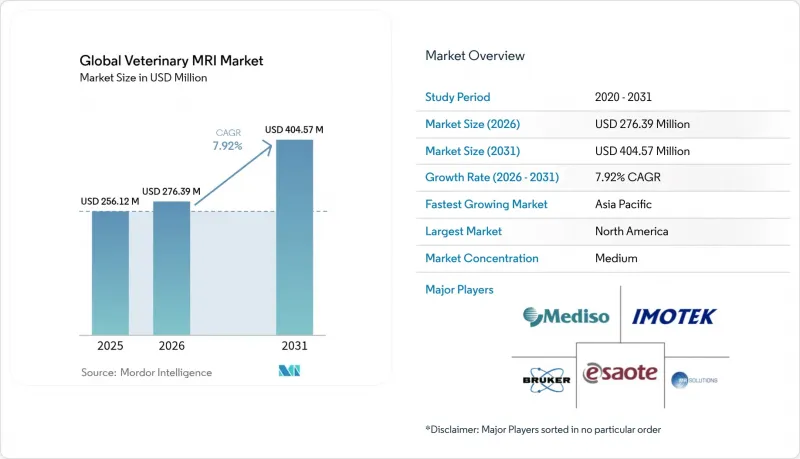
Mordor Intelligence에 의하면, 수의용 MRI 시장 규모는 2025년 2억 5,612만 달러로 평가되었고, 2026년에는 2억 7,639만 달러로 추정되고, 2026-2031년 CAGR 7.92%로 성장을 지속할 전망이며, 2031년에는 4억 457만 달러에 이를 것으로 예측됩니다.
본 보고서는 제품 유형별(MRI 시스템, 영상 처리 소프트웨어, 소모품), 용도별(신경학, 정형외과·근골격계, 기타), 동물 유형별(소형 반려동물, 말, 기타), 최종 사용자별(동물병원, 기타), 지역별(북미, 유럽, 아시아태평양, 중동 및 아프리카, 남미)로 분류되어 있습니다. 시장 예측은 금액(100만 달러) 단위로 제시되어 있습니다.
세계의 수의용 MRI 시장 동향 및 인사이트
반려동물 사육 두수 증가와 반려동물의 건강을 위한 지출 증가
세계 반려동물 관리 지출은 반려동물을 가족의 일원으로 여기는 밀레니얼 세대와 Z세대의 주도 하에 2030년까지 2,790억 달러에 달할 것으로 예측됩니다. 개의 MRI 검사 비용은 2,500-6,000달러에 달하지만, 비용의 70%-90%를 보장하는 보험 플랜을 통한 환급이 점점 늘어나고 있습니다. 이러한 고액 진단 검사에 대한 비용 부담 의지가 수의용 MRI 시장의 꾸준한 성장세를 뒷받침하고 있습니다. 유럽의 반려동물 의료비는 연평균 성장률(CAGR) 6.4%를 기록하며, 첨단 영상 진단에 대한 장기적인 수요를 뒷받침하고 있습니다. 도시 지역에서는 가구 규모가 작아질수록 반려동물에 대한 선택적 지출이 집중되어 프리미엄 케어의 도입을 촉진하고 있습니다. 이러한 추세는 예측 기간 동안 지속적인 수요 증가를 시사합니다.
수의용 MRI 하드웨어 및 소프트웨어의 기술적 진보
헬륨을 사용하지 않는 아키텍처 덕분에 냉각제 사용량이 1,500리터에서 1리터 미만으로 줄어들어 운영상의 복잡성이 크게 완화되었습니다. AI 기반 재구성 기술로 스캔 시간이 최대 50% 단축되는 동시에 신호 대 잡음비(S/N비)가 향상되어, 임상의가 더 신속하게 진단할 수 있게 되었습니다. 브루커(Bruker)사의 d-DNP 편광기는 1만 배 이상의 신호 증폭을 실현하여 종양학 연구의 기회를 확대되고 있습니다. 소비 전력이 불과 1,800W인 저자기장 0.05T 시스템은 기존 25kW 장치에 비해 에너지 비용을 절감합니다. 이러한 획기적인 발전들이 결합되어 도입 장벽이 낮아지면서 수의용 MRI 시장이 확대되고 있습니다.
MRI 시스템의 높은 초기 도입 비용과 유지 관리 비용
구매 가격은 리퍼브 저자기장 장치의 경우 15만 달러부터, 고자기장 스캐너의 경우 100만 달러 이상에 달할 전망입니다. 또한 구형 기계의 경우 연간 3만 달러 상당 이상의 헬륨을 소비하는 경우도 있습니다. 설치에는 차폐실과 보강된 바닥이 필요하기 때문에 소규모 동물병원에게는 설비 투자 부담이 큽니다. 그로 인해 개인 동물병원은 이동식 서비스나 공동 이용 센터를 이용하는 경향이 있으며, 구매를 미루는 바람에 수의용 MRI 시장 규모 확대가 둔화되고 있습니다. 헬륨을 사용하지 않는 자석은 비용 면에서의 격차를 줄이는 데 일조하고 있지만, 도입은 여전히 초기 단계에 머물러 있습니다.
부문 분석
시스템 부문은 2025년 매출의 74.86%를 차지했으며, 수의용 MRI 시장에서 그 매우 중요한 역할을 부각시켰습니다. 표준 진료실에서 작동 가능한 헬륨이 없는 1.5T 콘솔의 도입으로 시설 개보수 예산을 절감할 수 있어 전 세계적인 수요가 뒷받침되고 있습니다. Hallmarq는 2024년에 최초의 무헬륨 소형 동물용 스캐너를 출시했습니다. 이는 기술의 급속한 보급을 뒷받침하는 획기적인 사건입니다. 또한, AI 지원 콘솔에는 스캔 시간을 최대 50% 단축하는 재구성 알고리즘이 사전 설치되어 있어, 일일 검사 처리 능력을 향상시키고 있습니다.
소모품(조영제, 위치 조정 보조 기구, 유지보수 키트)은 2025년 현재 점유율이 미미한 수준에 그치고 있지만, 연평균 성장률(CAGR) 8.86%를 나타낼 것으로 예측되어 제품 카테고리 중 가장 높은 성장률을 보이고 있습니다. 증례 수 증가로 인해 연금과 같은 안정적인 수익원이 창출되는 한편, 가돌리늄 프리 제제에 대한 규제 당국의 승인으로 임상에서의 사용 범위가 확대되고 있습니다. 이미징 소프트웨어는 매출 규모는 작지만, 초기 비용이 많이 드는 라이선스보다 운영비 예산을 중시하는 동물병원에서 구독 모델이 받아들여짐에 따라 꾸준히 성장하고 있습니다. 이러한 동향들이 맞물려 수의용 MRI 시장의 지속적인 확장을 뒷받침하는 다양한 수익 구조가 강화되고 있습니다.
2025년 매출 중 신경학 부문이 35.02%를 차지했는데, 이는 X선 촬영이나 초음파 검사만으로는 충분히 특징을 파악할 수 없는 뇌종양, 척수 손상, 발작성 질환의 평가에서 MRI가 중심적인 역할을 하고 있음을 보여줍니다. 고자장 자석과 위상 배열 코일을 결합함으로써 1mm 이하의 해상도가 실현되었으며, 이는 미세한 두개내 병변의 매핑에 필수적입니다. AI를 활용한 분할을 통해 병변의 경계가 더욱 정교해져, 검사 보고서 작성 기간 단축과 임상의의 확신 제도로 이어지고 있습니다.
한편, 예방 의료의 발전으로 반려동물의 수명이 연장되고 암 유병률이 증가함에 따라, 종양학 분야의 적용은 연평균 성장률(CAGR) 9.28%로 성장을 지속하고, 있습니다. 동적 조영제 강화 MRI를 통해 종양의 혈관 변화를 조기에 감지할 수 있게 되어, 수술 계획 및 방사선 치료의 표적 설정에 활용되고 있습니다. 또한, 의식이 있는 환자의 움직임으로 인한 아티팩트를 줄여주는 정교한 시퀀싱에 힘입어, 심흉부 검사 프로토콜도 보급이 확대되고 있습니다. 정형외과 부문에서는 마취 위험을 제거하는 입식 MRI의 도입이 성과를 거두고 있어, 경주마의 힘줄 치료 상황을 반복적으로 모니터링할 수 있게 되었습니다. 이러한 동향들이 맞물려 전문적인 임상 적응증 분야에서 수의용 MRI 시장 규모를 확대시키고 있습니다.
지역별 분석
2025년, 북미는 전 세계 매출의 44.15%를 차지한 것으로 평가되었으며, 그 배경에는 미국 내 보험에 가입된 반려동물의 수가 많고 AI 지원 스캐너가 조기에 도입된 점이 있습니다. 콜로라도 주립대학교와 펜실베니아 대학교 수의과대학에서는 임상 환자와 중개 연구 모두에 활용되는 여러 대의 고자기장 자석을 운영하고 있습니다. 캐나다에서는 민관 공동 연구 보조금이 헬륨 프리 시스템의 구매를 촉진하고 있는 반면, 멕시코에서는 신흥 중산층이 민간 클리닉의 장비 교체를 뒷받침하고 있습니다. ‘동물·수의학 혁신 의제’를 통한 FDA와의 지속적인 협력을 통해 새로운 코일 및 소프트웨어의 승인이 신속화되어, 해당 지역의 리더십이 강화되고 있습니다.
유럽은 2위를 차지하고 있으며, 엄격한 동물 복지법과 MRI 프로토콜에 관한 진료 지침을 발행하는 유럽 수의진단영상학회(EAVDI) 등 활발한 전문 단체들의 혜택을 받고 있습니다. 독일, 프랑스, 영국이 스캐너 설치 대수에서 주도적인 위치를 차지하고 있지만, 이탈리아와 스페인도 소규모 클리닉을 전국 규모의 그룹으로 통합함으로써 MRI 투자 자금을 조달할 수 있게 하는 사업 재편을 통해 빠르게 추격하고 있습니다. EU 의료기기 규정(MDR)은 안전성과 성능 기준을 통일하여 임상의의 신뢰를 높이고, 기기 교체 주기를 가속화하고 있습니다.
아시아태평양은 중국과 한국의 반려동물 보유 수 증가, 일본과 호주의 첨단 연구 생태계에 힘입어 연평균 성장률(CAGR) 9.98%로 가장 빠르게 성장하고 있는 지역입니다. 일본에는 대학 및 사립 병원에 100대 이상의 동물용 MRI 장비가 도입되어 있으며, 그 중 다수는 가동률을 극대화하기 위해 연구와 임상을 병행하는 하이브리드 운영 형태를 취하고 있습니다. 캐논 메디컬 시스템즈의 인도 내 유통업체 네트워크는 최근 인간용 스캐너에 수의학 전용 시퀀싱를 추가하여 클리닉의 추가 비용을 절감했습니다. 싱가포르와 태국에서 시행되고 있는 정부 주도의 반려동물 건강 보험 시범 사업은 규모는 제한적이지만, 향후 성장에 더욱 탄력을 줄 가능성을 시사하고 있습니다. 중동 및 아프리카와 남미는 여전히 초기 단계 시장이지만, 가처분 소득 증가와 원격 멘토링을 통한 전문 지식의 보급에 따라 장기적인 성장 여지가 있습니다.
기타 혜택
- 엑셀 형식 시장 예측(ME) 시트
- 3개월간의 애널리스트 지원
자주 묻는 질문
목차
제1장 서론
제2장 조사 방법
제3장 주요 요약
제4장 시장 구도
제5장 시장 규모 및 성장 예측
제6장 경쟁 구도
제7장 시장 기회 및 향후 전망
AJY 26.08.28According to Mordor Intelligence, the veterinary MRI market size is expected to grow from USD 256.12 million in 2025 to USD 276.39 million in 2026 and is forecast to reach USD 404.57 million by 2031 at 7.92% CAGR over 2026-2031.
This report is Segmented by Product Type (MRI Systems, Imaging Software, Consumables), Application (Neurology, Orthopedics & Musculoskeletal, and More), Animal Type (Small Companion Animals, Equine, and More), End User (Veterinary Hospitals, and More), and Geography (North America, Europe, Asia-Pacific, Middle East & Africa, South America). The Market Forecasts are Provided in Terms of Value (USD Million).
Global Veterinary MRI Market Trends and Insights
Growing Pet Ownership & Rising Spend On Companion-Animal Health
Global pet care expenditure is projected to climb to USD 279 billion by 2030, largely driven by millennials and Gen Z who treat pets as family members . MRI scans for dogs can cost USD 2,500-6,000 yet are increasingly reimbursed by insurance plans covering 70%-90% of fees. This willingness to finance high-value diagnostics underpins steady utilization growth in the veterinary MRI market. Europe's companion-animal health outlays are tracking a 6.4% CAGR, reinforcing long-term demand for advanced imaging. In urban centers, smaller household sizes concentrate discretionary spend on pets, fueling premium care adoption. These patterns signal durable volume expansion through the forecast horizon.
Technological Advances In Veterinary MRI Hardware & Software
Helium-free architectures slash operating complexity by reducing coolant volumes from 1,500 L to under 1 L. AI reconstruction now shortens scans by up to 50% while improving signal-to-noise ratios, letting clinicians deliver faster diagnoses. Bruker's d-DNP polarizer achieves >10,000X signal gains, broadening oncology research opportunities. Low-field 0.05 T systems that draw only 1,800 W of power cut energy costs relative to conventional 25 kW units . Collectively, these breakthroughs lower ownership barriers and widen the veterinary MRI market.
High Upfront & Maintenance Cost Of MRI Systems
Purchase prices span USD 150,000 for refurbished low-field units to over USD 1 million for high-field scanners, while older designs can consume helium worth more than USD 30,000 per year. Installation demands shielded rooms and reinforced floors, raising capital needs for smaller clinics. Independent practices thus lean toward mobile services or shared centers, delaying purchases and tempering veterinary MRI market size expansion. Helium-free magnets are helping narrow the affordability gap but remain early in the adoption curve.
Other drivers and restraints analyzed in the detailed report include:
- Higher Incidence Of Chronic Neurological & Orthopedic Disorders In Pets
- Shift Toward Standing Equine MRI Reducing Anesthesia Risk & Throughput Time
- Shortage Of Board-Certified Veterinary Radiologists
For complete list of drivers and restraints, kindly check the Table Of Contents.
Segment Analysis
The systems segment generated 74.86% of 2025 revenue, underscoring its pivotal role in the veterinary MRI market. Global demand is buoyed by installation of helium-free 1.5 T consoles that can operate in standard exam rooms, trimming facility modification budgets. Hallmarq installed the first zero-helium small-animal scanner in the United States in 2024, a milestone that underscores rapid technology diffusion. AI-ready consoles are also shipping with pre-loaded reconstruction algorithms that shrink scan times by up to 50%, elevating daily study throughput.
Consumables-contrast agents, positioning aids, and maintenance kits-captured a modest share in 2025 yet are forecast for 8.86% CAGR, the fastest among product categories. Rising case volumes create annuity-like revenue streams, while regulatory approvals of gadolinium-free formulations widen clinical use. Imaging software, although a smaller revenue pool, grows steadily as subscription models gain acceptance among clinics that prefer operating-expense budgeting over upfront licenses. Collectively, these dynamics reinforce the diversified revenue profile that underpins sustained expansion of the veterinary MRI market.
Neurology accounted for 35.02% of 2025 revenue, illustrating MRI's centrality in evaluating brain tumors, spinal injuries, and seizure disorders that cannot be characterized adequately with radiography or ultrasonography. High-field magnets combined with phased-array coils deliver sub-millimeter resolution, critical for mapping subtle intracranial lesions. AI-powered segmentation further refines lesion boundaries, accelerating report turnaround and clinician confidence.
Oncology applications, however, are charting 9.28% CAGR as cancer prevalence rises in pets living longer under improved preventive care. Dynamic contrast-enhanced MRI allows earlier detection of vascular changes in neoplasms, guiding surgical planning and radiotherapy targeting. Cardiothoracic protocols are also gaining popularity, propelled by refined sequences that reduce motion artifacts in conscious patients. Orthopedic studies benefit from standing MRI adoption that eliminates anesthesia risks, enabling repetitive monitoring of tendon healing in performance horses. These trends collectively augment the veterinary MRI market size for specialized clinical indications.
Complete Report Scope:
- By Product Type
- MRI Systems
- Imaging Software
- Consumables
- By Application
- Neurology
- Orthopedics & Musculoskeletal
- Oncology
- Cardiology & Thoracic
- Other Applications
- By Animal Type
- Small Companion Animals
- Equine
- Livestock & Large Animals
- Exotic & Zoo Animals
- By End User
- Veterinary Hospitals
- Veterinary Clinics
- Others
- By Geography
- North America
- United States
- Canada
- Mexico
- Europe
- Germany
- United Kingdom
- France
- Italy
- Spain
- Rest of Europe
- Asia-Pacific
- China
- Japan
- India
- Australia
- South Korea
- Rest of Asia-Pacific
- Middle East & Africa
- GCC
- South Africa
- Rest of Middle East & Africa
- South America
- Brazil
- Argentina
- Rest of South America
- North America
Geography Analysis
North America retained 44.15% of global revenue in 2025, anchored by the United States' large insured companion-animal population and early adoption of AI-ready scanners. Veterinary schools at Colorado State University and University of Pennsylvania operate multiple high-field magnets that serve both clinical clients and translational research. Canada's public-private research grants incentivize purchase of helium-free systems, while Mexico's emerging middle class fuels private clinic upgrades. Continuous FDA engagement through the Animal and Veterinary Innovation Agenda speeds approval of novel coils and software, reinforcing regional leadership .
Europe ranked second, benefitting from stringent welfare statutes and active professional bodies such as the European Association of Veterinary Diagnostic Imaging, which issues practice guidelines on MRI protocols. Germany, France, and the United Kingdom dominate scanner installations, but Italy and Spain are catching up through consolidation plays that roll smaller clinics into national groups able to finance MRI investments. EU Medical Device Regulation harmonizes safety and performance benchmarks, boosting clinician confidence and accelerating replacement cycles.
Asia-Pacific is the fastest-growing region at 9.98% CAGR, propelled by rising pet ownership in China and South Korea and advanced research ecosystems in Japan and Australia. Japan hosts more than 100 animal MRI units in universities and private hospitals, many operating in hybrid research-clinical modes that maximize uptime. Canon Medical Systems' distributor network in India recently added veterinary-specific sequences to human scanners, reducing incremental costs for clinics. Government-sponsored pet health insurance pilots in Singapore and Thailand, though limited, hint at additional tailwinds. The Middle East & Africa and South America remain early-stage markets but offer long-run upside as disposable incomes rise and expertise diffuses via tele-mentoring.
- Esaote
- Hallmarq Veterinary Imaging Ltd
- Imotek International
- Universal Medical Systems
- Bruker
- MR Solutions
- Burgess Diagnostics
- Mindray
- Mediso
- Animal Imaging Partners
- Time Medical Systems
- Aspect Imaging Ltd.
- Canon
- Siemens Healthineers
- GE HealthCare Technologies Inc.
- Fujifilm Healthcare Corporation
- Animage
- Epica Animal Health
- JPI Healthcare Solutions
- Agfa-Gevaert
Additional Benefits:
- The market estimate (ME) sheet in Excel format
- 3 months of analyst support
TABLE OF CONTENTS
1 Introduction
- 1.1 Study Assumptions & Market Definition
- 1.2 Scope of the Study
2 Research Methodology
3 Executive Summary
4 Market Landscape
- 4.1 Market Overview
- 4.2 Market Drivers
- 4.2.1 Growing Pet Ownership & Rising Spend On Companion-Animal Health
- 4.2.2 Technological Advances In Veterinary Mri Hardware & Software
- 4.2.3 Higher Incidence Of Chronic Neurological & Orthopedic Disorders In Pets
- 4.2.4 Shift Toward Standing Equine Mri Reducing Anesthesia Risk & Throughput Time
- 4.2.5 Helium-Free Compact Magnets Lowering Facility Barriers
- 4.2.6 Ai-Assisted Image Reconstruction Enabling Low-Field Systems Adoption
- 4.3 Market Restraints
- 4.3.1 High Upfront & Maintenance Cost Of Mri Systems
- 4.3.2 Shortage Of Board-Certified Veterinary Radiologists
- 4.3.3 Absence Of Reimbursement Pathways For Advanced Imaging In Most Regions
- 4.3.4 Global Helium Supply Volatility Impacting Operational Costs
- 4.4 Value / Supply-Chain Analysis
- 4.5 Regulatory Landscape
- 4.6 Technological Outlook
- 4.7 Porter's Five Forces Analysis
- 4.7.1 Bargaining Power of Suppliers
- 4.7.2 Bargaining Power of Buyers
- 4.7.3 Threat of New Entrants
- 4.7.4 Threat of Substitutes
- 4.7.5 Competitive Rivalry
5 Market Size & Growth Forecasts (Value - USD Million)
- 5.1 By Product Type
- 5.1.1 MRI Systems
- 5.1.2 Imaging Software
- 5.1.3 Consumables
- 5.2 By Application
- 5.2.1 Neurology
- 5.2.2 Orthopedics & Musculoskeletal
- 5.2.3 Oncology
- 5.2.4 Cardiology & Thoracic
- 5.2.5 Other Applications
- 5.3 By Animal Type
- 5.3.1 Small Companion Animals
- 5.3.2 Equine
- 5.3.3 Livestock & Large Animals
- 5.3.4 Exotic & Zoo Animals
- 5.4 By End User
- 5.4.1 Veterinary Hospitals
- 5.4.2 Veterinary Clinics
- 5.4.3 Others
- 5.5 By Geography
- 5.5.1 North America
- 5.5.1.1 United States
- 5.5.1.2 Canada
- 5.5.1.3 Mexico
- 5.5.2 Europe
- 5.5.2.1 Germany
- 5.5.2.2 United Kingdom
- 5.5.2.3 France
- 5.5.2.4 Italy
- 5.5.2.5 Spain
- 5.5.2.6 Rest of Europe
- 5.5.3 Asia-Pacific
- 5.5.3.1 China
- 5.5.3.2 Japan
- 5.5.3.3 India
- 5.5.3.4 Australia
- 5.5.3.5 South Korea
- 5.5.3.6 Rest of Asia-Pacific
- 5.5.4 Middle East & Africa
- 5.5.4.1 GCC
- 5.5.4.2 South Africa
- 5.5.4.3 Rest of Middle East & Africa
- 5.5.5 South America
- 5.5.5.1 Brazil
- 5.5.5.2 Argentina
- 5.5.5.3 Rest of South America
- 5.5.1 North America
6 Competitive Landscape
- 6.1 Market Concentration
- 6.2 Market Share Analysis
- 6.3 Company Profiles (includes Global-level Overview, Market-level Overview, Core Segments, Financials as available, Strategic Information, Market Rank/Share for key companies, Products & Services, and Recent Developments)
- 6.3.1 Esaote SpA
- 6.3.2 Hallmarq Veterinary Imaging Ltd
- 6.3.3 Imotek International Ltd
- 6.3.4 Universal Medical Systems Inc.
- 6.3.5 Bruker Corporation
- 6.3.6 MR Solutions Ltd
- 6.3.7 Burgess Diagnostics Ltd
- 6.3.8 Shenzhen Mindray Bio-Medical Electronics Co., Ltd.
- 6.3.9 Mediso Ltd
- 6.3.10 Animal Imaging Partners
- 6.3.11 Time Medical Systems
- 6.3.12 Aspect Imaging Ltd.
- 6.3.13 Canon Medical Systems Corporation
- 6.3.14 Siemens Healthineers AG
- 6.3.15 GE HealthCare Technologies Inc.
- 6.3.16 Fujifilm Healthcare Corporation
- 6.3.17 Animage LLC
- 6.3.18 Epica Animal Health
- 6.3.19 JPI Healthcare Solutions
- 6.3.20 Agfa-Gevaert Group
7 Market Opportunities & Future Outlook
- 7.1 White-space & Unmet-need Assessment


