

|
시장보고서
상품코드
2114942
산화아연 시장 : 점유율 분석, 업계 동향과 통계, 성장 예측(2026-2031년)Zinc Oxide - Market Share Analysis, Industry Trends & Statistics, Growth Forecasts (2026 - 2031) |
||||||
 Mordor Intelligence
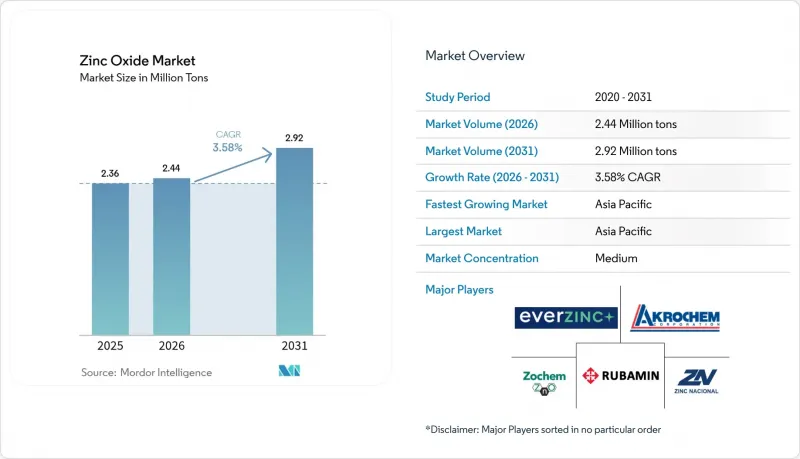
Mordor Intelligence에 의하면, 2026년 산화아연 시장 규모는 244만 톤으로 추정되고 있고 2025년 236만 톤에서 확대되어 2031년에는 292만 톤에 이를 것으로 예측됩니다.
2026년부터 2031년까지 연평균 성장률(CAGR) 3.58%로 성장할 것으로 전망됩니다.
본 보고서는 제조 공정(간접법, 직접법, 습식 화학법), 용도(고무·타이어, 세라믹 및 유리, 의약품 및 화장품, 농업, 페인트 및 코팅, 기타 용도) 및 지역(아시아태평양, 북미, 유럽, 남미, 중동 및 아프리카)별로 분류되어 있습니다. 시장 전망은 수량(톤) 기준으로 제시되어 있습니다.
세계 산화아연 시장 동향 및 인사이트
고무·타이어 업계의 견조한 수요
세계 타이어 제조업체들은 내후성과 기계적 내구성을 높이는 가황 촉진제로 산화아연에 의존하고 있습니다. 전기자동차의 차체 중량과 토크가 증가함에 따라 이러한 특성은 점점 더 중요해지고 있습니다. JG Chemicals의 보고서에 따르면, 이 회사의 연간 생산량 59,904 MTPA 중 자동차 용도가 약 30%를 차지하고 있으며, 이 부문이 아시아 공급업체에 미치는 견인력이 부각되고 있습니다. 나노 등급의 산화아연을 채택함으로써 성능을 유지하면서 컴파운드당 아연 사용량을 최대 40%까지 줄일 수 있어, 타이어 제조업체는 주행 거리를 희생하지 않고도 점점 엄격해지는 배출 기준을 달성할 수 있게 됩니다. 현재 일부 대규모 공장에서는 재생 금속 사용률이 90%를 초과하여 비용과 탄소 강도를 모두 낮추고 있습니다. 전 세계 자동차 생산의 회복과 맞물려, 이러한 요인들이 산화아연 시장의 꾸준한 상승 추세를 뒷받침하고 있습니다.
화장품 및 자외선 차단제 제형의 확대
규제 당국이 옥시벤존 등의 화학 물질 사용을 제한함에 따라, 무기질 자외선 차단제는 호재를 맞이하고 있습니다. ‘GRASE(일반적으로 안전하다고 인정되는)’로 인정받는 산화아연의 광범위한 보호 효과는 기존 문제였던 백탁 현상을 해소하는 초미세 등급에 대한 수요를 촉진하고 있습니다. GMP 기준에 따라 제조된 EverZinc사의 ‘Zano’ 포트폴리오는 에코서트(Ecocert) 및 코스모스(Cosmos) 인증을 획득한 투명한 분산액을 제공하며, ‘클린 뷰티’라는 포지셔닝에 부합합니다. 표면 처리된 입자는 높은 SPF를 유지하면서도 피부 감촉을 개선하여, 아시아태평양의 프리미엄 스킨케어 라인과 북미의 산호초 친화적인 자외선 차단 제품에의 채택을 가속화하고 있습니다. 식물 추출물을 활용한 친환경적인 합성 방법은 건강 지향적인 소비자를 대상으로 제품의 차별화를 한층 더 강화하고 있습니다.
아연 농축물의 가격 변동
공급 차질과 지정학적 긴장으로 인해 2024년에는 농축물 가격이 13% 상승하여 톤당 2,978.50달러에 달했습니다. 이로 인해 제련소의 처리 비용이 압박을 받아 산화아연 생산자의 이익률이 축소되었습니다. 국제 납·아연 연구 그룹(ILZSG)은 현재 2025년에 정제 아연이 15만 톤공급 과잉이 될 것으로 예측하고 있지만, 운송 병목 현상과 광석 품질의 편차로 인해 가격 변동이 지속되어 조달 계획 수립을 어렵게 만들고 있습니다. 수입에 73% 의존하고 있는 미국의 생산자들은 환율 변동이나 관세 리스크의 영향을 특히 받기 쉬운 상황에 놓여 있습니다. 대기업들은 공급 계약 기간을 연장하고, 이미 아연 투입량의 40% 이상을 공급하고 있는 재활용 자원을 통합하는 방식으로 대응하고 있지만, 한편 중소기업들은 운전 자금 부담 증가에 직면해 있으며, 이로 인해 산화아연 시장의 단기적인 성장세가 둔화되고 있습니다.
부문 분석
2025년에는 간접법(프랑스식)에 의한 생산이 총 생산량의 70.62%를 차지했습니다. 이는 고무, 세라믹, 안료와 같은 대중 시장이 요구하는 비용 효율성과 일관된 순도를 확립하기 위해 수십 년에 걸쳐 미세 조정이 거듭된 결과입니다. 연속로 업그레이드, 열 회수 루프, 폐가스를 이용한 열병합 발전으로 단위당 에너지 소비량이 더욱 감소하여 산화아연 시장에서 간접법의 경쟁력이 강화되고 있습니다. 이와 병행하여 습식 화학법에 의한 생산도 급속히 확대되고 있으며, 화장품, 전자, 정밀 농업에 필수적인 입자 크기 분포가 좁은 나노 수준 또는 마이크로 수준의 형태를 설계할 수 있는 능력 덕분에 연평균 성장률(CAGR) 4.02%로 성장을 지속하고, 있습니다. 플랜트 개조를 통해 현재는 간접 소성 공정과 습식 화학 침전법을 결합하여, 대량 생산 부문과 틈새 고부가가치 부문 모두를 아우르는 유연한 등급 포트폴리오를 실현하고 있습니다.
규제 당국의 감시가 강화됨에 따라, 습식 화학 공정 라인에서 그린 케미스트리의 도입이 가속화되고 있습니다. 식물 추출물과 미생물 촉매가 기존의 알칼리성 침전제를 대체하여, 피부과용 및 생의학 제품에 적합한 생체 적합성 나노 입자가 생산되고 있습니다. 동시에, 디지털 공정 제어 알고리즘이 pH, 온도, 체류 시간을 실시간으로 모니터링함으로써 배치 간 편차를 최소화하고 수율을 향상시키고 있습니다. 이러한 혁신을 종합적으로 살펴보면, 최종 용도 분야를 확대하고, 산화아연 시장이 진화하는 고객 사양에 부응하는 균형 잡힌 공정 구성을 유지할 수 있게 될 것입니다.
지역별 분석
아시아태평양은 2025년에 전 세계 총량의 45.10%를 차지하고, 중국, 인도, 동남아시아의 대규모 하류 산업인 고무 및 전자 부문에 힘입어 2031년까지 연평균 성장률(CAGR) 3.92%로 다른 지역을 앞지르는 성장을 보일 것으로 전망됩니다. 중국만 해도 연간 0.3-50만 톤을 소비하고 있으며, 이는 중국의 정제 아연 사용량의 5-10%에 해당하여 이 소재가 해당 지역의 제조 생태계에서 전략적으로 중요한 위치를 차지하고 있음을 여실히 보여줍니다. 이 지역의 생산자들은 저비용 에너지와 제련·산화물의 일체형 생산 체계를 활용하여 세계 주요 타이어 제조업체들과 장기 계약을 확보하고 있으며, 이러한 요인이 산화아연 시장에서 아시아태평양의 핵심적인 역할을 공고히 하고 있습니다.
북미는 생산량 면에서는 뒤처져 있지만, 특히 고순도 또는 나노 엔지니어링 등급이 요구되는 항공우주용 세라믹, 의료기기, 광전자 분야에서, 용도의 혁신을 주도하고 있습니다. 그러나 정제 아연의 73%를 수입에 의존하고 있어, 이 지역의 산화아연 제조업체들은 환율 변동이나 운송 병목 현상의 영향을 받기 쉬운 상황에 놓여 있습니다. 2차 아연 회수 및 배터리 등급 재활용에 대한 투자는 이러한 위험을 완화하기 위한 것입니다. 유럽에서는 엄격한 수명 주기 규제로 인해 폐쇄형 수처리 시스템, EverZinc사가 40% 이상을 재활용 금속으로 충당하는 것과 같은 저탄소 제련 원료의 도입이 촉진되고 있어, 지속가능성의 리더로서 해당 지역의 이미지가 강화되고 있습니다.
남미와 중동 및 아프리카의 신흥 지역에서는 인프라 및 건설 붐으로 인해 도료 및 고무용 수요가 증가하고 있습니다. 이 지역들은 현재 수입에 의존하고 있지만, 페루와 오만에서의 새로운 제련 능력 확충은 중기적으로 현지 생산으로의 전환을 시사하고 있습니다. 이러한 수요 분산은 지역별 요구에 맞춘 제품 개발을 촉진하여, 산화아연 시장 전체의 성장에 탄력성을 부여하고 있습니다.
기타 혜택:
- 엑셀 형식 시장 예측(ME) 시트
- 3개월간의 애널리스트 지원
자주 묻는 질문
목차
제1장 서론
제2장 조사 방법
제3장 주요 요약
제4장 시장 구도
제5장 시장 규모와 성장 예측
제6장 경쟁 구도
제7장 시장 기회와 향후 전망
JHS 26.08.26According to Mordor Intelligence, zinc oxide market size in 2026 is estimated at 2.44 million tons, growing from 2025 value of 2.36 million tons with 2031 projections showing 2.92 million tons, growing at 3.58% CAGR over 2026-2031.
This report is Segmented by Process (Indirect Process, Direct Process, Wet-Chemical Process), Application (Rubber and Tires, Ceramics and Glass, Pharmaceuticals and Cosmetics, Agriculture, Paints and Coatings, Other Applications), and Geography (Asia-Pacific, North America, Europe, South America, Middle East and Africa). The Market Forecasts are Provided in Terms of Volume (Tons).
Global Zinc Oxide Market Trends and Insights
Robust Demand from Rubber and Tire Industry
Global tire makers rely on zinc oxide as a vulcanization activator that delivers weather resistance and mechanical durability, attributes that become more critical as electric vehicles increase curb weight and torque. JG Chemicals reports that automotive applications contribute roughly 30% of its 59,904 MTPA output, highlighting the segment's pull on Asian suppliers. Adoption of nano-grade zinc oxide allows up to 40% reduction in zinc dosage per compound while sustaining performance, helping tire makers meet tightening discharge targets without sacrificing mileage. Recycled-metal inputs now exceed 90% at several large plants, lowering both cost and carbon intensity. Coupled with a rebound in global vehicle production, these factors reinforce a steady upward trajectory for the zinc oxide market.
Expansion of Cosmetics and Sunscreen Formulations
Mineral UV filters enjoy tailwinds as regulators restrict chemicals such as oxybenzone. Zinc oxide's broad-spectrum protection, recognized as GRASE, drives formulators toward ultrafine grades that eliminate the historical white-cast hurdle. EverZinc's Zano portfolio, produced under GMP, offers transparent dispersions that carry Ecocert and Cosmos approvals, aligning with clean-beauty positioning. Surface-treated particles improve skin feel while maintaining high SPF, accelerating take-up across premium skincare lines in Asia-Pacific and reef-safe sun care in North America. Green synthesis methods using plant extracts further differentiate products for health-conscious consumers.
Zinc Concentrate Price Volatility
Supply disruptions and geopolitical tensions drove concentrate prices up 13% to USD 2,978.50 / t in 2024, squeezing smelter treatment charges and narrowing margins for oxide producers. The International Lead and Zinc Study Group now projects a 150,000-ton refined zinc surplus in 2025, yet freight bottlenecks and ore-quality variation sustain price swings that complicate procurement planning. U.S. producers, 73% reliant on imports, remain especially exposed to currency fluctuations and tariff risk. Larger firms respond by lengthening supply contracts and integrating recycling streams that already supply over 40% of their zinc input, whereas smaller firms encounter higher working-capital burdens, damping near-term growth in the zinc oxide market.
Other drivers and restraints analyzed in the detailed report include:
- Growth of Specialty Ceramics and Glass Applications
- Micronutrient-Rich Fertilizers in Precision Agriculture
- Tightening Discharge Regulations on ZnO Leachate
For complete list of drivers and restraints, kindly check the Table Of Contents.
Segment Analysis
Indirect (French) production delivered 70.62% of output in 2025, benefiting from decades of fine-tuning that anchor cost efficiency and consistent purity demanded by mass markets in rubber, ceramics, and pigments. Continuous furnace upgrades, heat-recovery loops, and waste-gas cogeneration further lower specific energy consumption, reinforcing the indirect route's competitiveness in the zinc oxide market. In parallel, wet-chemical operations are scaling quickly, recording a 4.02% CAGR thanks to their ability to engineer nano- or micro-level morphology with narrow size distributions essential for cosmetics, electronics, and precision agriculture. Plant retrofits now blend indirect calcination stages with wet-chemical precipitation for flexible grade portfolios that capture both high-volume and niche value segments.
Growing regulatory scrutiny accelerates adoption of green chemistry inside wet-chemical lines. Botanical extracts and microbial catalysts replace conventional alkali precipitants, producing bio-compatible nanoparticles suited for dermatological and biomedical products. Simultaneously, digital process-control algorithms monitor pH, temperature, and residence time in real time, minimizing batch-to-batch variance and improving yield. Collectively, these innovations broaden end-use fields and ensure that the zinc oxide market maintains a balanced process mix responsive to evolving customer specifications.
Complete Report Scope:
- By Process
- Indirect (French) Process
- Direct (American) Process
- Wet-chemical Process
- By Application
- Rubber and Tires
- Ceramics and Glass
- Pharmaceuticals and Cosmetics
- Agriculture
- Paints and Coatings
- Other Applications (Chemicals and Food, etc.)
- By Geography
- Asia-Pacific
- China
- Japan
- India
- South Korea
- ASEAN Countries
- Rest of Asia-Pacific
- North America
- United States
- Canada
- Mexico
- Europe
- Germany
- United Kingdom
- France
- Italy
- Spain
- Russia
- NORDIC Countries
- Rest of Europe
- South America
- Brazil
- Argentina
- Rest of South America
- Middle East and Africa
- Saudi Arabia
- South Africa
- Rest of Middle East and Africa
- Asia-Pacific
Geography Analysis
Asia-Pacific accounted for 45.10% of global volume in 2025 and is slated to outpace other regions with a 3.92% CAGR through 2031, powered by large downstream rubber and electronics sectors in China, India, and Southeast Asia. China alone consumes 0.3-0.5 million tons per year, equal to 5-10% of its refined-zinc usage, underscoring the material's strategic relevance to the region's manufacturing ecosystems. Regional producers leverage low-cost energy and integrated smelting-oxide chains to secure long-term contracts with global tire majors, a factor that consolidates Asia-Pacific's anchor role within the zinc oxide market.
North America trails in volume yet leads in application innovation, particularly in aerospace ceramics, medical devices, and optoelectronics that command high-purity or nano-engineered grades. However, a 73% import reliance on refined zinc leaves regional oxide makers exposed to forex swings and freight bottlenecks. Investment in secondary zinc recovery and battery-grade recycling aims to mitigate this exposure. In Europe, stringent life-cycle regulations spur adoption of closed-loop water systems and low-carbon smelting inputs such as EverZinc's use of over 40% recycled metal, reinforcing the region's image as a sustainability leader.
Emerging zones in South America and the Middle East & Africa benefit from infrastructure and construction booms that raise coatings and rubber volumes. Although these regions currently depend on imports, new smelting capacity in Peru and Oman signals a shift toward local production over the medium term. This diffusion spreads demand and invites regional customization, adding resilience to overall zinc oxide market growth.
- Akrochem Corporation
- American Chemet Corporation
- EverZinc
- GRILLO-Werke AG
- HAKUSUI TECH.
- HANIL
- Hindustan Zinc
- Pan-Continental Chemical Co., Ltd.
- RUBAMIN
- Silox India Pvt Ltd
- SURAJ UDYOG
- Zinc Nacional S.A.
- Zinc-o-India
- ZM SILESIA SA
- Zochem LLC
Additional Benefits:
- The market estimate (ME) sheet in Excel format
- 3 months of analyst support
TABLE OF CONTENTS
1 Introduction
- 1.1 Study Assumptions and Market Definition
- 1.2 Scope of the Study
2 Research Methodology
3 Executive Summary
4 Market Landscape
- 4.1 Market Overview
- 4.2 Market Drivers
- 4.2.1 Robust demand from rubber and tire industry
- 4.2.2 Expansion of cosmetics and sunscreen formulations
- 4.2.3 Growth of specialty ceramics and glass applications
- 4.2.4 Micronutrient-rich fertilizers in precision agriculture
- 4.2.5 Commercialisation of nano-ZnO in opto-electronics
- 4.3 Market Restraints
- 4.3.1 Zinc concentrate price volatility
- 4.3.2 Tightening discharge regulations on ZnO leachate
- 4.3.3 Substitution by Calcium or Zinc-free green-tire activators
- 4.4 Value Chain Analysis
- 4.5 Porter's Five Forces
- 4.5.1 Bargaining Power of Suppliers
- 4.5.2 Bargaining Power of Buyers
- 4.5.3 Threat of New Entrants
- 4.5.4 Threat of Substitutes
- 4.5.5 Degree of Competition
5 Market Size and Growth Forecasts (Volume)
- 5.1 By Process
- 5.1.1 Indirect (French) Process
- 5.1.2 Direct (American) Process
- 5.1.3 Wet-chemical Process
- 5.2 By Application
- 5.2.1 Rubber and Tires
- 5.2.2 Ceramics and Glass
- 5.2.3 Pharmaceuticals and Cosmetics
- 5.2.4 Agriculture
- 5.2.5 Paints and Coatings
- 5.2.6 Other Applications (Chemicals and Food, etc.)
- 5.3 By Geography
- 5.3.1 Asia-Pacific
- 5.3.1.1 China
- 5.3.1.2 Japan
- 5.3.1.3 India
- 5.3.1.4 South Korea
- 5.3.1.5 ASEAN Countries
- 5.3.1.6 Rest of Asia-Pacific
- 5.3.2 North America
- 5.3.2.1 United States
- 5.3.2.2 Canada
- 5.3.2.3 Mexico
- 5.3.3 Europe
- 5.3.3.1 Germany
- 5.3.3.2 United Kingdom
- 5.3.3.3 France
- 5.3.3.4 Italy
- 5.3.3.5 Spain
- 5.3.3.6 Russia
- 5.3.3.7 NORDIC Countries
- 5.3.3.8 Rest of Europe
- 5.3.4 South America
- 5.3.4.1 Brazil
- 5.3.4.2 Argentina
- 5.3.4.3 Rest of South America
- 5.3.5 Middle East and Africa
- 5.3.5.1 Saudi Arabia
- 5.3.5.2 South Africa
- 5.3.5.3 Rest of Middle East and Africa
- 5.3.1 Asia-Pacific
6 Competitive Landscape
- 6.1 Market Concentration
- 6.2 Strategic Moves
- 6.3 Market Share(%)/Ranking Analysis
- 6.4 Company Profiles (includes Global level Overview, Market level overview, Core Segments, Financials as available, Strategic Information, Market Rank/Share, Products and Services, Recent Developments)
- 6.4.1 Akrochem Corporation
- 6.4.2 American Chemet Corporation
- 6.4.3 EverZinc
- 6.4.4 GRILLO-Werke AG
- 6.4.5 HAKUSUI TECH.
- 6.4.6 HANIL
- 6.4.7 Hindustan Zinc
- 6.4.8 Pan-Continental Chemical Co., Ltd.
- 6.4.9 RUBAMIN
- 6.4.10 Silox India Pvt Ltd
- 6.4.11 SURAJ UDYOG
- 6.4.12 Zinc Nacional S.A.
- 6.4.13 Zinc-o-India
- 6.4.14 ZM SILESIA SA
- 6.4.15 Zochem LLC
7 Market Opportunities and Future Outlook
- 7.1 White-space and Unmet-Need Assessment


