

|
시장보고서
상품코드
2114992
생산 모니터링 시장 : 점유율 분석, 업계 동향과 통계, 성장 예측(2026-2031년)Production Monitoring - Market Share Analysis, Industry Trends & Statistics, Growth Forecasts (2026 - 2031) |
||||||
 Mordor Intelligence
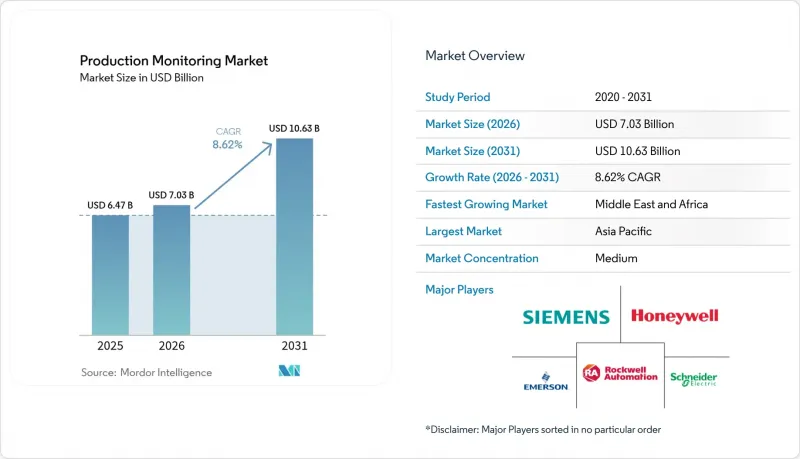
Mordor Intelligence에 의하면, 생산 모니터링 시장 규모는 2025년에 64억 7,000만 달러로 평가되었고 2026년 70억 3,000만 달러에서 2031년까지 106억 3,000만 달러에 이를 것으로 예측되며, 예측 기간(2026-2031년) CAGR은 8.62%를 나타낼 전망입니다.
본 보고서는 구성 요소(솔루션, 서비스), 도입 형태(클라우드, On-Premise), 용도(비즈니스 프로세스 최적화, 물류 및 공급망 관리 등), 최종 사용자(석유 및 가스, 화학, 자동차, 에너지 및 전력, 식품 및 음료 등), 그리고 지역별로 분류되어 있습니다. 시장 예측은 금액(달러) 기준으로 제시되어 있습니다.
세계 생산 모니터링 시장 동향 및 인사이트
통합 모니터링 및 예측 유지보수에 대한 수요
각 제조업체는 AI 유지보수 모델에 정보를 제공하는 ‘단일 신뢰할 수 있는 정보원’을 구축하기 위해 공장 전체의 자산 데이터를 통합하고 있습니다. Zebra Technologies의 보고서에 따르면, 2024년 현재 생산 기업의 불과 16%만이 현장 상황을 실시간으로 가시화하고 있어, 큰 성과 격차가 드러나고 있습니다. 예측 분석을 도입한 한 자동차 그룹은 예기치 못한 고장을 최대 70% 줄였으며, 엣지 인프라 최적화를 통해 설비의 수명 주기 가치로 1억 달러를 창출했습니다. 이에 따라 생산 관리자들은 예측 유지보수를 단순한 비용 절감 수단이 아닌 수익 증대의 수단으로 인식하고 있으며, 진동, 온도, 압력 데이터를 실용적인 건전성 점수로 통합하는 플랫폼에 대한 수요가 증가하고 있습니다.
실시간 가시화를 위한 IIoT 플랫폼 도입
IIoT 제품군은 현재 단일 디지털 패브릭 상에서 기계, 작업자, 물류 흐름을 통합적으로 관리하고 있습니다. Midea Thailand의 5G 도입을 통해 로봇 공학과 AI를 활용한 검사 흐름을 통합함으로써 생산성이 15-20% 향상되었습니다. TDK의 ‘i3 Micro’와 같은 센서 모듈은 우표 크기의 폼 팩터로 멀티모달 데이터를 통합하여, 대규모 개조 공사 없이도 기존 설비(브라운필드)를 데이터 레이크에 연결할 수 있게 해줍니다. 클라우드 엣지 게이트웨이가 도입 비용을 절감하고 생산 모니터링 시장 진입 장벽을 낮추기 때문에 2차 공급업체들도 혜택을 보고 있습니다.
데이터 보안 및 개인정보 보호에 대한 우려
커넥티드 팩토리는 공격 표면을 확대합니다. 2024년 VOID 보고서에 따르면, 자동화 시스템은 설정 오류가 있을 경우 사고를 확대시켜 운영자가 수동으로 개입할 수밖에 없게 된다는 사실이 밝혀졌습니다. 현재 EU의 제조업체들은 엄격한 데이터 거버넌스 규정을 준수해야 하며, 투명성을 유지하면서 개인정보 보호를 강화하는 블록체인 기반의 추적성에 대한 관심이 높아지고 있습니다.
부문 분석
2025년, 솔루션은 생산 모니터링 시장의 61.20%를 차지하고, 이는 하드웨어 및 플랫폼 판매가 안정화되고 있음을 반영합니다. 그러나 조직이 다양한 프로토콜의 혼용 및 직원의 기술 격차에 직면함에 따라, 서비스 부문은 2031년까지 연평균 성장률(CAGR) 9.62%라는 빠른 속도로 성장할 것으로 전망됩니다. 에머슨의 DeltaV 업데이트가 그 이유를 여실히 보여줍니다. 이 기능 팩을 통해 유틸리티자는 레거시 I/O를 유지한 채 타사 제어 시스템에서 마이그레이션할 수 있지만, 성공적인 도입을 위해서는 태그 재매핑 및 안전 로직 검증을 수행할 전문 통합 업체가 필수적입니다. 따라서 관리형 분석 및 지속적인 최적화 계약은 벤더에게 지속적인 수익원을 확보해 주는 동시에, 플랜트 팀이 대규모 채용 활동 없이도 전문 지식을 확대할 수 있게 해줍니다.
동시에, 각 자문 파트너사들은 현재 기술적 도입과 함께 변경 관리 플레이북을 패키지화하고 있습니다. 고객들은 단순히 대시보드를 표시하는 것뿐만 아니라, AI를 통한 인사이트를 활용하기 위해서는 조직의 워크플로우를 발전시켜야 한다는 사실을 깨닫고 있습니다. 이러한 ‘서비스 우선’ 사고방식은 솔루션 제공업체가 고객의 업무에 깊이 통합되어 생산 모니터링 시장에서 평생 가치(LTV)를 확대하는 선순환을 강화하고 있습니다.
2025년에는 제조업체들이 탄력적인 컴퓨팅과 신속한 모델 업데이트를 선호하는 경향에 따라, 클라우드 솔루션이 생산 모니터링 시장의 57.40%를 차지하며 연평균 성장률(CAGR) 9.31%로 성장할 전망입니다. 마이크로소프트는 클라우드 분석이 에너지 패턴을 분석하여 탄소 발자국을 줄이는 동시에 규제 보고의 정확성을 높이는 방법을 소개하고 있습니다(microsoft.com). 그러나 데이터 주권이나 지연 시간이 극히 중요한 작업의 경우, On-Premise 환경의 중요성은 여전히 남아 있습니다. 특히 에어 갭 환경에서 지휘통제 기능이 작동해야 하는 국방 및 유틸리티 분야에서는 이러한 경향이 두드러집니다. 거버넌스상의 타협점으로 하이브리드형 프레임워크가 등장하고 있습니다. 기밀성이 높은 제어 루프는 On-Premise에 남겨두면서, AI를 많이 사용하는 워크로드는 하이퍼스케일 리소스로 오프로드됩니다. 에머슨의 ‘Ovation 4.0’은 이러한 아키텍처에 생성형 AI를 통합하여, 사이버 보안 기준을 저해하지 않으면서 운영자에게 클라우드 수준의 인사이트를 제공합니다.
또한 기업들은 종량제 OPEX 모델을 활용하여 틈새 이용 사례의 프로토타입을 제작하고, 검증된 청사진을 전체 플랜트에 배포하고 있습니다. 이러한 민첩성 덕분에 디지털 전환 일정이 가속화되고 있으며, 생산 모니터링 시장에서 클라우드가 혁신을 위한 기본 ‘샌드박스’로서의 역할을 확고히 하고 있습니다.
지역별 분석
2025년, 아시아태평양은 생산 모니터링 시장의 33.70%를 차지했습니다. 중국은 전국적으로 인더스트리 4.0을 확대하고 있으며, 인도는 인프라 부족에도 불구하고 인센티브 프로그램을 통해 스마트 팩토리 도입이 촉진되고 있습니다. LG전자가 내세운 ‘2030년까지 수조 원의 기업 가치를 달성하겠다’는 비전은 조립 셀 전체에 AI를 접목하려는 기업의 야망을 상징합니다. 아세안(ASEAN) 지역 공장에서는 5G 프라이빗 네트워크를 활용해 자재 흐름을 자동화함으로써 두 자릿수의 수율 향상을 실현하고 있습니다.
중동 및 아프리카는 연평균 성장률(CAGR) 10.34%로 성장 전망의 선두를 달리고 있습니다. 사우디아라비아가 900억 사우디 리얄(240억 달러)을 투자하는 제조업 진흥책에는 지속적인 모니터링을 통해 생산 품질을 보장하는 스마트 식품 가공 클러스터가 포함되어 있습니다. 남아프리카공화국의 디지털화 추진 정책은 투명성이 높고 유연한 생산을 촉진하고 있지만, 전력 공급 제약과 자금 조달의 장벽으로 인해 도입 속도는 완만해지고 있습니다.
북미와 유럽은 계속해서 기술 선도자로서의 위상을 유지하고 있습니다. EU의 ‘기업 지속가능성 보고 지침’은 에너지 소비량의 자동 측정을 의무화하고 있으며, 이를 통해 탄소 배출량 추적 대시보드에 대한 투자가 촉진되고 있습니다. 북미의 경영진은 직원의 기술 재교육을 우선시하고 있으며, 73%가 의사결정에 데이터를 활용하기 위한 기술 향상 프로그램을 계획하고 있습니다. 이러한 동향으로 인해 신흥 경제국이 급성장하는 상황에서도 안정적인 수요 기반이 확보되고 있습니다.
기타 혜택:
- 엑셀 형식 시장 예측(ME) 시트
- 3개월간의 애널리스트 지원
자주 묻는 질문
목차
제1장 서론
제2장 조사 방법
제3장 주요 요약
제4장 시장 구도
제5장 시장 규모와 성장 예측
제6장 경쟁 구도
제7장 시장 기회와 향후 전망
JHS 26.08.26According to Mordor Intelligence, the production monitoring market size was valued at USD 6.47 billion in 2025 and estimated to grow from USD 7.03 billion in 2026 to reach USD 10.63 billion by 2031, at a CAGR of 8.62% during the forecast period (2026-2031).
This report is Segmented by Component (Solutions, Services), Deployment (Cloud, On-Premise), Application (Business Process Optimization, Logistics and Supply-Chain Management, and More), End User (Oil and Gas, Chemical, Automotive, Energy and Power, Food and Beverage, and More), and by Geography. The Market Forecasts are Provided in Terms of Value (USD).
Global Production Monitoring Market Trends and Insights
Demand for Centralized Monitoring and Predictive Maintenance
Manufacturers are consolidating asset data across plants to create single sources of truth that feed AI maintenance models. Zebra Technologies reported that only 16% of producers had real-time shop-floor visibility in 2024, exposing a sizeable performance gap. Automotive groups adopting predictive analytics reduced unplanned breakdowns by up to 70% and unlocked USD 100 million in lifetime equipment value by optimizing edge infrastructure. Production managers therefore view predictive maintenance as a profit lever, not merely a cost-avoidance tool, elevating demand for platforms that integrate vibration, temperature, and pressure data into actionable health scores.
Adoption of IIoT Platforms for Real-Time Visibility
IIoT suites now orchestrate machines, workers, and logistics streams in a single digital fabric. A 5G rollout at Midea Thailand delivered 15-20% productivity gains by unifying robotics and AI inspection flows. Sensor modules such as TDK's i3 Micro integrate multi-modal data in a postage-stamp form factor, enabling brownfield sites to join data lakes without heavy retrofits. Tier-two suppliers benefit because cloud edge gateways compress deployment costs, lowering barriers to entry in the Production monitoring market.
Data-Security and Privacy Concerns
Connected factories widen the attack surface. The 2024 VOID Report showed that automated systems can amplify incidents when mis-configured, forcing operators to intervene manually.EU manufacturers must now comply with stringent data-governance rules, driving interest in blockchain-based traceability that preserves transparency while hardening privacy.
Other drivers and restraints analyzed in the detailed report include:
- Expansion of Industry 4.0 Smart-Factory Initiatives
- Edge-AI Deployment for Anomaly Detection
- High Upfront Integration Costs
For complete list of drivers and restraints, kindly check the Table Of Contents.
Segment Analysis
Solutions captured 61.20% of the Production monitoring market in 2025, reflecting entrenched hardware and platform sales. Services, however, will expand faster at 9.62% CAGR to 2031 as organisations confront protocol heterogeneity and workforce skill gaps. Emerson's DeltaV update illustrates why: the feature pack lets utilities migrate from third-party controls while retaining legacy I/O, yet successful adoption hinges on specialist integrators who re-map tags and validate safety logic. Managed analytics and continuous optimisation contracts therefore secure recurring revenue streams for vendors and enable plant teams to scale expertise without large hiring drives.
At the same time, advisory partners now bundle change-management playbooks with technical deployments. Clients realise that organisational workflows must evolve to exploit AI insights, not simply display dashboards. This services-first mind-set reinforces a virtuous circle where solution providers embed deeper in customer operations, enlarging lifetime value in the Production monitoring market.
Cloud options held 57.40% of the Production monitoring market in 2025, advancing at a 9.31% CAGR as manufacturers favour elastic compute and rapid model updates. Microsoft showcases how cloud analytics decodes energy patterns to lower carbon footprints and sharpen regulatory reporting microsoft.com. Yet data-sovereignty and latency-critical tasks keep on-premise estates relevant, especially in defense and utilities where command-and-control must function under air-gapped conditions. Hybrid frameworks emerge as the governance compromise: sensitive control loops stay local, while AI-heavy workloads offload to hyperscale resources. Emerson's Ovation 4.0 wraps generative AI inside such an architecture, giving operators cloud-grade insights without sacrificing cybersecurity standards.
Enterprises also exploit pay-as-you-go OPEX models to prototype niche use cases, then scale proven blueprints across plants. That agility accelerates digital-transformation timelines and cements cloud's role as the default innovation sandbox for the Production monitoring market.
Complete Report Scope:
- By Component
- Solutions
- Services
- By Deployment
- Cloud
- On-Premise
- By Application
- Business Process Optimization
- Logistics and Supply-Chain Management
- Emergency and Incident Management
- Automation and Control Management
- By End User
- Oil and Gas
- Chemical
- Automotive
- Energy and Power
- Food and Beverage
- Aerospace and Defense
- Healthcare and Life Sciences
- Others
- By Geography
- North America
- United States
- Canada
- Mexico
- South America
- Brazil
- Argentina
- Rest of South America
- Europe
- Germany
- United Kingdom
- France
- Italy
- Spain
- Russia
- Rest of Europe
- Asia Pacific
- China
- India
- Japan
- South Korea
- Australia and New Zealand
- ASEAN-5
- Rest of Asia Pacific
- Middle East and Africa
- Middle East
- GCC Countries
- Turkey
- Rest of Middle East
- Africa
- South Africa
- Nigeria
- Egypt
- Rest of Africa
- Middle East
- North America
Geography Analysis
Asia-Pacific held 33.70% of the Production monitoring market in 2025. China scales Industry 4.0 statewide, and India's incentive programmes underwrite smart-factory deployments despite infrastructure gaps. LG Electronics' vision for multi-trillion KRW enterprise value by 2030 exemplifies corporate ambition to embed AI across assembly cells. ASEAN plants leverage 5G private networks to automate material flow, gaining double-digit yield lifts.
The Middle East and Africa lead growth prospects at 10.34% CAGR. Saudi Arabia's SAR 90 billion (USD 24 billion) manufacturing push includes smart food-processing clusters that rely on continuous monitoring to certify output quality. South Africa's digitalisation events promote transparent and flexible production, but power constraints and financing hurdles moderate rollout speed.
North America and Europe remain technology bellwethers. The EU Corporate Sustainability Reporting Directive obliges automated energy metering, prompting investments in carbon-tracking dashboards. North American executives prioritise workforce reskilling; 73% plan upskilling programmes to turn data into decisions. These dynamics ensure a steady baseline of demand even as emerging economies surge.
- Siemens AG
- Schneider Electric SE
- Emerson Electric Co.
- Rockwell Automation Inc.
- Honeywell International Inc.
- ABB Ltd.
- GE Digital
- Capgemini SE
- Oracle Corporation
- SAP SE
- IBM Corporation
- PTC Inc.
- Dassault Systemes SE (DELMIA)
- AVEVA Group plc
- National Instruments Corp.
- Aspen Technology Inc.
- ATS Automation Tooling Systems
- Konecranes Oyj
- Cognex Corporation
- Ignition (Inductive Automation)
- OSIsoft LLC (AVEVA)
- Hexagon AB
- Hitachi Vantara LLC
- Yokogawa Electric Corp.
Additional Benefits:
- The market estimate (ME) sheet in Excel format
- 3 months of analyst support
TABLE OF CONTENTS
1 INTRODUCTION
- 1.1 Study Assumptions and Market Definition
- 1.2 Scope of the Study
2 RESEARCH METHODOLOGY
3 EXECUTIVE SUMMARY
4 MARKET LANDSCAPE
- 4.1 Market Overview
- 4.2 Market Drivers
- 4.2.1 Demand for centralized monitoring and predictive maintenance
- 4.2.2 Adoption of IIoT platforms for real-time visibility
- 4.2.3 Expansion of Industry 4.0 smart-factory initiatives
- 4.2.4 Edge-AI deployment for anomaly detection
- 4.2.5 Regulatory push for energy-efficiency disclosures
- 4.2.6 Growth of green-production certification tracking
- 4.3 Market Restraints
- 4.3.1 Data-security and privacy concerns
- 4.3.2 High upfront integration costs
- 4.3.3 OT-protocol heterogeneity in legacy assets
- 4.3.4 Shortage of OT-cybersecurity talent
- 4.4 Value / Supply-Chain Analysis
- 4.5 Regulatory Landscape
- 4.6 Technological Outlook
- 4.7 Porter's Five Forces
- 4.7.1 Threat of New Entrants
- 4.7.2 Bargaining Power of Buyers
- 4.7.3 Bargaining Power of Suppliers
- 4.7.4 Threat of Substitutes
- 4.7.5 Intensity of Competitive Rivalry
5 MARKET SIZE AND GROWTH FORECASTS (VALUE)
- 5.1 By Component
- 5.1.1 Solutions
- 5.1.2 Services
- 5.2 By Deployment
- 5.2.1 Cloud
- 5.2.2 On-Premise
- 5.3 By Application
- 5.3.1 Business Process Optimization
- 5.3.2 Logistics and Supply-Chain Management
- 5.3.3 Emergency and Incident Management
- 5.3.4 Automation and Control Management
- 5.4 By End User
- 5.4.1 Oil and Gas
- 5.4.2 Chemical
- 5.4.3 Automotive
- 5.4.4 Energy and Power
- 5.4.5 Food and Beverage
- 5.4.6 Aerospace and Defense
- 5.4.7 Healthcare and Life Sciences
- 5.4.8 Others
- 5.5 By Geography
- 5.5.1 North America
- 5.5.1.1 United States
- 5.5.1.2 Canada
- 5.5.1.3 Mexico
- 5.5.2 South America
- 5.5.2.1 Brazil
- 5.5.2.2 Argentina
- 5.5.2.3 Rest of South America
- 5.5.3 Europe
- 5.5.3.1 Germany
- 5.5.3.2 United Kingdom
- 5.5.3.3 France
- 5.5.3.4 Italy
- 5.5.3.5 Spain
- 5.5.3.6 Russia
- 5.5.3.7 Rest of Europe
- 5.5.4 Asia Pacific
- 5.5.4.1 China
- 5.5.4.2 India
- 5.5.4.3 Japan
- 5.5.4.4 South Korea
- 5.5.4.5 Australia and New Zealand
- 5.5.4.6 ASEAN-5
- 5.5.4.7 Rest of Asia Pacific
- 5.5.5 Middle East and Africa
- 5.5.5.1 Middle East
- 5.5.5.1.1 GCC Countries
- 5.5.5.1.2 Turkey
- 5.5.5.1.3 Rest of Middle East
- 5.5.5.2 Africa
- 5.5.5.2.1 South Africa
- 5.5.5.2.2 Nigeria
- 5.5.5.2.3 Egypt
- 5.5.5.2.4 Rest of Africa
- 5.5.5.1 Middle East
- 5.5.1 North America
6 COMPETITIVE LANDSCAPE
- 6.1 Market Concentration
- 6.2 Strategic Moves
- 6.3 Market Share Analysis
- 6.4 Company Profiles (includes Global level Overview, Recent Developments)
- 6.4.1 Siemens AG
- 6.4.2 Schneider Electric SE
- 6.4.3 Emerson Electric Co.
- 6.4.4 Rockwell Automation Inc.
- 6.4.5 Honeywell International Inc.
- 6.4.6 ABB Ltd.
- 6.4.7 GE Digital
- 6.4.8 Capgemini SE
- 6.4.9 Oracle Corporation
- 6.4.10 SAP SE
- 6.4.11 IBM Corporation
- 6.4.12 PTC Inc.
- 6.4.13 Dassault Systemes SE (DELMIA)
- 6.4.14 AVEVA Group plc
- 6.4.15 National Instruments Corp.
- 6.4.16 Aspen Technology Inc.
- 6.4.17 ATS Automation Tooling Systems
- 6.4.18 Konecranes Oyj
- 6.4.19 Cognex Corporation
- 6.4.20 Ignition (Inductive Automation)
- 6.4.21 OSIsoft LLC (AVEVA)
- 6.4.22 Hexagon AB
- 6.4.23 Hitachi Vantara LLC
- 6.4.24 Yokogawa Electric Corp.
7 MARKET OPPORTUNITIES AND FUTURE OUTLOOK
- 7.1 White-space and Unmet-need Assessment


