

|
시장보고서
상품코드
2122284
에너지 분야 예지보전 : 시장 점유율 분석, 업계 동향과 통계, 성장 예측(2026-2031년)Predictive Maintenance In The Energy - Market Share Analysis, Industry Trends & Statistics, Growth Forecasts (2026 - 2031) |
||||||
 Mordor Intelligence
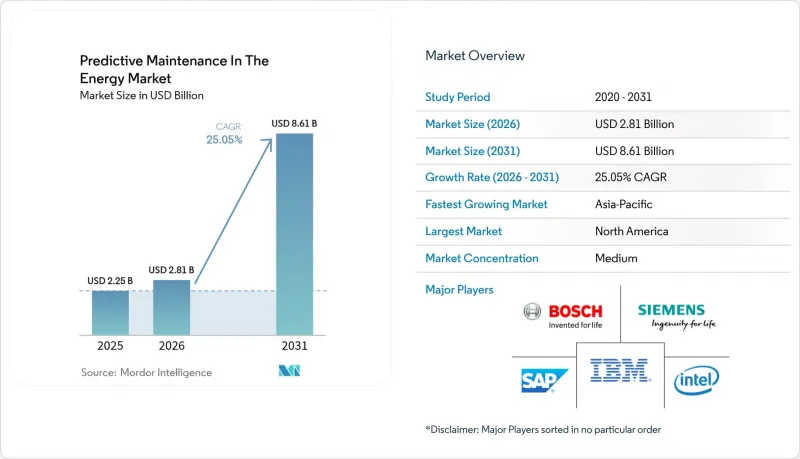
Mordor Intelligence에 의하면, 에너지 분야 예지보전 시장 규모는 2025년 22억 5,000만 달러에서 2026년에는 28억 1,000만 달러에 이르고, 2026-2031년 CAGR 25.05%로 성장을 지속하여 2031년에는 86억 1,000만 달러에 달할 것으로 예측됩니다.
본 보고서는 제공 유형별(솔루션, 서비스), 배포 모델별(클라우드, On-Premise), 최종 사용자 산업별(발전, 재생 에너지, 석유 및 가스, 기타), 자산 유형별(터빈·회전 장비, 변압기·변전소, 기타), 지역별로 분류되어 있습니다. 시장 예측은 금액(달러) 기준으로 제시되어 있습니다.
세계 에너지 시장 예측 유지보수 동향 및 인사이트
IIoT, AI, 빅데이터 분석의 통합
저비용 센서와 AI 패턴 인식 알고리즘의 융합을 통해 터빈 데크 및 압축기 스테이션 전체에서 유지보수가 사후 대응형에서 예방 유지보수형으로 전환되고 있습니다. 지멘스의 ‘Senseye’ 플랫폼은 현재 디지털 거동 모델을 자동으로 생성하여 심각한 인력 부족 문제를 해결하는 동시에 유지보수 비용을 최대 40%까지 절감하고 있습니다. 셰브론의 누출 방지를 위한 실시간 이상 감지 기술은 에너지 집약적인 데이터센터 클러스터에 대한 지속적인 전력 공급을 보호하고 있습니다. 엣지 노드는 방대한 진동 및 온도 데이터를 로컬에서 처리한 후, 요약된 인사이트를 클라우드로 전송하여 전체 플릿의 패턴 마이닝을 수행하고, 사람의 지시 없이 개입 일정을 수립하는 거의 자율적인 생태계를 구축하고 있습니다. 이러한 발전으로 인해 에너지 시장 예측 유지보수는 많은 자산을 보유한 유틸리티자의 디지털 전환 로드맵의 중심에 자리 잡고 있습니다.
예기치 못한 가동 중단을 줄이기 위한 비용 압박
정전에 따른 벌칙 강화와 AI 워크로드로 인한 수요 급증으로 인해 가동 중단 시간은 경영진 차원의 위험 요소가 되었으며, 예측 유지보수는 단순한 선택적 비용 항목에서 사업 운영의 필수 요건으로 변화하고 있습니다. NextEra Energy의 가스 터빈 프로그램에서는 정전을 23% 줄이고, 연간 2,500만 달러의 비용 절감을 실현했습니다. 이는 에너지 시장에서 예측 유지보수가 탄탄한 ROI를 뒷받침한다는 것을 입증하는 사례입니다. 대형 석유 및 가스 사업자들은 점검 주기를 최적화하여 자산 수명을 20-40% 연장한 실적이 있으며, 수십 년에 걸친 설비 수명 주기 전반에 걸쳐 가치를 복리적으로 높이고 있습니다. 도입이 지연되고 있는 기업은 경쟁사가 더 적은 예비 부품 재고로도 높은 자산 가동률을 유지하는 가운데, 고객 경험 저하와 에너지 공급 비용 상승에 직면하게 될 것입니다.
도입 및 통합에 드는 높은 초기 비용
종합적인 센서 개조, 엣지 게이트웨이, 클라우드 오케스트레이션 도입으로 인해 대형 유틸리티 회사의 경우 프로젝트 예산이 8자리 수에 달하는 경우가 많아, 자금 조달에 어려움을 겪는 개발도상국 사업자들에게는 장벽이 되고 있습니다. GE Vernova가 진행한 약 6억 달러 규모의 미국 공장 개조 프로젝트는 설비군 수준에서 예측의 가치를 이끌어내기 위해 필요한 현대화 규모를 여실히 보여주고 있습니다. 구리 및 희토류 가격 상승으로 인해 2024년 이후 하드웨어 지출은 최대 25% 증가했습니다. 선도적으로 도입한 기업들은 2년 이내에 투자 비용을 회수했으며, 공급업체들이 성능 보증과 연계된 구독 모델을 도입함에 따라 자금 조달 측면의 장벽도 점차 완화되고 있습니다. 이는 에너지 시장에서 예측 유지보수의 장기적인 경쟁력을 다시 한번 입증하는 것입니다.
부문 분석
2025년, 에너지 시장 예측 유지보수 시장에서 솔루션이 64.72%를 차지하고 있으며, 이는 사업자들이 분석, 시각화, 워크플로우 자동화를 통합한 통합 플랫폼을 선호하는 경향을 반영합니다. 하루에 테라바이트 규모의 터빈 및 변압기 데이터를 수집할 수 있는 소프트웨어 제품군이 여전히 핵심을 이루는 한편, 디바이스 상의 추론 기능을 갖춘 임베디드 센서가 엣지 인텔리전스를 강화하여 불필요한 데이터 유출을 줄이는 동시에 인사이트력 도출을 가속화하고 있습니다. 서비스 부문은 절대적인 매출 규모는 작지만, 유틸리티체와 독립 발전 사업자가 통합, 변경 관리, 연중무휴 모니터링을 벤더에 의존하고 있기 때문에 연평균 성장률(CAGR) 25.3%라는 높은 성장률을 기록하며 급성장하고 있습니다.
서비스 제공업체는 데이터 사이언스 및 회전 기계 물리학 분야의 인력 부족 심화로 인해 혜택을 보고 있습니다. 특히, 사업자가 가동을 중단하지 않고 레거시 히스토리안 데이터베이스를 클라우드 데이터 레이크로 마이그레이션할 때, 통합 및 구현의 가치가 높이 평가되고 있습니다. 대부분의 경우 성과 기반 계약으로 구성되는 매니지드 서비스는 벤더의 인센티브와 자산의 성과를 일치시키는 가용성 지표를 보장합니다. 고객이 툴킷보다 성과를 우선시함에 따라, 에너지 산업의 예측 유지보수는 기능 체크리스트보다 운영상의 탁월성이 우선시되는 서비스 지향 시장으로 꾸준히 변모하고 있습니다.
2025년 현재, 에너지 시장 예측 유지보수 분야에서 클라우드 도입 비중은 72.05%를 차지하고 있으며, 알고리즘의 복잡성과 데이터 양이 On-Premise 연산 능력을 초과함에 따라 이러한 추세는 더욱 강화될 것으로 예측됩니다. 현재 단일 해상 풍력 발전소에서 매일 수십 테라바이트의 SCADA 데이터와 LiDAR 데이터가 생성되고 있습니다. 즉각적인 확장성과 지속적인 모델 재학습이 가능하기 때문에 클라우드 네이티브 아키텍처가 우위를 점하고 있습니다. 엣지 클라우드의 하이브리드 구성은 부하 차단 및 블레이드 피치 조정 시 발생하는 지연을 줄이고, 미션 크리티컬한 제어 루프를 로컬에서 유지하면서 대규모 분석 처리를 중앙에서 수행합니다.
주권이나 지연 시간에 대한 요구 사항이 엄격한 외딴 지역의 분지나 원자력 발전소에서는 여전히 On-Premise 시스템이 사용되고 있지만, 대부분의 벤더는 향후 전환을 대비하여 클라우드 커넥터를 번들로 제공합니다. Honeywell이 Verizon과 공동으로 전개하고 있는 5G 지원 스마트 미터 도입은 이러한 변화를 상징합니다. 보안이 강화된 셀룰러 백홀을 통해 1초 미만의 원격 측정 데이터가 AI 엔진으로 집계되어, 변압기의 핫스팟을 며칠 전에 예측합니다. 이러한 이용 사례는 에너지 시장 예측 유지보수가, 유비쿼터스하고 지연 시간이 짧은 연결성을 전제로 한, 보다 광범위한 전력망 디지털화 이니셔티브와 밀접하게 연결되어 있는 이유를 여실히 보여줍니다.
지역별 분석
북미는 연방 정부의 인프라 구축 프로그램, 전력 회사의 적극적인 투자, AI 플랫폼의 조기 도입에 힘입어 2025년 매출의 27.55%를 차지하며 계속해서 주도적인 위치를 유지했습니다. 에너지 정보국(EIA)은 하이퍼스케일 데이터센터의 영향 등으로 2030년까지 국내 전력 수요가 15-20% 증가할 것으로 예측하고 있으며, 이에 따라 정전 방지에 대한 관심이 더욱 높아지고 있습니다. 클라우드 네이티브 규제 환경과 풍부한 벤처 자금 덕분에 신기술의 시범 도입이 더욱 가속화되면서, 에너지 시장 예측 유지보수 부문에서 이 지역의 우위가 확고해지고 있습니다.
유럽에서는 ‘그린 딜(Green Deal)’의 탈탄소화 목표와 신뢰성 지표 향상에 기여하는 엄격한 정전 벌칙 제도의 뒷받침을 받아 꾸준한 성장세가 유지되고 있습니다. ‘기업 지속가능성 보고 지침(CSRD)’에 따라 전력 사업자는 실시간 배출량 및 에너지 효율 KPI를 공개해야 하며, 예측 유지보수 데이터 세트는 이와 높은 시너지 효과를 발휘합니다. 대규모 차량 운영 사업자들은 규정 준수 및 회복탄력성이라는 두 가지 목표를 모두 달성하기 위해 디지털 트윈과 위성을 활용한 식생 모니터링을 결합하고 있습니다.
아시아태평양은 중국 정부가 지원하는 디지털 그리드 구상과 동남아시아의 급속한 전기화에 힘입어 연평균 성장률(CAGR) 25.95%를 기록하며 가장 빠르게 성장하고 있는 지역입니다. 중국 남방전망(China Southern Power Grid)의 종단간 디지털 전환은 레거시 시스템의 병목 현상을 피하고, 예측형 워크플로우를 새로운 인프라에 직접 통합하는 ‘도약적 기술’의 가능성을 보여주고 있습니다. 동시에 인도와 인도네시아는 송전망 업그레이드에 막대한 투자를 하고 있어, 클라우드를 통해 제공되는 분석 서비스에 대한 새로운 수요를 창출하고 있습니다. 중동 및 아프리카는 규모는 작지만, ‘비전 2030’ 및 이와 유사한 이니셔티브에 따른 메가 프로젝트가 가혹한 사막 환경에서도 완벽한 가동 시간을 요구하고 있어 관심이 높아지고 있으며, 에너지 시장에서 예측 유지보수의 적용 범위가 확대되고 있습니다.
기타 혜택
- 엑셀 형식 시장 예측(ME) 시트
- 3개월간의 애널리스트 지원
자주 묻는 질문
목차
제1장 서론
제2장 조사 방법
제3장 주요 요약
제4장 시장 구도
제5장 시장 규모와 성장 예측(금액, 2024-2030년)
제6장 경쟁 구도
제7장 시장 기회와 향후 전망
LSH 26.09.04According to Mordor Intelligence, the predictive maintenance in the energy market size is expected to grow from USD 2.25 billion in 2025 to USD 2.81 billion in 2026 and is forecast to reach USD 8.61 billion by 2031 at 25.05% CAGR over 2026-2031.
This report is Segmented by Offering (Solutions and Services), Deployment Model (Cloud, On-Premise), End-User Industry (Power Generation, Renewables, Oil and Gas, and More), Asset Type (Turbines and Rotating Equipment, Transformers and Sub-Stations, and More), and Geography. The Market Forecasts are Provided in Terms of Value (USD)
Global Predictive Maintenance In The Energy Market Trends and Insights
Integration of IIoT, AI and Big-Data Analytics
The fusion of low-cost sensors with AI pattern-recognition algorithms is recasting maintenance from reactive to prescriptive modes across turbine decks and compressor stations.Siemens' Senseye platform now generates digital behavior models automatically, slicing maintenance spend by up to 40% while addressing acute workforce shortages. Chevron's real-time anomaly detection for leak prevention safeguards continuous power delivery to energy-intensive data-center clusters. Edge nodes process torrents of vibration and temperature data locally before forwarding condensed insights to the cloud for fleet-wide pattern mining, creating near-autonomous ecosystems that schedule interventions without human prompts. These developments place predictive maintenance in the energy market squarely at the center of digital-transformation roadmaps for asset-heavy utilities.
Cost Pressure to Cut Unplanned Downtime
Escalating outage penalties and demand spikes from AI workloads are making downtime a board-level risk, moving predictive maintenance from a discretionary line item to an operational imperative. NextEra Energy's gas-turbine program delivered a 23% outage reduction and USD 25 million in annual savings, validating the hard ROI underpinning the predictive maintenance in the energy market. Large oil-and-gas operators have documented 20-40% asset-life extension through optimized service intervals, compounding value over decades-long equipment cycles. Firms that lag on adoption face customer-experience erosion and higher delivered-energy costs as competitors sustain higher asset availability with leaner spares inventories.
High Upfront Implementation and Integration Cost
Comprehensive sensor retrofits, edge gateways, and cloud orchestration commonly push project budgets into eight figures for large utilities, deterring cash-constrained operators in developing economies. GE Vernova's nearly USD 600 million U.S. factory upgrades illustrate the scale of modernization needed to unlock predictive value at fleet level. Rising copper and rare-earth prices have inflated hardware outlays by up to 25% since 2024. Nonetheless, leading adopters recuperate capital within two years, and financial barriers are softening as vendors roll out subscription models linked to performance guarantees, reiterating the long-term competitiveness of the predictive maintenance in the energy market.
Other drivers and restraints analyzed in the detailed report include:
- Aging Energy Infrastructure and Grid Reliability Focus
- Regulatory Mandates on Safety / Emissions
- Rising Cyber-Security Vulnerabilities
For complete list of drivers and restraints, kindly check the Table Of Contents.
Segment Analysis
Solutions controlled 64.72% of the predictive maintenance in the energy market in 2025, reflecting operators' preference for unified platforms that amalgamate analytics, visualization, and workflow automation. Software suites capable of ingesting terabytes of turbine and transformer data per day remain central, while embedded sensors equipped with on-device inference augment edge intelligence, reducing unnecessary data egress and accelerating insights. Services, although smaller in absolute revenue, sprint ahead at 25.3% CAGR as utilities and independent power producers rely on vendors for integration, change management, and 24X7 monitoring.
Service providers benefit from widening talent gaps in data science and rotating-machinery physics. Integration and implementation are especially valued when operators migrate legacy historian databases into cloud data lakes without production interruptions. Managed services, often structured as outcome-based contracts, guarantee availability metrics that align vendor incentives with asset performance. As clients prioritize outcomes over toolkits, the predictive maintenance in the energy industry is steadily morphing into a service-oriented market where operational excellence overrides feature checklists.
Cloud deployments represented 72.05% share of the predictive maintenance in the energy market in 2025, a position expected to strengthen as algorithm complexity and data volumes outstrip on-premise compute capacity. A single offshore wind farm now generates tens of terabytes of SCADA and lidar data daily; instant scalability and continuous model retraining favor cloud-native architectures. Edge-cloud hybrids mitigate latency for load-shedding or blade-pitch adjustments, keeping mission-critical loops local while bulk analytics run centrally.
On-premise systems persist in remote basins and nuclear sites with stringent sovereignty or latency requirements, yet most vendors bundle cloud connectors for future migration. Honeywell's 5G-enabled smart-meter roll-out with Verizon exemplifies the shift: secure cellular backhaul funnels sub-second telemetry into an AI engine that forecasts transformer hot-spots days in advance. Such use cases underscore why the predictive maintenance in the energy market is entwined with broader grid-digitalization initiatives premised on ubiquitous, low-latency connectivity.
Complete Report Scope:
- By Offering
- Solutions
- Software Platforms
- Embedded Hardware and Sensors
- Services
- Integration and Implementation
- Managed Services
- Solutions
- By Deployment Model
- Cloud
- On-premise
- By End-user Industry
- Power Generation (Thermal, Nuclear, Hydro)
- Renewables (Wind, Solar, Storage)
- Oil and Gas (Upstream, Mid, Downstream)
- Utilities and TandD
- Mining and Minerals
- By Asset Type
- Turbines and Rotating Equipment
- Transformers and Sub-stations
- Pipelines and Compressors
- Pumps and Valves
- By Geography
- North America
- United States
- Canada
- Mexico
- South America
- Brazil
- Argentina
- Rest of South America
- Europe
- Germany
- United Kingdom
- France
- Netherlands
- Rest of Europe
- Asia-Pacific
- China
- Japan
- India
- South Korea
- Australia and New Zealand
- Rest of Asia-Pacific
- Middle East and Africa
- Middle East
- United Arab Emirates
- Saudi Arabia
- Turkey
- Rest of Middle East
- Africa
- South Africa
- Nigeria
- Rest of Africa
- Middle East
- North America
Geography Analysis
North America retained leadership with 27.55% of 2025 revenue, supported by federal infrastructure programs, aggressive utility spending, and early adoption of AI platforms. The Energy Information Administration projects domestic electricity demand to rise 15-20% by 2030, partly due to hyperscale data centers, intensifying the focus on outage prevention. Cloud-native regulatory environments and ample venture financing further accelerate new-tech pilots, anchoring regional dominance in the predictive maintenance in the energy market.
Europe maintains steady momentum driven by the Green Deal's decarbonization targets and strict outage-penalty regimes that elevate reliability metrics. The Corporate Sustainability Reporting Directive obliges utilities to disclose real-time emissions and energy-efficiency KPIs, for which predictive-maintenance datasets are highly synergistic. Large fleet operators are combining digital twins with satellite-based vegetation monitoring to meet both compliance and resilience goals.
Asia-Pacific is the fastest-growing territory at 25.95% CAGR, buoyed by China's state-backed digital-grid blueprint and Southeast Asia's rapid electrification. China Southern Power Grid's end-to-end digital transformation shows how leapfrog technology can embed predictive workflows directly into new infrastructure, bypassing legacy bottlenecks. Concurrently, India and Indonesia invest heavily in transmission upgrades, creating greenfield demand for cloud-delivered analytics. The Middle East and Africa, though smaller, show rising interest as mega-projects under Vision 2030 and similar initiatives demand flawless uptime under harsh desert conditions, expanding the predictive maintenance in the energy market footprint.
- IBM Corporation
- SAP SE
- Siemens AG
- GE Digital
- ABB Ltd
- Schneider Electric SE
- Intel Corporation
- Robert Bosch GmbH
- Accenture plc
- Honeywell International Inc.
- Hitachi Energy Ltd.
- Emerson Electric Co.
- Aspen Technology, Inc.
- AVEVA Group plc
- Uptake Technologies Inc.
- SparkCognition, Inc.
- Senseye Ltd.
- SKF Group
- Bentley Systems, Inc.
- Mitsubishi Electric Corporation
- Caterpillar Inc. (Asset Intelligence)
- DNV AS
- KONUX GmbH
Additional Benefits:
- The market estimate (ME) sheet in Excel format
- 3 months of analyst support
TABLE OF CONTENTS
1 INTRODUCTION
- 1.1 Study Assumptions and Market Definition
- 1.2 Scope of the Study
2 RESEARCH METHODOLOGY
3 EXECUTIVE SUMMARY
4 MARKET LANDSCAPE
- 4.1 Market Overview
- 4.2 Market Drivers
- 4.2.1 Aging energy infrastructure and grid reliability focus (mainstream)
- 4.2.2 Integration of IIoT, AI and big-data analytics (mainstream)
- 4.2.3 Cost pressure to cut unplanned downtime (mainstream)
- 4.2.4 Regulatory mandates on safety / emissions (mainstream)
- 4.2.5 Drone- and satellite-enabled remote sensing fusion (under-the-radar)
- 4.2.6 Digital-twin-driven risk-based maintenance (under-the-radar)
- 4.3 Market Restraints
- 4.3.1 High upfront implementation and integration cost (mainstream)
- 4.3.2 Rising cyber-security vulnerabilities (mainstream)
- 4.3.3 Scarcity of energy-domain data-science talent (under-the-radar)
- 4.3.4 Data-ownership and liability disputes in multi-party assets (under-the-radar)
- 4.4 Supply-Chain Analysis
- 4.5 Regulatory Landscape
- 4.6 Technological Outlook
- 4.7 Porter's Five Forces
- 4.7.1 Threat of New Entrants
- 4.7.2 Bargaining Power of Buyers
- 4.7.3 Bargaining Power of Suppliers
- 4.7.4 Threat of Substitute Products
- 4.7.5 Intensity of Competitive Rivalry
- 4.8 Assessment of Macroeconomic Factors on the Market
5 MARKET SIZE AND GROWTH FORECASTS (VALUE, 2024-2030)
- 5.1 By Offering
- 5.1.1 Solutions
- 5.1.1.1 Software Platforms
- 5.1.1.2 Embedded Hardware and Sensors
- 5.1.2 Services
- 5.1.2.1 Integration and Implementation
- 5.1.2.2 Managed Services
- 5.1.1 Solutions
- 5.2 By Deployment Model
- 5.2.1 Cloud
- 5.2.2 On-premise
- 5.3 By End-user Industry
- 5.3.1 Power Generation (Thermal, Nuclear, Hydro)
- 5.3.2 Renewables (Wind, Solar, Storage)
- 5.3.3 Oil and Gas (Upstream, Mid, Downstream)
- 5.3.4 Utilities and TandD
- 5.3.5 Mining and Minerals
- 5.4 By Asset Type
- 5.4.1 Turbines and Rotating Equipment
- 5.4.2 Transformers and Sub-stations
- 5.4.3 Pipelines and Compressors
- 5.4.4 Pumps and Valves
- 5.5 By Geography
- 5.5.1 North America
- 5.5.1.1 United States
- 5.5.1.2 Canada
- 5.5.1.3 Mexico
- 5.5.2 South America
- 5.5.2.1 Brazil
- 5.5.2.2 Argentina
- 5.5.2.3 Rest of South America
- 5.5.3 Europe
- 5.5.3.1 Germany
- 5.5.3.2 United Kingdom
- 5.5.3.3 France
- 5.5.3.4 Netherlands
- 5.5.3.5 Rest of Europe
- 5.5.4 Asia-Pacific
- 5.5.4.1 China
- 5.5.4.2 Japan
- 5.5.4.3 India
- 5.5.4.4 South Korea
- 5.5.4.5 Australia and New Zealand
- 5.5.4.6 Rest of Asia-Pacific
- 5.5.5 Middle East and Africa
- 5.5.5.1 Middle East
- 5.5.5.1.1 United Arab Emirates
- 5.5.5.1.2 Saudi Arabia
- 5.5.5.1.3 Turkey
- 5.5.5.1.4 Rest of Middle East
- 5.5.5.2 Africa
- 5.5.5.2.1 South Africa
- 5.5.5.2.2 Nigeria
- 5.5.5.2.3 Rest of Africa
- 5.5.5.1 Middle East
- 5.5.1 North America
6 COMPETITIVE LANDSCAPE
- 6.1 Market Concentration
- 6.2 Strategic Moves
- 6.3 Market Share Analysis
- 6.4 Company Profiles (includes Global level Overview, Market level overview, Core Segments, Financials as available, Strategic Information, Market Rank/Share for key companies, Products and Services, and Recent Developments)
- 6.4.1 IBM Corporation
- 6.4.2 SAP SE
- 6.4.3 Siemens AG
- 6.4.4 GE Digital
- 6.4.5 ABB Ltd
- 6.4.6 Schneider Electric SE
- 6.4.7 Intel Corporation
- 6.4.8 Robert Bosch GmbH
- 6.4.9 Accenture plc
- 6.4.10 Honeywell International Inc.
- 6.4.11 Hitachi Energy Ltd.
- 6.4.12 Emerson Electric Co.
- 6.4.13 Aspen Technology, Inc.
- 6.4.14 AVEVA Group plc
- 6.4.15 Uptake Technologies Inc.
- 6.4.16 SparkCognition, Inc.
- 6.4.17 Senseye Ltd.
- 6.4.18 SKF Group
- 6.4.19 Bentley Systems, Inc.
- 6.4.20 Mitsubishi Electric Corporation
- 6.4.21 Caterpillar Inc. (Asset Intelligence)
- 6.4.22 DNV AS
- 6.4.23 KONUX GmbH
7 MARKET OPPORTUNITIES AND FUTURE OUTLOOK
- 7.1 White-space and Unmet-need Assessment


