

|
시장보고서
상품코드
2115060
자동차용 디지털 콕핏 시장 : 시장 점유율 분석, 업계 동향 및 통계, 성장 예측(2026-2031년)Automotive Digital Cockpit - Market Share Analysis, Industry Trends & Statistics, Growth Forecasts (2026 - 2031) |
||||||
 Mordor Intelligence
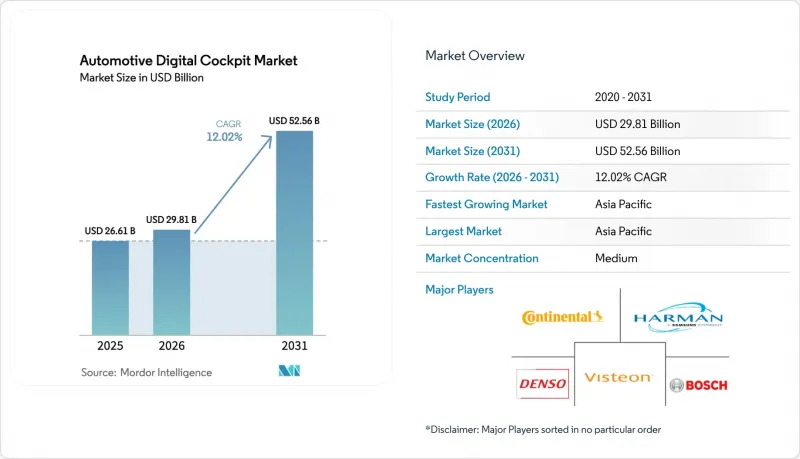
Mordor Intelligence에 의하면, 2026년 자동차용 디지털 콕핏 시장 규모는 298억 1,000만 달러로 추정되고, 2025년 266억 1,000만 달러에서 확대해, 2031년에는 525억 6,000만 달러에 이를 것으로 예측됩니다.
2026-2031년 연평균 성장률(CAGR) 12.02%로 성장할 것으로 전망됩니다.
본 보고서는 유형별(헤드업 디스플레이(HUD), 디지털 계기판, 센터 스택 디스플레이 등), 차량 유형별(승용차, 소형 상용차 등), 추진 방식별(내연기관(ICE) 등), 판매 채널별(OEM 장착 및 애프터마켓 사후 장착), 지역별로 분류되어 있습니다. 시장 예측은 금액(달러) 기준으로 제시되어 있습니다.
세계의 자동차용 디지털 콕핏 시장 동향 및 인사이트
몰입형 인포테인먼트에 대한 소비자 수요 증가
각 자동차 제조업체는 스마트폰의 조작 경험을 모방한 멀티스크린 레이아웃과 AI 음성 어시스턴트를 중심으로 차량 내 공간을 설계하고 있습니다. TCL CSOT의 파노라마 HUD와 32:9 센터 디스플레이는 차세대 디자인 언어를 선점하고 있는 반면, 혼다가 조만간 출시할 예정인 ‘ASIMO OS’에는 머신러닝을 통한 개인화 기능이 탑재되어 있습니다. Visteon과 TuneIn 같은 컨텐츠 제휴를 통해 대시보드에 스트리밍 미디어가 추가되고 있습니다. 프리미엄 브랜드들은 이러한 추세를 더욱 부추기고 있습니다. 예를 들어, 아우디의 A6 Sportback e-tron은 11.9인치 가상 계기판과 14.5인치 OLED 터치스크린을 결합하여 선명한 그래픽을 구현하고 있습니다.
ADAS 및 안전 규제의 의무화
규제 요건이 ADAS(첨단 운전자 지원 시스템)와 디지털 콕핏 플랫폼의 통합을 촉진하고 있으며, 이는 안전성과 사용자 경험 모두를 향상시키는 동시에 시스템의 복잡성을 줄이는 시너지 효과를 창출하고 있습니다. EU의 일반 안전 규정 II 개정으로 인해 모든 승용차에 ADAS 기능 탑재가 의무화되었으며, 이 모든 기능이 직관적이고 실시간 경고를 표시해야 합니다. 퀄컴과 보쉬는 이에 대응하여 인포테인먼트와 ADAS의 워크로드를 하나의 SoC에서 처리하는 혼합 중요도 컴퓨팅을 개발하여 지연 시간과 배선을 줄였습니다. 이러한 융합은 ISO 26262 ASIL-B 준수 요건과 같은 기능 안전 표준에 의해 더욱 가속화되고 있으며, 이는 디스플레이 기술 및 LED 드라이버 아키텍처의 혁신을 주도하고 있습니다.
높은 초기 시스템 및 검증 비용
콕핏 디스플레이에서 ISO 26262 ASIL-B를 달성하려면 중복된 전원 레일, 고장 주입 테스트 및 철저한 소프트웨어 감사가 필요하며, 이 모든 것이 비반복적인 엔지니어링 비용을 부풀리고 있습니다. HARMAN만 해도 콕핏 프로그램에 500명 이상의 엔지니어를 투입하고 있어, 그 노동 집약도가 얼마나 높은지 알 수 있습니다. 중소규모 OEM은 도입을 늦추고 있으며, 2024년에 새로운 사이버 보안 규정이 시행되었을 때 유럽에서는 일부 구형 모델이 시장에서 철수했습니다.
부문 분석
2025년, 디지털 계기판은 자동차용 디지털 콕핏 시장 점유율의 37.45%를 차지했으며, 속도, 주행 거리, ADAS 알림의 주요 인터페이스 역할을 수행했습니다. 한편, 헤드업 디스플레이는 운전자의 시선을 전방에 계속 유지시켜 주는 증강현실(AR) 오버레이에 대한 OEM 수요에 힘입어 연평균 성장률(CAGR) 18.05%로 시장을 주도하고 있습니다. 또한, 디지털 콕핏 시장은 파노라마형 CID, 승객용 PID, 그리고 Euro NCAP의 운전자 주의력 평가 기준을 충족하는 데 도움이 되는 카메라 기반 운전자 모니터링 모듈로 전환되고 있습니다.
센터 스택 스크린은 고화소 밀도와 발열을 억제하는 저전력 LTPO 백플레인을 통해 15인치를 넘는 크기로 확대되고 있습니다. Envisics사의 2세대 홀로그래픽 HUD는 GM의 2024년형 캐딜락 리릭에 최초로 탑재되어, 과거에는 프리미엄 기술로 여겨졌던 것이 부문을 넘어 보급되고 있음을 보여줍니다. TCL CSOT의 32:9 콤보 디스플레이는 계기판과 인포테인먼트 시스템을 단일 화면으로 통합하여, 부품의 추가적인 통합을 선도하고 있습니다. 몰입형 경험에 대한 수요가 높아짐에 따라, 멀티 디스플레이 패키지는 앞으로도 디지털 콕핏 시장의 성장 동력으로 계속 자리매김할 것이 확실합니다.
2025년, 승용차가 자동차용 디지털 콕핏 시장을 주도하며 68.89%의 점유율을 확보한 한편, 전년 대비 13.92%의 성장을 기록했습니다. 소비자들은 이제 과거에는 고급 세단에서만 볼 수 있었던 클라우드 연동 서비스를 소형 해치백에서도 기대하게 되었으며, 양산 브랜드들은 콕핏의 기능 목록을 확충할 수밖에 없게 되었습니다. 소형 상용차에 대한 디지털 콕핏 도입은 경로 계획과 운전자 상태 모니터링을 결합한 텔레매틱스 통합을 요구하는 차량 대여 업체 수요에 힘입어 가속화되고 있습니다.
중형 및 대형 트럭에서는 전자 기록 장치(ELD)의 탑재가 점점 더 요구되고 있으며, 도메인 컨트롤러가 탑재된 콕핏은 이러한 요건을 충족하는 동시에 예측 유지보수 분석도 지원하고 있습니다. BYD가 자체 개발한 콕핏용 칩을 탑재한 21개 모델을 출시한 것은 비용 최적화된 설계가 주력 모델인 밴과 픽업 트럭으로도 확대되고 있음을 보여줍니다. 이러한 추세로 인해 디지털 콕핏 시장 규모에서는 여전히 승용차가 우위를 점하고 있지만, 판매 대수 증가율 측면에서는 소형 상용차가 승용차를 앞지를 가능성이 있습니다.
지역별 분석
2025년, 아시아태평양은 디지털 콕핏 시장을 주도하며 전 세계 매출의 39.42%를 차지했습니다. 예측에 따르면, 이 지역은 2031년까지 연평균 성장률(CAGR) 14.44%라는 견실한 성장세를 유지할 전망입니다. 적극적인 보조금과 현지 부품 생태계의 뒷받침을 받은 중국의 전기차 붐으로 인해, 중국 국내 브랜드들은 콕핏 기술 수출 기업으로 변모했습니다. 폭스바겐, GM, 닛산은 현지 시장용 모델을 위해 중국 HMI 스택의 라이선스를 취득했습니다. 일본도 이 지역의 소프트웨어 발전을 뒷받침하고 있습니다. 덴소는 2035년까지 소프트웨어 매출을 4배인 8,000억 엔으로 확대할 계획이며, 도요타의 ‘Arene OS’는 차종을 아우르는 차량 내 경험을 제공하는 것을 목표로 하고 있습니다.
유럽에서는 콕핏 연구개발 예산을 뒷받침하는 프리미엄 브랜드의 유럽 내 리더십에 힘입어 중간 정도의 성장 속도를 유지할 것으로 전망됩니다. EU의 ‘일반 안전 규정 II’에 따라 의무화된 경고를 표시할 수 있는 스마트 클러스터의 채택이 의무화되었습니다. 그러나 규정 준수 비용은 여전히 높으며, 사이버 보안 규정의 발효에 따라 2024년에는 일부 소량 생산 모델의 생산이 중단되었습니다. 이에 대해 독일 자동차 제조업체들은 아날로그 계기판보다 사용자 중심의 HUD를 우선시하는 BMW의 ‘NEUE KLASSE’와 같은 디지털 우선 플랫폼에 자원을 집중함으로써 대응하고 있습니다.
북미 시장에서는 연평균 성장률(CAGR) 8.94%라는 꾸준한 성장이 예상됩니다. 이 지역의 대형 SUV 및 픽업 트럭 부문에서는 직사광선 아래에서도 시인성이 확보된 고휘도 디스플레이가 요구되고 있으며, 이는 광학 접착 및 반사 방지 코팅 분야의 기술 혁신을 촉진하고 있습니다. NHTSA(미국 도로교통안전국)의 NCAP(전미 자동차 충돌 시험) 기준 확대에 따라 사각지대 감지, 차선 유지, 보행자 제동 기능 기준이 추가되어, 사실상 첨단 HMI의 도입이 의무화되었습니다. 한편, 스텔란티스가 제시한 달러 기준 소프트웨어 매출 목표는 조종석과 연동된 디지털 서비스가 수익률에 얼마나 중요한 원동력이 될 수 있는지를 보여줍니다.
기타 혜택 :
- 엑셀 형식 시장 예측(ME) 시트
- 3개월간의 애널리스트 지원
자주 묻는 질문
목차
제1장 서론
제2장 조사 방법
제3장 주요 요약
제4장 시장 구도
제5장 시장 세분화
제6장 경쟁 구도
제7장 시장 기회 및 향후 전망
AJY 26.08.28According to Mordor Intelligence, automotive digital cockpit market size in 2026 is estimated at USD 29.81 billion, growing from 2025 value of USD 26.61 billion with 2031 projections showing USD 52.56 billion, growing at 12.02% CAGR over 2026-2031.
This report is Segmented by Type (Heads-Up Display (HUD), Digital Instrument Cluster, Center Stack Display, and More), Vehicle Type (Passenger Cars, Light Commercial Vehicles, and More), Propulsion (Internal Combustion Engine (ICE) and More), Sales Channel (OEM-Fitted and Aftermarket Retro-Fit), and Geography. The Market Forecasts are Provided in Terms of Value (USD).
Global Automotive Digital Cockpit Market Trends and Insights
Surging Consumer Appetite for Immersive Infotainment
Carmakers are designing cabins around multi-screen layouts and AI voice assistants that mimic smartphone experiences. TCL CSOT's panoramic HUD and 32:9 center displays preview the next design language, while Honda's forthcoming ASIMO OS embeds machine-learning personalization. Content partnerships, such as Visteon-TuneIn, add streaming media to the dashboard. Premium brands further reinforce the trend. For instance, Audi's A6 Sportback e-tron combines an 11.9-inch virtual cluster with a 14.5-inch OLED touch screen for vivid graphics.
Mandatory ADAS and Safety Regulations
Regulatory mandates are catalyzing the integration of advanced driver assistance systems with digital cockpit platforms, creating synergies that enhance both safety and user experience while reducing system complexity. EU General Safety Regulation II updates require mandatory advanced driver-assistance features in all passenger vehicles, all of which must present intuitive, real-time alerts. Qualcomm and Bosch responded with a mixed-criticality computer that hosts infotainment and ADAS workloads on one SoC, reducing latency and wiring. This convergence is further accelerated by functional safety standards like ISO 26262 ASIL-B compliance requirements, which are driving innovation in display technologies and LED driver architectures.
High Upfront System and Validation Cost
Achieving ISO 26262 ASIL-B for cockpit displays demands redundant power rails, fault-injection testing, and exhaustive software audits, all of which inflate non-recurring engineering spend. HARMAN alone employs more than 500 engineers on cockpit programs, underscoring the labor intensity. Smaller OEMs delay rollouts, and some legacy models were withdrawn in Europe when new cybersecurity rules took effect in 2024.
Other drivers and restraints analyzed in the detailed report include:
- EV Platforms Favoring Software-Defined Cockpits
- Centralized Domain Controllers Slashing BOM Cost
- Escalating Vehicle-Cybersecurity and Data-Privacy Liabilities
For complete list of drivers and restraints, kindly check the Table Of Contents.
Segment Analysis
In 2025, digital instrument clusters commanded a 37.45% of the automotive digital cockpit market share, serving as the primary interface for speed, range, and ADAS alerts. Heads-up displays, however, are setting the pace with an 18.05% CAGR, pushed by OEM demand for augmented-reality overlays that keep drivers' eyes forward. The digital cockpit market is also shifting toward panoramic CIDs, passenger-indulgent PIDs, and camera-based driver-monitoring modules that help satisfy Euro NCAP driver-attention ratings.
Center stack screens now stretch beyond 15 inches, enabled by higher pixel densities and low-power LTPO backplanes that limit heat. Envisics' second-generation holographic HUD debuted in GM's 2024 Cadillac Lyriq, highlighting cross-segment trickle-down of once-premium tech. TCL CSOT's 32:9 combo display merges cluster and infotainment on a single surface, heralding further component consolidation. Growing demand for immersive experiences guarantees that multi-display packages remain a growth lever for the digital cockpit market.
In 2025, passenger cars led the automotive digital cockpit market, securing a 68.89% share and witnessing a 13.92% annual growth. Consumers now expect the same cloud-linked services in a compact hatchback that they once saw only in luxury sedans, forcing volume brands to stretch cockpit feature lists. Digital cockpit market adoption in light commercial vehicles is quickening as fleets seek telematics integration that pairs route planning with driver-condition monitoring.
Medium and heavy trucks increasingly require electronic logging devices, and domain-controller cockpits satisfy this mandate while supporting predictive maintenance analytics. BYD's roll-out of 21 models with self-developed cockpit chips demonstrates how cost-optimized designs are scaling into workhorse vans and pickups. This divergence means light commercial vehicles may outpace passenger cars in incremental unit growth, even though the latter still dominate the digital cockpit market size.
Complete Report Scope:
- By Type
- Heads-up Display (HUD)
- Digital Instrument Cluster
- Center Stack Display
- Advanced Driver-Monitoring Camera
- Telematics/Connectivity Control Unit
- By Vehicle Type
- Passenger Cars
- Light Commercial Vehicles
- Medium and Heavy Commercial Vehicles
- By Propulsion
- Internal Combustion Engine (ICE)
- Battery Electric Vehicle (BEV)
- Hybrid and Plug-in Hybrid (HEV/PHEV)
- By Sales Channel
- OEM-fitted
- Aftermarket Retro-fit
- By Geography
- North America
- United States
- Canada
- Rest of North America
- South America
- Brazil
- Argentina
- Rest of South America
- Europe
- Germany
- United Kingdom
- France
- Italy
- Spain
- Rest of Europe
- Asia-Pacific
- China
- Japan
- South Korea
- India
- Rest of Asia-Pacific
- Middle East and Africa
- United Arab Emirates
- Saudi Arabia
- Morocco
- South Africa
- Rest of the Middle East and Africa
- North America
Geography Analysis
In 2025, the Asia-Pacific region dominated the digital cockpit market, accounting for 39.42% of global revenues. Projections indicate a robust growth rate of 14.44% CAGR for the region, extending through 2031. China's EV boom, propelled by aggressive subsidies and local component ecosystems, has turned domestic brands into cockpit technology exporters; Volkswagen, GM, and Nissan have licensed Chinese HMI stacks for local-market variants. Japan reinforces the region's software push: DENSO plans to quadruple software revenue to JPY 800 billion by 2035, and Toyota's Arene OS aims to deliver cross-model cabin experiences.
Europe is projected to maintain a medium pace, driven by the continent's leadership in premium marques that anchor cockpit R&D budgets. EU General Safety Regulation II forces the adoption of smart clusters capable of presenting mandatory warnings. Yet compliance costs remain high; several low-volume models exited production in 2024 after cybersecurity rules took effect. German OEMs counter by concentrating resources on digital-first platforms such as BMW's NEUE KLASSE, which prioritizes user-centric HUDs over analog gauges.
North America is expected to deliver a steady 8.94% CAGR. The region's large SUV and pickup segments demand high-brightness displays visible under direct sunlight, spurring innovation in optical bonding and anti-reflective coatings. NHTSA's broadened NCAP adds blind-spot, lane-keep, and pedestrian braking criteria, effectively mandating advanced HMIs. Meanwhile, Stellantis' USD-denominated software revenue goals illustrate how cockpit-tied digital services can become a core margin contributor.
- Continental AG
- Robert Bosch GmbH
- DENSO Corporation
- Visteon Corporation
- Harman International (Samsung)
- Panasonic Holdings Corp.
- Aptiv PLC
- Hyundai Mobis
- Nippon Seiki Co., Ltd.
- Faurecia SE
- LG Electronics Inc.
- Qualcomm Technologies Inc.
- NVIDIA Corp.
- Magna International Inc.
- Marelli Holdings
- Pioneer Corp.
- Alps Alpine Co., Ltd.
- Valeo SA
- Yazaki Corp.
- Panasonic Automotive Systems
Additional Benefits:
- The market estimate (ME) sheet in Excel format
- 3 months of analyst support
TABLE OF CONTENTS
1 Introduction
- 1.1 Study Assumptions and Market Definition
- 1.2 Scope of the Study
2 Research Methodology
3 Executive Summary
4 Market Landscape
- 4.1 Market Overview
- 4.2 Market Drivers
- 4.2.1 Surging consumer appetite for immersive infotainment and always-on connectivity
- 4.2.2 Mandatory ADAS and safety regulations accelerating integration of multi-display clusters
- 4.2.3 EV platforms favouring software-defined cockpits and zonal architectures
- 4.2.4 Centralized domain controllers slashing BOM cost
- 4.2.5 Subscription revenue (IVI, games, video) incentivizing OEM cockpit upgrades
- 4.2.6 Android Automotive and open-source stacks lowering entry barriers for Tier-2 OEMs
- 4.3 Market Restraints
- 4.3.1 High upfront system and validation cost
- 4.3.2 Escalating vehicle-cybersecurity and data-privacy liabilities
- 4.3.3 Automotive-grade advanced-node SoC supply tightness
- 4.3.4 Driver-distraction scrutiny spurring display size restrictions
- 4.4 Value / Supply-Chain Analysis
- 4.5 Regulatory Landscape
- 4.6 Technological Outlook
- 4.7 Porter's Five Forces Analysis
- 4.7.1 Threat of New Entrants
- 4.7.2 Bargaining Power of Buyers/Consumers
- 4.7.3 Bargaining Power of Suppliers
- 4.7.4 Threat of Substitute Products
- 4.7.5 Intensity of Competitive Rivalry
5 Market Segmentation
- 5.1 By Type
- 5.1.1 Heads-up Display (HUD)
- 5.1.2 Digital Instrument Cluster
- 5.1.3 Center Stack Display
- 5.1.4 Advanced Driver-Monitoring Camera
- 5.1.5 Telematics/Connectivity Control Unit
- 5.2 By Vehicle Type
- 5.2.1 Passenger Cars
- 5.2.2 Light Commercial Vehicles
- 5.2.3 Medium and Heavy Commercial Vehicles
- 5.3 By Propulsion
- 5.3.1 Internal Combustion Engine (ICE)
- 5.3.2 Battery Electric Vehicle (BEV)
- 5.3.3 Hybrid and Plug-in Hybrid (HEV/PHEV)
- 5.4 By Sales Channel
- 5.4.1 OEM-fitted
- 5.4.2 Aftermarket Retro-fit
- 5.5 By Geography
- 5.5.1 North America
- 5.5.1.1 United States
- 5.5.1.2 Canada
- 5.5.1.3 Rest of North America
- 5.5.2 South America
- 5.5.2.1 Brazil
- 5.5.2.2 Argentina
- 5.5.2.3 Rest of South America
- 5.5.3 Europe
- 5.5.3.1 Germany
- 5.5.3.2 United Kingdom
- 5.5.3.3 France
- 5.5.3.4 Italy
- 5.5.3.5 Spain
- 5.5.3.6 Rest of Europe
- 5.5.4 Asia-Pacific
- 5.5.4.1 China
- 5.5.4.2 Japan
- 5.5.4.3 South Korea
- 5.5.4.4 India
- 5.5.4.5 Rest of Asia-Pacific
- 5.5.5 Middle East and Africa
- 5.5.5.1 United Arab Emirates
- 5.5.5.2 Saudi Arabia
- 5.5.5.3 Morocco
- 5.5.5.4 South Africa
- 5.5.5.5 Rest of the Middle East and Africa
- 5.5.1 North America
6 Competitive Landscape
- 6.1 Market Concentration
- 6.2 Strategic Moves
- 6.3 Market Share Analysis
- 6.4 Company Profiles (includes Global Level Overview, Market Level Overview, Core Segments, Financials as Available, Strategic Information, Market Rank/Share for Key Companies, Products and Services, SWOT Analysis, and Recent Developments)
- 6.4.1 Continental AG
- 6.4.2 Robert Bosch GmbH
- 6.4.3 DENSO Corporation
- 6.4.4 Visteon Corporation
- 6.4.5 Harman International (Samsung)
- 6.4.6 Panasonic Holdings Corp.
- 6.4.7 Aptiv PLC
- 6.4.8 Hyundai Mobis
- 6.4.9 Nippon Seiki Co., Ltd.
- 6.4.10 Faurecia SE
- 6.4.11 LG Electronics Inc.
- 6.4.12 Qualcomm Technologies Inc.
- 6.4.13 NVIDIA Corp.
- 6.4.14 Magna International Inc.
- 6.4.15 Marelli Holdings
- 6.4.16 Pioneer Corp.
- 6.4.17 Alps Alpine Co., Ltd.
- 6.4.18 Valeo SA
- 6.4.19 Yazaki Corp.
- 6.4.20 Panasonic Automotive Systems


