|
시장보고서
상품코드
2115139
토양 개량제 시장 : 점유율 분석, 업계 동향과 통계, 성장 예측(2026-2031년)Soil Conditioners - Market Share Analysis, Industry Trends & Statistics, Growth Forecasts (2026 - 2031) |
||||||
 Mordor Intelligence
Mordor Intelligence에 의하면, 토양 개량제 시장 규모는 2025년 44억 5,000만 달러에서 2026년에는 48억 1,000만 달러로 확대되어 2026년부터 2031년까지 CAGR 7.99%로 성장을 지속하여, 2031년까지 70억 6,000만 달러에 이를 것으로 예측됩니다.
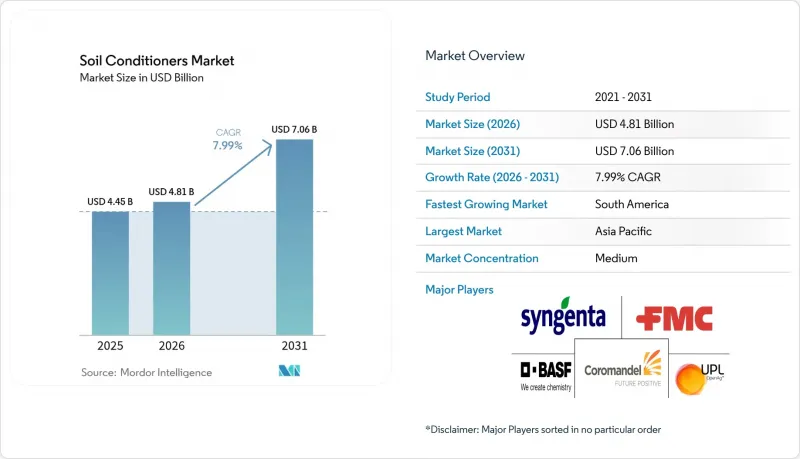
본 보고서는 제품 유형(유기 및 무기), 작물 유형(곡물, 과일 및 채소 등), 제형(건조, 액체, 과립 등) 및 지역(북미, 유럽, 남미, 아시아태평양 등)별로 분류되어 있습니다. 시장 예측은 금액(달러) 기준으로 제시되어 있습니다.
전 세계 토양 개량제 시장 동향 및 인사이트
유기 농업 및 재생 농업의 확산
세계적으로 재생형 농업으로의 전환이 진행되고 있는 것이 토양 개량제 시장의 확대를 뒷받침하고 있습니다. 2022년 유기농 과일 및 채소의 소매 매출액은 600억 달러에 달했으며, 지속 가능한 방식으로 재배된 농산물에 대해 소비자들이 기꺼이 대가를 지불하려는 태도가 부각되었습니다. Agrology사가 2024년에 실시한 실험에 따르면, 가뭄이 발생하기 쉬운 과수원에서 커버 작물로 사용된 마르스드라이 밀이 미생물 활동과 토양의 보수력을 높인 것으로 밝혀졌습니다. 농가들이 토양 건강과 인증 기준 모두를 충족하는 자재를 찾는 가운데, 유기농 토양 개량제에 대한 수요가 가속화되고 있습니다.
토양 열화와 침식의 심각화
현재 농지의 약 40%가 토양 열화 상태로 분류되어 식량 안보를 위협하고 있습니다. 특히 아시아태평양과 아프리카에서 그 영향이 가장 심각합니다. 바이오숯의 시용은 토양 재생 시험에서 수분 보유력을 최대 154% 향상시키고 식물 성장을 약 70% 증가시킨 것으로 입증되었습니다. 따라서 토양 개량제 시장은 생산성을 회복하고 토지 악화에 따른 경제적 손실을 경감하기 위한 전략적 수단으로 간주되고 있습니다.
고급 토양 개량제의 높은 가격 책정
효소 활성화형 및 미생물 유래 토양 개량제는 높은 연구 개발(R&D) 집약도를 반영하여 더 높은 가격을 책정할 수 있습니다. 초기 도입자들은 수확량 증가와 탄소 크레딧을 통해 그 비용을 정당화하고 있지만, 개발도상국 시장의 소규모 농가들은 여전히 가격에 민감합니다. 또한, 각 제조업체들은 다양한 구매력에 대응하기 위해 단계적인 제품 라인 확장을 시도하고 있으며, 이를 통해 토양 개량제 시장에 미치는 부정적인 영향을 완화하고 있습니다.
부문 분석
2025년에는 유기 자재가 토양 개량제 시장의 55.60% 점유율을 차지했으며, 잔류물이 없는 농산물에 대한 수요 증가와생물 유래 자재에 대한 규제적 지원에 힘입어, 효소 강화형 제품은 2031년까지 연평균 성장률(CAGR) 8.54%를 나타낼 것으로 예측됩니다. 유기 자재는 탄소 크레딧 체계와도 부합하여 그 보급을 촉진하고 있습니다. 이 분야에서는 효소 강화형 유기 자재가 등장하여 보다 신속한 영양 순환과 미세 응집체 형성을 가져오고 있습니다.
무기계 부문은 규모는 작지만, pH 불균형이나 중점토질 토양에서 발생하는 구조적 문제에 대한 대응을 지속하고 있으며, 영국의 새로운 농업법안(Agriculture Bill) 준수 프로그램에서 액체 석고가 지지를 얻고 있습니다. 토양 개량제 시장에서는 토양 구조 개선 효과와 보습력 향상을 겸비한 고분자계 마이크로 과립에 대한 연구 개발이 활발해지고 있습니다.
지역별 분석
2025년, 아시아태평양은 토양 개량제 시장 점유율의 37.90%를 차지하며, 남미는 연평균 성장률(CAGR) 8.15%로 가장 빠르게 성장하는 지역입니다. 광범위한 농업 기반과 토양 침식과 관련된 심각한 문제가 토양 개량제 시장의 성장을 견인하고 있습니다. 중국과 인도에서는 정부가 유기 자재에 대한 보조금을 지급하고 있으며, 일본과 호주에서는 보호 재배가 확대되고 있습니다. 구이저우성에서 실시된 포장 시험에서는 바이오매스 재계열 토양 개량제를 사용해 토양 pH가 최대 13.6% 상승하고, 작물 수확량이 25.3% 증가하는 등 현저한 성능 향상이 입증되었습니다.
유럽, 중동 및 아프리카에서는 정책 전환에 따라 토양의 건전성이 농업 관련 법규에 반영됨에 따라 시장이 가장 빠르게 성장하고 있습니다. 유럽연합(EU)의 유기농업 목표에서는 생물학적 접근법에 기반한 비옥도 관리가 의무화되어 있습니다. 독일과 북유럽 국가들에서는 바이오숯 도입이 급증하고 있는 반면, 아프리카의 재활용 이니셔티브에서는 유기 비료 및 바이오 비료공급원이 작물의 영양 요구량의 20-40%를 충당할 수 있을 가능성이 시사되고 있습니다.
북미는 토양 개량제 시장에서 기술적으로 선진적인 위치를 유지하고 있습니다. 현재 탄소 크레딧을 통한 수익이 보전 농업에 따른 초기 수확량 감소를 상쇄하고 있으며, 이것이 토양 개량제에 대한 투자를 뒷받침하고 있습니다. 정밀 농업 플랫폼은 토양 개량제의 권장량을 장비 탑재형 가변 시비 장치와 통합하여 해당 지역에서의 선도적 입지를 강화하고 있습니다.
기타 혜택:
- 엑셀 형식 시장 예측(ME) 시트
- 3개월간의 애널리스트 지원
자주 묻는 질문
목차
제1장 서론
제2장 조사 방법
제3장 주요 요약
제4장 시장 구도
제5장 시장 규모와 성장 예측
제6장 경쟁 구도
제7장 시장 기회와 향후 전망
JHS 26.08.26According to Mordor Intelligence, the soil conditioners market size is expected to grow from USD 4.45 billion in 2025 to USD 4.81 billion in 2026 and is forecast to reach USD 7.06 billion by 2031 at 7.99% CAGR over 2026-2031.
This report is Segmented by Product Type (Organic and Inorganic), by Crop Type (Cereals and Grains, Fruits and Vegetables, and More), by Formulation (Dry, Liquid, Granular, and More), and by Geography (North America, Europe, South America, Asia-Pacific, and More). The Market Forecasts are Provided in Terms of Value (USD).
Global Soil Conditioners Market Trends and Insights
Rising Adoption of Organic and Regenerative Farming
A global pivot toward regenerative practices is elevating the soil conditioners market. Retail sales of organic fruits and vegetables reached USD 60 billion in 2022, underscoring consumer willingness to pay for sustainably grown produce. Agrology's 2024 trials revealed that Merced rye cover crops boosted microbial activity and soil water retention in drought-prone orchards. As farmers seek inputs compatible with both soil health and certification standards, demand for organic conditioners accelerates.
Increasing Soil Health Degradation and Erosion
Roughly 40% of farmland is now classified as degraded, placing food security at risk, with the most severe effects in Asia-Pacific and Africa. Biochar applications have demonstrated water-retention gains of up to 154% and plant-growth increases of nearly 70% in rehabilitation trials. The soil conditioners market is therefore viewed as a strategic lever to restore productivity and mitigate the economic drag linked to land degradation.
Premium Pricing of Advanced Soil Conditioners
Enzyme-activated and microbial conditioners can command higher prices, reflecting their high R&D intensity. While early adopters justify the cost through higher yields and carbon credits, smallholders in developing markets remain price-sensitive. Producers are also experimenting with tiered product lines to accommodate diverse purchasing power, tempering the negative impact on the soil conditioners market.
Other drivers and restraints analyzed in the detailed report include:
- Rapid Growth in Protected and Vertical Farming Acreage
- Carbon-Credit Monetization for Soil-Health Inputs
- Fragmented On-Farm Advisory and Awareness Gaps
For complete list of drivers and restraints, kindly check the Table Of Contents.
Segment Analysis
Organic inputs held 55.60% of the soil conditioners market share in 2025, while enzyme-enhanced variants are predicted to grow at an 8.54% CAGR through 2031, aided by burgeoning demand for residue-free produce and regulatory support for biological inputs. Organic amendments also align with carbon credit frameworks, reinforcing their uptake. Enzyme-enhanced organic variants are emerging within this space, offering faster nutrient cycling and micro-aggregate formation.
The inorganic segment, although smaller, continues to address pH imbalances and structural issues in heavy soils, with liquid gypsum gaining favour in the United Kingdom's new Agriculture Bill compliance programs. The soil conditioners market is witnessing increased R&D in polymer-based micro-granules that combine soil structural benefits with enhanced moisture retention.
Complete Report Scope:
- By Product Type
- Organic
- Compost
- Green and Farmyard Manure
- Peat
- Other Organic Types
- Inorganic
- Polymers
- Gypsum
- Organic
- By Crop Type
- Cereals and Grains
- Fruits and Vegetables
- Oilseeds and Pulses
- Other Crops
- By Formulation
- Dry
- Liquid
- Granular
- Pellets and Others
- By Geography
- North America
- United States
- Canada
- Mexico
- Rest of North America
- South America
- Brazil
- Argentina
- Rest of South America
- Europe
- Germany
- France
- United Kingdom
- Spain
- Italy
- Russia
- Rest of Europe
- Asia-Pacific
- China
- India
- Japan
- Australia
- Rest of Asia-Pacific
- Middle East
- Saudi Arabia
- Rest of Middle East
- Africa
- South Africa
- Rest of Africa
- North America
Geography Analysis
Asia-Pacific accounted for 37.90% of the market share of the soil conditioners market in 2025, and South America is the fastest-growing region at 8.15% CAGR. An extensive agricultural base and acute challenges related to soil erosion drive the soil conditioners market. Government programs in China and India subsidise organic inputs, and protected cultivation is expanding in Japan and Australia. Biomass-ash conditioners increased soil pH by up to 13.6% and crop yield by 25.3% in Guizhou field tests, demonstrating notable performance gains.
Europe, the Middle East, and Africa record the fastest market growth as policy shifts embed soil health into agricultural legislation. The European Union's organic-farming targets mandate biologically driven fertility management. Biochar adoption is surging in Germany and the Nordics, while African recycling initiatives propose that organic and bio-fertiliser streams could supply 20-40% of crop nutrient demand.
North America maintains a technologically advanced position within the soil conditioners market. Carbon-credit revenues now offset early yield dips associated with conservation agriculture, underpinning investments in soil amendments. Precision-ag platforms integrate soil-conditioner recommendations with equipment-mounted variable-rate applicators, reinforcing regional leadership.
- BASF SE
- UPL Limited
- Syngenta Group
- Croda International Plc
- Solvay S.A.
- Evonik Industries AG
- Coromandel International Ltd.
- Novonesis Group
- Humintech GmbH
- FMC Corporation
- Yara International ASA
- Haifa Group
Additional Benefits:
- The market estimate (ME) sheet in Excel format
- 3 months of analyst support
TABLE OF CONTENTS
1 Introduction
- 1.1 Study Assumptions and Market Definition
- 1.2 Scope of the Study
2 Research Methodology
3 Executive Summary
4 Market Landscape
- 4.1 Market Overview
- 4.2 Market Drivers
- 4.2.1 Rising adoption of organic and regenerative farming
- 4.2.2 Increasing soil-health degradation and erosion
- 4.2.3 Rapid growth in protected and vertical farming acreage
- 4.2.4 Carbon-credit monetization for soil-health inputs
- 4.2.5 Enzyme-activated bio-conditioners boosting nutrient-use efficiency
- 4.2.6 Government "4 per 1000" and similar soil-carbon initiatives are linking subsidies to conditioner adoption
- 4.3 Market Restraints
- 4.3.1 Premium pricing of advanced soil conditioners
- 4.3.2 Fragmented on-farm advisory and awareness gaps
- 4.3.3 Regulatory uncertainty on emerging bio-stimulant classifications
- 4.3.4 Supply-chain risk for speciality raw materials
- 4.4 Porter's Five Forces
- 4.4.1 Bargaining Power of Buyers
- 4.4.2 Bargaining Power of Suppliers
- 4.4.3 Threat of New Entrants
- 4.4.4 Threat of Substitute Products
- 4.4.5 Intensity of Competitive Rivalry
5 Market Size and Growth Forecasts (Value)
- 5.1 By Product Type
- 5.1.1 Organic
- 5.1.1.1 Compost
- 5.1.1.2 Green and Farmyard Manure
- 5.1.1.3 Peat
- 5.1.1.4 Other Organic Types
- 5.1.2 Inorganic
- 5.1.2.1 Polymers
- 5.1.2.2 Gypsum
- 5.1.1 Organic
- 5.2 By Crop Type
- 5.2.1 Cereals and Grains
- 5.2.2 Fruits and Vegetables
- 5.2.3 Oilseeds and Pulses
- 5.2.4 Other Crops
- 5.3 By Formulation
- 5.3.1 Dry
- 5.3.2 Liquid
- 5.3.3 Granular
- 5.3.4 Pellets and Others
- 5.4 By Geography
- 5.4.1 North America
- 5.4.1.1 United States
- 5.4.1.2 Canada
- 5.4.1.3 Mexico
- 5.4.1.4 Rest of North America
- 5.4.2 South America
- 5.4.2.1 Brazil
- 5.4.2.2 Argentina
- 5.4.2.3 Rest of South America
- 5.4.3 Europe
- 5.4.3.1 Germany
- 5.4.3.2 France
- 5.4.3.3 United Kingdom
- 5.4.3.4 Spain
- 5.4.3.5 Italy
- 5.4.3.6 Russia
- 5.4.3.7 Rest of Europe
- 5.4.4 Asia-Pacific
- 5.4.4.1 China
- 5.4.4.2 India
- 5.4.4.3 Japan
- 5.4.4.4 Australia
- 5.4.4.5 Rest of Asia-Pacific
- 5.4.5 Middle East
- 5.4.5.1 Saudi Arabia
- 5.4.5.2 Rest of Middle East
- 5.4.6 Africa
- 5.4.6.1 South Africa
- 5.4.6.2 Rest of Africa
- 5.4.1 North America
6 Competitive Landscape
- 6.1 Market Concentration
- 6.2 Strategic Moves
- 6.3 Market Share Analysis
- 6.4 Company Profiles (Includes Global level Overview, Market level overview, Core Segments, Financials as available, Strategic Information, Market Rank/Share, Products and Services, Recent Developments)
- 6.4.1 BASF SE
- 6.4.2 UPL Limited
- 6.4.3 Syngenta Group
- 6.4.4 Croda International Plc
- 6.4.5 Solvay S.A.
- 6.4.6 Evonik Industries AG
- 6.4.7 Coromandel International Ltd.
- 6.4.8 Novonesis Group
- 6.4.9 Humintech GmbH
- 6.4.10 FMC Corporation
- 6.4.11 Yara International ASA
- 6.4.12 Haifa Group