

|
시장보고서
상품코드
2116089
반려동물 백신 : 시장 점유율 분석, 업계 동향 및 통계, 성장 예측(2026-2031년)Companion Animal Vaccine - Market Share Analysis, Industry Trends & Statistics, Growth Forecasts (2026 - 2031) |
||||||
 Mordor Intelligence
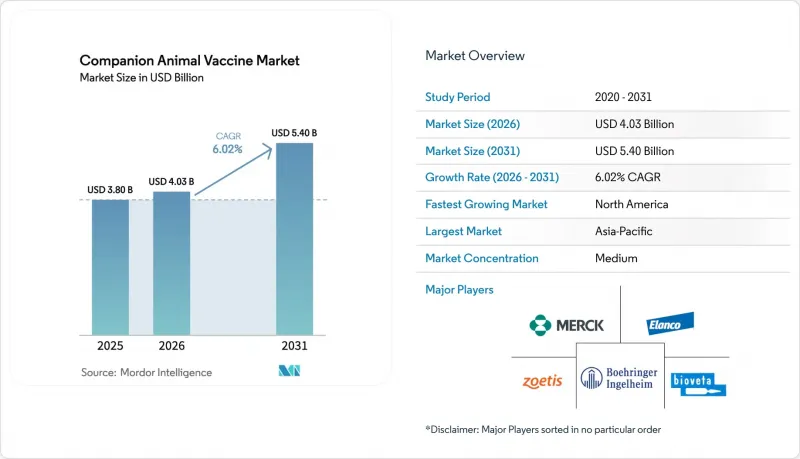
Mordor Intelligence에 의하면, 반려동물 백신 시장 규모는 2025년 38억 달러로 평가되었습니다. 2026년 40억 3,000만 달러에서 2031년까지 54억 달러로 확대되고 2026-2031년까지 연평균 성장률(CAGR)은 6.02%를 나타낼 전망입니다.
본 보고서는 기술별(생약독화 백신, 불활성화 백신, 기타), 동물 유형별(개, 고양이, 기타 반려동물), 적응증별(광견병, 기타), 최종 사용자별(동물병원 및 클리닉, 기타),지역별(북미, 유럽, 아시아태평양, 중동 및 아프리카, 남미)로 분류되어 있습니다. 시장 예측은 금액(달러) 기준으로 제시되어 있습니다.
세계의 반려동물 백신 시장 동향 및 인사이트
전 세계 반려동물 사육 마릿수 증가
2024년 기준, 중국의 개와 고양이 수는 1억 8,700만 마리에 달했으며, 인도의 개 사육 마리는 2018년 1,940만 마리에서 2023년에는 3,100만 마리로 증가하여 정기 예방접종을 위한 견고한 기반이 형성되었습니다. 미국에서도 유사한 증가세가 관찰되며, 미국수의사협회(AVMA)의 기록에 따르면 2024년 가정에서 사육되는 개는 8,970만 마리, 고양이는 7,380만 마리였습니다. 보호 시설에서 입양되는 수는 전년 대비 12% 증가했으며, 개정된 입양 지침에 따라 48시간 이내에 백신 접종이 의무화됨에 따라 즉효성 있는 제제에 대한 수요가 즉시 증가하고 있습니다. 도시화에 따라 가처분 소득이 증가함에 따라, 반려인들은 반려동물을 가족처럼 대하며 복합 부스터 백신을 포함한 예방 의료를 우선시하고 있습니다. 이에 대응하여 각 제조업체들은 편의성을 추구하는 초보 반려인을 끌어들이기 위해 1회 투여용 고역가 바이알을 시장에 출시하고 있습니다.
인수공통감염병 발생률 증가와 공중보건 캠페인
신종 인체 병원체의 약 60%는 인수공통감염병이며, 이 통계는 CDC(미국 질병통제예방센터)와 WHO(세계보건기구)의 ‘원헬스(One Health)’ 프레임워크의 근거가 되고 있습니다. 2024년에는 광견병으로 인해 추정 5만 9,000명이 사망했으며, 그 감염 경로의 99%가 개에 의한 것이기 때문에 WHO의 ‘Zero by 30’ 캠페인이 추진되고 있습니다. 미국에서는 2020년부터 2024년에 걸쳐 개의 렙토스피라증 사례가 18% 증가함에 따라, 수의사회가 32개 주에서 해당 백신의 접종 분류를 ‘선택’에서 ‘권장’으로 재분류했습니다. 2024년에 도입된 CDC의 새로운 수입 기준에 따르면, 고위험 국가에서 입국하는 개에 대해 광견병 백신 접종이 의무화되어 국경 규제 준수가 보장되고 있습니다.
백신 개발 및 규제 당국의 승인에 소요되는 막대한 비용
새로운 동물용 백신이 신약 개발 단계부터 미국 농무부(USDA) 또는 FDA-CVM의 승인을 받기까지 5-7년과 1,000만-5,000만 달러가 소요될 수 있으며, 이러한 수준은 소규모 신규 진출기업들의 진입을 주저하게 만드는 요인이 되고 있습니다. 대상 종에 대한 필수 유효성 검사, 소아 대상 안전성 평가, 다양한 온도 조건 하에서의 안정성 검사는 일부 인간용 긴급 승인 절차와 비교할 때 개발 기간을 연장시키는 요인이 되고 있습니다. 재조합 및 mRNA 제제는 GMO 규제에 따라 더욱 철저한 심사의 대상이 됩니다. 호주에서 ‘Nobivac Puppy DP Plus’에 대한 3년간의 심사 과정에서 2024년 승인에 앞서 환경 영향 평가 및 공개 의견 수렴이 진행되었습니다. Vanguard나 Nobivac과 같은 블록버스터 제품 포트폴리오에는 특허 만료 위기가 다가오고 있지만, 현행 우수 제조 기준(cGMP) 조건 하에서 약독화 생백신 마스터 시드를 복제하는 것은 기술적으로 어렵기 때문에 제네릭 제품은 여전히 부족한 실정입니다.
부문별 분석
2025년, 생백신 제품은 반려동물 백신 시장에서 42.45%의 시장 점유율을 차지하며, 디스템퍼 및 파보바이러스와 같은 주요 질병에 대한 비용 효율적인 대안으로서의 입지를 확고히 했습니다. 재조합 백신 부문은 2026년부터 2031년까지 연평균 성장률(CAGR) 8.43%를 나타낼 것으로 예측됩니다. 이는 안전성 우위, 안정성 향상, 2024년 호주에서 ‘노비백 퍼피 DP 플러스’가 승인됨으로써 입증된 새롭게 확립된 규제 채널에 힘입은 결과입니다. 불활성화 백신은 광견병 및 렙토스피라증에서 여전히 중요하지만, 재조합 백신의 항체가가 동등한 수준에 도달함에 따라 가격 측면에서 압박을 받고 있습니다. 2025년에는 토к소이드, 바이러스 벡터, 바이러스 유사 입자(VLP) 기술이 합쳐서 매출의 약 8%를 차지했으나, DNA 및 mRNA 후보 물질은 2025년 동료 심사를 거친 임상시험에서 유망한 항체 프로파일을 보였음에도 불구하고 여전히 상용화 전 단계에 있습니다.
향후 성장은 제조 비용 절감과 콜드체인 물류의 간소화에 달려 있습니다. 재조합 서브유닛은 생물안전 수준이 낮은 발효조에서 생산할 수 있어 설비 투자를 줄일 수 있으며, 1회 투여용 포장으로 인해 클리닉의 업무 흐름이 효율화됩니다. 또한, 각 제조업체는 동물과 반려인에게 가해지는 부담을 최소화하기 위해 무바늘 주사기나 비강 투여제의 도입도 검토하고 있으며, 이러한 요인들이 도입률을 더욱 끌어올릴 가능성이 있습니다. 기존의 약독화 백신의 특허 보호가 약화됨에 따라, 재조합 백신 개발 기업들은 반려동물 백신 시장에서 가격 및 제품 구성을 통한 이익 확대의 여지가 넓어지고, 신규 백신의 보급이 가속화될 것으로 전망하고 있습니다.
2025년 매출의 62.56%는 개가 차지했으며, 이는 주로 대상 질병의 범위가 넓고 광견병 예방 접종 의무가 더 엄격하기 때문입니다. 그럼에도 불구하고, 고양이 부문은 2031년까지 연평균 성장률(CAGR) 8.65%를 나타낼 것으로 예측되며, 이는 아파트 생활로의 전환과 입실 후 2일 이내에 예방접종을 의무화하는 FVRCP 프로토콜의 광범위한 도입을 반영한 것입니다. 고양이 백신 접종은 여러 번 병원을 방문해야 하는 번거로움을 줄여주는 편리한 복합 백신 바이알의 보급에 힘입어 성장하고 있습니다. 한편, 토끼, 조류, 말, 이국적인 반려동물을 합친 지출은 2025년에 전체의 약 12%를 차지할 것으로 보이며, 이는 주로 RHDV와 같은 틈새 병원체와 관련이 있습니다.
2024년 지침 개정에 따라, 완전 실내 사육 고양이의 경우 FeLV가 필수 백신에서 비필수 백신으로 재분류되었습니다. 이로 인해 당분간 해당 백신의 수량은 감소하는 한편, 새로운 고양이 면역결핍 바이러스(FIV) 및 전염성 복막염(FIP) 후보 백신에 대한 예산이 확보되게 되었습니다. 개용 의약품 부문에서는 진드기와 설치류의 서식 범위가 확대됨에 따라 라임병과 렙토스피라증에 대한 추가 접종 수요가 증가하고 있습니다. 아시아태평양의 도시화가 진행됨에 따라, 고양이용 백신 포트폴리오는 개용 부문보다 빠른 속도로 계속 성장할 것으로 예상되며, 이에 따라 반려동물 백신 시장에서 그 역할이 더욱 강화될 것으로 전망됩니다.
지역별 분석
북미는 2025년, 높은 반려동물 보유율과 광견병 백신 접종을 공중보건상의 의무 조치로 간주하는 CDC의 규제에 힘입어 전 세계 물량 점유율의 41.45%를 유지했습니다. 캐나다의 반려동물 보험 가입률은 2024년에 4.5%에 달했으며, 보험 계약의 40%가 예방 접종을 보장하고 있어 이는 보다 안정적인 주문 패턴으로 이어지고 있습니다. 미국에서는 기업형 동물병원 체인이 점포 수의 25-30%를 차지하고 있으며, 그 규모를 활용하여 공급업체에 리베이트를 요구하는 한편, 프리미엄 재조합 브랜드도 계속해서 취급하고 있습니다.
아시아태평양에서는 중국의 1억 8,700만 마리의 반려동물과 인도의 적극적인 광견병 근절 예산에 힘입어, 2031년 연평균 성장률(CAGR)은 7.43%로 예측됩니다. 2024년 필리핀에서 ‘라비신’과 ‘페로셀-4’가 승인됨에 따라 정부 조달 대상 품목이 확대되었습니다. 일본, 한국, 호주는 해당 지역 내 반려동물 보험 보급률(8-12%)을 주도하고 있습니다. 이러한 보험에서는 필수 예방접종이 아닌 비용도 보상 대상이 되는 사례가 늘어나고 있어, 가격 구조를 끌어올리는 요인이 되고 있습니다.
유럽은 반려동물 여행과 관련된 엄격한 광견병 규제 및 다가 백신 시장 출시를 가속화하는 유럽의약품청(EMA)의 감독 체제에 힘입어 2025년 매출의 약 28%를 차지했습니다. 중동 및 아프리카를 합친 점유율은 6%를 차지했으며, 케냐,탄자니아, 남아프리카공화국에서는 2024년에 1억 2,000만 달러를 투입해 개 집단 예방접종 캠페인을 실시했습니다. 남미의 점유율은 5%로, 브라질과 아르헨티나가 물량의 대부분을 차지하고 있지만, 거시경제적 역풍으로 인해 프리미엄 제품의 확대가 주춤하고 있습니다. 많은 농촌 지역에서는 여전히 콜드체인 인프라가 부족한 실정이며, 내열성 제제가 반려동물 백신 시장에서 차별화를 꾀할 여지가 있습니다.
기타 혜택
- 엑셀 형식 시장 예측(ME) 시트
- 3개월간의 애널리스트 지원
자주 묻는 질문
목차
제1장 서론
제2장 조사 방법
제3장 개요
제4장 시장 구도
제5장 시장 규모 및 성장 예측
제6장 경쟁 구도
제7장 시장 기회 및 향후 전망
KTH 26.08.31According to Mordor Intelligence, the companion animal vaccine market size is projected to expand from USD 3.80 billion in 2025 and USD 4.03 billion in 2026 to USD 5.40 billion by 2031, registering a CAGR of 6.02% between 2026 to 2031.
This report is Segmented by Technology (Live Attenuated, Inactivated, and More), Animal Type (Dogs, Cats, and Other Companion Animals), Disease Indication (Rabies, and More), End-User (Veterinary Hospitals & Clinics, and More), and Geography (North America, Europe, Asia-Pacific, Middle East and Africa, and South America). The Market Forecasts are Provided in Terms of Value (USD).
Global Companion Animal Vaccine Market Trends and Insights
Rising Adoption of Companion Animals Globally
China counted 187 million dogs and cats in 2024, and India's dog population climbed from 19.4 million in 2018 to 31 million by 2023, creating a durable base for routine immunization. Similar gains appeared in the United States, where the American Veterinary Medical Association (AVMA) recorded 89.7 million dogs and 73.8 million cats in households during 2024. Shelter adoptions advanced 12% year-over-year, and updated intake guidelines require vaccination within 48 hours, which boosts immediate demand for rapid-onset formulations. Urbanization elevates disposable income, allowing owners to treat pets as family and prioritize preventive care, including combination boosters. Manufacturers have responded with single-dose, high-titer vials that appeal to first-time owners seeking convenience.
Increasing Incidence of Zoonotic Diseases and Public Health Campaigns
Roughly 60% of emerging human pathogens are zoonotic, a statistic that underpins the CDC-WHO One Health framework. Rabies caused an estimated 59,000 human deaths in 2024, with dogs responsible for 99% of transmission, propelling the WHO Zero by 30 campaign. In the United States, leptospirosis cases in dogs rose 18% between 2020 and 2024, prompting veterinary associations to reclassify the vaccine from optional to recommended in 32 states. New CDC import standards introduced in 2024 mandate rabies vaccination for dogs entering from high-risk countries, ensuring cross-border compliance.
High Cost of Vaccine Development and Regulatory Approvals
Bringing a new veterinary vaccine from discovery to USDA or FDA-CVM approval can require 5-7 years and USD 10-50 million, levels that deter smaller entrants. Mandatory efficacy studies in target species, pediatric safety assessments, and multi-temperature stability trials extend timelines compared with some human emergency pathways. Recombinant and mRNA constructs face extra scrutiny under GMO rules; Australia's three-year Nobivac Puppy DP Plus review included environmental assessments and public comments before clearance in 2024. Patent cliffs loom for blockbuster portfolios, such as those of Vanguard and Nobivac, yet generics remain scarce because replicating live attenuated master seeds under current Good Manufacturing Practice (cGMP) conditions is technically demanding.
Other drivers and restraints analyzed in the detailed report include:
- Advancements in Vaccine Biotechnology Such as Recombinant Platforms
- Government Rabies Elimination Initiatives Mandating Canine Vaccination
- Cold-Chain and Distribution Challenges in Emerging Economies
For complete list of drivers and restraints, kindly check the Table Of Contents.
Segment Analysis
Live attenuated products held a 42.45% market share in the companion animal vaccines market in 2025, securing their role as cost-efficient options for core diseases such as distemper and parvovirus. The recombinant segment is projected to grow at an 8.43% CAGR from 2026 to 2031, driven by its safety edge, improved stability, and the newly validated regulatory path, as demonstrated by Australia's 2024 approval of Nobivac Puppy DP Plus. Inactivated platforms remain important for rabies and leptospirosis, but face price pressure as recombinant titers reach parity. Toxoid, viral vector, and virus-like particle technologies collectively represented roughly 8% of sales in 2025, while DNA and mRNA candidates are still in pre-commercial phases, despite showing encouraging antibody profiles in 2025 peer-reviewed trials.
Future growth will hinge on lowering production costs and simplifying cold-chain logistics. Recombinant subunits can be produced in lower-biosafety fermenters, reducing capital expenditures, and single-dose packaging streamlines clinic workflow. Manufacturers are also exploring needle-free injectors and intranasal formats to minimize stress on animals and owners, factors that could further lift adoption. As patent protection wanes for legacy attenuated brands, recombinant developers expect more expansive room for price-mix gains and faster uptake of novel constructs within the companion animal vaccines market.
Dogs generated 62.56% of 2025 revenue, mainly due to higher disease-coverage breadth and stricter rabies mandates. Nevertheless, the cat segment is forecasted to grow at an 8.65% CAGR through 2031, mirroring the shift toward apartment living and the widespread implementation of FVRCP protocols that require vaccination within two days of admission. Feline uptake also benefits from convenient combination vials that reduce the need for multiple clinic visits. Meanwhile, rabbits, birds, equines, and exotic pets together accounted for about 12% of spending in 2025, primarily tied to niche pathogens such as RHDV.
Guideline updates in 2024 reclassified FeLV from core to non-core for strictly indoor cats, temporarily reducing the vaccine's unit volumes while freeing budgets for newer feline immunodeficiency and infectious peritonitis candidates. In canine medicine, Lyme and leptospirosis boosters are climbing as tick and rodent ranges expand. Continued urbanization in the Asia-Pacific region is expected to keep the cat portfolio growing faster than the dog segment, thereby reinforcing its role in the companion animal vaccines market.
Complete Report Scope:
- By Technology
- Live Attenuated Vaccines
- Inactivated Vaccines
- Toxoid Vaccines
- Recombinant Vaccines
- DNA & mRNA Vaccines
- Other Technologies
- By Animal Type
- Dogs
- Cats
- Other Companion Animals (Rabbits, Avian, Equine, Exotic)
- By Disease Indication
- Rabies
- Canine Distemper / Adenovirus / Parvovirus (DAPP)
- Feline Panleukopenia / Herpes / Calicivirus (FVRCP)
- Leptospirosis
- Lyme Disease
- Bordetella & Canine Parainfluenza
- Other Disease Indications
- By End-User
- Veterinary Hospitals & Clinics
- Retail Pharmacies & Pet Stores
- E-Commerce & Online Pharmacies
- Animal Shelters & Rescue Organizations
- Geography
- North America
- United States
- Canada
- Mexico
- Europe
- Germany
- United Kingdom
- France
- Italy
- Spain
- Rest Of Europe
- Asia-Pacific
- China
- Japan
- India
- South Korea
- Australia
- Rest Of Asia-Pacific
- Middle East And Africa
- GCC
- South Africa
- Rest Of Middle East And Africa
- South America
- Brazil
- Argentina
- Rest Of South America
- North America
Geography Analysis
North America maintained a 41.45% share of global volume in 2025, driven by high ownership rates and CDC regulations that consider rabies vaccination a compulsory public health measure. Canada's pet insurance coverage reached 4.5% in 2024, with 40% of policies covering preventive shots, a factor that translates into steadier order patterns. Corporate clinic chains dominate 25-30% of U.S. outlets, leveraging scale to pressure suppliers for rebates while still stocking premium recombinant brands.
Asia-Pacific is forecast for a 7.43% CAGR through 2031, buoyed by China's 187 million pets and India's aggressive rabies elimination budgets. Philippine approvals for Rabisin and Felocell-4 in 2024 broadened the catalogue for government procurement. Japan, South Korea, and Australia lead regional pet insurance uptake at 8-12%; these policies increasingly reimburse non-core vaccinations, nudging price mix higher.
Europe held roughly 28% of 2025 sales, aided by strict pet-travel rabies rules and EMA oversight that accelerates multi-antigen launches. The Middle East and Africa together captured 6%, with Kenya, Tanzania, and South Africa deploying USD 120 million in 2024 toward mass canine drives. South America represented 5%; Brazil and Argentina drive most volume, but face macroeconomic headwinds that slow the rollout of premium products. Cold-chain gaps persist in many rural areas, providing thermostable formulations with room to differentiate within the companion animal vaccines market.
- Bayer
- Bioveta
- Boehringer Ingelheim
- Bimeda Animal Health
- Brilliant Bio Pharma
- Ceva Sante Animale
- Dechra Pharmaceuticals
- Durvet
- Elanco
- Heska
- Hester Biosciences
- Hipra
- IDT Biologika
- Indian Immunologicals
- Merck
- Phibro Animal Health
- Vaxxinova International
- Vetoquinol
- Virbac
- Zoetis
Additional Benefits:
- The market estimate (ME) sheet in Excel format
- 3 months of analyst support
TABLE OF CONTENTS
1 Introduction
- 1.1 Study Assumptions & Market Definition
- 1.2 Scope of the Study
2 Research Methodology
3 Executive Summary
4 Market Landscape
- 4.1 Market Overview
- 4.2 Market Drivers
- 4.2.1 Rising Adoption of Companion Animals Globally
- 4.2.2 Increasing Incidence of Zoonotic Diseases and Public Health Campaigns
- 4.2.3 Advancements in Vaccine Biotechnology Such as Recombinant Platforms
- 4.2.4 Government Rabies Elimination Initiatives Mandating Canine Vaccination
- 4.2.5 Shelter Intake Protocols Requiring Rapid-Onset Vaccines
- 4.2.6 Pet Insurance Expansion Covering Preventive Vaccination Costs
- 4.3 Market Restraints
- 4.3.1 High Cost of Vaccine Development and Regulatory Approvals
- 4.3.2 Cold-Chain and Distribution Challenges in Emerging Economies
- 4.3.3 Vaccine Hesitancy among Some Owners over Safety Concerns
- 4.3.4 Consolidation of Veterinary Clinics Pressuring Pricing
- 4.4 Value / Supply-Chain Analysis
- 4.5 Regulatory Landscape
- 4.6 Technological Outlook
- 4.7 Porter's Five Forces Analysis
- 4.7.1 Threat Of New Entrants
- 4.7.2 Bargaining Power Of Suppliers
- 4.7.3 Bargaining Power Of Buyers
- 4.7.4 Threat Of Substitute Products
- 4.7.5 Intensity Of Competitive Rivalry
5 Market Size & Growth Forecasts (Value, USD)
- 5.1 By Technology
- 5.1.1 Live Attenuated Vaccines
- 5.1.2 Inactivated Vaccines
- 5.1.3 Toxoid Vaccines
- 5.1.4 Recombinant Vaccines
- 5.1.5 DNA & mRNA Vaccines
- 5.1.6 Other Technologies
- 5.2 By Animal Type
- 5.2.1 Dogs
- 5.2.2 Cats
- 5.2.3 Other Companion Animals (Rabbits, Avian, Equine, Exotic)
- 5.3 By Disease Indication
- 5.3.1 Rabies
- 5.3.2 Canine Distemper / Adenovirus / Parvovirus (DAPP)
- 5.3.3 Feline Panleukopenia / Herpes / Calicivirus (FVRCP)
- 5.3.4 Leptospirosis
- 5.3.5 Lyme Disease
- 5.3.6 Bordetella & Canine Parainfluenza
- 5.3.7 Other Disease Indications
- 5.4 By End-User
- 5.4.1 Veterinary Hospitals & Clinics
- 5.4.2 Retail Pharmacies & Pet Stores
- 5.4.3 E-Commerce & Online Pharmacies
- 5.4.4 Animal Shelters & Rescue Organizations
- 5.5 Geography
- 5.5.1 North America
- 5.5.1.1 United States
- 5.5.1.2 Canada
- 5.5.1.3 Mexico
- 5.5.2 Europe
- 5.5.2.1 Germany
- 5.5.2.2 United Kingdom
- 5.5.2.3 France
- 5.5.2.4 Italy
- 5.5.2.5 Spain
- 5.5.2.6 Rest Of Europe
- 5.5.3 Asia-Pacific
- 5.5.3.1 China
- 5.5.3.2 Japan
- 5.5.3.3 India
- 5.5.3.4 South Korea
- 5.5.3.5 Australia
- 5.5.3.6 Rest Of Asia-Pacific
- 5.5.4 Middle East And Africa
- 5.5.4.1 GCC
- 5.5.4.2 South Africa
- 5.5.4.3 Rest Of Middle East And Africa
- 5.5.5 South America
- 5.5.5.1 Brazil
- 5.5.5.2 Argentina
- 5.5.5.3 Rest Of South America
- 5.5.1 North America
6 Competitive Landscape
- 6.1 Market Concentration
- 6.2 Market Share Analysis
- 6.3 Company Profiles (includes Global Level Overview, Market Level Overview, Core Segments, Financials As Available, Strategic Information, Market Rank/Share For Key Companies, Products & Services, And Recent Developments)
- 6.3.1 Bayer AG
- 6.3.2 Bioveta AS
- 6.3.3 Boehringer Ingelheim GmbH
- 6.3.4 Bimeda Animal Health
- 6.3.5 Brilliant Bio Pharma
- 6.3.6 Ceva Sante Animale
- 6.3.7 Dechra Pharmaceuticals PLC
- 6.3.8 Durvet Inc.
- 6.3.9 Elanco Animal Health Incorporated
- 6.3.10 Heska Corporation
- 6.3.11 Hester Biosciences Limited
- 6.3.12 HIPRA
- 6.3.13 IDT Biologika GmbH
- 6.3.14 Indian Immunologicals Ltd
- 6.3.15 Merck & Co. Inc.
- 6.3.16 Phibro Animal Health Corporation
- 6.3.17 Vaxxinova International
- 6.3.18 Vetoquinol SA
- 6.3.19 Virbac
- 6.3.20 Zoetis Inc.
7 Market Opportunities & Future Outlook
- 7.1 White-Space & Unmet-Need Assessment


