
|
시장보고서
상품코드
2125607
수의용 항생제 시장 : 시장 점유율 분석, 산업 동향 및 통계 데이터, 성장 예측(2026-2031년)Veterinary Antibiotics - Market Share Analysis, Industry Trends & Statistics, Growth Forecasts (2026 - 2031) |
||||||
 Mordor Intelligence
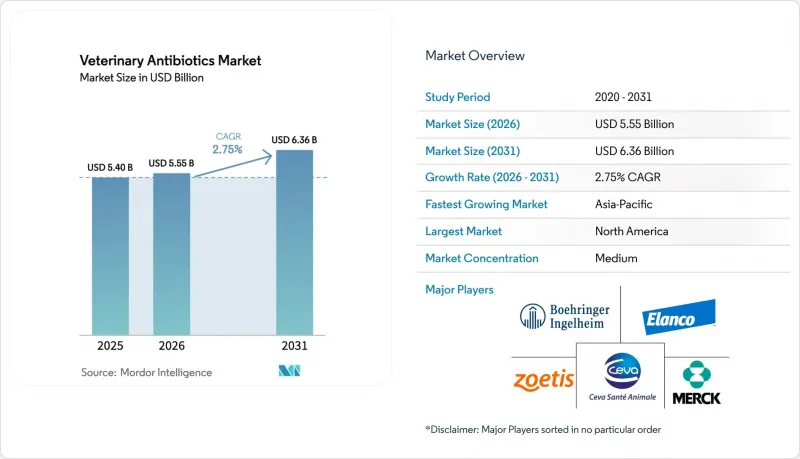
Mordor Intelligence에 의하면, 수의용 항생제 시장 규모는 2025년에 54억 달러로 평가되었고, 2026년 55억 5,000만 달러에서 2031년까지 63억 6,000만 달러에 이를 것으로 예측되며, 예측 기간 중 연평균 복합 성장률(CAGR)은 2.75%를 나타낼 전망입니다.

본 보고서는 동물 유형별(가금류 등), 약물 분류별(테트라사이클린 등), 제형별(프리믹스 등), 항균 스펙트럼별(광역 스펙트럼 등), 최종 사용자별(육용 가축 생산자 등), 유통 채널별(동물병원 등), 지역별(북미, 유럽 등)로 세분화되어 있습니다. 시장 규모 및 예측치는 금액(달러)으로 표시되어 있습니다.
세계의 수의용 항생제 시장 동향 및 인사이트
팬데믹 이후 동물성 단백질에 대한 국제적 수요 급증
2025년에는 음식점 영업 재개 및 수출 회복에 따라 전 세계 육류 생산량이 회복되어, 가금류 생산량은 4.2%, 돼지고기 생산량은 3.8% 증가했습니다. 아시아태평양 및 라틴아메리카의 생산자들은 중국 및 중동의 수입업체에 대한 공급을 목적으로 집약적 경영을 확대했으며, 육계 및 비육돈 사육 시스템에서 예방적 항생제 사용이 증가했습니다. 선진국 시장에서는 협역 스펙트럼의 처방전 전용 치료제에 대한 수요가 증가하는 반면, 신흥국에서는 여전히 일반의약품인 광역 스펙트럼 제제에 의존하고 있습니다. 이러한 수요의 양극화로 인해 규제가 엄격한 지역에서 법 집행이 미흡한 국가들로 수요가 이동하고 있으며, 이로 인해 수의용 항생제 시장의 기초적인 성장이 유지되고 있습니다. 그러나 전 세계 소매업체들의 감시가 강화됨에 따라 수출업체들은 적정 사용 프로토콜을 채택해야 할 필요가 생겼으며, 동물 전용 분자로의 전환이 가속화되고 있습니다.
반려동물 사육률 및 수의 의료비 회복
미국에서는 2025년 가구당 반려동물 보유율이 67%를 기록하여 2023년 대비 4포인트 상승했습니다. 또한 2024-2025년 반려동물 1마리당 수의학 비용은 연평균 6.1% 증가했습니다. 유럽 및 아시아태평양의 도시 지역에서도 유사한 경향이 관찰되었습니다. 진료소에서의 진단 기반 처방에서는 아미노글리코사이드 계열이나 1세대 세팔로스포린 계열이 선호되고 있으며, 광범위 스펙트럼의 플루오로퀴놀론 계열에 대한 수요는 축소되고 있습니다. 원격 수의학 플랫폼과 연계된 온라인 약국이 처방전 재조제 시장을 선점하고 있지만, 미국의 주 차원 원격의료 규제와 EU의 국경을 넘는 면허 발급 제한으로 인해 그 규모는 제한되고 있습니다. 그 결과 반려동물 분야에서 성장이 나타나고 있는 것이 수의학용 항생제 시장의 프리미엄 가격 강세를 뒷받침하고 있습니다.
부문 분석
가금류용 수의학 항생제 시장은 전 세계 매출의 32.55%를 차지했습니다. EU와 북미의 규제 압력으로 인해 예방적 사용이 억제되고 있으며, 이오노포어 계열 약제로의 대체도 정착되고 있습니다. 대조적으로, 수산 양식 분야의 매출액은 6억 2,000만 달러에 그치고 있지만, 동남아시아의 새우 및 틸라피아 양식장에서 감독 없는 항생제 투여가 계속되고 있어 연평균 성장률(CAGR) 6.85%로 확대되고 있습니다. 이러한 차이는 규제 집행의 엄격함이 어종별로 판매량을 좌우하고 있음을 여실히 보여줍니다.
수산물 양식의 성장은 높은 질병 발생률과 어종별로 승인된 제제가 제한적이라는 점에 기인하며, 이로 인해 양식업자들은 가축용 의약품을 적응증 외로 사용할 수밖에 없는 상황에 처해 있습니다. 돼지용 수요는 테트라사이클린계 약제의 벌크 제품을 대신하여 정밀 투여가 가능한 플루오로무틸린계 약제가 보급되고 있어 견조한 추세를 보이고 있습니다. 한편, 소용 시장에서는 육용 비육장에서의 장시간 작용형 주사제와 젖소 농장에서의 유방 내 투여용 튜브 사용이 양극화되고 있습니다. 반려동물용 항생제 매출은 반려동물 사육 마릿수 증가를 배경으로 성장하고 있으며, 요로 감염증 치료제로서 아미노글리코사이드계 약제의 점유율이 확대되고 있습니다. 양 및 염소용 시장은 지중해 및 중동 이외의 상업적 사육이 제한적이기 때문에 여전히 틈새 시장으로 남아 있습니다.
테트라사이클린 계열은 2025년 매출의 28.53%를 차지했으며, 수의용 항생제 시장에서 가장 큰 점유율을 차지하고 있습니다. 그러나 폐수 배출 기준 및 사료 관련 규제로 인해 예방적 투여는 감소하는 추세입니다. 아미노글리코사이드 계열의 매출액은 6억 8,000만 달러이며, 2031년까지 연평균 성장률(CAGR) 6.75%를 나타낼 것으로 예측됩니다. 이는 수의사들이 반려동물의 호흡기 감염증 및 요로 감염증 치료에 겐타마이신과 아미카신을 선호하여 사용하고 있기 때문입니다.
페니실린 및 1세대 세팔로스포린은 젖소의 유방염 치료 프로토콜에서 수요를 유지하고 있지만, 3세대 세팔로스포린은 ‘예비 약제’로 지정되어 있습니다. 마크로라이드계 항균제는 툴라트로마이신을 필두로, 지속성 주사제 덕분에 소의 호흡기 질환 치료 시장에서 점유율을 확대되고 있습니다. 중국의 수산 양식 분야 사용 금지 및 EU의 규제 강화에 따라 플루오로퀴놀론의 판매량은 감소하고 있으며, 또한 병용 요법을 통해 저용량으로도 더 높은 효능을 얻을 수 있게 됨에 따라 설폰아미드 시장 점유율은 하락하고 있습니다.
지역별 분석
2025년 매출의 32.52%를 차지한 북미 시장은 수의용 사료 지침에 따른 일반의약품 판매 규제와 처방전 발급 범위를 제한하는 지역 수의사 부족으로 인해 위축될 것으로 예측됩니다. 그럼에도 불구하고, 반려동물용 고부가가치 제품에 대한 지출과 비육우용 지속형 주사제의 보급이 안정적인 이익률을 뒷받침하고 있습니다.
아시아태평양은 2031년까지 연평균 성장률(CAGR) 6.12%로 확대될 것으로 예측됩니다. 중국의 유전자형 검사 의무화 및 인도의 낙농 분야 현대화로 인해 협역 스펙트럼 항균제 수요가 증가하고 있지만, 한편 동남아시아의 규제가 미흡한 수산 양식 지역에서는 비공식적인 네트워크를 통해 광역 스펙트럼 항균제의 구매가 계속되고 있습니다. 규제의 미비함은 판매량 증가를 뒷받침하고 있지만, 더욱 엄격한 EU의 수입 요건에 직면한 수출업체에게는 잔존 위험을 높이고 있습니다.
유럽에서는 규정 준수 비용을 높이는 엄격한 항생제 내성(AMR) 대책 및 방류 기준 대응이 진행되고 있습니다. 제네릭 의약품 제조업체의 재편이 진행 중이며, 소규모 기업들은 0.2-50만 유로에 달하는 ERA 신청 서류 작성 비용을 마련하지 못해 시장에서 철수하고 있습니다. 라틴아메리카에서는 다양한 동향이 관찰됩니다. 브라질의 수출 지향형 통합 기업들은 수입국의 프로토콜을 준수하는 반면, 국내 생산자들은 계속해서 OTC(처방전 없이 구입할 수 있는 의약품)를 사용하고 있습니다. 중동 및 아프리카는 합쳐서 큰 수익원이 되고 있지만, 여전히 시장이 세분화되어 있습니다. 걸프 국가들은 프리미엄 제제를 수입하고 있는 반면, 사하라 이남 시장은 수의사의 감독이 제한적인 협동조합을 통해 판매되는 제네릭 의약품에 의존하고 있습니다.
기타 혜택 :
- Excel 형식 시장 예측(ME) 시트
- 3개월간의 애널리스트 지원
자주 묻는 질문
목차
제1장 서론
제2장 분석 방법
제3장 주요 요약
제4장 시장 구도
제5장 시장 규모 및 성장률 예측
제6장 경쟁 구도
제7장 시장 기회 및 향후 전망
AJY 26.09.15According to Mordor Intelligence, the veterinary antibiotics market size was valued at USD 5.40 billion in 2025 and is estimated to grow from USD 5.55 billion in 2026 to reach USD 6.36 billion by 2031, at a CAGR of 2.75% during the forecast period.
This report is Segmented by Animal Type (Poultry, and More), Drug Class (Tetracyclines, and More), Delivery Form (Premixes, and More), Spectrum of Activity (Broad-Spectrum and More), End User (Food-Producing Animal Producers and More), Distribution Channel (Veterinary Hospitals and More), and Geography (North America, Europe, and More). The Market Sizes and Forecasts are Provided in Terms of Value (USD).
Global Veterinary Antibiotics Market Trends and Insights
Surging Global Demand for Animal-Source Protein Post-Pandemic
Global meat output rebounded in 2025 with poultry volumes up 4.2% and pork up 3.8% as restaurants reopened and exports recovered. Producers in Asia-Pacific and Latin America expanded intensive operations to serve China and Middle Eastern importers, increasing prophylactic antibiotic use in broiler and finishing pig systems. Developed markets are channelling growth into narrow-spectrum, prescription-only therapies, whereas emerging economies still rely on over-the-counter broad-spectrum formulations. This demand bifurcation is shifting volume from highly regulated regions to countries with limited enforcement, sustaining baseline growth for the veterinary antibiotics market. However, mounting scrutiny from global retailers is pressuring exporters to adopt stewardship protocols, accelerating the transition to animal-only molecules.
Rebound in Companion-Animal Ownership & Veterinary Expenditure
The United States recorded 67% household pet ownership in 2025, up four percentage points from 2023, and per-pet veterinary spend rose 6.1% annually during 2024-2025. Similar patterns emerged in Europe and urban Asia-Pacific. Diagnostics-guided prescribing in clinics is favouring aminoglycosides and first-generation cephalosporins, narrowing demand for broad-spectrum fluoroquinolones. Online pharmacies linked to tele-veterinary platforms are capturing prescription refills, although state-level telemedicine rules in the U.S. and cross-border licensing limits in the EU temper the scale. The resulting growth in the companion sector underpins premium pricing resilience for the veterinary antibiotics market.
Other drivers and restraints analyzed in the detailed report include:
- Regulatory Shift Toward Animal-Only Antibiotic Classes
- Expansion of Injectable, Heat-Stable Long-Acting Formulations in Ruminants
- Tightening AMR Regulations Reducing Group Treatments
- Rapid Penetration of Probiotic / Phage Growth-Promoter Alternatives
For complete list of drivers and restraints, kindly check the Table Of Contents.
Segment Analysis
The veterinary antibiotics market for poultry accounted for 32.55% of global revenue. Regulatory pressure in the EU and North America is capping prophylactic usage, and ionophore substitution is maturing. In contrast, aquaculture generated only USD 0.62 billion but is advancing at a 6.85% CAGR as Southeast Asian shrimp and tilapia farms continue unmonitored antibiotic dosing. The divergence underscores how enforcement intensity steers volume across species.
Growth in aquaculture is driven by high disease incidence and limited approved fish-specific formulations, prompting farmers to use livestock drugs off-label. Swine demand remains steady as precision-dose pleuromutilins replace bulk tetracyclines, and cattle uptake is bifurcated between long-acting injectables in beef feedlots and intramammary tubes in dairies. Companion-animal antibiotic sales climb on the back of rising pet ownership, with aminoglycosides gaining share for urinary tract infections. Sheep and goats remain niche, reflecting limited commercial farming outside the Mediterranean and Middle-East belts.
Tetracyclines accounted for 28.53% of 2025 revenue, making them the largest share of the veterinary antibiotics market. Wastewater discharge limits and feed directives, however, are trimming metaphylactic use. Aminoglycoside revenue stood at USD 0.68 billion and is set to grow at a 6.75% CAGR to 2031, as veterinarians favor gentamicin and amikacin for companion-animal respiratory and urinary infections.
Penicillins and first-generation cephalosporins sustain demand in dairy mastitis protocols, while third-generation cephalosporins face "reserve" designations. Macrolides, spearheaded by tulathromycin, gain in bovine respiratory disease owing to long-acting injectables. Fluoroquinolone volumes contract following aquaculture bans in China and tightened EU rules, and sulfonamide share erodes as combination therapies pack higher efficacy at lower doses.
Complete Report Scope:
- By Animal Type
- Poultry
- Swine
- Cattle
- Sheep & Goats
- Companion Animals
- Aquaculture
- Other Livestock
- By Drug Class
- Tetracyclines
- Penicillins
- Sulfonamides
- Macrolides
- Aminoglycosides
- Cephalosporins
- Fluoroquinolones
- Others
- By Delivery Form
- Premixes
- Oral Powders
- Oral Solutions
- Injections
- Intramammary & Intra-uterine
- Feed-Additive Blends
- By Spectrum of Activity
- Broad-Spectrum
- Narrow-Spectrum
- By End User
- Food-Producing Animal Producers
- Companion-Animal Owners
- By Distribution Channel
- Veterinary Hospitals & Clinics
- Retail Pharmacies
- Online Channels
- Geography
- North America
- United States
- Canada
- Mexico
- Europe
- Germany
- United Kingdom
- France
- Italy
- Spain
- Rest of Europe
- Asia-Pacific
- China
- India
- Japan
- Australia
- South Korea
- Rest of Asia-Pacific
- Middle East and Africa
- GCC
- South Africa
- Rest of Middle East and Africa
- South America
- Brazil
- Argentina
- Rest of South America
- North America
Geography Analysis
North America, accounting for 32.52% of 2025 revenue, is expected to decline due to veterinary feed directive curbs on over-the-counter sales and a rural veterinarian shortage, which limits prescription bandwidth. Nevertheless, premium companion-animal spending and uptake of long-acting injectables for feedlot cattle underpin stable margins.
Asia-Pacific projected to climb 6.12% CAGR to 2031. China's genotyping mandates and India's dairy upgrades lift narrow-spectrum demand, while under-regulated aquaculture corridors in Southeast Asia continue broad-spectrum purchases via informal networks. Regulatory gaps facilitate volume growth but raise residual risks for exporters facing stricter EU entry requirements.
Europe is navigating aggressive AMR and wastewater standards that elevate compliance costs. Generic manufacturer consolidation is underway, as smaller firms exit rather than fund EUR 0.2-0.5 million ERA dossiers. Latin America records varied trajectories: Brazil's export-oriented integrators align with importing-country protocols, while domestic producers continue to use OTC. The Middle East and Africa together contribute significant revenue but remain fragmented; Gulf states import premium formulations, whereas sub-Saharan markets depend on generics sold through co-ops with limited vet oversight.
- AdvaCare Pharma LLP
- Ashish Life Science Private Limited
- Bimeda Holdings Limited
- Boehringer Ingelheim Animal Health International GmbH
- Ceva Sante Animale S.A.
- Chanelle Pharma Private Limited
- Dechra Pharmaceuticals Limited
- Elanco
- HIPRA, S.A
- Huvepharma
- KRKA d.d.
- Kyoritsu Seiyaku
- Merck Animal Health (MSD)
- Norbrook
- Ourofino Saude Animal
- Phibro Animal Health
- Vetoquinol
- Virbac
- Zoetis
- Zydus Animal Health
Additional Benefits:
- The market estimate (ME) sheet in Excel format
- 3 months of analyst support
TABLE OF CONTENTS
1 Introduction
- 1.1 Study Assumptions & Market Definition
- 1.2 Scope of the Study
2 Research Methodology
3 Executive Summary
4 Market Landscape
- 4.1 Market Overview
- 4.2 Market Drivers
- 4.2.1 Surging Global Demand for Animal-Source Protein Post-Pandemic
- 4.2.2 Rebound in Companion-Animal Ownership and Veterinary Expenditure
- 4.2.3 Regulatory Shift Toward Animal-Only Antibiotic Classes
- 4.2.4 Expansion of Injectable, Heat-Stable Long-Acting Formulations
- 4.2.5 Livestock Genotyping and on-Farm Diagnostics for Precision Dosing
- 4.2.6 Unmonitored Antibiotic Use in ASEAN Aquaculture
- 4.3 Market Restraints
- 4.3.1 Tightening AMR Regulations Reducing Group Treatments
- 4.3.2 Rapid Penetration of Probiotic / Phage Growth-Promoter Alternatives
- 4.3.3 Chronic Shortage of Rural Veterinarians and Skilled Farm Labor
- 4.3.4 EU Wastewater and ERA Rules Lifting Compliance Costs for Generics
- 4.4 Supply-Chain Analysis
- 4.5 Regulatory Landscape
- 4.6 Technological Outlook
- 4.7 Porter's Five Forces
- 4.7.1 Threat of New Entrants
- 4.7.2 Bargaining Power of Buyers
- 4.7.3 Bargaining Power of Suppliers
- 4.7.4 Threat of Substitutes
- 4.7.5 Competitive Rivalry
5 Market Size & Growth Forecasts (Value, USD)
- 5.1 By Animal Type
- 5.1.1 Poultry
- 5.1.2 Swine
- 5.1.3 Cattle
- 5.1.4 Sheep & Goats
- 5.1.5 Companion Animals
- 5.1.6 Aquaculture
- 5.1.7 Other Livestock
- 5.2 By Drug Class
- 5.2.1 Tetracyclines
- 5.2.2 Penicillins
- 5.2.3 Sulfonamides
- 5.2.4 Macrolides
- 5.2.5 Aminoglycosides
- 5.2.6 Cephalosporins
- 5.2.7 Fluoroquinolones
- 5.2.8 Others
- 5.3 By Delivery Form
- 5.3.1 Premixes
- 5.3.2 Oral Powders
- 5.3.3 Oral Solutions
- 5.3.4 Injections
- 5.3.5 Intramammary & Intra-uterine
- 5.3.6 Feed-Additive Blends
- 5.4 By Spectrum of Activity
- 5.4.1 Broad-Spectrum
- 5.4.2 Narrow-Spectrum
- 5.5 By End User
- 5.5.1 Food-Producing Animal Producers
- 5.5.2 Companion-Animal Owners
- 5.6 By Distribution Channel
- 5.6.1 Veterinary Hospitals & Clinics
- 5.6.2 Retail Pharmacies
- 5.6.3 Online Channels
- 5.7 Geography
- 5.7.1 North America
- 5.7.1.1 United States
- 5.7.1.2 Canada
- 5.7.1.3 Mexico
- 5.7.2 Europe
- 5.7.2.1 Germany
- 5.7.2.2 United Kingdom
- 5.7.2.3 France
- 5.7.2.4 Italy
- 5.7.2.5 Spain
- 5.7.2.6 Rest of Europe
- 5.7.3 Asia-Pacific
- 5.7.3.1 China
- 5.7.3.2 India
- 5.7.3.3 Japan
- 5.7.3.4 Australia
- 5.7.3.5 South Korea
- 5.7.3.6 Rest of Asia-Pacific
- 5.7.4 Middle East and Africa
- 5.7.4.1 GCC
- 5.7.4.2 South Africa
- 5.7.4.3 Rest of Middle East and Africa
- 5.7.5 South America
- 5.7.5.1 Brazil
- 5.7.5.2 Argentina
- 5.7.5.3 Rest of South America
- 5.7.1 North America
6 Competitive Landscape
- 6.1 Market Concentration
- 6.2 Market Share Analysis
- 6.3 Company Profiles (includes Global level Overview, Market level overview, Core Segments, Financials as available, Strategic Information, Market Rank/Share for key companies, Products & Services, and Recent Developments)
- 6.3.1 AdvaCare Pharma LLP
- 6.3.2 Ashish Life Science Private Limited
- 6.3.3 Bimeda Holdings Limited
- 6.3.4 Boehringer Ingelheim Animal Health International GmbH
- 6.3.5 Ceva Sante Animale S.A.
- 6.3.6 Chanelle Pharma Private Limited
- 6.3.7 Dechra Pharmaceuticals Limited
- 6.3.8 Elanco Animal Health Incorporated
- 6.3.9 HIPRA, S.A
- 6.3.10 Huvepharma
- 6.3.11 KRKA d.d.
- 6.3.12 Kyoritsu Seiyaku
- 6.3.13 Merck Animal Health (MSD)
- 6.3.14 Norbrook
- 6.3.15 Ourofino Saude Animal
- 6.3.16 Phibro Animal Health
- 6.3.17 Vetoquinol
- 6.3.18 Virbac
- 6.3.19 Zoetis
- 6.3.20 Zydus Animal Health
7 Market Opportunities & Future Outlook
- 7.1 White-Space & Unmet-Need Assessment