

|
시장보고서
상품코드
2116319
수의 검사 기관 : 시장 점유율 분석, 업계 동향 및 통계, 성장 예측(2026-2031년)Veterinary Reference Laboratory - Market Share Analysis, Industry Trends & Statistics, Growth Forecasts (2026 - 2031) |
||||||
 Mordor Intelligence
Mordor Intelligence에 의하면, 2026년 수의 검사 기관 시장 규모는 59억 7,000만 달러로 추정되고 2025년 54억 5,000만 달러에서 확대해, 2031년에는 93억 8,000만 달러에 이를 것으로 예측됩니다.
2026년부터 2031년까지 연평균 성장률(CAGR) 9.45%를 나타낼 것으로 전망됩니다.
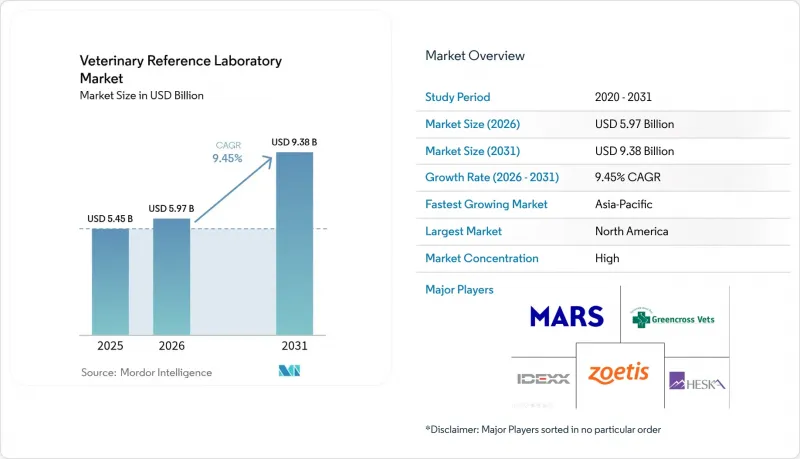
본 보고서는 서비스 유형별(임상화학, 면역진단, 분자진단, 혈액학), 용도별(병리학, 세균학, 바이러스학 등), 동물 유형별(가축 및 반려동물), 지역별(북미, 유럽, 아시아태평양 등)로 분류되어 있습니다. 시장 예측은 금액(달러)으로 표시되어 있습니다.
세계의 수의 검사 기관 시장 동향 및 인사이트
반려동물 보험의 보급 확대와 수의 의료비 증가
보험료는 2024년에 45억 달러에 달하여, 2019년 대비 2배 이상 증가했습니다. 상위 10개 보험사의 인수 집중화로 인해 보험금 지급의 표준화가 진행되고 있으며, 그 결과 첨단 진단법의 수용이 촉진되고 있습니다. 8.24%에 달하는 수의 의료비 인플레이션율은 보험의 가치 제안을 강화하여, 반려인이 비용에 대한 불안감 없이 종합적인 검사를 승인하도록 유도하고 있습니다.
면역 진단 및 분자진단 분야의 기술 발전
Zoetis Vetscan Imagyst와 같은 AI 탑재 플랫폼을 통해 현재는 진료소 내에서 세포진, 혈액 검사, 소변 침전물 판정이 가능해졌습니다. 차세대 시퀀싱을 활용한 암 패널은 92.7%의 검출 정확도를 달성하여, 치료 계획 수립에 도움이 되는 실용적인 유전체 변이를 밝혀내고 있습니다(frontiersin.org). 다중 PCR 분석법은 국가 기준을 준수하면서도 10 카피/μL의 낮은 농도에서도 병원체를 검출합니다.
고도의 검사와 검사실 자동화의 높은 비용
완전 자동화 시스템에는 막대한 설비 투자가 필요하며, 많은 소규모 동물병원에서는 그 부담을 감당할 수 없습니다. 중국 반려동물 병원의 80% 이상이 연간 240만 위안 미만의 수익만을 올리고 있어, 이것이 장비 업그레이드를 제약하고 있습니다. 이동식 검사실이나 카트리지식 분석 장치는 이러한 장벽을 완화해 주지만, 그럼에도 초기 하드웨어 투자가 필요합니다.
부문별 분석
면역 진단은 일상적인 선별 검사에서 확고하게 자리 잡은 사용에 힘입어 2025년 수의 검사 기관 시장에서 42.98%의 점유율을 차지했습니다. 한편, 분자진단은 병원체에 대한 뛰어난 특이성, 정밀의료 및 검사 시간 단축을 배경으로 2031년까지 연평균 10.48%의 성장률로 확대될 것으로 예측됩니다. 멀티플렉스 PCR 패널과 차세대 염기서열 분석이 이러한 성장 궤도를 주도하고 있으며, 시약 비용의 감소와 소프트웨어를 통한 자동화가 이를 뒷받침하고 있습니다. 면역 진단은 기존의 도입 실적과 임상의들의 익숙함 덕분에 수익을 유지하고 있지만, 경쟁 압력으로 인해 고부가가치의 종양학 및 감염병 검사는 꾸준히 분자진단 방식으로 전환되고 있습니다.
AI를 활용한 카트리지식 분석 장치를 통해 분자진단의 처리 능력이 진료 현장에 도입되면서, 결과가 나오기까지 걸리는 시간이 며칠에서 1시간 미만으로 단축되었습니다. 검사 기관은 표적 치료 선택에 도움이 되는 전장 유전체 분석 및 액체 생검 서비스를 통해 타사와의 차별화를 꾀하고 있습니다. 검사 메뉴가 확대됨에 따라 세트 할인형 구독 가격 모델이 등장하여 고객 충성도를 공고히 하고 현금 흐름을 안정시키고 있습니다. 이러한 변화에 따라 분자진단 플랫폼은 계속해서 증분 수익을 확보하고 있는 반면, 면역 분석 제공업체는 시장 점유율을 지키기 위해 다중 검사 기능을 추가하고 있습니다. 두 부문 모두 수의 검사 기관 시장의 전반적인 성장을 주도하고 있습니다.
바이러스학 분야의 연평균 성장률(CAGR) 11.05%는 H5N1 감시 강화 및 가축에 대한 인플루엔자 검사 의무화로 인해 다른 모든 응용 분야를 상회하고 있습니다. 국가 기준에 따라 검증된 신속 항원 검사 및 RT-PCR 패널은 대량 선별 검사 프로토콜에서 주류를 이루며, 무역 규정 준수를 촉진하고 있습니다. 조기 발견을 중시하는 규제 동향에 따라 각국 정부는 젖소, 가금류, 말 분야에서의 바이러스학 검사 역량 확충을 지원하고 있습니다.
한편, 항생제 적정 사용 프로그램으로 인해 세균학에 대한 수요가 증가하고 있으며, AI(인공지능)를 활용한 분변 분석 시스템이 기생충학 분야의 도입을 가속화하고 있습니다. 반려동물이 가정용 화학 물질에 노출될 기회가 늘어나는 것을 배경으로, 독물학 검사는 꾸준히 성장하고 있습니다. 또한, 신종 병원체나 새로운 치료법에 대한 전문적인 검사법이 요구됨에 따라 그 밖의 틈새 응용 분야도 등장하고 있습니다. 이러한 다양한 검사 수요가 맞물려 동물용 기준 실험실의 성장 전망을 뒷받침하고 있습니다.
지역별 분석
아시아태평양은 2031년까지 연평균 성장률(CAGR) 12.04%를 기록하며 가장 빠르게 성장하는 지역입니다. 중국의 반려동물 경제는 2024년에 3,000억 위안(410억 달러)에 달하며, 그 지출의 28%를 수의학이 차지했지만, 소규모 동물 병원의 수익성 제약으로 인해 비용 효율적인 진단법에 대한 수요가 증가하고 있습니다. 일본의 혁신 기업들은 AI를 활용한 분변 분석 및 시간 외 원격 의료를 도입하여 고령화 사회에서 접근성을 높이고 있습니다. 호주에서는 조에티스(Zoetis)가 멜버른의 새로운 거점을 통해 백신 생산 능력을 확대하는 등 다국적 기업들의 투자를 유치하고 있습니다. 규제 체계의 다양성과 인프라의 불균형으로 인해 지역별로 기회는 제각각이지만, 가구 소득 증가와 반려동물 소유자의 행동 변화가 검사 서비스의 지속적인 이용 확대를 뒷받침하고 있습니다.
북미는 성숙한 진료 인프라와 높은 반려동물 관리 지출에 힘입어 2025년에도 38.90%의 시장 점유율을 유지했습니다. 2024년 6월에 발효된 FDA 지침 제263호는 항균제 처방 관리를 의무화하고 있어, 간접적으로 식용 동물의 진단 건수를 증가시키고 있습니다(avma.org). 인력 부족과 내원자 수 감소가 성장세를 둔화시키고 있어, 생산성을 유지하기 위해 사업자들은 자동화로의 전환을 추진하고 있습니다.
유럽에서는 규제 조화와 최근의 업계 재편에 힘입어 한 자릿수 중반의 꾸준한 성장이 나타나고 있습니다. 마스 인코퍼레이티드(Mars Incorporated)는 SYNLAB Vet 및 Cerba Vet 인수를 완료하여 검사 메뉴의 폭과 지리적 커버리지를 확대했습니다. 항생제 적정 사용 캠페인을 통해 진단 결과에 기반한 치료가 촉진되고 있으며, 확립된 수의학 교육 프로그램이 전문적인 검사 수요를 뒷받침하고 있습니다. 중동 및 아프리카의 신흥 시장은 아직 발전 단계에 있지만, 미래가 기대되고 있습니다. 그 예로, 필리핀이 새로운 수의 진단 시설에 2,000만 필리핀 페소를 투자한 것을 들 수 있습니다(pna.gov.ph). 포인트 오브 케어(PoC) 플랫폼은 광범위한 검사 네트워크가 구축되지 않은 지역에 확장성이 뛰어난 대안을 제공하며, 접근성이 높은 진단을 지향하는 전 세계적인 추세를 여실히 보여주고 있습니다.
기타 혜택 :
- 엑셀 형식 시장 예측(ME) 시트
- 3개월간의 애널리스트 지원
자주 묻는 질문
목차
제1장 서론
제2장 조사 방법
제3장 개요
제4장 시장 구도
제5장 시장 규모 및 성장 예측
제6장 경쟁 구도
제7장 시장 기회 및 향후 전망
KTH 26.08.31According to Mordor Intelligence, veterinary reference laboratory market size in 2026 is estimated at USD 5.97 billion, growing from 2025 value of USD 5.45 billion with 2031 projections showing USD 9.38 billion, growing at 9.45% CAGR over 2026-2031.
This report is Segmented by Service Type (Clinical Chemistry, Immunodiagnostics, Molecular Diagnostics, and Hematology), Application (Pathology, Bacteriology, Virology, and More), Animal Type (Livestock Animals and Companion Animals), and Geography (North America, Europe, Asia-Pacific, and More). The Market Forecasts are Provided in Terms of Value (USD).
Global Veterinary Reference Laboratory Market Trends and Insights
Growing uptake of pet insurance and higher veterinary spend
Premiums reached USD 4.5 billion in 2024, more than doubling since 2019. Concentrated underwriting among the top ten insurers heightens reimbursement standardization, which in turn lifts acceptance of advanced diagnostics. Veterinary cost inflation of 8.24% reinforces the value proposition of insurance and encourages owners to authorize comprehensive testing without cost anxiety..
Technology advances in immuno- and molecular diagnostics
AI-enabled platforms such as Zoetis Vetscan Imagyst now deliver cytology, hematology, and urine-sediment readings inside the clinic. Next-generation sequencing cancer panels achieve 92.7% detection accuracy and reveal actionable genomic variants for therapeutic planning frontiersin.org. Multiplex PCR assays detect pathogens at 10 copies/µL while matching national reference standards.
High cost of advanced tests and lab automation
Fully automated systems carry steep capital requirements that many small clinics cannot absorb. Over 80% of China's pet hospitals earn under 2.4 million yuan annually, constraining equipment upgrades. Mobile laboratories and cartridge-based analyzers mitigate barriers but still require upfront hardware investment.
Other drivers and restraints analyzed in the detailed report include:
- Rising companion animal population and pet-humanization trend
- Increasing prevalence of zoonotic and chronic animal diseases
- Shortage of board-certified veterinary pathologists
For complete list of drivers and restraints, kindly check the Table Of Contents.
Segment Analysis
Immunodiagnostics held 42.98% of the veterinary reference laboratory market in 2025 based on entrenched use in routine screening. Molecular diagnostics, however, is forecast to compound at 10.48% through 2031 on the back of superior pathogen specificity, precision medicine, and shrinking run times. Multiplex PCR panels and next-generation sequencing propel this growth trajectory, supported by falling reagent costs and software automation. Immunodiagnostics' installed base and clinician familiarity sustain its revenue, but competitive pressure steadily diverts high-value oncology and infectious disease testing toward molecular formats.
AI-enhanced cartridge analyzers bring molecular throughput into clinics, shortening result cycles from days to under an hour. Reference laboratories differentiate themselves with whole-genome and liquid biopsy services that inform targeted therapy selection. As test menus broaden, bundled subscription pricing models emerge, anchoring client loyalty and stabilizing cash flows. With these shifts, molecular platforms continue to capture incremental revenue while immunoassay providers add multiplex capability to defend share. Both segments fuel aggregate expansion of the veterinary reference laboratory market.
Clinical pathology accounted for 38.22% of 2025 revenues and remains indispensable for wellness exams and chronic-disease monitoring. Virology's 11.05% CAGR outpaces every other application due to heightened H5N1 surveillance and mandatory influenza testing in livestock. Rapid antigen and RT-PCR panels, validated against national standards, dominate high-volume screening protocols and facilitate trade compliance. Regulatory emphasis on early detection prompts governments to subsidize virology capacity expansion in dairy, poultry, and equine sectors.
Meanwhile, antimicrobial-stewardship programs elevate bacteriology demand, and AI fecal-analysis systems accelerate parasitology adoption. Toxicology testing grows steadier, driven by rising pet exposure to household chemicals. Other niche applications appear as emerging pathogens and novel therapies require specialized assays. Collectively, diverse testing needs reinforce the growth prospects of the veterinary reference laboratory.
Complete Report Scope:
- By Service Type
- Clinical Chemistry
- Hematology
- Immunodiagnostics
- Molecular Diagnostics
- Urinalysis
- Others
- By Application
- Clinical Pathology
- Bacteriology
- Virology
- Parasitology
- Toxicology
- Others
- By Animal Type
- Companion Animals
- Dogs
- Cats
- Horses
- Others
- Livestock Animals
- Cattle
- Swine
- Poultry
- Others
- Companion Animals
- By End User
- Veterinary Hospitals
- Veterinary Clinics
- Research Institutes & Universities
- Point-of-Care / In-house Labs
- By Geography
- North America
- United States
- Canada
- Mexico
- Europe
- Germany
- United Kingdom
- France
- Italy
- Spain
- Russia
- Rest of Europe
- Asia-Pacific
- China
- Japan
- India
- South Korea
- Australia
- Rest of Asia-Pacific
- Middle East & Africa
- GCC
- South Africa
- Rest of Middle East & Africa
- South America
- Brazil
- Argentina
- Rest of South America
- North America
Geography Analysis
Asia-Pacific is the fastest-advancing region at a 12.04% CAGR to 2031. China's pet economy reached 300 billion yuan (USD 41 billion) in 2024 with veterinary care at 28% of spend, though profitability constraints in smaller clinics spur demand for cost-efficient diagnostics. Japanese innovators deploy AI-powered fecal analysis and after-hours tele-health, improving accessibility in an aging-society. Australia attracts multinational investment, as Zoetis expanded vaccine production capacity through a new Melbourne site. Varied regulatory frameworks and uneven infrastructure create a patchwork of opportunities across the region, yet rising household incomes and changing pet-owner behavior support sustained uptake of laboratory services.
North America maintained 38.90% market share in 2025 courtesy of mature practice infrastructure and high pet-care expenditure. FDA Guidance #263, effective June 2024, mandates prescription oversight for antimicrobials, indirectly boosting diagnostic volumes in food animals avma.org. Workforce shortages and declining clinic visits temper momentum, nudging providers toward automation to preserve productivity.
Europe demonstrates steady mid-single-digit expansion supported by regulatory harmonization and recent consolidation. Mars Incorporated completed acquisitions of SYNLAB Vet and Cerba Vet, enhancing test menu breadth and geographic reach . Antimicrobial-stewardship campaigns encourage diagnostics-guided therapy, and established veterinary training programs sustain demand for specialized assays. Emerging markets in the Middle East and Africa remain nascent yet promising, evidenced by the Philippines' PHP 20 million investment in a new veterinary-diagnostic facility pna.gov.ph. Point-of-care platforms offer scalable options for regions lacking extensive laboratory networks, underlining a global convergence toward accessible diagnostics.
- IDEXX
- VCA Animal Diagnostic Services (Mars)
- Zoetis Reference Laboratories
- GD Animal Health (Royal GD)
- Heska
- Antech Diagnostics
- SYNLAB Vet
- Veterinary Pathology Group (VPG)
- Laboklin GmbH
- NationWide Laboratories
- Asia Veterinary Diagnostics
- CVS Group plc
- Pathovet (Latin America)
- IDEXX BioAnalytics
- Inovie Vet
- ProtaTek International
- Thermo Fisher Scientific (Vet diagnostic services)
- Neogen
- Virbac Diagnostics
- Boehringer Ingelheim Vetmedica Labs
- Phibro Animal Health Diagnostics
Additional Benefits:
- The market estimate (ME) sheet in Excel format
- 3 months of analyst support
TABLE OF CONTENTS
1 Introduction
- 1.1 Study Assumptions & Market Definition
- 1.2 Scope of the Study
2 Research Methodology
3 Executive Summary
4 Market Landscape
- 4.1 Market Overview
- 4.2 Market Drivers
- 4.2.1 Rising companion animal population & "pet-humanization" trend
- 4.2.2 Growing uptake of pet insurance & higher veterinary spend
- 4.2.3 Increasing prevalence of zoonotic & chronic animal diseases
- 4.2.4 Technology advances in immuno- & molecular diagnostics
- 4.2.5 Tele-veterinary logistics platforms boosting sample volumes
- 4.2.6 Antimicrobial-stewardship rules accelerating lab testing in food animals
- 4.3 Market Restraints
- 4.3.1 High cost of advanced tests & lab automation
- 4.3.2 Shortage of board-certified veterinary pathologists
- 4.3.3 Clinic-level PoC diagnostics cannibalising send-out volumes
- 4.3.4 Data-privacy hurdles for cloud-based LIMS integration
- 4.4 Supply-Chain Analysis
- 4.5 Regulatory Landscape
- 4.6 Technological Outlook
- 4.7 Porter's Five Forces
- 4.7.1 Bargaining Power of Suppliers
- 4.7.2 Bargaining Power of Buyers
- 4.7.3 Threat of New Entrants
- 4.7.4 Threat of Substitutes
- 4.7.5 Competitive Rivalry
5 Market Size & Growth Forecasts (Value)
- 5.1 By Service Type
- 5.1.1 Clinical Chemistry
- 5.1.2 Hematology
- 5.1.3 Immunodiagnostics
- 5.1.4 Molecular Diagnostics
- 5.1.5 Urinalysis
- 5.1.6 Others
- 5.2 By Application
- 5.2.1 Clinical Pathology
- 5.2.2 Bacteriology
- 5.2.3 Virology
- 5.2.4 Parasitology
- 5.2.5 Toxicology
- 5.2.6 Others
- 5.3 By Animal Type
- 5.3.1 Companion Animals
- 5.3.1.1 Dogs
- 5.3.1.2 Cats
- 5.3.1.3 Horses
- 5.3.1.4 Others
- 5.3.2 Livestock Animals
- 5.3.2.1 Cattle
- 5.3.2.2 Swine
- 5.3.2.3 Poultry
- 5.3.2.4 Others
- 5.3.1 Companion Animals
- 5.4 By End User
- 5.4.1 Veterinary Hospitals
- 5.4.2 Veterinary Clinics
- 5.4.3 Research Institutes & Universities
- 5.4.4 Point-of-Care / In-house Labs
- 5.5 By Geography
- 5.5.1 North America
- 5.5.1.1 United States
- 5.5.1.2 Canada
- 5.5.1.3 Mexico
- 5.5.2 Europe
- 5.5.2.1 Germany
- 5.5.2.2 United Kingdom
- 5.5.2.3 France
- 5.5.2.4 Italy
- 5.5.2.5 Spain
- 5.5.2.6 Russia
- 5.5.2.7 Rest of Europe
- 5.5.3 Asia-Pacific
- 5.5.3.1 China
- 5.5.3.2 Japan
- 5.5.3.3 India
- 5.5.3.4 South Korea
- 5.5.3.5 Australia
- 5.5.3.6 Rest of Asia-Pacific
- 5.5.4 Middle East & Africa
- 5.5.4.1 GCC
- 5.5.4.2 South Africa
- 5.5.4.3 Rest of Middle East & Africa
- 5.5.5 South America
- 5.5.5.1 Brazil
- 5.5.5.2 Argentina
- 5.5.5.3 Rest of South America
- 5.5.1 North America
6 Competitive Landscape
- 6.1 Market Concentration
- 6.2 Competetion Benchmarking
- 6.3 Market Share Analysis
- 6.4 Company Profiles (includes Global level Overview, Market level overview, Core Segments, Financials as available, Strategic Information, Market Rank/Share for key companies, Products & Services, and Recent Developments)
- 6.4.1 IDEXX Laboratories
- 6.4.2 VCA Animal Diagnostic Services (Mars)
- 6.4.3 Zoetis Reference Laboratories
- 6.4.4 GD Animal Health (Royal GD)
- 6.4.5 Heska Corporation
- 6.4.6 Antech Diagnostics
- 6.4.7 SYNLAB Vet
- 6.4.8 Veterinary Pathology Group (VPG)
- 6.4.9 Laboklin GmbH
- 6.4.10 NationWide Laboratories
- 6.4.11 Asia Veterinary Diagnostics
- 6.4.12 CVS Group plc
- 6.4.13 Pathovet (Latin America)
- 6.4.14 IDEXX BioAnalytics
- 6.4.15 Inovie Vet
- 6.4.16 ProtaTek International
- 6.4.17 Thermo Fisher Scientific (Vet diagnostic services)
- 6.4.18 Neogen Corporation
- 6.4.19 Virbac Diagnostics
- 6.4.20 Boehringer Ingelheim Vetmedica Labs
- 6.4.21 Phibro Animal Health Diagnostics
7 Market Opportunities & Future Outlook
- 7.1 White-space & Unmet-need Assessment


