

|
시장보고서
상품코드
2116347
소형 무기 시장 : 점유율 분석, 업계 동향과 통계, 성장 예측(2025-2031년)Small Arms - Market Share Analysis, Industry Trends & Statistics, Growth Forecasts (2025 - 2031) |
||||||
 Mordor Intelligence
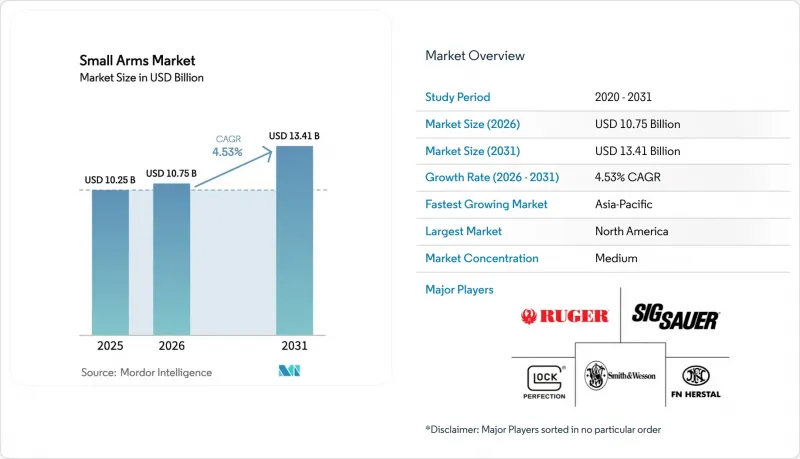
Mordor Intelligence에 의하면, 소형 무기 시장 규모는 2025년 102억 5,000만 달러에서 2026년에는 107억 5,000만 달러로 확대되어 2026년부터 2031년까지 CAGR 4.53%로 성장을 지속하여, 2031년에는 134억 1,000만 달러에 이를 것으로 예측됩니다.
본 보고서는 유형(권총, 리볼버, 소총, 기관총, 샷건, 기타 유형), 구경(5.56mm, 6.8mm, 7.62mm, 9mm, 12.7mm 및 기타 구경), 작동 방식(수동, 반자동, 완전 자동),최종 사용자(군, 민간, 법 집행 기관), 지역(북미, 유럽, 아시아태평양, 기타)별로 분류되어 있습니다. 시장 예측은 금액(달러) 기준으로 제시되어 있습니다.
세계 소형 무기 시장 동향 및 인사이트
현대화 프로그램에 따른 방위 조달 증가
세계 각국의 군은 600미터를 초과하는 사거리에서 레벨 IV 장갑을 관통할 수 있는 차세대 플랫폼을 도입하고 있으며, 이는 기존의 5.56mm 무기로는 달성할 수 없는 능력입니다. 캐나다는 ‘근접 지역 제압 무기(CASW)’ 및 ‘C7’ 프로그램의 일환으로 65,401정의 소형 무기 조달에 최대 10억 캐나다 달러(약 7억 4,000만 달러)를 배정했으며, 납품은 2026년에 시작될 예정입니다. 인도의 경우, 2024-25 회계연도 방위 생산액이 1.54 라크 크롤 루피(약 185억 달러)에 달했으며, 그 원동력은 AK-203 및 7.62mm UGRAM 소총의 생산이었습니다. 이러한 대규모 계약으로 인해 6.8mm 및 7.62mm 구경으로의 전환이 가속화되고 있으며, 이는 수요의 구조적 변화를 보여줍니다. 상호 운용성 및 살상 능력에 대한 요구 사항이 조화를 이루면서, NATO 회원국 및 중동 고객들의 추가 조달이 예상됩니다. 이러한 조달 파이프라인을 통해 주요 계약업체와 부품 공급업체들은 향후 수년에 걸친 수익 전망을 확보하게 됩니다.
개인용 방어용 총기에 대한 민간 수요 증가
2024년 은닉 휴대 허가 건수는 2,146만 건에 달했으며, 2023년에는 430만 명의 신규 총기 소유자가 탄생했습니다. 더 많은 주에서 ‘헌법에 근거한 휴대법’이 도입됨에 따라 허가 건수는 감소했으나, 판매 대수는 팬데믹 이전 수준을 계속 상회하고 있어 수요가 지속되고 있음을 반영하고 있습니다. 소비자들은 서브컴팩트 프레임에 10-15발 탄창을 결합한 글록 43X나 SIG P365와 같이, 콤팩트하고 광학 장비를 장착하기 쉬운 권총을 점점 더 많이 선택하고 있습니다. 처음으로 총기를 소유하는 사람들은 젊은 층이 많으며, 그 배경도 다양화되어 액세서리 및 훈련 서비스 시장을 확대시키고 있습니다. 이러한 추세로 인해 홀스터, 레드닷 사이트, 그리고 자기방어용 탄약의 판매가 증가하고 있습니다. 민간 부문은 안정적인 현금 흐름을 가져와 군사 예산의 주기적인 변동을 상쇄하고 있습니다.
더욱 엄격해진 최종 용도 감시 및 수출 관리 규제
미국 국방무역통제국(DDTC)은 ITAR(국제무기거래규정)에 따른 라이선스 발급 및 ‘블루 랜턴’이라 불리는 출하 후 검사를 철저히 시행하고 있어, 이로 인해 수출업체의 규정 준수 비용이 증가하고 있습니다. SIG Sauer사가 부적절한 수출로 인해 1,100만 달러의 벌금을 부과받은 사건은 감시를 강화하는 계기가 되었으며, 각 기업은 법무 부서 및 감사 부서를 확충할 수밖에 없게 되었습니다. EU가 개정한 ‘공통 입장’에서는 인권 및 전용 위험 평가가 의무화되어 있어, 이로 인해 행정 부담이 증가하고 있습니다. 중소 제조업체의 경우, 이러한 간접비는 매출액의 몇 퍼센트에 달할 가능성이 있어, 사실상 수출 기회를 제한하는 결과를 초래합니다. 규정 준수 절차의 지연은 납기일을 위태롭게 하고, 구매자의 신뢰를 훼손하며, 경쟁사에 입찰 기회를 넘겨줄 수도 있습니다.
부문 분석
2025년, 권총은 소형 무기 시장 점유율의 32.89%를 차지했습니다. 이는 은닉 휴대용 채택 증가와 법 집행 기관에서의 제식 무기로서의 표준화가 배경에 있습니다. 글록(Glock)은 미국 법 집행 기관 계약의 65% 이상을 차지하고 있지만, SIG 자우어(SIG Sauer)의 ‘P320 모듈러 핸드건 시스템’은 교체 가능한 그립 모듈과 슬라이드 길이를 특징으로 하여 애프터마켓 수익을 끌어올리고 있습니다. 리볼버는 계속해서 시장 점유율이 하락하고 있으며, 샷건은 여전히 돌격 작전이나 비치명적 용도에 특화되어 있습니다. 돌격소총은 인도의 AK-203 및 미국의 6.8mm XM7 도입과 같은 프로그램에 힘입어 연평균 성장률(CAGR) 5.12%로 성장하여 소형 무기 시장 전체를 상회할 것으로 예측됩니다. 높은 단가와 판매량 잠재력 덕분에 돌격소총은 주요 계약업체들에게 중요한 수익원이 되고 있습니다.
돌격소총의 업그레이드는 광학 장비, 소음기, 훈련 키트에 대한 수요도 자극하여 액세서리 생태계를 확장시키고 있습니다. 무기 고유의 액세서리는 수명 주기 비용의 20-30%를 차지하는 경우가 많아, 이로 인해 플랫폼에 대한 의존도가 높아지고 있습니다. 법 집행 기관 및 군 관계자들은 선정된 모델을 중심으로 예비 부품 재고와 정비사 자격 인증을 표준화하고 있으며, 이로 인해 전환 비용이 증가하고 있습니다. 기존 장비가 노후화됨에 따라 조달 주기가 통일되어 2031년까지의 수주 전망에 대한 가시성이 높아지고 있습니다. 마케팅 활동에서는 모듈러 레일과 양손잡이 대응 조작부가 강조되고 있으며, 이는 훈련 시간 단축으로 이어져 더 광범위한 채택을 촉진하고 있습니다.
9mm 구경은 NATO의 표준화와 대규모 도입 실적을 바탕으로 2025년 소형 무기 시장에서 27.64%의 점유율을 차지했습니다. FBI가 2014년에 9mm로 회귀한 것은 종말 탄도 성능의 향상을 입증한 것으로, 다른 기관들의 전환을 더욱 촉진했습니다. 그러나 미 육군이 XM7 및 XM250에 6.8×51mm 탄약을 채택함에 따라, 6.8mm 탄약은 연평균 성장률(CAGR) 7.85%를 나타낼 것으로 예측됩니다. 나토(NATO)가 공통 6.8mm 규격을 채택할 경우, 탄약 공급업체는 설비 갱신 비용을 부담해야 할 수도 있지만, 장기적인 수요 전망을 확보할 수 있다는 이점도 얻게 됩니다.
6.8mm로의 전환에는 탄약이 무거워짐에 따라 병사의 휴대량이 감소하고, 5.56mm에 비해 비용이 30-40% 증가하는 등 병참상의 과제가 수반됩니다. 잠정적인 두 구경 병용 체제는 훈련과 정비를 복잡하게 만듭니다. 이러한 과제가 있기는 하지만, 고도의 장갑에 대한 성능상의 우위 덕분에 6.8mm 탄은 최전방 부대에게 매력적인 선택지가 되고 있습니다. 민간에서의 채택은 탄약 비용이 비싸다는 이유로 여전히 제한적이지만, 정밀 사격 애호가들 사이에서 초기 관심이 나타나고 있으며, 가격이 안정되면 시장으로의 확산이 기대됩니다. 탄약 생산을 수직 통합하고 있는 제조업체는 구경 전환이 진행됨에 따라 가치를 확보하는 데 유리한 입장에 있습니다.
지역별 분석
북미는 2024년 FBI의 누적 신원 조회 건수 5억 1,800만 건 및 유효한 은닉 휴대 허가증 2,146만 건에 힘입어, 2025년 소형 무기 시장에서 34.98%의 점유율을 유지했습니다. 캐나다의 10억 캐나다 달러(7억 3,000만 달러) 규모의 근접 지역 제압 무기(CASW) 조달과 멕시코의 엄격한 민간 총기 규제는 각국의 대조적인 접근 방식을 부각시키고 있습니다. 미국에서는 헌법에 근거한 휴대 허가법으로 인해 허가증 발급에 따른 수입은 감소했으나 판매 대수는 증가했으며, CalPERS 등의 펀드가 ESG 관련 투자 철회 압력을 가하고 있음에도 불구하고 애프터마켓 수요는 유지되고 있습니다.
아시아태평양은 2031년까지 연평균 성장률(CAGR) 5.38%를 달성할 것으로 예측됩니다. 주요 촉진요인으로는 인도가 154,000 크롤(185억 달러)에 달하는 방위 생산의 이정표를 달성한 것, 필리핀의 자급자족 관련 법률, 그리고 한국의 소형 무기 수출 확대 등이 있습니다. 일본의 ‘호우아 20형’ 도입과 호주의 ‘탈레스 EF88 오스테어’ 도입은 국가 방위 능력 강화를 위한 노력을 반영하고 있습니다. 한편, 중국의 ‘191형’ 개량은 국내 자급자족을 추진하는 것이지만, 지정학적 긴장으로 인해 수출 기회는 제한적입니다.
유럽, 남미, 중동 및 아프리카가 나머지 시장 점유율을 합쳐 차지하고 있습니다. 유럽에서는 개정된 총기 지침에 따라 민간 총기 규제가 강화된 반면, 우크라이나 지원으로 인해 감소한 비축량을 보충하기 위해 각국에서 국방 지출이 증가하고 있습니다. 남미에서는 브라질의 민간 총기 보유 수가 2019년부터 2022년 사이에 100% 증가했으나, 최근의 정치 상황 변화로 인해 불확실성이 발생하고 있습니다. 중동 시장에서는 현지 생산에 대한 투자가 활발해지고 있으며, 사우디아라비아의 SAMI와 아랍에미리트(UAE)의 EDGE는 ‘비전 2030’의 지침에 따라 제조 체제를 통합하고 있습니다. 이스라엘 웨폰 인더스트리즈는 30개국 이상에 수출을 진행하며, 해당 지역 시장에서 입지를 더욱 공고히 하고 있습니다. 아프리카에서는 시장이 여전히 세분화된 상태를 유지하고 있습니다. 남아프리카공화국의 데넬(Denel)은 재정적 어려움에 직면한 반면, 이집트는 국내 수요를 위해 AK형 소총 조립 라인을 계속 가동하고 있습니다.
기타 혜택:
- 엑셀 형식 시장 예측(ME) 시트
- 3개월간의 애널리스트 지원
자주 묻는 질문
목차
제1장 서론
제2장 조사 방법
제3장 주요 요약
제4장 시장 구도
제5장 시장 규모와 성장 예측
제6장 경쟁 구도
제7장 시장 기회와 향후 전망
JHS 26.08.28According to Mordor Intelligence, the small arms market size is expected to grow from USD 10.25 billion in 2025 to USD 10.75 billion in 2026, and is forecasted to reach USD 13.41 billion by 2031 at a 4.53% CAGR over 2026-2031.
This report is Segmented by Type (Pistols, Revolvers, Rifles, Machine Guns, Shotguns, and Other Types), Caliber (5. 56 Mm, 6. 8 Mm, 7. 62 Mm, 9 Mm, 12. 7 Mm, and Other Calibers), Operation (Manual, Semi-Automatic, and Fully Automatic), End User (Military and Civil and Law Enforcement), and Geography (North America, Europe, Asia-Pacific, and More). The Market Forecasts are Provided in Terms of Value (USD).
Global Small Arms Market Trends and Insights
Increased Defense Procurement from Modernization Programs
Global militaries are deploying next-generation platforms capable of defeating Level IV armor at ranges exceeding 600 meters, a capability beyond the reach of legacy 5.56 mm weapons. Canada has allocated up to CAD 1 billion (approximately USD 740 million) for 65,401 rifles under its Close Area Suppression Weapon and C7 programs, with deliveries scheduled to begin in 2026. In India, defense production for FY 2024-25 reached INR 1.54 lakh crore (approximately USD 18.5 billion), driven by the production of the AK-203 and 7.62 mm UGRAM rifles. These large-scale contracts are accelerating the shift toward 6.8 mm and 7.62 mm calibers, indicating a structural change in demand. Follow-on procurement by NATO allies and Middle Eastern customers is anticipated as interoperability and lethality requirements align. This procurement pipeline ensures multi-year revenue visibility for prime contractors and their component suppliers.
Growing Civilian Demand for Personal-Protection Firearms
Concealed-carry permits reached 21.46 million in 2024, alongside 4.3 million first-time gun owners in 2023. While permit numbers declined as more states adopted constitutional carry laws, unit sales remained above pre-pandemic levels, reflecting sustained demand. Consumers are increasingly opting for compact, optics-ready pistols, such as the Glock 43X and SIG P365, which combine sub-compact frames with 10-to 15-round magazines. First-time gun owners are younger and more diverse, expanding the market for accessories and training services. This trend has led to higher sales of holsters, red-dot optics, and personal-defense ammunition. The civilian segment provides consistent cash flow, offsetting the cyclical nature of military budgets.
Stricter End-Use Monitoring And Export Control Regulations
The US Directorate of Defense Trade Controls enforces ITAR licensing and Blue Lantern post-shipment checks, increasing compliance costs for exporters. SIG Sauer's USD 11 million penalty for improper exports has heightened scrutiny, prompting companies to expand their legal and audit teams. The EU's updated Common Position requires human rights and diversion risk assessments, adding administrative burdens. For smaller manufacturers, these overhead costs can represent several percentage points of revenue, effectively limiting their export opportunities. Delays in compliance processes can also jeopardize delivery timelines, undermining buyer confidence and opening the door to competing bids.
Other drivers and restraints analyzed in the detailed report include:
- Surge in Competitive Shooting and Hunting Sports Memberships
- Shift Toward Lightweight, Modular Firearm Platforms
- Reduced Financing Due To ESG-Aligned Divestment Trends
For complete list of drivers and restraints, kindly check the Table Of Contents.
Segment Analysis
Pistols accounted for 32.89% of the small arms market share in 2025, driven by increased adoption for concealed carry and standardization as duty weapons among law enforcement agencies. Glock holds over 65% of US law enforcement contracts, while SIG Sauer's P320 Modular Handgun System, with its interchangeable grip modules and slide lengths, boosts aftermarket revenue. Revolvers continue to lose market share, and shotguns remain specialized for breaching and less-lethal applications. Assault rifles are expected to grow at a 5.12% CAGR, surpassing the overall small arms market, supported by programs such as India's AK-203 and the US's 6.8 mm XM7 rollout. Their higher unit value and volume potential position them as significant revenue drivers for prime contractors.
Upgrades to assault rifles also stimulate demand for optics, suppressors, and training kits, expanding the accessory ecosystem. Weapon-specific accessories often account for 20-30% of life-cycle costs, thereby reinforcing platform dependency. Law enforcement and military buyers standardize spare parts inventories and armorer certifications around selected models, increasing switching costs. As legacy fleets age, procurement cycles align, enhancing visibility of the order book through 2031. Marketing efforts emphasize modular rails and ambidextrous controls, which reduce training time and encourage broader adoption.
The 9 mm caliber held a 27.64% share of the small arms market in 2025, supported by NATO standardization and a large installed base. The FBI's 2014 return to 9 mm validated improved terminal ballistics, prompting additional agency transitions. However, 6.8 mm rounds are projected to grow at a 7.85% CAGR, driven by the US Army's adoption of 6.8 X 51 mm cartridges for the XM7 and XM250. If NATO adopts a common 6.8 mm standard, ammunition suppliers may face retooling costs but benefit from long-term demand visibility.
The transition to 6.8 mm introduces logistical challenges, including heavier cartridges that reduce soldier loadouts and increase costs by 30-40% compared to 5.56 mm. Interim dual-caliber inventories complicate training and maintenance. Despite these challenges, the performance advantages against advanced armor make 6.8 mm rounds appealing for frontline units. Civilian adoption remains limited due to higher ammunition costs, though precision-rifle enthusiasts show early interest, suggesting potential crossover as prices stabilize. Manufacturers with vertically integrated ammunition production are well-positioned to capture value as the caliber shift progresses.
Complete Report Scope:
- By Type
- Pistols
- Revolvers
- Rifles
- Assault Rifles
- Sniper Rifles
- Others
- Machine Guns
- Light Machine Guns
- Heavy Machine Guns
- Shotguns
- Other Types
- By Caliber
- 5.56 mm
- 6.8 mm
- 7.62 mm
- 9 mm
- 12.7 mm
- Other Calibers
- By Operation
- Manual
- Semi-automatic
- Fully Automatic
- By End User
- Civil and Law Enforcement
- Civilian Protection
- Hunting and Sporting
- Other End Users
- Military
- Civil and Law Enforcement
- By Geography
- North America
- United States
- Canada
- Mexico
- Europe
- United Kingdom
- France
- Germany
- Russia
- Rest of Europe
- Asia-Pacific
- China
- India
- Japan
- South Korea
- Rest of Asia-Pacific
- South America
- Brazil
- Rest of South America
- Middle East and Africa
- Middle East
- United Arab Emirates
- Saudi Arabia
- Rest of Middle East
- Africa
- South Africa
- Rest of Africa
- Middle East
- North America
Geography Analysis
North America maintained a 34.98% share of the small arms market in 2025, supported by 518 million cumulative FBI background checks and 21.46 million active concealed-carry permits in 2024. Canada's CAD 1 billion (USD 0.73 billion) Close Area Suppression Weapon procurement and Mexico's restrictive civilian firearm laws highlight contrasting national approaches. In the US, constitutional carry statutes have reduced permitting revenues but increased unit sales, sustaining aftermarket demand despite ESG divestment pressures from funds such as CalPERS.
The Asia-Pacific region is expected to achieve a 5.38% CAGR through 2031. Key drivers include India's INR 1.54 lakh crore (USD 18.5 billion) defense production milestone, the Philippines' self-reliance legislation, and South Korea's expanding rifle exports. Japan's introduction of the Howa Type 20 and Australia's Thales EF88 Austeyr reflect efforts to enhance sovereign capabilities. Meanwhile, China's Type 191 upgrade advances domestic self-sufficiency but faces limited export opportunities due to geopolitical tensions.
Europe, South America, and the Middle East and Africa collectively account for the remaining market share. In Europe, the updated Firearms Directive has tightened civilian firearm regulations, while defense spending has increased as countries replenish stocks depleted by aid to Ukraine. In South America, Brazil's civilian firearm ownership increased by 100% between 2019 and 2022, although recent political changes have introduced uncertainty. Middle Eastern markets are heavily investing in local production, with Saudi Arabia's SAMI and the UAE's EDGE consolidating manufacturing under the mandates of Vision 2030. Israel Weapon Industries exports to over 30 countries, further strengthening its market presence in the region. In Africa, the market remains fragmented; South Africa's Denel faces financial challenges, while Egypt continues to operate AK-pattern assembly lines for domestic use.
- Smith & Wesson Brands, Inc.
- Sturm, Ruger & Co., Inc.
- SIG SAUER, Inc.
- FN Browning Group
- Fabbrica d'Armi Pietro Beretta S.p.A.
- Heckler & Koch GmbH
- GLOCK Gesellschaft m.b.H.
- Colt's Manufacturing Company LLC
- Browning International S.A.
- Kalashnikov Concern JSC
- Barrett Firearms Manufacturing Inc.
- Benelli Armi S.p.A.
- Ceska zbrojovka a.s.
- Taurus Holdings, Inc.
- Israel Weapon Industries (IWI) Ltd.
- STEYR ARMS GmbH
- Armscor International, Inc.
- Springfields, Inc.
Additional Benefits:
- The market estimate (ME) sheet in Excel format
- 3 months of analyst support
TABLE OF CONTENTS
1 INTRODUCTION
- 1.1 Study Assumptions and Market Definition
- 1.2 Scope of the Study
2 RESEARCH METHODOLOGY
3 EXECUTIVE SUMMARY
4 MARKET LANDSCAPE
- 4.1 Market Overview
- 4.2 Market Drivers
- 4.2.1 Increased defense procurement from modernization programs
- 4.2.2 Growing civilian demand for personal-protection firearms
- 4.2.3 Increased focus on domestic manufacturing and supply chain resilience
- 4.2.4 Shift toward lightweight, modular firearm platforms
- 4.2.5 Surge in competitive shooting and hunting sports memberships
- 4.2.6 Emerging adoption of biometric and smart-locking handguns in law enforcement
- 4.3 Market Restraints
- 4.3.1 Stricter end-use monitoring and export control regulations
- 4.3.2 Reduced financing due to ESG-aligned divestment trends
- 4.3.3 Ammunition supply chain disruptions from primer material shortages
- 4.3.4 Technological substitution from gunshot detection and surveillance systems
- 4.4 Value Chain Analysis
- 4.5 Regulatory Landscape and Technological Outlook
- 4.6 Porter's Five Forces Analysis
- 4.6.1 Bargaining Power of Suppliers
- 4.6.2 Bargaining Power of Buyers/Consumers
- 4.6.3 Threat of New Entrants
- 4.6.4 Threat of Substitute Products
- 4.6.5 Intensity of Competitive Rivalry
5 MARKET SIZE AND GROWTH FORECASTS (VALUE)
- 5.1 By Type
- 5.1.1 Pistols
- 5.1.2 Revolvers
- 5.1.3 Rifles
- 5.1.3.1 Assault Rifles
- 5.1.3.2 Sniper Rifles
- 5.1.3.3 Others
- 5.1.4 Machine Guns
- 5.1.4.1 Light Machine Guns
- 5.1.4.2 Heavy Machine Guns
- 5.1.5 Shotguns
- 5.1.6 Other Types
- 5.2 By Caliber
- 5.2.1 5.56 mm
- 5.2.2 6.8 mm
- 5.2.3 7.62 mm
- 5.2.4 9 mm
- 5.2.5 12.7 mm
- 5.2.6 Other Calibers
- 5.3 By Operation
- 5.3.1 Manual
- 5.3.2 Semi-automatic
- 5.3.3 Fully Automatic
- 5.4 By End User
- 5.4.1 Civil and Law Enforcement
- 5.4.1.1 Civilian Protection
- 5.4.1.2 Hunting and Sporting
- 5.4.1.3 Other End Users
- 5.4.2 Military
- 5.4.1 Civil and Law Enforcement
- 5.5 By Geography
- 5.5.1 North America
- 5.5.1.1 United States
- 5.5.1.2 Canada
- 5.5.1.3 Mexico
- 5.5.2 Europe
- 5.5.2.1 United Kingdom
- 5.5.2.2 France
- 5.5.2.3 Germany
- 5.5.2.4 Russia
- 5.5.2.5 Rest of Europe
- 5.5.3 Asia-Pacific
- 5.5.3.1 China
- 5.5.3.2 India
- 5.5.3.3 Japan
- 5.5.3.4 South Korea
- 5.5.3.5 Rest of Asia-Pacific
- 5.5.4 South America
- 5.5.4.1 Brazil
- 5.5.4.2 Rest of South America
- 5.5.5 Middle East and Africa
- 5.5.5.1 Middle East
- 5.5.5.1.1 United Arab Emirates
- 5.5.5.1.2 Saudi Arabia
- 5.5.5.1.3 Rest of Middle East
- 5.5.5.2 Africa
- 5.5.5.2.1 South Africa
- 5.5.5.2.2 Rest of Africa
- 5.5.5.1 Middle East
- 5.5.1 North America
6 COMPETITIVE LANDSCAPE
- 6.1 Market Concentration
- 6.2 Strategic Moves
- 6.3 Market Share Analysis
- 6.4 Company Profiles (includes Global-level Overview, Market-level overview, Core Segments, Financials as available, Strategic Information, Market Rank/Share, Products and Services, and Recent Developments)
- 6.4.1 Smith & Wesson Brands, Inc.
- 6.4.2 Sturm, Ruger & Co., Inc.
- 6.4.3 SIG SAUER, Inc.
- 6.4.4 FN Browning Group
- 6.4.5 Fabbrica d'Armi Pietro Beretta S.p.A.
- 6.4.6 Heckler & Koch GmbH
- 6.4.7 GLOCK Gesellschaft m.b.H.
- 6.4.8 Colt's Manufacturing Company LLC
- 6.4.9 Browning International S.A.
- 6.4.10 Kalashnikov Concern JSC
- 6.4.11 Barrett Firearms Manufacturing Inc.
- 6.4.12 Benelli Armi S.p.A.
- 6.4.13 Ceska zbrojovka a.s.
- 6.4.14 Taurus Holdings, Inc.
- 6.4.15 Israel Weapon Industries (IWI) Ltd.
- 6.4.16 STEYR ARMS GmbH
- 6.4.17 Armscor International, Inc.
- 6.4.18 Springfields, Inc.
7 MARKET OPPORTUNITIES AND FUTURE OUTLOOK
- 7.1 White-space and Unmet-Need Assessment


