|
시장보고서
상품코드
2116508
제약용 인공지능(AI) : 시장 점유율 분석, 업계 동향 및 통계, 성장 예측(2026-2031년)Artificial Intelligence (AI) In Pharmaceutical - Market Share Analysis, Industry Trends & Statistics, Growth Forecasts (2026 - 2031) |
||||||
 Mordor Intelligence
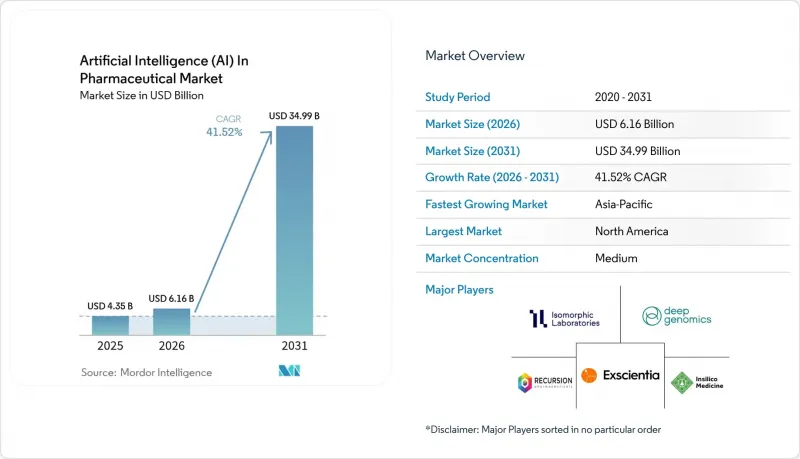
Mordor Intelligence에 의하면, 제약용 인공지능(AI) 시장 규모는 2025년에 43억 5,000만 달러로 평가되었습니다. 2026년에 61억 6,000만 달러에 달하고, 2031년까지 349억 9,000만 달러에 이를 것으로 예측되며, 2026년부터 2031년에 걸쳐 CAGR 41.52%로 성장할 전망입니다.
본 보고서는 기술(머신러닝 등), 제공 방식(소프트웨어 플랫폼 및 서비스), 용도(신약 개발, 임상시험 설계 등), 배포 방식(클라우드 기반, On-Premise/엣지형, 하이브리드형), 지역(북미, 유럽, 아시아태평양 등)별로 분류되어 있습니다. 시장 전망은 금액(달러) 기준으로 제시되어 있습니다.
세계의 제약용 인공지능(AI) 시장 동향 및 인사이트
산업 간 협력 및 파트너십 확대
제약 업계의 기존 기업들은 자사의 규제 관련 전문 지식과 스타트업이 보유한 알고리즘을 통한 신속성을 융합하려는 움직임을 강화하고 있습니다. 2024년 PostEra가 화이자와 체결한 6억 1,000만 달러 규모의 사업 확장 계약은 암 치료제 분자의 저비용 합성 경로를 수립하는 합성 계획 모델을 목표로 하고 있습니다. 2024년에 실시된 Recursion과 Exscientia의 주식 교환을 통한 합병을 통해, 23조 건의 관측 데이터로 구성된 데이터 레이크를 기반으로 한 10건의 임상 파이프라인이 구축되었으며, 대규모 데이터 집약의 이점이 입증되었습니다. 인실리코 메디신(In silico Medicine)과 치루제약(Qilu Pharmaceutical) 간의 1억 2,000만 달러 규모의 제휴는 국경을 초월한 제휴가 아시아 내 환자 접근성과 제조 능력을 어떻게 확보할 수 있는지를 보여줍니다. 이러한 위험 분담 모델에서는 마일스톤 지급을 임상 성과와 연계함으로써, 대형 제약사의 연구 개발 초기 위험을 낮추는 동시에 AI 벤더에게는 이익 분배의 기회가 주어집니다. FDA가 2025년 1월에 발표한 지침안은 공동 개발 계약을 명시적으로 지지하며, 과거 협업의 걸림돌이 되었던 데이터 공유 및 책임에 관한 규정을 명확히 하고 있습니다.
신약 개발 비용 및 기간 단축에 대한 압박 고조
승인된 의약품 1건당 평균 자체 부담 연구개발비는 26억 달러에 달하고, 개발 기간은 10-15년에 이르기 때문에 기업의 수익성을 잠식하고 있습니다. AI를 활용한 파이프라인은 히트 화합물 식별, 리드 화합물 최적화, 독성 예측을 자동화하여 비용과 개발 기간을 모두 약 3분의 1로 단축합니다. 인실리코 메디신(In silico Medicine)의 섬유증 치료 후보물질 ISM001-055는 표적 발견부터 제IIa상 개념 증명 시험까지 30개월 만에 달성하여 효율성 향상을 입증했습니다. FDA는 2025년 12월, 자체 개발한 자율형 AI를 도입하여 초기 시범 운영에서 임상시험용 의약품 심사 기간을 22% 단축했습니다. 생성 화학 모델 1개의 계산 비용은 500만 달러에 달할 수 있지만, BCG의 추산에 따르면 플랫폼이 규모를 확대하면 프로그램당 비용은 40% 절감되고 소요 기간은 30% 단축될 것으로 예측됩니다.
AI·바이오의약품 분야의 숙련된 인재 부족
머신러닝, 분자 생물학, 규제 과학을 모두 갖춘 전문가에 대한 전 세계적 수요는 공급을 훨씬 초과하고 있습니다. 이 조건에 부합하는 고위급 전문가는 5,000명 미만이며, 2025년 연봉 중앙값은 25만 달러를 넘어 소프트웨어 엔지니어 직종에 비해 35% 높은 수준이었습니다. Meta, Google, OpenAI가 주식이나 무제한 컴퓨팅 리소스를 미끼로 과학자들을 스카우트하고 있어 이직률은 20%를 넘고 있습니다. 학계에서는 컴퓨터 지원 신약 개발 분야의 의학박사(MD)와 이학박사(PhD)를 동시에 취득한 인원이 연간 200명 미만에 그치고 있어, 인재 공급망의 만성적인 부족을 초래하고 있습니다. 제약 업계 인사 부서에 따르면, AI 관련 채용 공고의 60%가 6개월 이상 미충원 상태로 남아 있어 플랫폼 도입이 지연될 뿐만 아니라, 지적 재산(IP)보다 인재 확보에 주된 가치를 두는 경쟁이 치열한 ‘어퀴하이어(인수합병을 통한 인재 확보)’가 잇따르고 있습니다. 인재를 확보할 수 없는 상황에서는 자금력이 탄탄한 AI 전략이라 해도 실행이 지연되어, 시장 출시까지의 시간적 우위가 훼손될 위험이 있습니다.
부문별 분석
기술 부문은 USD-(부문 수준의 수치는 제공되지 않음)를 기록했으나, 생성형 AI 플랫폼은 43.21%의 연평균 성장률(CAGR) 예측으로 제약 시장 내 전체 인공지능을 상회하는 성장을 보인 반면, 머신러닝은 2025년 매출의 38.21%를 차지했습니다. 이러한 차이는 연구개발(R&D) 담당 임원들이 단순히 분자를 분류하는 알고리즘보다 분자를 생성하는 알고리즘을 선호하기 때문입니다. NVIDIA의 ‘BioNeMo’는 트랜스포머 모델과 확산 모델을 보급하여, 중규모 바이오테크 기업이 GPU 팜을 구축하지 않고도 단백질 언어 추론을 수행할 수 있게 했습니다. Isomorphic Labs의 확산 스택과 같은 모델이 표적 1개당 하루 1만 건의 리간드 후보를 생성함에 따라, 생성형 시스템 분야의 제약 시장 내 인공지능 시장 규모는 급속히 확대될 것으로 예측됩니다.
컴퓨터 비전과 자연어 처리(NLP)는 여전히 필수적이지만, 부차적인 위치에 머물러 있습니다. 컨볼루션 신경망은 조직병리학 이미지 분류에서 95% 이상의 진단 정확도를 달성한 반면, NLP 모듈은 FAERS(미국 식품의약국(FDA)의 이상반응 보고 시스템)의 서술문에서 규칙 기반 엔진보다 40% 더 많은 안전성 신호를 추출하고 있습니다. 강화 학습은 투여 요법을 최적화하지만, 성능의 불안정성으로 인해 그 적용 범위는 제한된 이용 사례에 그치고 있습니다. 기호 AI는 규제 문서 초안 작성에 활용되고 있지만, 그 보급은 미미한 수준입니다. 2026년부터 2031년에 걸쳐 딥러닝을 활용한 이미지 분석은 제약 분야의 인공지능 평균 성장률에 가까운 속도로 성장할 것이지만, 화합물의 신규성을 유지하는 단백질 인식형 확산 모델에 주목을 양보하게 될 것입니다.
서비스 분야는 43.78%의 성장률을 보이며, 2025년 매출 점유율 45.32%를 차지한 플랫폼 소프트웨어를 능가할 전망입니다. CIO들은 임상 마일스톤에 연동된 변동 가격 책정을 선호하며, 그 대표적인 예가 Recursion사의 ‘후보 화합물별 과금 모델’입니다. 이 모델로 인해 2025년에는 1억 8,000만 달러의 리스크가 전가되었습니다. 각 하이퍼스케일러 기업들은 GPU 클러스터, 사전 학습된 모델, 규정 준수 도구를 결합하여 서비스 하위 부문의 35%를 차지하고 있습니다. 클라우드 관리형 LLMOps 분야에서 제약 업계의 AI 시장 점유율은 한 자릿수 후반에 달하며, AWS, Azure, Google Cloud의 벤더 락인(vendor lock-in)을 통해 우위를 공고히 하고 있습니다.
데이터가 풍부한 제약 기업에게 소프트웨어 플랫폼은 여전히 필수적입니다. 슈뢰딩거, 벤칠링, 닷매틱스는 2025년에 각각 50만 달러를 넘는 엔터프라이즈 ACV를 기록했습니다. 그러나 라이선스 비용 부담이 큰 모델이 CFO의 현금 확보 요구와 상충되면서 성장은 둔화되고 있습니다. 맞춤형 프로젝트 수주는 전년 대비 22% 증가했습니다. 특히 맞춤형 피처 엔지니어링이 필요한 희귀질환 파이프라인에서 두드러졌습니다. 예측 기간 동안 규제 기준을 충족하는 결과물을 보장하는 서비스 제공업체가 시장 점유율을 공고히 하는 한편, 단일형 라이선스 계약은 구독형이나 마일스톤 연계형 계약으로 전환될 것입니다.
지역별 분석
북미는 2025년 매출의 41.52%를 차지했으며, 그 배경에는 42억 달러 규모의 벤처 자금 유입과 알고리즘 검증을 가속화하는 FDA의 샌드박스 프로그램이 있었습니다. 캘리포니아주, 매사추세츠주, 뉴욕주가 거래 흐름을 주도했으나, 캐나다는 개인정보 보호법을 준수하기 위한 연방 학습(federated learning) 프레임워크를 제공했음에도 불구하고 해당 지역의 자금 조달에서 고작 4%만을 차지했습니다. 멕시코의 수탁 제조 공장에서는 컴퓨터 비전을 활용한 품질 보증(QA) 시범 운영이 시작되었으나, 다국적 기업 이외의 도입은 여전히 제한적입니다. 2026년 1월 FDA가 발표한 ‘고품질 AI’ 관련 지침은 이 지역의 선구자로서의 우위를 더욱 공고히할 것입니다.
아시아태평양은 연평균 성장률(CAGR) 42.54%를 나타낼 것으로 예측되며, 이는 어느 지역보다 높은 성장률입니다. 중국은 2025년에 AI·제약 컨소시엄에 150억 위안(21억 달러)을 투입하여 XtalPi 등 국내 유력 기업들을 지원했습니다. 일본은 인구의 3분의 1이 65세 이상이라는 점을 감안하여(2), 샌드박스 프로그램에서 고령자의 유해 사건 예측을 중점 분야로 삼고 있습니다. 인도는 비용 효율적인 임상시험 인프라를 활용하여 2024년에 3억 2,000만 달러의 AI 자금을 유치했습니다. 그 대부분은 제네릭 의약품의 최적화에 사용되었습니다. 한국과 호주의 점유율은 합쳐서 5% 미만이었습니다만, 미국이나 중국의 기술 스택에 대한 의존도를 줄이기 위해 국가 컨소시엄을 결성했습니다.
2025년, 유럽은 전 세계 매출의 22%를 차지했습니다. 독일의 프라운호퍼 연구소는 바이엘 및 베링거와 제휴하여 EMA(유럽의약품청)의 감사 요건을 준수하는 설명 가능한 모듈을 개발했습니다(3). 영국의 ‘AI Airlock Sandbox’는 적응형 임상시험의 승인 기간을 7개월 단축했습니다. 프랑스에는 6,700만 건의 의료 데이터가 축적된 허브가 있지만, GDPR(EU 개인정보보호규정)의 동의 관련 제약으로 인해 제약사가 접근할 수 있는 데이터는 1,000만 건으로 제한되어 있어 대규모 모델 학습에 걸림돌이 되고 있습니다. 라틴아메리카, 중동 및 아프리카의 합계는 2025년 매출의 8%를 차지했습니다. 브라질과 UAE는 AI를 활용한 의약품 안전성 모니터링 시범 사업을 실시했으나, 세계 수준의 데이터 세트를 생성하기에는 임상시험 실시 건수가 부족합니다.
기타 혜택 :
- 엑셀 형식 시장 예측(ME) 시트
- 3개월간의 애널리스트 지원
자주 묻는 질문
목차
제1장 서론
제2장 조사 방법
제3장 개요
제4장 시장 구도
제5장 시장 규모 및 성장 예측
제6장 경쟁 구도
제7장 시장 기회 및 향후 전망
KTH 26.08.31According to Mordor Intelligence, the artificial intelligence in pharmaceutical market size is projected to be USD 4.35 billion in 2025, USD 6.16 billion in 2026, and reach USD 34.99 billion by 2031, growing at a CAGR of 41.52% from 2026 to 2031.
This report is Segmented by Technology (Machine Learning, and More), Offering (Software Platforms and Services), Application (Drug Discovery, Clinical-Trial Design, and More), Deployment Mode (Cloud-Based, On-Premise/Edge, and Hybrid), and Geography (North America, Europe, Asia-Pacific, and More). The Market Forecasts are Provided in Terms of Value (USD).
Global Artificial Intelligence (AI) In Pharmaceutical Market Trends and Insights
Proliferation of Cross-Industry Collaborations and Partnerships
Pharmaceutical incumbents increasingly fuse their regulatory expertise with startups' algorithmic speed. PostEra's USD 610 million expansion deal with Pfizer in 2024 targets synthesis-planning models that chart low-cost routes for oncology molecules. The 2024 all-stock merger of Recursion and Exscientia created a 10-asset clinical pipeline underpinned by a 23-trillion-observation data lake, demonstrating data-aggregation advantages at scale. Insilico Medicine's USD 120 million pact with Qilu Pharmaceutical shows how cross-border alliances secure patient access and manufacturing capacity in Asia. Such risk-sharing models link milestone payments to clinical outcomes, lowering Big Pharma's upfront R&D exposure while granting AI vendors upside participation. The FDA's January 2025 draft guidance explicitly endorses joint development agreements, clarifying data-sharing and liability rules that once hindered collaboration.
Escalating Pressure to Reduce Drug-Discovery Costs and Timelines
Average out-of-pocket R&D spend per approved asset reached USD 2.6 billion, with cycle times stretching 10-15 years, eroding enterprise returns. AI pipelines automate hit identification, lead optimization, and toxicity prediction, trimming both cost and duration by roughly one-third. Insilico Medicine's fibrosis candidate ISM001-055 progressed from target discovery to Phase IIa proof-of-concept in 30 months, underscoring efficiency gains. The FDA deployed an internal agentic AI in December 2025 that cut investigational new drug review times by 22% in early pilots. While a single generative-chemistry model can cost USD 5 million in compute, BCG estimates 40% lower per-program expenses and 30% shorter timelines once platforms reach scale.
Shortage of Skilled AI-Biopharmaceutical Talent
Global demand for specialists who combine machine learning, molecular biology, and regulatory science far exceeds supply. Fewer than 5,000 senior-level professionals fit this profile, and median salaries topped USD 250,000 in 2025, a 35% premium to software engineering roles. Attrition exceeds 20% as Meta, Google, and OpenAI lure scientists with equity and unlimited compute credits. Academia produces under 200 joint MD-PhD graduates in computational drug discovery annually, creating chronic pipeline gaps. Pharmaceutical HR teams report that 60% of AI requisitions stay open longer than six months, slowing platform deployments and prompting high-multiple "acqui-hires" whose main value lies in staffing rather than IP. Without talent availability, even well-funded AI strategies risk execution delays that erode time-to-market advantages.
Other drivers and restraints analyzed in the detailed report include:
- Accelerated Adoption of AI-Driven Adaptive Clinical-Trial Designs
- Maturation of Generative AI Foundation Models for Protein Folding
- Fragmentation of Clinical and Genomic Data Sets
For complete list of drivers and restraints, kindly check the Table Of Contents.
Segment Analysis
The technology segment posted USD - numbers at segment level not supplied; still generative AI platforms outperformed the overall artificial intelligence in pharmaceutical market with a 43.21% CAGR forecast, while machine learning held a 38.21% share of 2025 sales. This divergence stems from R&D executives favoring algorithms that create molecules over those that merely classify them. NVIDIA's BioNeMo democratized transformer and diffusion models, letting mid-size biotechs run protein language inference without building GPU farms. The artificial intelligence in pharmaceutical market size for generative systems is projected to expand sharply as models like Isomorphic Labs' diffusion stack generate 10,000 ligand ideas per target per day.
Computer vision and NLP remain indispensable but secondary. Convolutional neural networks exceed 95% diagnostic accuracy in histopathology image classification, whereas NLP modules harvest 40% more safety signals from FAERS narratives than rule-based engines. Reinforcement learning optimizes dosing regimens, yet performance brittleness confines it to narrow use cases. Symbolic AI drafts regulatory documents, but uptake is modest. Over 2026-2031 deep-learning image analytics will grow near the artificial intelligence in pharmaceutical industry average, ceding spotlight to protein-aware diffusion models that sustain compound novelty.
Services will grow at 43.78%, eclipsing platform software despite the latter's 45.32% 2025 revenue share. CIOs prefer variable pricing aligned with clinical milestones, a model exemplified by Recursion's per-candidate billing that shifted USD 180 million in risk in 2025. Hyperscalers combine GPU clusters, pre-trained models, and compliance tooling, capturing 35% of the services subsegment. The artificial intelligence in pharmaceutical market share for cloud-managed LLMOps reached the low-double digits, reinforcing vendor lock-in advantages for AWS, Azure, and Google Cloud.
Software platforms remain essential for data-rich pharmas. Schrodinger, Benchling, and Dotmatics each commanded enterprise ACVs above USD 500,000 in 2025. Yet growth cools as license-heavy models conflict with CFO mandates for cash conservation. Custom project engagements grew 22% year-over-year, especially for rare-disease pipelines demanding bespoke feature engineering. Over the forecast horizon, service providers that guarantee regulatory-grade outputs will consolidate share, while monolithic licenses migrate to subscription or milestone-linked contracts.
Complete Report Scope:
- By Technology
- Machine Learning
- Supervised Learning
- Unsupervised & Self-Supervised Learning
- Deep Learning
- Natural Language Processing
- Computer Vision
- Generative AI (Diffusion / Transformer-Based)
- Other Technologies
- Machine Learning
- By Offering
- Software Platforms
- Services (AI-As-A-Service, Custom Projects, Managed LLMOps)
- By Application
- Drug Discovery & Pre-Clinical Development
- Clinical-Trial Design & Patient Recruitment
- Manufacturing & Quality Control
- Pharmacovigilance & Safety Monitoring
- Sales, Marketing & Commercial Analytics
- Laboratory Automation / Self-Driving Labs
- Other Applications
- By Deployment Mode
- Cloud-Based
- Public Cloud
- Private VPC / Sovereign Cloud
- On-Premise / Edge
- Hybrid (Burst-To-Cloud)
- Cloud-Based
- Geography
- North America
- United States
- Canada
- Mexico
- Europe
- Germany
- United Kingdom
- France
- Italy
- Spain
- Rest of Europe
- Asia-Pacific
- China
- Japan
- India
- Australia
- South Korea
- Rest of Asia-Pacific
- Middle East & Africa
- GCC
- South Africa
- Rest of Middle East & Africa
- South America
- Brazil
- Argentina
- Rest of South America
- North America
Geography Analysis
North America held 41.52% of 2025 revenue, underpinned by a USD 4.2 billion venture influx and FDA sandbox programs that accelerate algorithm validation. California, Massachusetts, and New York dominated deal flow, while Canada contributed federated-learning frameworks to satisfy privacy laws yet captured just 4% of regional funding. Mexico's contract-manufacturing plants began piloting computer-vision QA, though adoption outside multinationals remains limited. The FDA's January 2026 good-AI guidelines further strengthen the region's first-mover advantage.
Asia-Pacific is forecast to post a 42.54% CAGR, the fastest of any region. China committed RMB 15 billion (USD 2.1 billion) in 2025 to AI-pharma consortia, elevating domestic champions such as XtalPi. Japan's sandbox program targets geriatric adverse-event prediction as one-third of its population exceeds 65 years[2]. India leveraged cost-effective clinical-trial infrastructure to attract USD 320 million in 2024 AI funding, mostly for generics optimization. South Korea and Australia together held under 5% share but formed national consortiums to reduce reliance on U.S. and Chinese stacks.
Europe accounted for 22% of global turnover in 2025. Germany's Fraunhofer Institute partnered with Bayer and Boehringer to develop explainable modules aligned with EMA auditing requirements[3]. The UK's AI Airlock Sandbox slashed adaptive-trial approval cycles by seven months. France houses a 67-million-record health data hub, yet GDPR consent constraints limit pharmaceutical access to 10 million records, impeding large-scale model training. Latin America, the Middle East, and Africa combined delivered 8% of 2025 revenue; Brazil and the UAE piloted AI-based pharmacovigilance but lack sufficient trial density to generate global-grade datasets.
- AbSci Corp.
- Alphabet
- Atomwise Inc.
- Benevolent AI
- Cyclica Inc. (Numinus)
- Deep Genomics
- Evotec
- Exscientia PLC
- InveniAI
- Insilico Medicine
- NVIDIA Corp.
- Owkin SA
- PathAI
- Recursion Pharmaceuticals
- Valo Health
- Verge Genomics
- VeriSIM Life
- XtalPi
Additional Benefits:
- The market estimate (ME) sheet in Excel format
- 3 months of analyst support
TABLE OF CONTENTS
1 Introduction
- 1.1 Study Assumptions & Market Definition
- 1.2 Scope Of The Study
2 Research Methodology
3 Executive Summary
4 Market Landscape
- 4.1 Market Overview
- 4.2 Market Drivers
- 4.2.1 Proliferation of Cross-Industry Collaborations and Partnerships
- 4.2.2 Escalating Pressure to Reduce Drug-Discovery Costs and Timelines
- 4.2.3 Accelerated Adoption of AI-Driven Adaptive Clinical-Trial Designs
- 4.2.4 Maturation of Generative AI Foundation Models for Protein Folding
- 4.2.5 Emergence of Quantum-Enhanced Computing for Molecular Simulation
- 4.2.6 Expansion Of Regulatory AI Sandboxes Facilitating Algorithmic Trial Design
- 4.3 Market Restraints
- 4.3.1 Shortage of Skilled AI-Biopharmaceutical Talent
- 4.3.2 Fragmentation of Clinical and Genomic Data Sets
- 4.3.3 Rising Cloud Compute Costs Relative to R&D Budgets
- 4.3.4 Regulatory Concerns Over Algorithmic Bias And Transparency
- 4.4 Value / Supply-Chain Analysis
- 4.5 Regulatory Landscape
- 4.6 Technological Outlook
- 4.7 Porter's Five Forces Analysis
- 4.7.1 Threat Of New Entrants
- 4.7.2 Bargaining Power Of Buyers / Consumers
- 4.7.3 Bargaining Power Of Suppliers
- 4.7.4 Threat Of Substitute Products
- 4.7.5 Intensity Of Competitive Rivalry
5 Market Size & Growth Forecasts (Value, USD)
- 5.1 By Technology
- 5.1.1 Machine Learning
- 5.1.1.1 Supervised Learning
- 5.1.1.2 Unsupervised & Self-Supervised Learning
- 5.1.2 Deep Learning
- 5.1.3 Natural Language Processing
- 5.1.4 Computer Vision
- 5.1.5 Generative AI (Diffusion / Transformer-Based)
- 5.1.6 Other Technologies
- 5.1.1 Machine Learning
- 5.2 By Offering
- 5.2.1 Software Platforms
- 5.2.2 Services (AI-As-A-Service, Custom Projects, Managed LLMOps)
- 5.3 By Application
- 5.3.1 Drug Discovery & Pre-Clinical Development
- 5.3.2 Clinical-Trial Design & Patient Recruitment
- 5.3.3 Manufacturing & Quality Control
- 5.3.4 Pharmacovigilance & Safety Monitoring
- 5.3.5 Sales, Marketing & Commercial Analytics
- 5.3.6 Laboratory Automation / Self-Driving Labs
- 5.3.7 Other Applications
- 5.4 By Deployment Mode
- 5.4.1 Cloud-Based
- 5.4.1.1 Public Cloud
- 5.4.1.2 Private VPC / Sovereign Cloud
- 5.4.2 On-Premise / Edge
- 5.4.3 Hybrid (Burst-To-Cloud)
- 5.4.1 Cloud-Based
- 5.5 Geography
- 5.5.1 North America
- 5.5.1.1 United States
- 5.5.1.2 Canada
- 5.5.1.3 Mexico
- 5.5.2 Europe
- 5.5.2.1 Germany
- 5.5.2.2 United Kingdom
- 5.5.2.3 France
- 5.5.2.4 Italy
- 5.5.2.5 Spain
- 5.5.2.6 Rest of Europe
- 5.5.3 Asia-Pacific
- 5.5.3.1 China
- 5.5.3.2 Japan
- 5.5.3.3 India
- 5.5.3.4 Australia
- 5.5.3.5 South Korea
- 5.5.3.6 Rest of Asia-Pacific
- 5.5.4 Middle East & Africa
- 5.5.4.1 GCC
- 5.5.4.2 South Africa
- 5.5.4.3 Rest of Middle East & Africa
- 5.5.5 South America
- 5.5.5.1 Brazil
- 5.5.5.2 Argentina
- 5.5.5.3 Rest of South America
- 5.5.1 North America
6 Competitive Landscape
- 6.1 Market Concentration
- 6.2 Market Share Analysis
- 6.3 Company Profiles (Includes Global-Level Overview, Market-Level Overview, Core Segments, Financials As Available, Strategic Information, Market Rank/Share For Key Companies, Products & Services, And Recent Developments)
- 6.3.1 AbSci Corp.
- 6.3.2 Alphabet Inc. (Isomorphic Labs)
- 6.3.3 Atomwise Inc.
- 6.3.4 BenevolentAI
- 6.3.5 Cyclica Inc. (Numinus)
- 6.3.6 Deep Genomics
- 6.3.7 Evotec SE
- 6.3.8 Exscientia PLC
- 6.3.9 InveniAI LLC
- 6.3.10 Insilico Medicine
- 6.3.11 NVIDIA Corp.
- 6.3.12 Owkin SA
- 6.3.13 PathAI
- 6.3.14 Recursion Pharmaceuticals
- 6.3.15 Valo Health
- 6.3.16 Verge Genomics
- 6.3.17 VeriSIM Life
- 6.3.18 XtalPi Inc.
7 Market Opportunities & Future Outlook
- 7.1 White-Space & Unmet-Need Assessment