

|
시장보고서
상품코드
2116746
발현 벡터 시장 : 점유율 분석, 업계 동향과 통계, 성장 예측(2026-2031년)Expression Vectors - Market Share Analysis, Industry Trends & Statistics, Growth Forecasts (2026 - 2031) |
||||||
 Mordor Intelligence
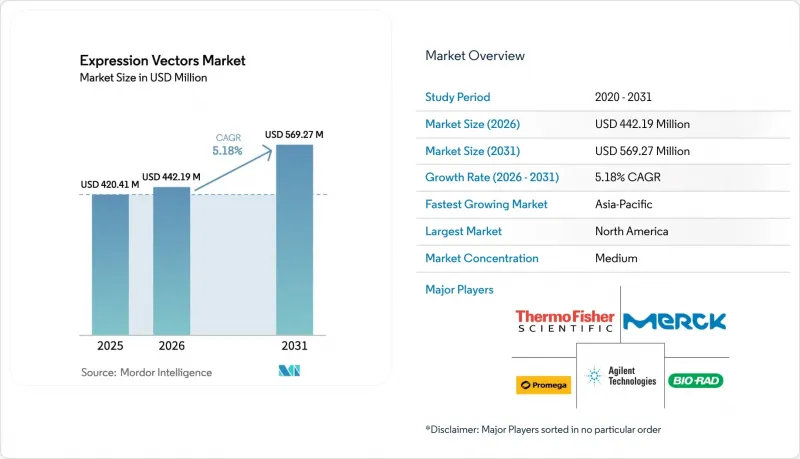
Mordor Intelligence에 의하면, 2026년 발현 벡터 시장 규모는 4억 4,219만 달러로 추정되고 있어 2025년 4억 2,041만 달러에서 성장하여 2031년에는 5억 6,927만 달러에 이를 것으로 예측됩니다.
2026년부터 2031년까지 연평균 성장률(CAGR) 5.18%를 기록하며 성장할 것으로 전망됩니다.
본 보고서는 숙주 유형(세균, 포유류, 곤충, 효모, 기타), 용도(치료, 연구, 효소 제조), 최종 사용자(제약·바이오기술 기업, CDMO·CRO·CMO, 학술·연구 기관, 기타),지역(북미, 유럽, 아시아태평양, 중동 및 아프리카, 남미)별로 분류되어 있습니다. 시장 예측은 금액(달러) 기준으로 제시되어 있습니다.
전 세계 발현 벡터 시장 동향 및 인사이트
첨단 바이오의약품 및 세포 및 유전자 치료에 대한 수요 급증
유전자 치료 승인 건수는 2023년 8건에서 2024년 15건으로 증가했으며, 각각에 맞춤형 고순도 벡터가 필요합니다. 현재 임상 프로그램에서는 퍼퓨전형 바이오리액터나 일회용 시스템에 대응하는 벡터 설계가 지정되고 있어, 공급업체 선정 기준이 엄격해지고 있습니다. 자가 유래 CAR-T 치료제 파이프라인의 확장으로 배치별 벡터 수요가 증가하고 있으며, Bluebird Bio나 Oxford BioMedica와 같은 기업들은 사내 생산 일정을 재구성할 수밖에 없는 상황입니다. 여분의 설비를 보유한 CDMO가 수요 과잉을 흡수하고 있지만, 규제 관련 수요가 급증하는 시기에는 해당 설비의 가동률이 정점에 달할 전망입니다. 개발 기업들은 벡터의 안정적인 공급을 전략적 차별화 요인으로 간주하고 있으며, 대부분의 경우 수년에 걸친 계약을 체결하고 있습니다. 이에 따라 발현 벡터 시장 전체의 장기적인 수익 전망이 강화되고 있습니다.
복잡한 단백질에 대한 포유류·곤충 숙주 채택 확대
바이오의약품 기업들은 진정한 번역 후 수정이 필요한 막 단백질 및 당단백질에 대해 바쿠로바이러스 발현 벡터 시스템(BEVS)으로의 전환을 추진하고 있습니다. 규제 당국의 지침에 따르면 현재 서열 동일성 외에도 당화 일관성도 평가 대상이 되고 있어, 진핵생물 숙주가 우위를 점하고 있습니다. 포유류 세포를 이용한 생산 비용은 여전히 높지만, 특히 ‘퍼스트 인 클래스(First-in-class)’ 치료제의 경우, 독보적인 안전성 및 유효성 프로파일에 대한 수요가 그 비용 차이를 정당화하고 있습니다. 이에 대응하여 각 공급업체들은 형질 도입 배지 라인업을 확충하고, 중국 햄스터 난소 세포와 흰줄무늬 나방(Spodoptera frugiperda) 세포에 최적화된 ‘형질 도입용 키트’를 제공합니다. 이러한 추세에 따라 연구개발비가 세균계 최적화에서 확장 가능한 진핵생물 플랫폼으로 재분배되면서, 발현 벡터 시장 전체의 수익원이 확대되고 있습니다.
GMP 등급 벡터 생산의 높은 비용과 복잡성
임상용 플라스미드 DNA의 비용은 1그램당 50-200달러로, 연구용 가격의 4-10배에 달할 전망입니다. ISO 규격을 준수하는 클린룸, 품질 관리 시스템, 무균 검사에 드는 설비 투자가 운영 예산을 상승시키고 있습니다. 소규모 생명공학 기업들은 조달상의 병목 현상으로 인해 임상시험을 연기하는 경우가 많으며, 반면 학술 기관이 규정 준수 비용을 전액 부담하는 경우는 드뭅니다. CDMO는 규모에 따른 제약을 완화하지만, 수요가 정점에 달할 때는 생산 능력이 한계에 달하고, 현물 가격의 급등과 리드타임의 장기화를 초래합니다. 이러한 동향은 신흥 시장에서의 도입 속도를 둔화시키고, 발현 벡터 시장 전체의 확장을 억제하는 요인이 되고 있습니다.
부문 분석
2025년, 세균 기반 시스템은 비용 효율적인 발효 공정과 충분히 확립된 유전자 조작 툴킷에 힘입어 발현 벡터 시장 점유율의 51.72%를 차지했습니다. 대조적으로, 곤충 벡터는 BEVS 기술로 인해 단백질 접힘 및 당사슬 부착과 관련된 제약이 해소됨에 따라 2031년까지 연평균 성장률(CAGR) 5.97%라는 견실한 성장세를 기록하고 있습니다.
발현 벡터 시장은 계속해서 진핵생물 숙주로 전환되고 있으며, 단백질 품질에 대한 규제적 중요성이 커짐에 따라 포유류 플랫폼은 프리미엄 가격을 유지하고 있습니다. 효모 시스템은 특정 효소 분야에서 여전히 중요성을 유지하고 있는 반면, 식물 및 조류 벡터는 비의약품 틈새 시장을 개척하고 있습니다. 치료 파이프라인이 다중 서브유닛 생물제제로 전환됨에 따라, 숙주 선정 기준에서 비용보다 충실도가 우선시되면서 첨단 곤충 및 포유류 솔루션에 대한 수요가 가속화되고 있습니다.
지역별 분석
북미의 42.05% 점유율은 꾸준한 벤처 투자, 효율화된 FDA 승인 절차, 신약 개발부터 상용화까지를 연결하는 통합된 공급망을 반영합니다. 캐나다의 22억 캐나다 달러 규모의 ‘첨단 바이오 제조 이니셔티브’는 국내 벡터 생산 능력을 강화하고 있으며, 멕시코의 니어쇼어링 동향은 공정 개발 수요를 더욱 높이고 있습니다.
아시아태평양은 연평균 성장률(CAGR) 6.15%로 빠르게 성장하고 있는 지역입니다. 중국은 2024년에 최초의 국산 CAR-T 치료제를 승인하여, 국내 CDMO 기업들이 벡터 생산량을 늘리는 계기가 되었습니다. 싱가포르의 세제 혜택이 포함된 클러스터는 세계 유수의 기업들을 유치하고 있으며, 한국의 ‘K-Bio 벨트’는 바이오 제조 전용 회랑을 구축하고 있습니다. 일본은 심사 기간을 30% 단축하여 재생의학 제품 시장 출시 속도를 높이고 있습니다.
유럽은 통합되어 가면서도 혁신적인 시장을 유지하고 있으며, 독일의 5억 유로 규모 ‘BioRegion’ 프로그램이 인프라 강화를 추진하고 있습니다. 영국은 브렉시트 이후 승인 절차를 신속하게 진행하고 있으며, 프랑스의 ‘Genopole’은 벡터 전용 시설을 증설하고 있습니다. 남유럽 국가들은 완만한 성장세를 보이고 있지만, EMA(유럽의약품청)의 공통 지침에 따라 제품의 원활한 유통이 가능해져 발현 벡터 시장에서 지역 간 수요를 뒷받침하고 있습니다.
기타 혜택
- 엑셀 형식 시장 예측(ME) 시트
- 3개월간의 애널리스트 지원
자주 묻는 질문
목차
제1장 서론
제2장 조사 방법
제3장 개요
제4장 시장 구도
제5장 시장 규모와 성장 예측
제6장 경쟁 구도
제7장 시장 기회와 향후 전망
JHS 26.09.01According to Mordor Intelligence, expression vectors market size in 2026 is estimated at USD 442.19 million, growing from 2025 value of USD 420.41 million with 2031 projections showing USD 569.27 million, growing at 5.18% CAGR over 2026-2031.
This report is Segmented by Host Type (Bacterial, Mammalian, Insect, Yeast, Others), Application (Therapeutic, Research, Enzyme Manufacturing), End-User (Pharmaceutical and Biotechnology Companies, CDMOs/CROs/CMOs, Academic & Research Institutes, Others), and Geography (North America, Europe, Asia-Pacific, Middle East and Africa, South America). The Market Forecasts are Provided in Terms of Value (USD).
Global Expression Vectors Market Trends and Insights
Surge in Demand for Advanced Biologics & Cell-/Gene-Therapies
Gene-therapy approvals climbed from 8 in 2023 to 15 in 2024, each requiring customized, high-purity vectors. Clinical programs now specify vector designs compatible with perfusion bioreactors and single-use systems, tightening supplier selection. Autologous CAR-T pipelines intensify batch-specific vector demand, prompting companies such as Bluebird Bio and Oxford BioMedica to restructure in-house production schedules. CDMOs with redundant suites absorb overflow, but their capacity utilization peaks during regulatory surges. Developers perceive secure vector supply as a strategic differentiator and often lock multi-year contracts, reinforcing long-term revenue visibility across the Expression vectors market.
Growing Adoption of Mammalian & Insect Hosts for Complex Proteins
Biopharma firms pivot toward baculovirus expression vector systems (BEVS) for membrane proteins and glycoproteins that need authentic post-translational modifications . Regulatory guidance now evaluates glycosylation consistency alongside sequence identity, favoring eukaryotic hosts. Although mammalian cell production costs remain higher, demand for distinctive safety and efficacy profiles justifies premiums, particularly for first-in-class therapies. Suppliers respond by widening transfection-media portfolios and offering ready-to-transfect kits optimized for Chinese hamster ovary and Spodoptera frugiperda cells. The trend reallocates R&D spending from bacterial optimization toward scalable eukaryotic platforms, broadening revenue channels across the Expression vectors market.
High Cost & Complexity of GMP-Grade Vector Production
Clinical-grade plasmid DNA costs range between USD 50-200 per gram, four to ten times research-grade pricing. Capital expenses for ISO-classified cleanrooms, quality-management systems, and sterility testing inflate operating budgets. Small biotech firms often delay trials due to procurement bottlenecks, while academic centers rarely absorb full compliance costs. Although CDMOs mitigate scale constraints, tighter capacity during peak demand inflates spot prices and lengthens lead times. These dynamics dampen adoption rates in emerging markets and moderate overall expansion of the Expression vectors market.
Other drivers and restraints analyzed in the detailed report include:
- Expansion of Contract Vector Manufacturing Capacity
- AI-Driven Codon Optimization & De-Novo Vector Design
- Stringent Viral-Vector Safety Regulations
For complete list of drivers and restraints, kindly check the Table Of Contents.
Segment Analysis
Bacterial systems captured 51.72% of the Expression vectors market share in 2025, supported by cost-efficient fermentation and well-understood genetic toolkits. In contrast, Insect vectors record a robust 5.97% CAGR to 2031 as BEVS technology resolves folding and glycosylation constraints.
The Expression vectors market continues to migrate toward eukaryotic hosts, with mammalian platforms commanding premium pricing due to regulatory emphasis on protein quality. Yeast systems maintain relevance for certain enzymes, while plant and algal vectors explore non-pharma niches. As therapeutic pipelines tilt toward multi-subunit biologics, host-selection frameworks prioritize fidelity over cost, accelerating demand for sophisticated insect and mammalian solutions.
Complete Report Scope:
- By Host Type
- Bacterial Expression Vectors
- Mammalian Expression Vectors
- Insect Expression Vectors
- Yeast Expression Vectors
- Others
- By Application
- Therapeutic Applications
- Research Applications
- Enzyme Manufacturing
- By End-User
- Pharmaceutical and Biotechnology Companies
- CDMOs / CROs / CMOs
- Academic & Research Institutes
- Others
- By Geography
- North America
- United States
- Canada
- Mexico
- Europe
- Germany
- United Kingdom
- France
- Italy
- Spain
- Rest of Europe
- Asia-Pacific
- China
- Japan
- India
- Australia
- South Korea
- Rest of Asia-Pacific
- Middle East and Africa
- GCC
- South Africa
- Rest of Middle East and Africa
- South America
- Brazil
- Argentina
- Rest of South America
- North America
Geography Analysis
North America's 42.05% share reflects entrenched venture investment, streamlined FDA pathways, and integrated supply chains connecting discovery through commercialization. Canada's CAD 2.2 billion Advanced Biomanufacturing initiative furthers domestic vector capacity, and Mexico's near-shoring trend adds process-development demand.
Asia-Pacific is the fast-growing region at 6.15% CAGR. China authorised its first home-grown CAR-T therapy in 2024, spurring domestic CDMOs to boost vector output. Singapore's tax-incentive clusters attract global majors, and South Korea's K-Bio Belt builds dedicated biomanufacturing corridors. Japan reduces review timelines by 30%, enhancing deployment speeds for regenerative products.
Europe maintains a consolidated but innovative market, with Germany's EUR 500 million BioRegion program enhancing infrastructure. The United Kingdom speeds approvals post-Brexit, while France's Genopole adds vector suites. Southern European nations grow gradually, yet shared EMA guidelines permit seamless product movement, reinforcing pan-regional demand within the Expression vectors market.
- Thermo Fisher Scientific
- Merck
- Takara Bio
- Promega
- Agilent Technologies
- Bio-Rad Laboratories
- QIAGEN
- New England Biolabs
- Genscript
- OriGene Technologies
- System Biosciences
- Lonza Group
- Aldevron
- Cobra Biologics
- Sirion-Biotech
- Bluebird bio
- Catalent
- Addgene
- Oxford BioMedica
Additional Benefits:
- The market estimate (ME) sheet in Excel format
- 3 months of analyst support
TABLE OF CONTENTS
1 Introduction
- 1.1 Study Assumptions & Market Definition
- 1.2 Scope of the Study
2 Research Methodology
3 Executive Summary
4 Market Landscape
- 4.1 Market Overview
- 4.2 Market Drivers
- 4.2.1 Surge in demand for advanced biologics & cell-/gene-therapies
- 4.2.2 Growing adoption of mammalian & insect hosts for complex proteins
- 4.2.3 Expansion of contract vector manufacturing capacity
- 4.2.4 AI-driven codon optimisation & de-novo vector design
- 4.2.5 Open-source vector repositories accelerating translation
- 4.2.6 mRNA-vaccine spill-over boosting plasmid-vector demand
- 4.3 Market Restraints
- 4.3.1 High cost & complexity of GMP-grade vector production
- 4.3.2 Stringent viral-vector safety regulations
- 4.3.3 Patent thickets around promoters/regulatory elements
- 4.3.4 Supply-chain fragility for critical raw materials
- 4.4 Regulatory Landscape
- 4.5 Technological Outlook
- 4.6 Porter's Five Forces Analysis
- 4.6.1 Threat of New Entrants
- 4.6.2 Bargaining Power of Buyers
- 4.6.3 Bargaining Power of Suppliers
- 4.6.4 Threat of Substitutes
- 4.6.5 Intensity of Competitive Rivalry
5 Market Size & Growth Forecasts (Value, USD)
- 5.1 By Host Type
- 5.1.1 Bacterial Expression Vectors
- 5.1.2 Mammalian Expression Vectors
- 5.1.3 Insect Expression Vectors
- 5.1.4 Yeast Expression Vectors
- 5.1.5 Others
- 5.2 By Application
- 5.2.1 Therapeutic Applications
- 5.2.2 Research Applications
- 5.2.3 Enzyme Manufacturing
- 5.3 By End-User
- 5.3.1 Pharmaceutical and Biotechnology Companies
- 5.3.2 CDMOs / CROs / CMOs
- 5.3.3 Academic & Research Institutes
- 5.3.4 Others
- 5.4 By Geography
- 5.4.1 North America
- 5.4.1.1 United States
- 5.4.1.2 Canada
- 5.4.1.3 Mexico
- 5.4.2 Europe
- 5.4.2.1 Germany
- 5.4.2.2 United Kingdom
- 5.4.2.3 France
- 5.4.2.4 Italy
- 5.4.2.5 Spain
- 5.4.2.6 Rest of Europe
- 5.4.3 Asia-Pacific
- 5.4.3.1 China
- 5.4.3.2 Japan
- 5.4.3.3 India
- 5.4.3.4 Australia
- 5.4.3.5 South Korea
- 5.4.3.6 Rest of Asia-Pacific
- 5.4.4 Middle East and Africa
- 5.4.4.1 GCC
- 5.4.4.2 South Africa
- 5.4.4.3 Rest of Middle East and Africa
- 5.4.5 South America
- 5.4.5.1 Brazil
- 5.4.5.2 Argentina
- 5.4.5.3 Rest of South America
- 5.4.1 North America
6 Competitive Landscape
- 6.1 Market Concentration
- 6.2 Market Share Analysis
- 6.3 Company Profiles (includes Global level Overview, Market level overview, Core Segments, Financials as available, Strategic Information, Market Rank/Share, Products & Services, Recent Developments)
- 6.3.1 Thermo Fisher Scientific
- 6.3.2 Merck KGaA (Sigma-Aldrich)
- 6.3.3 Takara Bio
- 6.3.4 Promega Corporation
- 6.3.5 Agilent Technologies
- 6.3.6 Bio-Rad Laboratories
- 6.3.7 QIAGEN
- 6.3.8 New England Biolabs
- 6.3.9 GenScript
- 6.3.10 OriGene Technologies
- 6.3.11 System Biosciences
- 6.3.12 Lonza Group
- 6.3.13 Aldevron
- 6.3.14 Cobra Biologics
- 6.3.15 Sirion-Biotech
- 6.3.16 Bluebird bio
- 6.3.17 Catalent
- 6.3.18 Addgene
- 6.3.19 Oxford BioMedica
7 Market Opportunities & Future Outlook
- 7.1 White-space & Unmet-need Assessment


