

|
시장보고서
상품코드
2120711
바이러스 벡터 및 플라스미드 DNA 제조 : 시장 점유율 분석, 업계 동향과 통계, 성장 예측(2026-2031년)Viral Vector And Plasmid DNA Manufacturing - Market Share Analysis, Industry Trends & Statistics, Growth Forecasts (2026 - 2031) |
||||||
 Mordor Intelligence
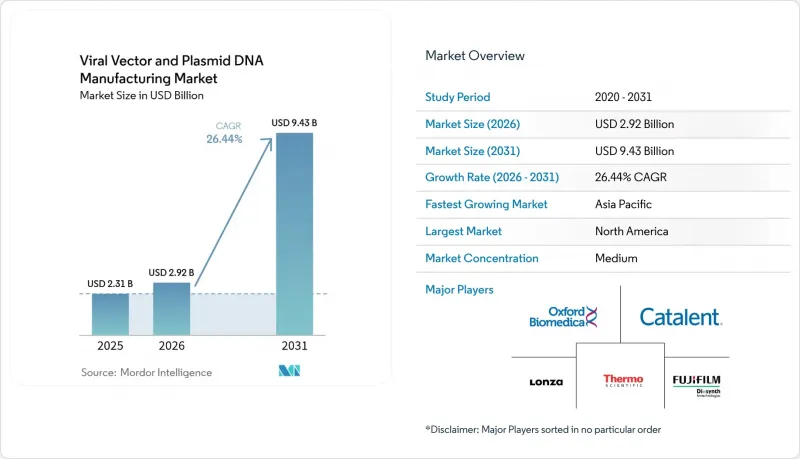
바이러스 벡터 및 플라스미드 DNA 제조 시장 규모는 2026년에 29억 2,000만 달러로 추정되며, 2025년 23억 1,000만 달러에서 확대되어 2031년에는 94억 3,000만 달러에 달할 것으로 예측됩니다.
2026년부터 2031년까지 연평균 성장률(CAGR) 26.44%로 성장할 것으로 전망됩니다.
본 보고서는 제품 유형(플라스미드 DNA, 바이러스 벡터, 비바이러스 벡터), 용도(암, 유전성 질환, 감염증, 안과 질환 등), 지역(북미, 유럽, 아시아태평양, 중동 및 아프리카, 남미)별로 분류되어 있습니다. 시장 예측은 금액(달러)으로 표시되어 있습니다.
세계 바이러스 벡터 및 플라스미드 DNA 제조 시장의 동향과 인사이트
유전성 질환 및 만성 질환의 유병률 증가
희귀 유전성 질환 및 만성 질환에 대해 더 많은 환자가 정확한 진단을 받고 있으며, 이러한 적응증의 상당수에서 승인되었거나 후기 임상시험 단계에 있는 유전자 치료법이 주목받고 있습니다. ‘Zevaskyn’이나 ‘Kebilidi’와 같이 최근 승인된 제품들은 당국이 기존에는 치료가 어렵다고 여겨졌던 질환에 대한 첨단 치료법을 적극적으로 승인하는 태도를 보여주고 있으며, 이것이 벡터 수요의 꾸준한 확대를 뒷받침하고 있습니다. 고령화로 인한 역학적 변화로 만성 질환의 유병률이 상승하고 있어, 일회성 유전자 치환 치료의 적응증 후보가 될 수 있는 환자층이 지속적으로 확대되고 있습니다. 심사 신속화나 시장 독점권 등 희귀질환에 대한 인센티브도 전망을 더욱 공고히 하고 있습니다. 이러한 요인들이 맞물려 바이러스 벡터 및 플라스미드 DNA 제조 시장에 상당한 수요 증가를 가져오고 있습니다.
확대되는 유전자·세포 치료 파이프라인
현재 전 세계 각국의 등록부에는 2,000건 이상의 유전자 치료 프로그램이 등록되어 있으며, 아데노연관바이러스(AAV)가 여전히 가장 일반적인 벡터로 사용되고 있습니다. 살레프타(Salepta)사의 rAAVrh74 템플릿에 대한 FDA의 ‘플랫폼 기술 지정’은 특성이 충분히 규명된 벡터의 재사용을 촉진하여 비용과 개발 기간을 모두 단축하고 있습니다. 제약사들은 이에 발맞춰 노바티스가 EU에 4,000만 유로를 투자해 건설한 벡터 제조 공장과 같은 실물 시설에 투자하며, 후기 개발 단계 자산에 대한 생산능력을 확보하고 있습니다. 조기에 생산능력을 확보한 개발 기업은 2상 임상시험 데이터를 바탕으로 신속하게 제품 출시로 넘어갈 수 있습니다. 따라서 꾸준히 축적되는 임상시험 파이프라인은 수년에 걸친 생산 전망을 확고히 하고, 바이러스 벡터 및 플라스미드 DNA 제조 시장 전체의 확장을 뒷받침하고 있습니다.
높은 제조 비용과 자본 비용
유전자 치료 1회 과정의 비용은 100만 달러에 달하기도 하며, 그 비용의 최대 40%를 바이러스 벡터 비용이 차지하는 경우가 많습니다. 브라질에서는 현지 생산을 통해 CAR-T의 가격을 3만 5,000달러까지 낮출 수 있는 길이 보였지만, 대부분의 의료 시스템은 이 정도의 규모에 대한 지불을 감당하기 어려워하고 있습니다. 성과 연계형 계약은 위험 분산에 도움이 되지만, 중소 바이오기술 기업들은 생산 할당량을 확보하거나 공장을 건설하기 위해 여전히 막대한 선행 투자를 감수해야 합니다. 자동화 및 표준화된 플랫폼이 부담 경감을 가져올 것으로 기대되지만, 이를 위해서는 수백만 달러 규모의 설비 투자가 필요하며, 자금력이 있는 후원자만이 이를 감당할 수 있습니다. 이러한 비용은 특히 저소득 지역에서 바이러스 벡터 및 플라스미드 DNA 제조 시장 진입을 가로막고 있습니다.
부문 분석
2025년, 바이러스 벡터는 확립된 규제 선례와 높은 형질 도입 효율에 힘입어 바이러스 벡터 및 플라스미드 DNA 제조 시장의 54.92%를 차지했습니다. 비바이러스 벡터는 면역 장벽을 우회하는 지질 나노입자, 폴리머 접합체 및 전기 천공 시스템에 힘입어 2031년까지 연평균 성장률(CAGR) 29.12%라는 가장 높은 성장률을 보일 것으로 예상됩니다. 플라스미드 DNA는 바이러스 조립의 출발점이 되는 템플릿으로서, 또한 직접 주입법에서 치료용 구축체로서 두 범주의 기반을 계속해서 형성하고 있습니다.
바이러스 벡터 및 플라스미드 DNA 제조 시장 규모는 Casgevy 및 Elevidys와 같은 신규 승인 제품이 상업적 규모로 전환됨에 따라 더욱 확대될 것으로 예상됩니다. AAV 및 렌티바이러스 계열은 지속적인 발현과 조직 특이성으로 인해 암 및 희귀질환 파이프라인에서 주도적인 위치를 차지하고 있습니다. 그러나 제조의 복잡성으로 인해 비용이 높은 수준을 유지하고 있어, 제약 기업들은 확장 가능한 비바이러스성 운반체의 시험에 적극적인 관심을 보이고 있습니다. mRNA COVID-19 백신 개발 과정에서 얻은 지질 나노입자에 대한 전문 지식은 플라스미드나 siRNA 전달에도 활용될 수 있어, 비바이러스성 기법이 시장 점유율을 점차 확대하는 데 기여할 것입니다. 나노입자 전문 기업과 기존 바이오의약품 CDMO 간의 제휴로 인해 공장의 총 가동률은 이미 확대되기 시작했으며, 바이러스 벡터 및 플라스미드 DNA 제조 시장에서 두 기법이 공존해 나갈 것임을 시사하고 있습니다.
지역별 분석
북미는 FDA의 주도적인 역할, 대규모 벤처 자금, 그리고 탄탄한 임상시험 생태계의 뒷받침을 받아 2025년 매출의 42.11%를 차지했습니다. 론자(Lonza)의 바카빌(Vacaville) 공장 12억 달러 인수와 찰스 리버(Charles River)의 비진 바이오사이언스(Vigene Biosciences) 인수와 같은 주요 거래는 이 지역에서의 수직 통합에 대한 의지를 여실히 보여주고 있습니다. 숙련된 인력 부족과 원자재 공급 병목 현상은 여전히 존재하지만, 협력적인 인재 양성 프로그램과 리쇼어링(reshoring) 인센티브를 통해 이러한 격차를 해소하는 것을 목표로 하고 있습니다. 전반적으로, 바이러스 벡터 및 플라스미드 DNA 제조 시장에서 미국은 여전히 가장 높은 가격 책정과 가장 신뢰할 수 있는 규제 경로를 제공하고 있습니다.
아시아태평양에서는 다국적 기업과 국내 유력 기업들이 중국, 한국, 인도, 호주에 새로운 생산 거점을 건설하고 있어 연평균 성장률(CAGR) 28.02%라는 가장 강력한 전망이 제시되고 있습니다. 벡터빌더(VectorBuilder)사의 5억 달러 규모 광저우 캠퍼스와우시 바이오로직스(Wuxi Biologics)의 지속적인 확장은 베이징이 중요한 치료법의 현지화를 중시하고 있음을 반영하는 반면, 인도의 바라트 바이오테크(Bharat Biotech)는 자사 최초의 CGT(세포·유전자 치료) 공장에 7,500만 달러를 투자하고 있습니다. 각 지역 당국은 승인 절차를 효율화하고 세액 공제를 제공함으로써 리터당 비용을 절감하고 환자의 접근성을 확대하고 있습니다. 이러한 움직임에 힘입어 해당 지역의 바이러스 벡터 및 플라스미드 DNA 제조 시장은 급속히 확대되고 있으며, 세계 공급망의 다각화가 진행되고 있습니다.
유럽은 성숙해 가면서도 계속 진화하는 입장을 유지하고 있습니다. 유럽의약품청(EMA)의 지침에 따라 심사 일정이 예측 가능해졌으며, 국경을 초월한 컨소시엄을 통해 ‘호라이즌 유럽’ 자금이 첨단 치료 인프라에 투입되고 있습니다. 노바티스가 4,000만 유로를 투자해 슬로베니아의 벡터 제조 거점을 확장한 것은, 회원국 간에 환급 제도에 차이가 있음에도 불구하고 기업의 자신감을 뒷받침하고 있습니다. 브렉시트 이후, 영국은 임상시험 및 제조 거점으로서의 매력을 유지하기 위해 병행 규제 체계를 추진하고 있습니다. 라틴아메리카와 중동 및 아프리카는 절대적인 규모 면에서는 뒤처져 있지만, 브라질의 비용 효율성 측면에서 획기적인 진전과 걸프 국가들의 정부계 투자 기관의 움직임은 새로운 생산능력 확충을 시사하고 있습니다. 전반적으로, 지리적 분산은 위험을 분산시키고 바이러스 벡터 및 플라스미드 DNA 제조 시장에 회복력을 부여하고 있습니다.
기타 혜택:
- 엑셀 형식의 시장 예측(ME) 시트
- 3개월간의 애널리스트 지원
자주 묻는 질문
목차
제1장 소개
제2장 조사 방법
제3장 주요 요약
제4장 시장 구도
제5장 시장 규모와 성장 예측
제6장 경쟁 구도
제7장 시장 기회와 향후 전망
KSM 26.09.02According to Mordor Intelligence, the viral vectors and plasmid DNA manufacturing market size in 2026 is estimated at USD 2.92 billion, growing from 2025 value of USD 2.31 billion with 2031 projections showing USD 9.43 billion, growing at 26.44% CAGR over 2026-2031.
This report is Segmented by Product Type (Plasmid DNA, Viral Vector, and Non-Viral Vector), Application (Cancer, Genetic Disorders, Infectious Diseases, Ophthalmic Disorders and More), Geography (North America, Europe, Asia-Pacific, The Middle East and Africa, and South America). The Market Forecasts are Provided in Terms of Value (USD).
Global Viral Vector And Plasmid DNA Manufacturing Market Trends and Insights
Rising Incidence of Genetic and Chronic Diseases
More patients receive precise diagnoses for rare genetic disorders and chronic conditions, and many of those indications now have either approved or late-stage gene therapies in view. Recently cleared products such as Zevaskyn and Kebilidi show that authorities are willing to green-light advanced treatments for historically intractable illnesses, driving steady vector demand. The epidemiological transition toward older populations amplifies chronic disease prevalence, creating a durable pool of candidates for one-time gene replacement. Rare-disease incentives, including streamlined reviews and market exclusivity, further fortify the outlook. Combined, these factors add material volume to the viral vectors and plasmid DNA manufacturing market.
Growing Pipeline of Gene and Cell Therapies
More than 2,000 gene-therapy programs now populate global registries, with adeno-associated viruses (AAV) still the most common payload. The FDA's Platform Technology Designation for Sarepta's rAAVrh74 template encourages reuse of well-characterized vectors, cutting both cost and timeline. Drug makers have followed with bricks-and-mortar commitments such as Novartis' EUR 40 million EU vector plant, ensuring slots for late-stage assets . Developers that secure capacity early can move rapidly from Phase II data to launch. The steady clinical queue therefore locks in multi-year production visibility and underpins expansion across the viral vectors and plasmid DNA manufacturing market.
High Manufacturing and Capital Costs
A single gene-therapy course can cost USD 1 million, and viral vector inputs often consume up to 40% of that bill. While Brazil showed a path to USD 35,000 CAR-T pricing through local production, most health systems struggle to pay at scale. Outcome-based contracts help spread risk, but smaller biotech firms still face heavy upfront investment to secure slots or build plants. Automation and standardized platforms promise relief, yet they require multimillion-dollar capital outlays that only deep-pocketed sponsors can afford. These costs temper penetration of the viral vectors and plasmid DNA manufacturing market, especially in lower-income regions.
Other drivers and restraints analyzed in the detailed report include:
- Expanding Adoption of Viral Vectors in Vaccines and Novel Modalities
- Technological Advancements in Scalable Vector Production Platforms
- Limited Global GMP Production Capacity
For complete list of drivers and restraints, kindly check the Table Of Contents.
Segment Analysis
Viral vectors accounted for 54.92% of the viral vectors and plasmid DNA manufacturing market in 2025, supported by well-established regulatory precedents and strong transfection efficiency. Non-viral vectors deliver the fastest 29.12% CAGR through 2031, propelled by lipid nanoparticles, polymer conjugates, and electroporation systems that bypass immunity hurdles. Plasmid DNA remains the backbone for both categories, serving as the starting template for viral assembly and as the therapeutic construct in direct injection approaches.
The viral vectors and plasmid DNA manufacturing market size for viral vectors is projected to widen further as newly approved products such as Casgevy and Elevidys transition to commercial scale. AAV and lentiviral lines dominate oncology and rare-disease pipelines thanks to durable expression and tissue tropism. Yet manufacturing complexity keeps cost high, motivating drug sponsors to trial scalable non-viral carriers. Lipid nanoparticle expertise gained in mRNA COVID-19 vaccines can be leveraged for plasmid and siRNA delivery, helping non-viral methods chip away at share. Partnerships between nanoparticle specialists and legacy biologics CDMOs have already started to expand total factory utilization, indicating that both modalities will coexist within the viral vectors and plasmid DNA manufacturing market.
Complete Report Scope:
- By Product Type
- Plasmid DNA
- Viral Vector
- Non-Viral Vector
- By Application
- Cancer
- Genetic Disorders
- Infectious Diseases
- Ophthalmic Disorders
- Neurological Disorders
- Other Applications
- Geography
- North America
- United States
- Canada
- Mexico
- Europe
- Germany
- United Kingdom
- France
- Italy
- Spain
- Rest of Europe
- Asia-Pacific
- China
- Japan
- India
- Australia
- South Korea
- Rest of Asia-Pacific
- Middle East & Africa
- GCC
- South Africa
- Rest of Middle East & Africa
- South America
- Brazil
- Argentina
- Rest of South America
- North America
Geography Analysis
North America controlled 42.11% of 2025 revenue, sustained by FDA leadership, large venture funding pools, and a deep clinical-trial ecosystem. Major transactions like Lonza's USD 1.2 billion takeover of a Vacaville plant and Charles River's purchase of Vigene Biosciences illustrate the region's appetite for vertical integration. Skilled labor shortages and raw-material chokepoints do persist, but concerted workforce programs and reshoring incentives aim to close gaps. Overall, the viral vectors and plasmid DNA manufacturing market still finds its highest pricing and most reliable regulatory pathway in the United States.
Asia-Pacific shows the strongest 28.02% CAGR outlook as multinational firms and domestic champions build new suites in China, South Korea, India, and Australia. VectorBuilder's USD 500 million Guangzhou campus and WuXi Biologics' continual expansions reflect Beijing's emphasis on localizing critical modalities, while India's Bharat Biotech commits USD 75 million to its inaugural CGT plant. Regional authorities streamline approvals and offer tax credits, bringing down cost per liter and widening patient access. These moves rapidly enlarge the viral vectors and plasmid DNA manufacturing market in the region and diversify global supply lines.
Europe retains a mature yet evolving position. EMA guidelines give predictable review timelines, and cross-border consortia channel Horizon Europe funds into advanced-therapy infrastructure. Novartis' EUR 40 million Slovenian vector expansion underscores corporate confidence despite reimbursement variations across member states. Post-Brexit, the United Kingdom pursues parallel regulatory schemes to stay attractive for trials and manufacturing. Latin America and Middle East/Africa trail in absolute terms, but Brazil's cost-effectiveness breakthroughs and Gulf sovereign investment vehicles hint at fresh capacity additions. Collectively, geographical diversification spreads risk and adds resilience to the viral vectors and plasmid DNA manufacturing market.
- Lonza Group
- Thermo Fisher Scientific, Inc. (Viral Vector Services)
- Catalent
- Oxford Biomedica
- FUJIFILM
- Wuxi Advanced Therapies
- Aldevron (Danaher)
- AGC Biologics
- SIRION Biotech
- Cell & Gene Therapy Catapult
- FinVector
- Cognate BioServices (Cobra Biologics)
- MassBiologics
- Merck KGaA (MilliporeSigma)
- UniQure
- Charles River
- Takara Bio USA (CDMO Services)
- Yposkesi
- VGXI (GeneOne Life Science)
- Genezen
Additional Benefits:
- The market estimate (ME) sheet in Excel format
- 3 months of analyst support
TABLE OF CONTENTS
1 Introduction
- 1.1 Study Assumptions & Market Definition
- 1.2 Scope of the Study
2 Research Methodology
3 Executive Summary
4 Market Landscape
- 4.1 Market Overview
- 4.2 Market Drivers
- 4.2.1 Rising Incidence of Genetic and Chronic Diseases
- 4.2.2 Growing Pipeline of Gene and Cell Therapies
- 4.2.3 Expanding Adoption of Viral Vectors in Vaccines And Novel Modalities
- 4.2.4 Increasing Outsourcing To Specialized CDMOs
- 4.2.5 Technological Advancements in Scalable Vector Production Platforms
- 4.2.6 Supportive Regulatory and Funding Environment For Advanced Therapies
- 4.3 Market Restraints
- 4.3.1 High Manufacturing and Capital Costs
- 4.3.2 Limited Global GMP Production Capacity
- 4.3.3 Complex and Evolving Regulatory Requirements
- 4.3.4 Supply Chain Dependence on Specialized Raw Materials
- 4.4 Regulatory Landscape
- 4.5 Porter's Five Forces Analysis
- 4.5.1 Threat Of New Entrants
- 4.5.2 Bargaining Power Of Buyers / Consumers
- 4.5.3 Bargaining Power Of Suppliers
- 4.5.4 Threat Of Substitute Products
- 4.5.5 Intensity Of Competitive Rivalry
5 Market Size & Growth Forecasts (Value, USD)
- 5.1 By Product Type
- 5.1.1 Plasmid DNA
- 5.1.2 Viral Vector
- 5.1.3 Non-Viral Vector
- 5.2 By Application
- 5.2.1 Cancer
- 5.2.2 Genetic Disorders
- 5.2.3 Infectious Diseases
- 5.2.4 Ophthalmic Disorders
- 5.2.5 Neurological Disorders
- 5.2.6 Other Applications
- 5.3 Geography
- 5.3.1 North America
- 5.3.1.1 United States
- 5.3.1.2 Canada
- 5.3.1.3 Mexico
- 5.3.2 Europe
- 5.3.2.1 Germany
- 5.3.2.2 United Kingdom
- 5.3.2.3 France
- 5.3.2.4 Italy
- 5.3.2.5 Spain
- 5.3.2.6 Rest of Europe
- 5.3.3 Asia-Pacific
- 5.3.3.1 China
- 5.3.3.2 Japan
- 5.3.3.3 India
- 5.3.3.4 Australia
- 5.3.3.5 South Korea
- 5.3.3.6 Rest of Asia-Pacific
- 5.3.4 Middle East & Africa
- 5.3.4.1 GCC
- 5.3.4.2 South Africa
- 5.3.4.3 Rest of Middle East & Africa
- 5.3.5 South America
- 5.3.5.1 Brazil
- 5.3.5.2 Argentina
- 5.3.5.3 Rest of South America
- 5.3.1 North America
6 Competitive Landscape
- 6.1 Market Concentration
- 6.2 Market Share Analysis
- 6.3 Company Profiles (includes Global level Overview, Market level overview, Core Business Segments, Financials, Headcount, Key Information, Market Rank, Market Share, Products and Services, and analysis of Recent Developments)
- 6.3.1 Lonza Group
- 6.3.2 Thermo Fisher Scientific, Inc. (Viral Vector Services)
- 6.3.3 Catalent Inc.
- 6.3.4 Oxford Biomedica
- 6.3.5 Fujifilm Diosynth Biotechnologies
- 6.3.6 Wuxi Advanced Therapies
- 6.3.7 Aldevron (Danaher)
- 6.3.8 AGC Biologics
- 6.3.9 SIRION Biotech
- 6.3.10 Cell & Gene Therapy Catapult
- 6.3.11 FinVector
- 6.3.12 Cognate BioServices (Cobra Biologics)
- 6.3.13 MassBiologics
- 6.3.14 Merck KGaA (MilliporeSigma)
- 6.3.15 UniQure NV
- 6.3.16 Charles River Laboratories
- 6.3.17 Takara Bio USA (CDMO Services)
- 6.3.18 Yposkesi
- 6.3.19 VGXI (GeneOne Life Science)
- 6.3.20 Genezen
7 Market Opportunities & Future Outlook
- 7.1 White-Space & Unmet-Need Assessment


