

|
시장보고서
상품코드
2116768
유럽의 재생에너지 시장 : 점유율 분석, 업계 동향과 통계, 성장 예측(2026-2031년)Europe Renewable Energy - Market Share Analysis, Industry Trends & Statistics, Growth Forecasts (2026 - 2031) |
||||||
 Mordor Intelligence
Mordor Intelligence에 의하면, 유럽 재생에너지 시장 규모(설치용량 기반)는 2025년 1.11 테라와트에서 2026년에는 1.20 테라와트로 확대되어 2026년부터 2031년까지 CAGR 8.51%로 성장을 지속하여, 2031년에는 1.81 테라와트에 이를 것으로 예측됩니다.
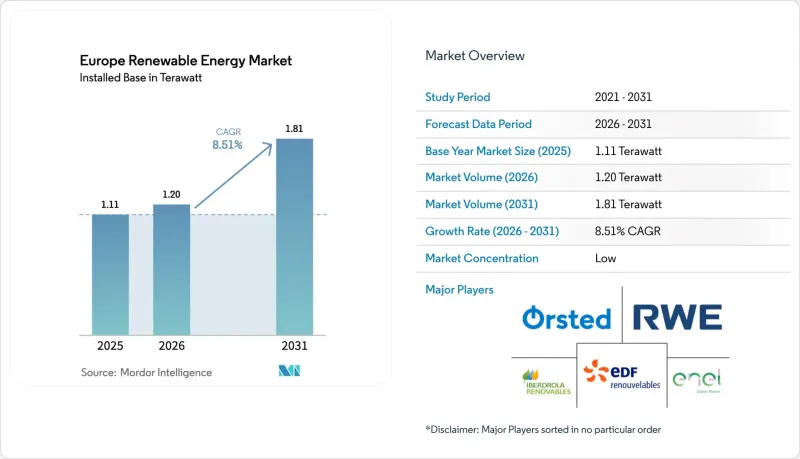
본 보고서는 기술별(태양에너지, 풍력에너지, 수력 발전, 바이오에너지, 지열, 해양 에너지), 최종 사용자별(유틸리티, 상업 및 산업, 주택), 지역별(독일, 영국, 스페인, 프랑스, 이탈리아, 네덜란드, 덴마크, 스웨덴, 기타 유럽 국가)로 분류되어 있습니다. 시장 규모 및 전망은 설치 용량(GW) 기준으로 제시되어 있습니다.
유럽 재생에너지 시장 동향 및 분석
‘Fit-for-55’ 및 ‘REPowerEU’의 45% 목표
REPowerEU 계획에서는 2030년 재생에너지 목표를 최종 에너지 소비량의 45%로 상향 조정하고 있으며, 독일은 전력의 80%를 재생에너지로 충당하겠다고 공약했고, 네덜란드는 2030년까지 21GW의 해상 풍력 발전을 목표로 하고 있습니다. 지정된 ‘우선 개발 지역’에서의 신속한 인허가 절차를 통해 평균 리드타임은 2년 미만으로 단축되고, WACC는 50-100 베이시스 포인트 감소하지만, 주요 목표의 달성은 여전히 송전망의 동기화 강화에 달려 있습니다.
태양광 및 육상 풍력 발전의 LCOE 급감
남유럽의 유틸리티급 태양광 발전은 양면 모듈 및 트래커 도입을 통한 효율화로 2025년에 1MWh당 25-30유로를 달성했습니다. 한편, 풍력 자원이 풍부한 육상 풍력 발전 사이트에서는 1MWh당 30-35유로에 도달하여, 스페인에서는 보조금 없는 입찰이, 이탈리아에서는 민간 주도의 건설이 가능해졌습니다. 마진 축소로 인해 개발업체의 재편이 가속화되는 한편, 투자자들의 관심은 주간 가격 변동을 활용하는 민간 주도 프로젝트로 옮겨가고 있습니다.
송전망 혼잡 및 계통 연계 병목 현상
2025년에는 출력 제한으로 인해 풍력 및 태양광 발전 출력이 8 TWh 감소하여 8억 유로의 미실현 수익 손실이 발생했습니다. 스페인에서 프랑스로, 그리고 북유럽 허브에서 중부 유럽으로의 송전 용량 제한으로 인해 민간 프로젝트 시장 진입률이 억제되고 있으며, 설비 투자(CAPEX)가 10-15% 더 높아짐에도 불구하고 발전소 병설형 축전지 도입이 진행되고 있습니다.
부문 분석
2025년, 태양광 발전은 유럽 재생에너지 시장 점유율의 38.24%를 차지했습니다. 이는 이베리아 반도 전역에 걸친 주거용 지붕 설치의 광범위한 보급과 전력 회사의 대규모 발전소 건설을 반영한 것입니다. 해양 에너지는 스코틀랜드의 상업용 조력 발전 시설과 포르투갈의 파력 발전 시범 사업의 호조에 힘입어 2031년까지 연평균 성장률(CAGR) 31.83%로 성장할 전망입니다.
유틸리티 규모의 태양광 발전은 여전히 유럽 재생에너지 시장의 양적 주축을 이루고 있지만, 개발사들은 주간 변동을 평준화하고 그린 수소 공급 계약을 이행하기 위해 배터리와의 하이브리드화를 점점 더 추진하고 있습니다. 현재 15-18MW급 터빈이 표준화되고 있는 해상 풍력은 50-55%의 설비 이용률로 베이스로드 공급 시간을 확대되고 있습니다. 총 발전 용량의 12-14%를 차지하는 양수식 수력 발전은 6시간 이상의 저장 능력을 확보할 수 있도록 출력 증강이 진행되고 있습니다. 바이오에너지와 지열 에너지는 틈새 시장 역할에 그치고 있지만, 북유럽이나 화산 지대에서 중요한 유연성을 제공합니다.
기타 특전:
- 엑셀 형식 시장 예측(ME) 시트
- 3개월간의 애널리스트 지원
자주 묻는 질문
목차
제1장 서론
제2장 조사 방법
제3장 주요 요약
제4장 시장 구도
제5장 시장 규모와 성장 예측
제6장 경쟁 구도
제7장 시장 기회와 향후 전망
JHS 26.08.28According to Mordor Intelligence, the Europe renewable energy market size in terms of installed base is expected to grow from 1.11 Terawatt in 2025 to 1.20 Terawatt in 2026 and is forecast to reach 1.81 Terawatt by 2031 at 8.51% CAGR over 2026-2031.
This report is Segmented by Technology (Solar Energy, Wind Energy, Hydropower, Bioenergy, Geothermal, and Ocean Energy), End-User (Utilities, Commercial and Industrial, and Residential), and Geography (Germany, United Kingdom, Spain, France, Italy, Netherlands, Denmark, Sweden, and Rest of Europe). The Market Sizes and Forecasts are Provided in Terms of Installed Capacity (GW).
Europe Renewable Energy Market Trends and Insights
Fit-for-55 & REPowerEU 45% Target
The REPowerEU plan elevates the 2030 renewables target to 45% of final energy, with Germany pledging 80% renewable electricity and the Netherlands aiming for 21 GW offshore wind by 2030. Fast-track permitting in designated "go-to" areas cuts average lead times below two years and trims WACC by 50-100 bps, yet reaching the headline goal still hinges on synchronous grid reinforcement.
Rapid Solar and Onshore-Wind LCOE Decline
Utility-scale solar in Southern Europe achieved EUR 25-30 per MWh in 2025 after bifacial-module and tracker gains, while high-resource onshore-wind sites reached EUR 30-35 per MWh, enabling subsidy-free auctions in Spain and merchant builds in Italy. Investor appetite is shifting toward merchant projects that exploit intraday volatility, even as narrower margins accelerate developer consolidation.
Grid Congestion & Interconnection Bottlenecks
Curtailment erased 8 TWh of wind and solar output in 2025, costing EUR 800 million in unrealized revenue. Limited capacity from Spain into France and from Nordic hubs into Central Europe suppresses merchant capture rates, driving co-located battery deployment despite 10-15% higher capex.
Other drivers and restraints analyzed in the detailed report include:
- Rising EU-ETS Carbon Price
- Offshore-Wind Build-Out Strategies
- Retroactive Policy Shifts
For complete list of drivers and restraints, kindly check the Table Of Contents.
Segment Analysis
Solar held 38.24% of Europe's renewable energy market share in 2025, reflecting broad rooftop adoption and utility builds across Iberia. Ocean energy is on track for a 31.83% CAGR to 2031, buoyed by Scotland's commercial tidal arrays and Portugal's wave pilots.
Utility-grade solar remains the volume anchor of the European renewable energy market, yet developers increasingly hybridize with batteries to smooth intraday volatility and satisfy green-hydrogen offtake contracts. Offshore wind, now standardizing 15-18 MW machines, contributes growing baseload hours at 50-55% capacity factors. Pumped-storage hydro, 12-14% of capacity, is being uprated for six-plus-hour storage duty. Bioenergy and geothermal preserve niche roles but supply key flexibility in Nordic and volcanic belts.
Complete Report Scope:
- By Technology
- Solar Energy (PV and CSP)
- Wind Energy (Onshore and Offshore)
- Hydropower (Small, Large, PSH)
- Bioenergy
- Geothermal
- Ocean Energy (Tidal and Wave)
- By End-User
- Utilities
- Commercial and Industrial
- Residential
- By Geography
- Germany
- United Kingdom
- Spain
- France
- Italy
- Netherlands
- Denmark
- Sweden
- Rest of Europe
List of Companies Covered in this Report:
- Enel Green Power S.p.A.
- Iberdrola Renovables S.A.
- Orsted A/S
- RWE Renewables GmbH
- EDF Renewables
- Engie SA (Renewables)
- Acciona Energia S.A.
- Statkraft AS
- EDP Renovaveis S.A.
- Vattenfall AB (Renewables)
- Vestas Wind Systems A/S
- Siemens Gamesa Renewable Energy S.A.
- Nordex SE
- Hanwha Q Cells GmbH
- TotalEnergies Renewables
- Repsol Renovables
- ContourGlobal PLC
- Abengoa SA
- Andritz AG
- BayWa r.e. AG
Additional Benefits:
- The market estimate (ME) sheet in Excel format
- 3 months of analyst support
TABLE OF CONTENTS
1 Introduction
- 1.1 Study Assumptions & Market Definition
- 1.2 Scope of the Study
2 Research Methodology
3 Executive Summary
4 Market Landscape
- 4.1 Market Overview
- 4.2 Market Drivers
- 4.2.1 EU "Fit-for-55" & REPowerEU 45 % target by 2030
- 4.2.2 Rapid LCOE decline in solar & onshore wind
- 4.2.3 Rising EU-ETS carbon price tilting merit-order
- 4.2.4 Offshore-wind build-out backed by EU strategies
- 4.2.5 Corporate PPAs from data-centre & heavy-industry clusters
- 4.2.6 Green-hydrogen quotas anchoring new RES capacity
- 4.3 Market Restraints
- 4.3.1 Grid congestion & interconnection bottlenecks
- 4.3.2 Retroactive policy shifts & tariff claw-backs
- 4.3.3 Price-inflated supply chains (transformers, subsea cables)
- 4.3.4 Local opposition/biodiversity litigation delays
- 4.4 Supply-Chain Analysis
- 4.5 Regulatory Landscape
- 4.6 Technological Outlook
- 4.7 Porter's Five Forces
- 4.7.1 Bargaining Power of Suppliers
- 4.7.2 Bargaining Power of Buyers
- 4.7.3 Threat of New Entrants
- 4.7.4 Threat of Substitutes
- 4.7.5 Competitive Rivalry
5 Market Size & Growth Forecasts
- 5.1 By Technology
- 5.1.1 Solar Energy (PV and CSP)
- 5.1.2 Wind Energy (Onshore and Offshore)
- 5.1.3 Hydropower (Small, Large, PSH)
- 5.1.4 Bioenergy
- 5.1.5 Geothermal
- 5.1.6 Ocean Energy (Tidal and Wave)
- 5.2 By End-User
- 5.2.1 Utilities
- 5.2.2 Commercial and Industrial
- 5.2.3 Residential
- 5.3 By Geography
- 5.3.1 Germany
- 5.3.2 United Kingdom
- 5.3.3 Spain
- 5.3.4 France
- 5.3.5 Italy
- 5.3.6 Netherlands
- 5.3.7 Denmark
- 5.3.8 Sweden
- 5.3.9 Rest of Europe
6 Competitive Landscape
- 6.1 Market Concentration
- 6.2 Strategic Moves (M&A, JVs, Funding, PPAs)
- 6.3 Market Share Analysis (Market Rank/Share for key companies)
- 6.4 Company Profiles (includes Global-level Overview, Market-level Overview, Core Segments, Financials, Strategic Information, Products & Services, Recent Developments)
- 6.4.1 Enel Green Power S.p.A.
- 6.4.2 Iberdrola Renovables S.A.
- 6.4.3 Orsted A/S
- 6.4.4 RWE Renewables GmbH
- 6.4.5 EDF Renewables
- 6.4.6 Engie SA (Renewables)
- 6.4.7 Acciona Energia S.A.
- 6.4.8 Statkraft AS
- 6.4.9 EDP Renovaveis S.A.
- 6.4.10 Vattenfall AB (Renewables)
- 6.4.11 Vestas Wind Systems A/S
- 6.4.12 Siemens Gamesa Renewable Energy S.A.
- 6.4.13 Nordex SE
- 6.4.14 Hanwha Q Cells GmbH
- 6.4.15 TotalEnergies Renewables
- 6.4.16 Repsol Renovables
- 6.4.17 ContourGlobal PLC
- 6.4.18 Abengoa SA
- 6.4.19 Andritz AG
- 6.4.20 BayWa r.e. AG
7 Market Opportunities & Future Outlook
- 7.1 White-space & Unmet-Need Assessment


