|
시장보고서
상품코드
2116938
북미의 파티클 보드 시장 : 점유율 분석, 업계 동향과 통계, 성장 예측(2026-2031년)North America Particle Board - Market Share Analysis, Industry Trends & Statistics, Growth Forecasts (2026 - 2031) |
||||||
 Mordor Intelligence
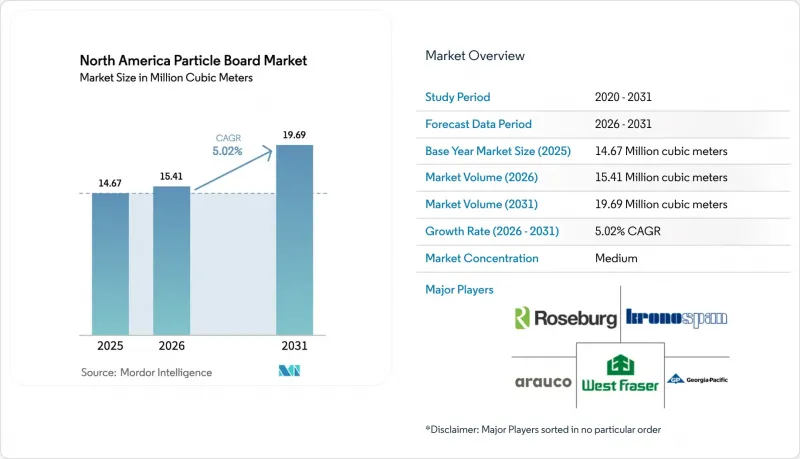
Mordor Intelligence에 의하면, 2026년 북미 파티클 보드 시장 규모는 1,541만 입방미터로 추정되고 있어 2025년 1,467만 입방미터에서 확대되어, 2031년에는 1,969만 입방미터에 이를 것으로 예측됩니다.
2026년부터 2031년까지 연평균 성장률(CAGR) 5.02%로 성장할 것으로 전망됩니다.
본 보고서는 원자재(목재(톱밥, 부스러기, 플레이크, 칩), 사탕수수 찌꺼기, 기타 원자재), 용도(가구, 건설, 인프라, 포장, 기타) 및 지역(미국, 캐나다, 멕시코)별로 분류되어 있습니다. 시장 예측은 수량(입방미터)으로 표시되어 있습니다.
북미 파티클 보드 시장 동향 및 인사이트
건설 업계 수요 증가
2024년, 주택 리모델링에 대한 지출이 예상을 상회하면서 조리대 심재, 계단 디딤판 및 칸막이 벽에 사용되는 파티클 보드 수요를 견인했습니다. 단독주택 착공 건수는 여전히 팬데믹 이전 기준치를 충분히 상회하고 있으며, 신축 주택 1채당 약 0.8-1.2 m3의 패널 제품이 사용되고 있습니다. 아파트 프로젝트에서는 모듈식 건축이 확대되고 있으며, 파티클 보드는 가공이 용이하고 현장 외 조립 시 반복적인 취급을 견딜 수 있어 선호되고 있습니다. 캐나다에서도 유사한 경향이 나타나고 있으며, 특히 온타리오주와 브리티시컬럼비아주에서는 주 건축 기준에 따라 비내력벽에 집성재의 사용이 허용되게 되었습니다. 인프라 지출은 전체 소비에서 차지하는 비중은 작지만, 교통 회랑에 사용되는 방음재와 가설 거푸집에 사용되는 파티클 보드 수요를 끌어올리고 있습니다.
지역 내 목재 잔재물의 용이한 입수
2023년 미국 에너지부의 ‘10억 톤 보고서’에서는 벌채 잔재물과 미이용 제재소 잔재물이 연간 폐기물 발생원으로 지목되었습니다. 앨라배마주, 조지아주, 미시시피주, 사우스캐롤라이나주는 매년 합쳐서 대량의 제재소 부산물을 생산하고 있으며, 산림과 멕시코만 연안 항구를 연결하는 주요 철도 회랑을 따라 제재소에 대한 투자를 촉진하고 있습니다. 퀘벡주와 온타리오주에서도 기후는 더 추운 편이지만, 유사한 추세가 관찰됩니다. 제재소와 패널 제조 시설이 동일 부지 내에 위치함으로써 운송 거리가 대폭 단축되고, 원료 비용이 안정화되었습니다. 미국 산림청의 간벌 계약을 통해 벌채되는 소경목도 매년 추가적인 공급원이 되고 있지만, 그 경제성은 지형이나 트럭 운송 반경에 따라 쉽게 좌우되는 것이 현실입니다.
MDF 및 합판 대체재의 위협
중밀도 섬유판(MDF)은 가격 면에서 다소 비싸지만, 미세한 섬유 구조 덕분에 에지 밴딩이 필요하지 않아 도장 완료 캐비닛 시장에서 점유율을 확대되고 있습니다. 합판은 구조용 선반이나 바닥 밑바닥 조립에서 여전히 우위를 점하고 있으며, 파티클 보드의 내부 결합 강도가 낮은 점이 불리하게 작용하고 있습니다. 교차 적층 목재(CLT)는 중층 건축의 골조로 부상하고 있어, 비구조용 몰딩 용도에서 파티클 보드의 입지를 위협하고 있습니다. 고급을 추구하는 소비자들은 특히 주방이나 욕실과 같이 습기가 많은 장소에서 MDF나 합판을 고품질의 대명사로 여기는 경향이 있습니다. 각 제조업체는 내습성을 향상시키기 위해 멜라민·요소·포름알데히드계 수지의 배합 및 왁스 첨가제에 대한 시험을 진행하고 있습니다. 그러나 이러한 개량으로 인해 MDF와의 가격 차이가 좁혀지면서, 파티클 보드의 가격적 매력이 점차 약화되고 있습니다.
부문 분석
2025년, 북미 파티클 보드 시장 점유율의 57.62%를 목재 잔여물이 차지했습니다. 이는 톱밥, 부스러기, 플레이크, 칩을 연속 프레스용 원료로 활용하는 확립된 제재소 인프라를 반영한 것입니다. 톱밥은 표면층에 사용되어 더욱 매끄러운 마감을 실현하는 한편, 거친 플레이크는 밀도에 따라 굽힘 강도가 좌우되는 코어층의 부피를 늘리는 역할을 합니다. 펄프 제조 공정에서 얻어지는 칩은 특히 미국 남부 지역에서 저품질 원목이 풍부하게 존재할 때 제3의 원료원이 됩니다. 사탕수수 착즙 과정에서 발생하는 섬유질 부산물인 바가스는 2031년까지 연평균 성장률(CAGR) 5.38%로 확대될 것으로 예측되며, 이는 원료 중 가장 높은 성장률입니다. 이는 과거 폐기 비용으로 간주되던 것을 수익화하기 위한 루이지애나주의 제당 공장과 패널 제조업체간의 제휴가 뒷받침하고 있습니다. 실험실 테스트를 통해 MDI 수지로 결합된 바가스 보드가 ANSI A208.1의 내부 결합 기준을 충족하는 것으로 확인되었습니다. 대마 줄기나 면 줄기 등의 2차 원료는 연속 압축 공정의 일정 관리에 필수적인 ‘연중 안정적인 공급’을 확보하기 어렵기 때문에 여전히 틈새 시장으로 남아 있습니다.
건조기 제어 및 수지 분사 기술의 지속적인 개선을 통해 재활용된 해체 목재의 수분 함량으로 인한 품질 저하가 완화되어, 공장은 배출 기준치를 초과하지 않으면서 재생 칩과 버진 원료를 혼합할 수 있게 되었습니다. 하지만 재활용률을 높이기 위해서는 더욱 엄격한 불순물 선별이 필요합니다. 이는 오래된 합판의 자투리 목재에는 페놀계 접착제가 포함되어 있는 경우가 많아, 이로 인해 포름알데히드 측정값이 왜곡되기 때문입니다. 광학 선별 라인을 갖춘 대규모 공장은 이러한 복잡성을 쉽게 해결할 수 있으므로, 북미 파티클 보드 시장을 특징짓는 규모의 경제가 더욱 강화되고 있습니다.
기타 혜택:
- 엑셀 형식 시장 예측(ME) 시트
- 3개월간의 애널리스트 지원
자주 묻는 질문
목차
제1장 서론
제2장 조사 방법
제3장 주요 요약
제4장 시장 구도
제5장 시장 규모와 성장 예측
제6장 경쟁 구도
제7장 시장 기회와 향후 전망
JHS 26.09.03According to Mordor Intelligence, north america particle board market size in 2026 is estimated at 15.41 million cubic meters, growing from 2025 value of 14.67 million cubic meters with 2031 projections showing 19.69 million cubic meters, growing at 5.02% CAGR over 2026-2031.
This report is Segmented by Raw Material (Wood [Sawdust, Shavings, Flakes, and Chips], Bagasse, and Other Raw Materials), Application (Furniture, Construction, Infrastructure, Packaging, and Others), and Geography (United States, Canada, and Mexico). The Market Forecasts are Provided in Terms of Volume (Cubic Meters).
North America Particle Board Market Trends and Insights
Growing Demand from the Construction Industry
Residential remodeling spending surpassed expectations in 2024, driving demand for particle board in countertop cores, stair treads, and interior partitions. Single-family housing starts remain comfortably above pre-pandemic baselines, and each new unit incorporates roughly 0.8-1.2 m3 of panel products. Modular construction is scaling in multi-family projects, favoring particle board because the material machines easily and withstands repeated handling during off-site assembly. Canada echoes this pattern, particularly in Ontario and British Columbia, where provincial codes now recognize engineered wood for use in non-load-bearing walls. Infrastructure spending, although a smaller slice of consumption, is lifting particle board volumes in acoustic baffles and temporary formwork used in transit corridors.
Easy Availability of Regional Wood Residues
The 2023 U.S. Department of Energy Billion-Ton Report identified logging residue and unused mill residue as sources of annual waste. Alabama, Georgia, Mississippi, and South Carolina collectively account for significant sawmill by-products each year, prompting mill investment along key rail corridors that connect forests to Gulf Coast ports. Quebec and Ontario enjoy a similar, if colder, dynamic: co-located sawmill and panel operations slash haul distances and stabilize furnish costs. Small-diameter trees harvested through U.S. Forest Service thinning contracts represent an additional source each year, although economics are sensitive to terrain and trucking radius.
Threat of MDF and Plywood Substitutes
Medium-density fiberboard commands a price premium but wins market share in painted cabinets because its fine fibers eliminate the need for edge banding. Plywood retains dominance in structural shelving and sub-floor assemblies where particle board's lower internal bond strength is a disadvantage. Cross-laminated timber is emerging in mid-rise frames and threatens particle board's foothold in non-structural skirting applications. Consumers in premium brackets often equate MDF or plywood with higher quality, particularly for moisture-prone areas such as kitchens and bathrooms. Producers are trialing melamine-urea-formaldehyde recipes, along with wax additives, to improve moisture resistance; however, these upgrades narrow the cost delta with MDF and curb particle board's pricing appeal.
Other drivers and restraints analyzed in the detailed report include:
- Surge in RTA Furniture and DIY Renovation Boom
- State-Level Landfill-Diversion Mandates Unlocking Recycled Feedstock
- Tightening Formaldehyde-Emission Regulations
For complete list of drivers and restraints, kindly check the Table Of Contents.
Segment Analysis
Wood residues captured 57.62% of the North America particle board market share in 2025, reflecting entrenched sawmill infrastructure that channels sawdust, shavings, flakes, and chips into continuous-press furnish. Sawdust feeds the surface layer for a smoother finish, while coarser flakes bulk out the core where density drives bending strength. Chips from pulp operations provide a tertiary stream when low-grade roundwood is plentiful, especially in the U.S. South. Bagasse, the fibrous by-product of sugarcane crushing, is forecast to expand at a 5.38% CAGR through 2031, the fastest rate among feedstocks, helped by partnerships between Louisiana sugar mills and panel makers that monetize what was once a disposal cost. Laboratory trials confirm that bagasse boards bonded with MDI resin pass ANSI A208.1 internal-bond benchmarks. Secondary materials such as hemp hurds and cotton stalks remain niche because year-round supply consistency is elusive, a key requirement for continuous-press scheduling.
Continuous refinements in dryer controls and resin sprays are lowering the moisture penalty of recycled demolition lumber, enabling mills to blend reclaimed chips with virgin furnish without exceeding emissions thresholds. Nevertheless, shifting to higher recycled content demands closer contaminant screening because legacy plywood offcuts often carry phenol-based adhesives that skew formaldehyde assays. Large mills with optical sorting lines absorb this complexity more readily, reinforcing the scale advantage that characterizes the North America particle board market.
Complete Report Scope:
- By Raw Material
- Wood
- Sawdust
- Shavings
- Flakes
- Chips
- Bagasse
- Other Raw Materials
- Wood
- By Application
- Furniture
- Construction
- Infrastructure
- Packaging
- Others
- By Geography
- United States
- Canada
- Mexico
List of Companies Covered in this Report:
- Amerhart
- Arauco
- Boise Cascade
- Collins Products
- Cornerstone Specialty Wood Products LLC
- Egger Wood Products LLC
- Forestral Terranova Mexico SA de CV (MASISA)
- Georgia-Pacific.
- GP Wood Products Inc.
- Kronospan LLC
- Maderas Conglomeradas SA de CV (MACOSA)
- Masonite Corporation
- Panolam Industries International Inc.
- Plummer Forest Products
- Roseburg Forest Products
- Tafisa Canada Inc.
- Timber Products Company
- Uniboard
- West Fraser Timber Co.
- Weyerhaeuser Company
Additional Benefits:
- The market estimate (ME) sheet in Excel format
- 3 months of analyst support
TABLE OF CONTENTS
1 Introduction
- 1.1 Study Assumptions and Market Definition
- 1.2 Scope of the Study
2 Research Methodology
3 Executive Summary
4 Market Landscape
- 4.1 Market Overview
- 4.2 Market Drivers
- 4.2.1 Growing demand from the construction industry
- 4.2.2 Easy availability of regional wood residues
- 4.2.3 Surge in RTA furniture and DIY renovation boom
- 4.2.4 State-level landfill-diversion mandates unlocking recycled feedstock
- 4.2.5 Continuous-press automation cutting unit costs
- 4.3 Market Restraints
- 4.3.1 Threat of MDF and plywood substitutes
- 4.3.2 Tightening formaldehyde-emission regulations
- 4.3.3 Bio-energy projects competing for wood residue supply
- 4.4 Value Chain Analysis
- 4.5 Porter's Five Forces Analysis
- 4.5.1 Bargaining Power of Suppliers
- 4.5.2 Bargaining Power of Buyers
- 4.5.3 Threat of New Entrants
- 4.5.4 Threat of Substitutes
- 4.5.5 Degree of Competition
5 Market Size and Growth Forecasts (Volume)
- 5.1 By Raw Material
- 5.1.1 Wood
- 5.1.1.1 Sawdust
- 5.1.1.2 Shavings
- 5.1.1.3 Flakes
- 5.1.1.4 Chips
- 5.1.2 Bagasse
- 5.1.3 Other Raw Materials
- 5.1.1 Wood
- 5.2 By Application
- 5.2.1 Furniture
- 5.2.2 Construction
- 5.2.3 Infrastructure
- 5.2.4 Packaging
- 5.2.5 Others
- 5.3 By Geography
- 5.3.1 United States
- 5.3.2 Canada
- 5.3.3 Mexico
6 Competitive Landscape
- 6.1 Market Concentration Analysis
- 6.2 Strategic Moves
- 6.3 Market Share (%)/ Ranking Analysis
- 6.4 Company Profiles (includes Global-level Overview, Market-level Overview, Core Segments, Financials as available, Strategic Information, Market Rank/Share, Products and Services, Recent Developments)
- 6.4.1 Amerhart
- 6.4.2 Arauco
- 6.4.3 Boise Cascade
- 6.4.4 Collins Products
- 6.4.5 Cornerstone Specialty Wood Products LLC
- 6.4.6 Egger Wood Products LLC
- 6.4.7 Forestral Terranova Mexico SA de CV (MASISA)
- 6.4.8 Georgia-Pacific.
- 6.4.9 GP Wood Products Inc.
- 6.4.10 Kronospan LLC
- 6.4.11 Maderas Conglomeradas SA de CV (MACOSA)
- 6.4.12 Masonite Corporation
- 6.4.13 Panolam Industries International Inc.
- 6.4.14 Plummer Forest Products
- 6.4.15 Roseburg Forest Products
- 6.4.16 Tafisa Canada Inc.
- 6.4.17 Timber Products Company
- 6.4.18 Uniboard
- 6.4.19 West Fraser Timber Co.
- 6.4.20 Weyerhaeuser Company
7 Market Opportunities and Future Outlook
- 7.1 White-space and Unmet-Need Assessment