

|
시장보고서
상품코드
2116961
중동의 수직농법 : 시장 점유율 분석, 업계 동향과 통계, 성장 예측(2026-2031년)Middle East Vertical Farming - Market Share Analysis, Industry Trends & Statistics, Growth Forecasts (2026 - 2031) |
||||||
 Mordor Intelligence
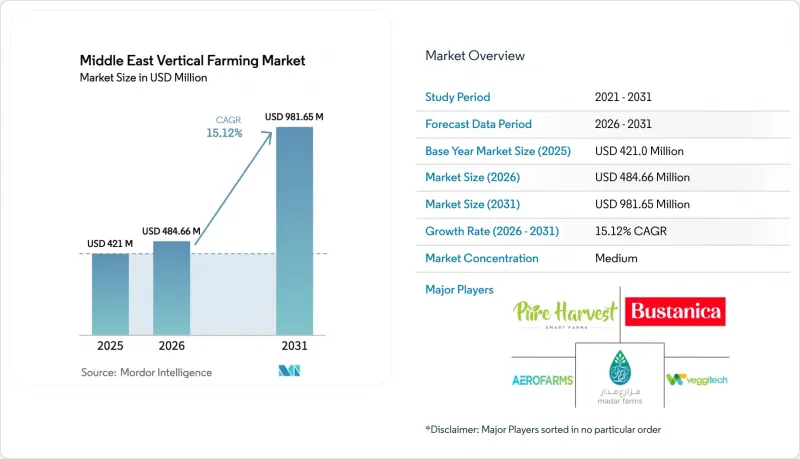
Mordor Intelligence에 따르면 2026년 중동에서 수직 농업 시장 규모는 4억 8,466만 달러로 추정되고 있으며, 2025년 4억 2,100만 달러에서 확대하며, 2031년에는 9억 8,165만 달러에 달할 것으로 예측됩니다.
2026-2031년까지 연평균 성장률(CAGR) 15.12%로 성장할 것으로 전망됩니다.
이 보고서는 성장 메커니즘별(에어로포닉스 등), 구조별(건물형 수직 농장, 운송용 컨테이너형 수직 농장 등), 작물 유형별(과일·채소 등) 및 지역별(사우디아라비아, 아랍에미리트, 이집트, 카타르,쿠웨이트, 오만, 바레인, 요르단 및 기타 중동)으로 분류되어 있습니다. 시장 전망은 금액(달러) 기준으로 제시되어 있습니다.
중동 수직 농업 시장의 동향 및 인사이트
식량안보를 위한 정부의 적극적인 노력
중동 국가 정부들은 수입 의존도를 낮추고 지정학적 혼란으로부터 식량 시스템을 보호하기 위해 수직농법을 국가 식량 전략에 포함시키고 있습니다. 아랍에미리트의 식량안보 계획에는 제어 환경 농업에 관한 구체적인 목표가 포함되어 있는 반면, 사우디아라비아의 개발 비전에서는 실내 농업 프로젝트에 대한 공공 투자가 배정되어 있습니다. 이집트의 농업 계획에는 나일강 삼각주의 경작지 감소 문제에 대처하기 위해 수직 농업이 포함되어 있습니다. 이러한 정책을 통해 농자재에 대한 허가 및 통관 절차가 간소화되는 동시에, 농업 은행을 통한 우대 대출이 제공되고 있습니다. 지역적 기후 변화 대책에 따라 지속가능한 농업 시스템에 대한 자금 지원이 증가하고 있습니다. 규제 당국은 현재 지속가능성 기준을 충족하는 영양액에 대해 신속한 인증을 진행하고 있습니다.
물 절약 가능성
만안 지역의 물 부족으로 인해 수직 농업은 지속가능한 농업을 위한 실용적인 해결책으로 자리 잡고 있습니다. 이러한 시스템은 순환식 수경 재배와 폐쇄형 양액 시스템을 활용하여 물 소비량을 줄이고 유출수를 차단함으로써 환경 규제를 충족하고 있습니다. 인공 강우와 같은 기존 방법의 효과가 제한적이기 때문에 정책 입안자들은 일관된 물 절약을 실현하기 위해 수경 재배 기술을 우선시하고 있습니다. 재생 가능 에너지를 동력원으로 하는 뿌리 영역 냉각 시스템 등 새로운 개발 기술이 고부가가치 작물의 물 사용량을 줄이기 위해 시험되고 있습니다. 이러한 기법들은 건조한 환경에서 자원 효율성과 상업적 실현 가능성 모두를 보여주고 있습니다.
통제 환경 농업 분야의 지역 인력 부족
중동에서는 최근 역량 강화 노력에도 불구하고 제어 환경 농업 분야의 인력 부족이 심각한 문제로 대두되고 있습니다. 교육 기관에는 전문적인 교육 과정이 부족하여, 사업자들은 첨단 시스템 관리에 있으며, 외국인 컨설턴트에 의존할 수밖에 없는 상황입니다. 이러한 의존은 운영 비용을 증가시키고, 장기적인 지속가능성을 저해하고 있습니다. 언어 장벽으로 인해 연수 효과도 떨어지는 한편, 이민 정책으로 인해 숙련된 재배자가 장기 체류하며 기여하는 데 제한을 받고 있습니다. 수직 농업 벤처 기업은 견고한 현지 인력 공급 체계가 갖춰지지 않는 한, 효율적으로 사업을 확장하기 어렵습니다. 이 지역에서는 농업 혁신에 필요한 현지 전문 지식을 육성하기 위해 교육, 직업 훈련, 정책 개혁에 대한 협력적인 투자가 요구되고 있습니다.
부문 분석
2025년, 중동 수직 농업 시장 점유율의 59.84%를 수경 재배가 차지했습니다. 이는 운영의 예측 가능성과 확립된 영양액 기술에 힘입은 결과입니다. 이 방식은 특히 사우디아라비아와 아랍에미리트에서 잘 정비된 공급망과 광범위한 기술적 전문 지식의 혜택을 받고 있습니다. 이 부문은 투자 회수 기간이 짧고 안정적인 수확량을 기대할 수 있으며, 투자를 유치하고 있습니다. 수경 재배 시스템의 확장성은 식량안보에 중점을 두는 상업 및 기관 이해관계자들에게 매력적입니다.
에어로포닉스 분야는 2031년까지 연평균 성장률(CAGR) 15.55%로 성장할 것으로 전망됩니다. 이 분야의 미스트 기술은 산소 흡수를 촉진하고 식물 성장을 가속화하여 수확량 증대로 이어집니다. 이 방법은 수경 재배에 비해 약 10% 적은 물만으로도 충분하므로 지역내 물 부족 문제에 대응하고 있습니다. 연구 기관과 레스토랑에서는 사막 환경에 적응한 작물을 활용한 에어로포닉스 시스템의 시험이 진행되고 있습니다. 아쿠아포닉스는 여전히 소규모 부문이지만, 순환형 시스템 특유의 이점으로 인해 프리미엄 시장의 소비자층 사이에서 수요가 확대되고 있습니다.
기타 혜택:
- 엑셀 형식의 시장 예측(ME) 시트
- 3개월간의 애널리스트 지원
자주 묻는 질문
목차
제1장 서론
제2장 조사 방법
제3장 개요
제4장 시장 구도
제5장 시장 규모와 성장 예측
제6장 경쟁 구도
제7장 시장 기회와 향후 전망
KSA 26.08.26According to Mordor Intelligence, the middle east vertical farming market size in 2026 is estimated at USD 484.66 million, growing from 2025 value of USD 421.0 million with 2031 projections showing USD 981.65 million, growing at 15.12% CAGR over 2026-2031.
This report is Segmented by Growth Mechanism (Aeroponics, and More), by Structure (Building-Based Vertical Farms, and Shipping-Container Vertical Farms), by Crop Type (Fruits and Vegetables, and More), and by Geography (Saudi Arabia, United Arab Emirates, Egypt, Qatar, Kuwait, Oman, Bahrain, Jordan, and Rest of Middle East). The Market Forecasts are Provided in Terms of Value (USD).
Middle East Vertical Farming Market Trends and Insights
Favorable Food-security Mandates by Governments
Middle Eastern governments are integrating vertical farming into national food strategies to reduce import dependence and protect food systems from geopolitical disruptions. The United Arab Emirates' food security plan includes specific targets for controlled-environment agriculture, while Saudi Arabia's development vision allocates public investment to indoor farming projects. Egypt's agricultural plan incorporates vertical farms to address land loss in the Nile Delta. These policies simplify licensing and customs procedures for farm inputs while providing concessional financing through agricultural banks. Regional climate initiatives have increased funding for sustainable farming systems. Regulatory authorities now provide expedited certification for nutrient solutions meeting sustainability standards.
Water-saving Potential
Water scarcity in the Gulf region has positioned vertical farming as a practical solution for sustainable agriculture. These systems utilize recirculating hydroponics and closed-loop nutrient systems to reduce water consumption and eliminate runoff, meeting environmental regulations. With traditional methods like cloud seeding showing limited effectiveness, policymakers are prioritizing hydroponic technologies for consistent water conservation. New developments, such as renewable energy-powered root-zone cooling systems, are being tested to decrease water usage in high-value crops. These methods demonstrate both resource efficiency and commercial feasibility in arid environments.
Scarce Regional Skill for Controlled-environment Agronomy
The Middle East faces a significant talent shortage in controlled-environment agriculture, despite recent capacity-building efforts. Academic institutions lack specialized curricula, forcing operators to rely on foreign consultants for managing advanced systems. This dependence increases operational costs and impedes long-term sustainability. Training effectiveness suffers due to language barriers, while immigration policies restrict skilled growers from long-term residency and contribution. Vertical farming ventures struggle to scale efficiently without a robust local talent pipeline. The region requires coordinated investments in education, vocational training, and policy reform to develop local expertise in agricultural innovation.
Other drivers and restraints analyzed in the detailed report include:
- Rapid Retail Adoption of Locally Branded "Zero-mile" Produce
- Expansion of Public-private Mega Farm Projects
- Fragmented Cold-chain Logistics for Micro-greens
For complete list of drivers and restraints, kindly check the Table Of Contents.
Segment Analysis
Hydroponics accounted for 59.84% of the Middle East vertical farming market share in 2025, driven by its operational predictability and established nutrient solutions. The method benefits from developed supply chains and widespread technical expertise, particularly in Saudi Arabia and the United Arab Emirates. The segment attracts investment due to shorter payback periods and reliable yields. The scalability of hydroponic systems appeals to commercial and institutional stakeholders focused on food security.
The aeroponic segment is projected to grow at a 15.55% CAGR through 2031. Its misting technique improves oxygen absorption, resulting in faster plant growth and higher yields. The method uses approximately 10% less water than hydroponics, addressing regional water scarcity concerns. Research institutions and restaurants are testing aeroponic systems with desert-adapted crops. Aquaponics remains a small segment but is growing among premium market consumers due to its circular system benefits.
Complete Report Scope:
- By Growth Mechanism
- Aeroponics
- Hydroponics
- Aquaponics
- By Structure
- Building-based Vertical Farms
- Shipping-Container Vertical Farms
- By Crop Type
- Fruits and Vegetables
- Herbs and Micro-greens
- Flowers and Ornamentals
- By Geography
- Saudi Arabia
- United Arab Emirates
- Egypt
- Qatar
- Kuwait
- Oman
- Bahrain
- Jordan
- Rest of Middle East
List of Companies Covered in this Report:
- AeroFarms
- Madar Farms
- Bustanica (Emirates Crop One LLC)
- Pure Harvest Smart Farms Ltd.
- VeggiTech Hydroponic Technologies Private Limited (SNASCO Holding Company)
- Badia Farms (Gulf Islamic Investments)
- Geap Group (Oasis Greens)
- Armela Farms
- GreenFactory Emirates
- Mowreq Specialized Agriculture Co.
- iFarm Corp.
- Vertical Field Ltd.
- Emirates Hydroponics Farms
Additional Benefits:
- The market estimate (ME) sheet in Excel format
- 3 months of analyst support
TABLE OF CONTENTS
1 Introduction
- 1.1 Study Assumptions and Market Definition
- 1.2 Scope of the Study
2 Research Methodology
3 Executive Summary
4 Market Landscape
- 4.1 Market Overview
- 4.2 Market Drivers
- 4.2.1 Favorable Food-security Mandates by Governments
- 4.2.2 Water-saving Potential
- 4.2.3 Rapid Retail Adoption of Locally Branded "Zero-mile" Produce
- 4.2.4 Integration of IoT-driven Climate Control Platforms
- 4.2.5 Expansion of Public-private Mega Farm Projects
- 4.2.6 Modular Farm-as-a-service Models for Hotels and Campuses
- 4.3 Market Restraints
- 4.3.1 High Capex per Meter Square Relative to Greenhouse Alternatives
- 4.3.2 Scarce Regional Skill for Controlled-environment Agronomy
- 4.3.3 Import Dependence on Nutrient Solutions and Substrates
- 4.3.4 Fragmented Cold-chain Logistics for Micro-greens
- 4.4 Regulatory Landscape
- 4.5 Technological Outlook
- 4.6 Porter's Five Forces Analysis
- 4.6.1 Bargaining Power of Suppliers
- 4.6.2 Bargaining Power of Buyers
- 4.6.3 Threat of New Entrants
- 4.6.4 Threat of Substitute Products
- 4.6.5 Intensity of Competitive Rivalry
5 Market Size and Growth Forecasts (Value)
- 5.1 By Growth Mechanism
- 5.1.1 Aeroponics
- 5.1.2 Hydroponics
- 5.1.3 Aquaponics
- 5.2 By Structure
- 5.2.1 Building-based Vertical Farms
- 5.2.2 Shipping-Container Vertical Farms
- 5.3 By Crop Type
- 5.3.1 Fruits and Vegetables
- 5.3.2 Herbs and Micro-greens
- 5.3.3 Flowers and Ornamentals
- 5.4 By Geography
- 5.4.1 Saudi Arabia
- 5.4.2 United Arab Emirates
- 5.4.3 Egypt
- 5.4.4 Qatar
- 5.4.5 Kuwait
- 5.4.6 Oman
- 5.4.7 Bahrain
- 5.4.8 Jordan
- 5.4.9 Rest of Middle East
6 Competitive Landscape
- 6.1 Market Concentration
- 6.2 Strategic Moves
- 6.3 Market Share Analysis
- 6.4 Company Profiles (Includes Global Level Overview, Market Level Overview, Core Segments, Financials as Available, Strategic Information, Market Rank/Share for Key Companies, Products and Services, and Recent Developments)
- 6.4.1 AeroFarms
- 6.4.2 Madar Farms
- 6.4.3 Bustanica (Emirates Crop One LLC)
- 6.4.4 Pure Harvest Smart Farms Ltd.
- 6.4.5 VeggiTech Hydroponic Technologies Private Limited (SNASCO Holding Company)
- 6.4.6 Badia Farms (Gulf Islamic Investments)
- 6.4.7 Geap Group (Oasis Greens)
- 6.4.8 Armela Farms
- 6.4.9 GreenFactory Emirates
- 6.4.10 Mowreq Specialized Agriculture Co.
- 6.4.11 iFarm Corp.
- 6.4.12 Vertical Field Ltd.
- 6.4.13 Emirates Hydroponics Farms


