|
시장보고서
상품코드
2117227
유럽의 구조화 배선 시장 : 시장 점유율 분석, 업계 동향 및 통계, 성장 예측(2026-2031년)Europe Structured Cabling - Market Share Analysis, Industry Trends & Statistics, Growth Forecasts (2026 - 2031) |
||||||
 Mordor Intelligence
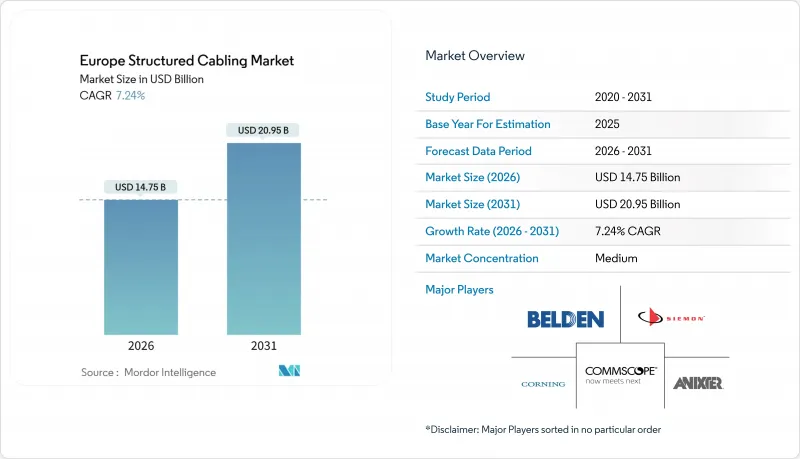
Mordor Intelligence에 의하면, 유럽의 구조화 배선 시장 규모는 2026년에 147억 5,000만 달러로 추정되고, 2031년까지 209억 2,000만 달러에 이를 것으로 예측되며, 예측 기간 중 CAGR은 7.24%를 나타낼 전망입니다.
본 보고서는 제조 유형별(구리 케이블, 구리 접속 장치, 단일 모드 광섬유 케이블 등), 케이블 카테고리별(카테고리 5e, 카테고리 6, 카테고리 6A 등), 용도별(LAN, 데이터센터, 캠퍼스 네트워크 등), 산업 분야별(IT 및 통신, 은행, 금융서비스 및 보험(BFSI), 의료, 제조 등), 국가별로 분류되어 있습니다. 시장 예측은 금액(달러) 기준으로 제시되어 있습니다.
유럽의 구조화 배선 시장 동향 및 인사이트
유럽 전역에서 하이퍼스케일 데이터센터 건설 확대
구글의 디첸바흐 및 하르나우에 대한 55억 유로(60억 달러) 투자,슈바르츠 그룹의 루베나우 110억 유로(121억 달러) 규모 AI 허브 건설은 하이퍼스케일 프로그램에서 총 자본 지출의 8-12%가 구조화 배선 예산으로 반영되고 있음을 여실히 보여줍니다. 각 캠퍼스에서는 탑 오브 랙(Top-of-Rack) 링크에 카테고리 8 구리선, 100미터를 초과하는 구간에는 단일 모드 광섬유 트렁크가 지정되어 있어, 864가닥 광섬유 MPO 어셈블리에 대한 수요를 견인하고 있습니다. Data4사의 180MW 규모 하나우 복합 시설과 Colt DCS사의 117MW 규모 독일 내 파이프라인은 설치 업체가 사전에 준비한 재고와 인증된 기술자에 의해 대응해야 하는 수년 치의 미처리 수주량을 뒷받침하고 있습니다. 네덜란드에서는 새로운 대서양 횡단 케이블이 암스테르담에 상륙함에 따라 지역 수요가 증가하고 있으며, 제한된 코로케이션 공간 내에 수용될 수 있는 고밀도 연결이 요구되고 있습니다. 이러한 메가 프로젝트들이 맞물리면서 유럽의 구조화 배선 시장은 기존의 기업 LAN 갱신 주기를 훨씬 뛰어넘어 대폭 확대되고 있습니다.
PoE와 IoT의 급속한 보급이 고대역폭 배선 수요를 견인
IEEE 802.3bt의 90와트 PoE 규격은 2024년 이후, 유럽의 물류 창고 및 스마트 시티 시범 프로젝트에서 조명, 카메라, Wi-Fi 6E가 통합 배선망에 집약됨에 따라 대규모 도입의 촉매제가 되었습니다. 카테고리 6A는 500 MHz의 대역폭을 통해 100미터에 걸쳐 10GBASE-T를 지원하면서도 팬-틸트-줌 카메라 등의 장비로 가는 전압 강하를 최소화할 수 있어 표준 사양으로 자리 잡았습니다. ‘유럽 시설 연결(CEF) 디지털’ 프로그램은 바르셀로나, 암스테르담, 코펜하겐의 스마트 시티 시범 사업에 자금을 배정함으로써, 차폐형 카테고리 6A 케이블 번들에 대한 단기 수요를 두 배로 늘렸습니다. 팬듀이트(Panduit)와 시몬(Seamon)은 채널 삽입 손실을 줄이고 원격 전원 공급 전략을 간소화하는 10GBASE-T 및 TERA 커넥터 시스템을 제공함으로써 이러한 기회를 활용하고 있습니다. PoE 전류 증가에 따라 케이블 번들의 충전률 재계산도 필요해졌습니다. 이는 도관의 점유율이 40%를 초과하면 열적 디레이팅으로 인해 인접한 도체에 악영향을 미칠 수 있기 때문이며, 시설 관리자들은 더 높은 등급의 LSZH 재킷을 채택하는 방향으로 나아가고 있습니다.
엔터프라이즈급 Wi-Fi 및 가상화 네트워크로의 전환
Wi-Fi 6E 및 신흥 Wi-Fi 7 장치는 6GHz 대역에서 멀티 기가비트 처리량을 실현하고 있어, 일부 기존 사무실에서는 새로운 구리선 드롭의 밀도를 낮출 수 있게 되었습니다. 프랑크푸르트와 런던의 금융 기업들은 5G와 위성 링크를 결합한 소프트웨어 정의 WAN(SD-WAN) 오버레이를 시범 운영 중이며, 이로 인해 카테고리 6A에 대한 상업용 부동산 수요가 소폭 억제되고 있습니다. 2024년 ETSI가 발표한 프라이빗 5G 표준에 따라, 공장에서는 특정 모바일 자산에 대해 유선 이더넷을 생략할 수 있게 됩니다. 그러나 지연에 민감한 워크로드, 고빈도 거래, 머신 비전을 통한 품질 관리 등은 여전히 확정적인 유선 링크에 의존하고 있어, 구조화 배선 공급업체가 공략할 수 있는 상당한 규모의 핵심 시장이 유지되고 있습니다.
부문 분석
2026년에는 하이퍼스케일 사업자들이 100미터를 초과하는 모든 랙 간 및 스파인-리프 링크에 단일 모드 광섬유 사용을 의무화함에 따라 광섬유 연결 수요가 가속화되어, 이 부문은 2031년까지 연평균 성장률(CAGR) 9.02%로 성장할 전망입니다. 데이터센터 내에서는 864개의 광섬유로 구성된 MPO 트렁크를 통해 모듈식 확장이 가능해질 뿐만 아니라 바닥 면적을 30% 절감할 수 있어 전력 사용 효율(PUE) 향상에 직접적으로 기여하고 있습니다. 2025년 시점에서 구리선은 여전히 유럽 구조화 배선 시장 점유율의 61.72%를 차지했으며, 그 배경에는 PoE 조명 및 Wi-Fi 6E로의 업그레이드를 지원하는 카테고리 6 및 6A의 방대한 도입 실적이 있습니다. 또한, 구리선은 동일한 매체를 통해 데이터와 90와트의 전력을 공급할 수 있는 독자적인 능력을 가지고 있으며, 이는 광섬유의 경우 고가의 하이브리드 케이블을 사용하지 않는 한 실현할 수 없는 장점입니다. 지속적으로 성장하는 유럽의 구조화 배선 시장에서 구글과 Data4가 단일 모드 전용 아키텍처를 의무화하고 있는 독일의 메가 캠퍼스에서는 광섬유가 구리선을 대체하고 있습니다. 그러나 물류 창고나 레거시 캠퍼스에서는 카테고리 6A가 여전히 비용 대비 성능 면에서 최적의 선택지이며, 벤더들이 균형을 맞추어야 하는 양극화된 도입 곡선이 두드러지고 있습니다.
구리선의 미래 전망은 PoE 동향과 융착 연결된 LC 커넥터에 비해 RJ45 단자의 연결이 비교적 간단하다는 점에 의해 뒷받침되고 있습니다. 그러나 카테고리 8의 등장으로 새로운 인증 장벽이 생겨났으며, 최대 2만 5,000유로(2만 7,400달러)에 달하는 시험 장비는 특히 프랑크푸르트나 암스테르담과 같이 건설이 활발한 지역에서 설치 업체의 대응 능력을 제약하고 있습니다. 광섬유는 전자기 간섭의 영향을 받지 않기 때문에 가변 주파수 드라이브와 정밀 로봇이 공존하는 자동차 공장이나 제약 공장에서 필수적인 존재가 되고 있습니다. 코닝이 2024년에 출시할 예정인 굽힘 반경 5mm를 지원하는 내굽힘 제품은 공간 제약이 있는 코로케이션 시설에서 캐비닛의 설치 면적을 더욱 줄여줍니다. 이러한 기술의 융합으로 인해, 구리 케이블이 PoE를 많이 사용하는 건물 내 네트워크에 집착하는 상황에서도 광섬유는 랙당 부가가치를 높이는 입장에 서 있습니다.
카테고리 8은 2031년까지 연평균 성장률(CAGR) 7.98%를 나타낼 것으로 예측됩니다. 이는 하이퍼스케일러 각사가 2GHz의 대역폭과 30미터의 도달 거리를 바탕으로, 스파인 패브릭 전체를 개편하지 않고도 400Gbps로 전환하기 위한 경제적인 가교로 간주하고 있기 때문입니다. 조기 도입 사례로는 슈바르츠 그룹의 루베나우 AI 허브를 들 수 있습니다. 이곳에서는 10만 개의 GPU를 수용하기 위해 랙의 통기성을 확보하는 콤팩트한 고속 구리 케이블이 필수적입니다. 2025년 현재, 카테고리 6은 유럽 구조화 배선 시장 점유율의 38.63%를 차지했으며, 이는 사무실 LAN 및 교육 시설에서의 확고한 사용 현황을 반영하고 있습니다. 에이리언 크로스톡(ACT) 차폐 기능을 갖추고 500 MHz의 헤드룸을 가진 카테고리 6A는 10GBASE-T 및 60-90와트의 PoE에서 여전히 표준으로 자리 잡고 있으며, 신규 상업시설 개보수의 대부분을 차지하고 있습니다. 카테고리 7 및 7A는 GG45 커넥터와 호환되지 않아 더 광범위한 채택이 저해되고 있으며, 틈새 산업용도로만 사용되고 있습니다.
인증과 관련된 병목 현상이 카테고리 8의 보급을 저해하고 있습니다. BICSI가 2GHz 시험을 교육 과정에 포함시킨 것은 2025년 후반이 되어서였기 때문에 엄격한 채널 제한을 검증할 수 있는 기술자는 거의 없습니다. 독일의 하이퍼스케일 시설에서는 현지 인력 공급이 수요를 따라가지 못하고 있어, 도급업체는 인증을 받은 인력을 해외에서 초빙하거나 공사 기간을 연장할 수밖에 없는데, 어느 쪽도 투자자의 조기 완공이라는 목표와는 부합하지 않습니다. 한편, 카테고리 5e의 잔여 점유율은 축소되는 추세입니다. 이는 100 MHz 채널이 최신 PoE 부하나 10GBASE-T를 지원하지 못하기 때문입니다. 이로 인해 사무실 소유주가 직접 카테고리 6A를 선택하는 업그레이드 주기가 촉진되고 있습니다. EU의 CPR에 따른 LSZH 요건으로 인해 카테고리 6A 및 카테고리 8의 자재비는 10-15% 증가하지만, 독일, 네덜란드, 북유럽 국가에서는 이 요건을 준수해야 하므로 각 벤더들은 LSZH 생산의 표준화를 추진하고 있습니다.
기타 혜택 :
- 엑셀 형식 시장 예측(ME) 시트
- 3개월간의 애널리스트 지원
자주 묻는 질문
목차
제1장 서론
제2장 조사 방법
제3장 개요
제4장 시장 구도
제5장 시장 규모 및 성장 예측
제6장 경쟁 구도
제7장 시장 기회 및 향후 전망
AJY 26.09.01According to Mordor Intelligence, the Europe structured cabling market size stands at USD 14.75 billion in 2026 and is projected to reach USD 20.92 billion by 2031, reflecting a 7.24% CAGR over the forecast period.
This report is Segmented by Product Type (Copper Cable, Copper Connectivity, Single-Mode Fiber Cable, and More), Cable Category (Category 5e, Category 6, Category 6A, and More), Application (LAN, Data Center, Campus Network, and More), Industry Vertical (IT and Telecom, BFSI, Healthcare, Manufacturing, and More), and Country. Market Forecasts are Provided in Terms of Value (USD).
Europe Structured Cabling Market Trends and Insights
Hyperscale Data-Center Build-Outs Across Europe
Google's EUR 5.5 billion (USD 6.0 billion) commitment to Dietzenbach and Hanau and Schwarz Group's EUR 11 billion (USD 12.1 billion) AI hub in Lubbenau epitomize how hyperscale programs embed structured cabling budgets of 8-12% of total capital outlays. Each campus specifies Category 8 copper for top-of-rack links and single-mode fiber trunks exceeding 100 meters, driving demand for 864-fiber MPO assemblies. Data4's 180 MW Hanau complex and Colt DCS's 117 MW German pipeline reinforce a multi-year order book that installers must service with pre-staged inventory and certified labor. The Netherlands amplifies regional demand as new trans-Atlantic cables terminate in Amsterdam, necessitating high-density connectivity that fits within tight colocation footprints. Collectively, these mega-projects significantly expand the addressable Europe structured cabling market beyond historical enterprise LAN refresh cycles.
Rapid Adoption of PoE and IoT Driving Higher-Bandwidth Cabling
IEEE 802.3bt's 90-watt PoE standard ignited large-scale deployments after 2024, when European logistics warehouses and smart-city pilots converged lighting, cameras, and Wi-Fi 6E on unified cabling. Category 6A became the default because its 500 MHz bandwidth supports 10GBASE-T across 100 meters while minimizing voltage drop for devices such as pan-tilt-zoom cameras. The Connecting Europe Facility Digital program earmarked funds for smart-city pilots in Barcelona, Amsterdam, and Copenhagen, multiplying near-term demand for shielded Category 6A bundles. Panduit and Siemon are capitalizing by offering 10GBASE-T and TERA connector systems that reduce channel insertion loss and simplify remote powering strategies. Rising PoE currents also require recalculating cable-bundle fill ratios because thermal derating can impair adjacent conductors when conduit occupancy exceeds 40%, nudging facility managers toward higher-grade LSZH jackets.
Shift Toward Enterprise-Class Wi-Fi and Virtualized Networks
Wi-Fi 6E and emerging Wi-Fi 7 devices deliver multi-gigabit throughput in the 6 GHz band, allowing some brownfield offices to reduce the density of new copper drops. Financial firms in Frankfurt and London are piloting software-defined WAN overlays that mix 5G and satellite links, marginally limiting commercial real-estate demand for Category 6A. Private 5G standards published by ETSI in 2024 enable factories to bypass wired Ethernet for certain mobile assets. However, latency-critical workloads, high-frequency trading, machine-vision quality control, still rely on deterministic wired links, preserving a sizable core addressable to structured cabling vendors.
Other drivers and restraints analyzed in the detailed report include:
- EU Digital-Infrastructure Funding Programs
- 5G Back-Haul Densification
- High Retrofit Cost of Fiber in Brownfield Buildings
For complete list of drivers and restraints, kindly check the Table Of Contents.
Segment Analysis
Fiber connectivity captured accelerating demand in 2026 as hyperscale operators specified single-mode runs for every inter-rack and spine-leaf link exceeding 100 meters, lifting the segment toward a 9.02% CAGR through 2031. Within data centers, 864-fiber MPO trunks enable modular growth while reducing floor-space by 30%, directly contributing to improved power-usage effectiveness metrics. Copper still held 61.72% Europe structured cabling market share in 2025, anchored by vast installed bases of Category 6 and 6A that support PoE lighting and Wi-Fi 6E upgrades. Copper also offers the unique ability to deliver data and 90-watt power over the same medium, an advantage fiber cannot replicate without expensive hybrid cables. The growing Europe structured cabling market continues to see fiber displacing copper in Germany's megacampuses, where Google and Data4 mandate single-mode only architectures. Yet in logistics warehouses and legacy campuses, Category 6A remains the cost-performance sweet spot, highlighting a bifurcated adoption curve that vendors must balance.
Copper's outlook is buoyed by PoE trends and the relative simplicity of RJ45 terminations compared to fusion-spliced LC connectors. However, Category 8's emergence imposes new certification hurdles; test gear costing up to EUR 25,000 (USD 27,400) constrains installer capacity, particularly in Frankfurt and Amsterdam build-hotspots. Fiber's immunity to electromagnetic interference makes it indispensable in automotive and pharmaceutical plants where variable-frequency drives operate alongside precision robots. Corning's 2024 bend-insensitive launch, allowing 5-millimeter radii, further reduces cabinet footprints in space-constrained colocation halls. This technology convergence positions fiber to capture higher value per rack even as copper clings to PoE-heavy building networks.
Category 8 is projected to log a 7.98% CAGR to 2031, because hyperscalers view its 2 GHz bandwidth and 30-meter reach as an economical bridge to 400 Gbps without overhauling entire spine fabrics. Early adopters include Schwarz Group's Lubbenau AI hub, where 100,000 GPUs necessitate compact high-speed copper to facilitate rack airflow. Category 6 dominated 38.63% of Europe structured cabling market share in 2025, reflecting its entrenched use across office LANs and education sites. Category 6A, with alien-crosstalk shielding and 500 MHz headroom, remains the go-to for 10GBASE-T and 60-90-watt PoE, accounting for most new commercial renovations. Category 7 and 7A linger in niche industrial settings due to GG45 connector incompatibilities that deter broader adoption.
Certification bottlenecks hamper Category 8 acceleration. BICSI only folded 2 GHz testing into curricula in late 2025, so few technicians can validate the stringent channel limits. As hyperscale sites in Germany outstrip local labor pools, contractors import certified staff or stretch schedules, neither of which aligns with investors' fast-track targets. Conversely, Category 5e's residual footprint is shrinking because 100 MHz channels cannot sustain modern PoE budgets or 10GBASE-T, catalyzing upgrade cycles where office landlords opt directly for Category 6A. EU CPR LSZH mandates add 10-15% material cost on Category 6A and Category 8, but compliance is non-negotiable in Germany, Netherlands, and Nordics, prompting vendors to standardize LSZH production.
Complete Report Scope:
- By Product Type
- Copper
- Copper Cable
- Copper Connectivity
- Fiber
- Single-Mode Fiber Cable
- Multi-Mode Fiber Cable
- Fiber Connectivity
- Copper
- By Cable Category
- Category 5e
- Category 6
- Category 6A
- Category 7
- Category 8
- By Application
- Local Area Network (LAN)
- Data Center
- Campus Network
- Industrial Automation Networks
- By Industry Vertical
- IT and Telecom
- BFSI
- Healthcare
- Manufacturing
- Government and Public Sector
- Education
- Energy and Utilities
- Other Industry Verticals
- By Country
- United Kingdom
- Germany
- France
- Italy
- Spain
- Netherlands
- Nordics (Denmark, Sweden, Norway, Finland)
- Rest of Europe
List of Companies Covered in this Report:
- Belden Inc.
- CommScope Holding Company, Inc.
- Corning Incorporated
- Schneider Electric SE
- Siemens AG
- Legrand SA
- Prysmian S.p.A.
- Nexans S.A.
- Panduit Corp.
- The Siemon Company
- Datwyler IT Infra AG
- ABB Ltd
- TE Connectivity Ltd.
- Fujikura Ltd.
- Furukawa Electric Co., Ltd.
- RandM AG (Reichle and De-Massari AG)
- Rosenberger Hochfrequenztechnik GmbH and Co. KG
- HellermannTyton Group PLC
- Huber+Suhner AG
- Draka Communications B.V.
- Anixter International Inc.
- RiT Tech (Intelligence Solutions) Ltd.
- METZ CONNECT GmbH
- ADVA Optical Networking SE
Additional Benefits:
- The market estimate (ME) sheet in Excel format
- 3 months of analyst support
TABLE OF CONTENTS
1 INTRODUCTION
- 1.1 Study Assumptions and Market Definition
- 1.2 Scope of the Study
2 RESEARCH METHODOLOGY
3 EXECUTIVE SUMMARY
4 MARKET LANDSCAPE
- 4.1 Market Overview
- 4.2 Market Drivers
- 4.2.1 Hyperscale data-center build-outs across Europe
- 4.2.2 Rapid adoption of PoE and IoT driving higher-bandwidth cabling
- 4.2.3 EU digital-infrastructure funding (CEF-Digital, Recovery Fund)
- 4.2.4 5G back-haul densification requiring fiber-rich cabling
- 4.2.5 Stricter EU green-building codes favoring LSZH cable
- 4.2.6 Edge micro-data-center rollout in Industry 4.0 plants
- 4.3 Market Restraints
- 4.3.1 Shift toward enterprise-class Wi-Fi and virtualized networks
- 4.3.2 High retrofit cost of fiber in brownfield buildings
- 4.3.3 Raw-material price volatility (copper and optical glass)
- 4.3.4 Shortage of Cat-8-certified installers and test gear
- 4.4 Industry Value Chain Analysis
- 4.5 Regulatory Landscape
- 4.6 Technological Outlook
- 4.7 Porter's Five Forces Analysis
- 4.7.1 Bargaining Power of Suppliers
- 4.7.2 Bargaining Power of Buyers
- 4.7.3 Threat of New Entrants
- 4.7.4 Threat of Substitutes
- 4.7.5 Intensity of Competitive Rivalry
5 MARKET SIZE AND GROWTH FORECASTS (VALUE)
- 5.1 By Product Type
- 5.1.1 Copper
- 5.1.1.1 Copper Cable
- 5.1.1.2 Copper Connectivity
- 5.1.2 Fiber
- 5.1.2.1 Single-Mode Fiber Cable
- 5.1.2.2 Multi-Mode Fiber Cable
- 5.1.2.3 Fiber Connectivity
- 5.1.1 Copper
- 5.2 By Cable Category
- 5.2.1 Category 5e
- 5.2.2 Category 6
- 5.2.3 Category 6A
- 5.2.4 Category 7
- 5.2.5 Category 8
- 5.3 By Application
- 5.3.1 Local Area Network (LAN)
- 5.3.2 Data Center
- 5.3.3 Campus Network
- 5.3.4 Industrial Automation Networks
- 5.4 By Industry Vertical
- 5.4.1 IT and Telecom
- 5.4.2 BFSI
- 5.4.3 Healthcare
- 5.4.4 Manufacturing
- 5.4.5 Government and Public Sector
- 5.4.6 Education
- 5.4.7 Energy and Utilities
- 5.4.8 Other Industry Verticals
- 5.5 By Country
- 5.5.1 United Kingdom
- 5.5.2 Germany
- 5.5.3 France
- 5.5.4 Italy
- 5.5.5 Spain
- 5.5.6 Netherlands
- 5.5.7 Nordics (Denmark, Sweden, Norway, Finland)
- 5.5.8 Rest of Europe
6 COMPETITIVE LANDSCAPE
- 6.1 Market Concentration
- 6.2 Strategic Moves
- 6.3 Market Share Analysis
- 6.4 Company Profiles (includes Global level Overview, Market level overview, Core Segments, Financials as available, Strategic Information, Market Rank/Share for key companies, Products and Services, and Recent Developments)
- 6.4.1 Belden Inc.
- 6.4.2 CommScope Holding Company, Inc.
- 6.4.3 Corning Incorporated
- 6.4.4 Schneider Electric SE
- 6.4.5 Siemens AG
- 6.4.6 Legrand SA
- 6.4.7 Prysmian S.p.A.
- 6.4.8 Nexans S.A.
- 6.4.9 Panduit Corp.
- 6.4.10 The Siemon Company
- 6.4.11 Datwyler IT Infra AG
- 6.4.12 ABB Ltd
- 6.4.13 TE Connectivity Ltd.
- 6.4.14 Fujikura Ltd.
- 6.4.15 Furukawa Electric Co., Ltd.
- 6.4.16 RandM AG (Reichle and De-Massari AG)
- 6.4.17 Rosenberger Hochfrequenztechnik GmbH and Co. KG
- 6.4.18 HellermannTyton Group PLC
- 6.4.19 Huber+Suhner AG
- 6.4.20 Draka Communications B.V.
- 6.4.21 Anixter International Inc.
- 6.4.22 RiT Tech (Intelligence Solutions) Ltd.
- 6.4.23 METZ CONNECT GmbH
- 6.4.24 ADVA Optical Networking SE
7 MARKET OPPORTUNITIES AND FUTURE OUTLOOK
- 7.1 White-space and Unmet-Need Assessment