|
시장보고서
상품코드
2117242
중국의 통신 MNO 시장 : 시장 점유율 분석, 업계 동향 및 통계, 성장 예측(2026-2031년)China Telecom MNO - Market Share Analysis, Industry Trends & Statistics, Growth Forecasts (2026 - 2031) |
||||||
 Mordor Intelligence
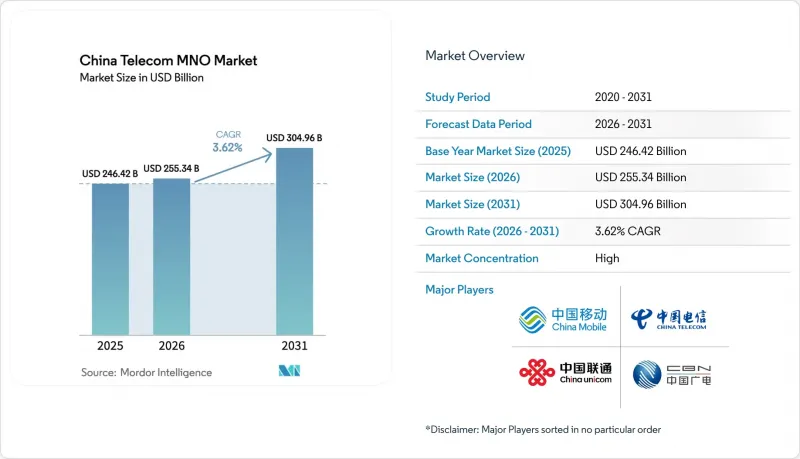
Mordor Intelligence에 의하면, 중국의 통신 MNO 시장 규모는 2025년 2,464억 2,000만 달러로 평가되었고, 2026년에는 2,553억 4,000만 달러로 추정되고, 2026-2031년 CAGR 3.62%로 성장을 지속할 전망이며, 2031년에는 3,049억 6,000만 달러에 이를 것으로 예측됩니다.
본 보고서는 서비스 유형별(음성 서비스, 데이터·인터넷 서비스, 메시징 서비스, IoT·M2M 서비스, OTT·유료 TV 서비스, 기타 서비스) 및 최종 사용자별(기업, 일반 소비자)로 분류되어 있습니다. 시장 예측은 금액(달러) 및 규모(가입자 수)로 제시되어 있습니다.
중국의 통신 사업자(MNO) 시장 동향 및 인사이트
전국적인 5G-Advanced 구축 및 설비 투자(CAPEX) 지원
중국의 3대 국영 통신 사업자는 산업정보화부(MIIT)의 우대 대출 및 6GHz 대역 주파수 할당을 바탕으로 세계 최대 규모의 5G-Advanced 네트워크 구축을 추진하고 있습니다. 차이나 모바일은 280만 개의 5G 셀을 계획하고 있으며, 차이나 유니콤은 2025년까지 300개 도시에서 전면적인 커버리지를 목표로 하고 있어, 이를 통해 산업 자동화에 필수적인 네트워크 슬라이싱 및 엣지 클라우드의 시너지 효과가 실현될 것입니다. 인프라 공유 협정으로 중복 투자가 줄어드는 한편, 국영 은행의 신용 한도 접근이 수년에 걸친 설비 투자 주기를 뒷받침하고 있습니다. 그 결과 기지국의 고밀도화가 실현되어 초저지연 서비스가 가능해졌으며, 중국의 이동통신사(MNO) 시장은 대규모 머신 유형 통신(MMC) 분야에서 세계적인 벤치마크로 자리매김하고 있습니다.
기업의 클라우드-네트워크 융합에 대한 수요 급증
제조업 및 전자정부 분야의 디지털 전환 추진에 따라 각 조직은 통합된 연결성과 클라우드 스택으로의 전환을 요구받고 있습니다. 통신 사업자들은 전국 규모의 광섬유 백본 및 IDC 자산을 활용하여 원스톱 SD-WAN, 프라이빗 5G, 그리고 차이나모바일의 ‘Dayin’ 컴퓨팅 플랫폼과 같은 하이브리드 클라우드 서비스를 제공합니다. 이러한 변화로 인해 평균 계약 금액이 상승하고, 관리형 보안을 통해 고객 충성도가 높아지면서 중국 통신 MNO 시장의 B2B 수익 구성이 가속화되고 있습니다. 수요는 Tier 1 하이테크 회랑에 집중되어 있지만, 정책적 우대 조치로 인해 스마트 팩토리 시범 사업이 추진되고 있는 지방 산업단지로도 파급되고 있습니다.
모바일 가입자 포화
주요 대도시권의 보급률이 115%를 초과함에 따라, 유기적인 SIM 가입자 수 증가 여지는 거의 남아 있지 않습니다. 성장은 현재 고객 유지, 멀티 디바이스용 데이터 요금제, 그리고 IoT 서비스 제공에 달려 있습니다. 가족용 데이터 요금제나 스마트 기기와의 번들 판매를 통해 해지율은 억제되고 있지만, ARPU(가입자 1인당 평균 수익)의 성장세는 여전히 완만하여 통신 사업자들은 계정당 평생 가치(LTV)를 더욱 높여야 할 필요에 직면해 있습니다. 이러한 포화 상태가 중국 통신 사업자(MNO) 시장의 소비자 부문 성장을 저해하고 있으며, 전략적 초점은 기업용 및 수직형 IoT 계약으로 이동하고 있습니다.
부문 분석
2025년, 데이터 및 인터넷 서비스는 중국 통신 MNO 시장에서 43.58%의 점유율을 차지했습니다. 이는 클라우드 게임, HD 스트리밍, 캐시리스 소매를 핵심으로 하는 중국의 ‘모바일 퍼스트’ 디지털 생태계를 반영한 것입니다. 대용량 5G-Advanced 셀과 통합된 광섬유 백본이 데이터 트래픽의 지속적인 성장을 뒷받침하고 있으며, 차별화된 속도 요금제와 무제한 번들 요금제가 ARPU의 점진적인 증가를 유지하고 있습니다. 제조 벨트 주변에서 엣지 컴퓨팅 노드의 부상은 프리미엄 연결 수요를 견인하고 있으며, 인더스트리 4.0을 도입하는 기업들에게 대역폭은 생산성 향상으로 이어지고 있습니다. 한편, OTT 채널이 개인 간 통신을 흡수함에 따라 음성 및 메시징 수익은 구조적인 감소를 이어가고 있습니다. 통신 사업자들은 기존 MPLS 회선을 활용한 Vo-over-NR 및 엔터프라이즈급 통합 커뮤니케이션 패키지를 통해 수익의 희석화를 완화하고 있습니다.
이와 동시에, IoT 및 M2M 서비스는 연평균 성장률(CAGR) 3.78%로 확대되고 있으며, 중국 통신 사업자(MNO) 시장 규모 내에서 압도적으로 큰 부가가치를 창출할 전망입니다. 2030년까지 스마트 계량기, AGV(무인 운반차) 차량, 커넥티드 농업 구역 등에 걸쳐 20억 대 이상의 라이선스를 취득한 셀룰러 IoT 엔드포인트가 온라인에 연결될 것으로 예측됩니다. 통신 사업자들은 플랫폼 경제, 기기 관리 포털, SIM 라이프사이클 자동화 및 통합 과금 시스템을 활용하여 고객 락인(lock-in)을 강화하고 있습니다. 연결 건당 수익은 일반 소비자용 회선보다 낮지만, 고객 관리에 드는 간접비가 최소화되어 있어 매출 총이익률은 향상되고 있습니다. 차량 텔레매틱스 및 전력 계량에 관한 정부 규제로 인해 IoT 트래픽의 성장은 더욱 제도화되어 장기적인 수익 전망이 견고해지고 있습니다.
기타 혜택 :
- 엑셀 형식 시장 예측(ME) 시트
- 3개월간의 애널리스트 지원
자주 묻는 질문
목차
제1장 서론
제2장 조사 방법
제3장 개요
제4장 시장 구도
제5장 시장 규모 및 성장 예측
제6장 경쟁 구도
제7장 시장 기회 및 향후 전망
AJY 26.09.01According to Mordor Intelligence, the China telecom MNO market size is expected to grow from USD 246.42 billion in 2025 to USD 255.34 billion in 2026 and is forecast to reach USD 304.96 billion by 2031 at 3.62% CAGR over 2026-2031.
This report is Segmented by Service Type (Voice Services, Data and Internet Services, Messaging Services, Iot and M2M Services, OTT and PayTV Services, and Other Services), and End User (Enterprises, Consumer). The Market Forecasts are Provided in Terms of Value (USD) and Volume (Subscribers).
China Telecom MNO Market Trends and Insights
National 5G-Advanced Rollout and CAPEX Support
China's three state-owned operators are in the middle of the world's largest 5G-Advanced build-out, backed by MIIT's preferential financing and 6 GHz spectrum allocations. China Mobile plans 2.8 million 5G cells, and China Unicom targets blanket coverage across 300 cities by 2025, enabling network slicing and edge-cloud synergies essential for industrial automation. Shared-infrastructure agreements reduce redundant spending, while access to state bank credit lines sustains the multi-year capex cycle. The resulting densification supports ultra-low-latency services, positioning the China Telecom MNO market as the global reference for massive machine-type communications.
Enterprise Cloud-Network Convergence Demand Surge
Digital-transformation mandates across manufacturing and e-government are pushing organizations toward integrated connectivity and cloud stacks. Operators are leveraging nationwide fiber backbones and IDC assets to deliver one-stop SD-WAN, private 5G, and hybrid-cloud offerings, such as China Mobile's Dayin computing platform . The shift lifts average contract values and deepens stickiness via managed security, accelerating the China Telecom MNO market's B2B revenue mix. Demand is clustered in Tier 1 tech corridors yet ripples into provincial industrial parks where policy incentives promote smart-factory pilots.
Mobile-Subscriber Saturation
Penetration exceeding 115% in the largest conurbations leaves little room for organic SIM additions. Growth now hinges on retention, multi-device data plans, and IoT provisioning. While family buckets and smart-device bundles slow churn, ARPU uplift remains modest, pressing operators to extract more lifetime value per account. The saturation ceiling weighs on the consumer slice of the China Telecom MNO market, shifting strategic weight toward enterprise and vertical-IoT contracts.
Other drivers and restraints analyzed in the detailed report include:
- Explosive Mobile-Data Traffic from Short-Video and XR
- Green-Network Incentives for AI-Optimized Energy Savings
- OTT Substitution of Legacy Voice and SMS
For complete list of drivers and restraints, kindly check the Table Of Contents.
Segment Analysis
Data and Internet Services held 43.58% China Telecom MNO market share in 2025, reflecting the nation's mobile-first digital ecosystem anchored by cloud gaming, HD streaming, and cash-light retail. High-capacity 5G-Advanced cells and converged fiber backbones underpin sustained data-traffic growth, while differentiated speed tiers and unlimited bundles sustain incremental ARPU. The rise of edge-computing nodes near manufacturing belts drives premium connectivity demand, converting bandwidth into productivity gains for Industry 4.0 adopters. Conversely, Voice and Messaging revenues continue their structural decline as OTT channels absorb person-to-person communications. Operators mitigate dilution through voice-over-NR and enterprise-grade unified-communications packages that piggyback on existing MPLS circuits.
In parallel, IoT and M2M Services are expanding at a 3.78% CAGR, set to capture outsized incremental value within the China Telecom MNO market size. Over 2 billion licensed cellular IoT endpoints are expected online by 2030, spanning smart-meter clusters, AGV fleets, and connected agriculture zones. Operators exploit platform economics, device management portals, SIM lifecycle automation, and integrated billing to deepen client lock-in. Revenue per connection is lower than consumer lines, yet gross margins improve owing to minimal customer-care overhead. Government mandates for vehicle telematics and electricity metering further institutionalize IoT traffic growth, reinforcing long-run revenue visibility.
Complete Report Scope:
- Overall Telecom Revenue and ARPU
- Service Type
- Voice Services
- Data and Internet Services
- Messaging Services
- IoT and M2M Services
- OTT and PayTV Services
- Other Services (VAS, Roaming and International Services, Enterprise and Wholesale Services, etc.)
- End-user
- Enterprises
- Consumer
List of Companies Covered in this Report:
- China Mobile Limited
- China Telecom Corporation Limited
- China United Network Communications Group Co., Ltd.
- China Broadnet (China Broadcast Network Co., Ltd.)
Additional Benefits:
- The market estimate (ME) sheet in Excel format
- 3 months of analyst support
TABLE OF CONTENTS
1 INTRODUCTION
- 1.1 Study Assumptions and Market Definition
- 1.2 Scope of the Study
2 RESEARCH METHODOLOGY
3 EXECUTIVE SUMMARY
4 MARKET LANDSCAPE
- 4.1 Market Overview
- 4.2 Regulatory and Policy Framework
- 4.3 Spectrum Landscape and Competitive Holdings
- 4.4 Telecom Industry Ecosystem
- 4.5 Macroeconomic and External Drivers
- 4.6 Porter's Five Forces Analysis
- 4.6.1 Competitive Rivalry
- 4.6.2 Threat of New Entrants
- 4.6.3 Bargaining Power of Suppliers
- 4.6.4 Bargaining Power of Buyers
- 4.6.5 Threat of Substitutes
- 4.7 Key MNO KPIs (2020-2025)
- 4.7.1 Unique Mobile Subscribers and Penetration Rate
- 4.7.2 Mobile Internet Users and Penetration Rate
- 4.7.3 SIM Connections by Access Technology and Penetration
- 4.7.4 Cellular IoT/M2M Connections
- 4.7.5 Broadband Connections (Mobile and Fixed)
- 4.7.6 ARPU (Average Revenue Per User)
- 4.7.7 Average Data Usage per Subscription (GB/month)
- 4.8 Market Drivers
- 4.8.1 National 5G-Advanced rollout and CAPEX support
- 4.8.2 Enterprise cloud-network convergence demand surge
- 4.8.3 Gigabit-fiber adoption lifting broadband ARPU
- 4.8.4 Explosive mobile-data traffic from short-video and XR
- 4.8.5 Monetisation of open-network APIs (GSMA Open Gateway)
- 4.8.6 Green-network incentives for AI-optimised energy savings
- 4.9 Market Restraints
- 4.9.1 Mobile-subscriber saturation
- 4.9.2 OTT substitution of legacy voice and SMS
- 4.9.3 Provincial price wars in digital-government tenders
- 4.9.4 Export-control risk for 5G core semiconductor supply
- 4.10 Technological Outlook
- 4.11 Analysis of key business models in Telecom Sector
- 4.12 Analysis of Pricing Models and Pricing
5 MARKET SIZE AND GROWTH FORECASTS (VALUE AND VOLUME)
- 5.1 Overall Telecom Revenue and ARPU
- 5.2 Service Type
- 5.2.1 Voice Services
- 5.2.2 Data and Internet Services
- 5.2.3 Messaging Services
- 5.2.4 IoT and M2M Services
- 5.2.5 OTT and PayTV Services
- 5.2.6 Other Services (VAS, Roaming and International Services, Enterprise and Wholesale Services, etc.)
- 5.3 End-user
- 5.3.1 Enterprises
- 5.3.2 Consumer
6 COMPETITIVE LANDSCAPE
- 6.1 Market Concentration
- 6.2 Strategic Moves and Investments by key vendors, 2023-2025
- 6.3 Market share analysis for MNOs, 2024
- 6.4 Product Benchmarking Analysis for mobile network services
- 6.5 MNO snapshot (subscribers, churn rate, ARPU, etc.)
- 6.6 Company Profiles* of MNOs (Includes Business Overview | Service Portfolio | Financials | Business Strategy and Recent Developments | SWOT Analysis)
- 6.6.1 China Mobile Limited
- 6.6.2 China Telecom Corporation Limited
- 6.6.3 China United Network Communications Group Co., Ltd.
- 6.6.4 China Broadnet (China Broadcast Network Co., Ltd.)
7 MARKET OPPORTUNITIES AND FUTURE OUTLOOK
- 7.1 White-space and Unmet-Need Assessment