
|
시장보고서
상품코드
2117246
유럽의 내륙 수로 화물 운송 시장 : 시장 점유율 분석, 업계 동향 및 통계, 성장 예측(2026-2031년)Europe Inland Water Freight Transport - Market Share Analysis, Industry Trends & Statistics, Growth Forecasts (2026 - 2031) |
||||||
 Mordor Intelligence
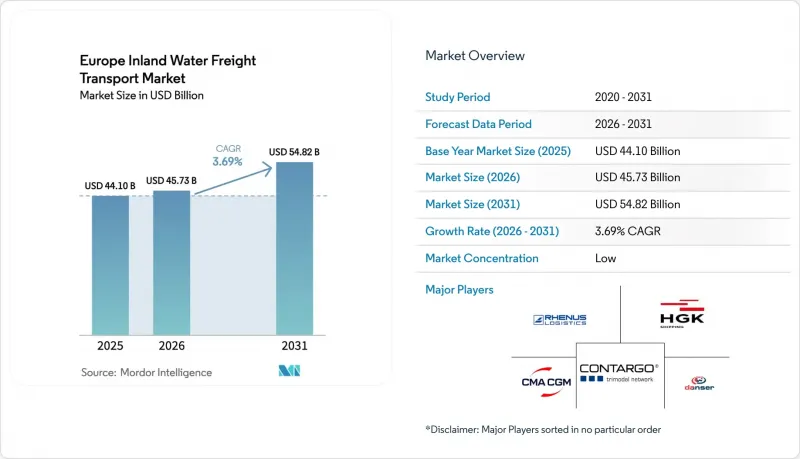
Mordor Intelligence에 의하면, 유럽의 내륙 수로 화물 운송 시장 규모는 2025년에 441억 달러로 평가되었고, 2026년 457억 3,000만 달러에서 2031년까지 548억 2,000만 달러에 이를 것으로 예측되며, 예측 기간(2026-2031년) CAGR은 3.69%를 나타낼 전망입니다.
본 보고서에서는 업계를 운송 형태별(액체 벌크 운송, 건식 벌크 운송, 컨테이너 화물 등), 최종 이용 산업별(농업·식품, 야금 및 광업, 석유·화학, 건설 등), 지역별(네덜란드, 독일, 벨기에, 프랑스 등)로 분류하고 있습니다. 시장 전망은 금액(달러) 기준으로 제시되어 있습니다.
유럽의 내륙 수로 화물 운송 시장 동향 및 인사이트
EU 그린 딜이 수로로 모달 시프트를 추진
유럽 그린딜은 2050년까지 운송 관련 온실가스 배출량을 90% 감축하는 것을 목표로 하고 있으며, 그 ‘지속 가능하고 스마트한 모빌리티 전략’에서는 내륙 수로를 통한 화물 운송량을 2030년까지 25%, 2050년까지 50% 증가시킬 것을 요구하고 있습니다. 해운 배출량에 대한 배출권 거래 제도(ETS) 요금이 인상됨에 따라 바지선과 트럭의 탄소 비용 격차가 확대되고 있으며, 각국의 화물 운송 전략에서 운송 수단 전환을 지지하는 논거가 강화되고 있습니다. 운항 사업자들로부터는 이미 라인강·네덜란드·델타 지역에서의 컨테이너 슬롯 수요에 대한 문의가 증가하고 있다는 보고가 나오고 있으며, 이는 2030년 목표 달성보다 훨씬 이른 시점에서 이러한 목표들이 일상적인 항로 결정에 영향을 미치고 있음을 시사합니다. 여기서 즉시 도출되는 결론은 비용 경쟁력만이 점차 수로를 유리하게 만들기 때문에 모달 시프트에 대한 보조금이 예상보다 빨리 단계적으로 축소될 가능성이 있다는 것입니다.
라인강·다뉴브강 회랑의 수송 능력 향상으로 바지선 수요 가속화
라인강·다뉴브강 회랑을 따라 발생하는 병목 현상 해소를 위한 유럽연합(EU)의 투자에는 슬로바키아, 헝가리, 루마니아의 깊은 수심 구간 정비, 교량 높이 증설, 수문 현대화 등이 포함됩니다. 이러한 공사가 완료되면, 하천 상황이 변동하는 가운데서도 기준 적재량이 증가하여, 과거 수익성을 저해했던 ‘공선 주행 거리’ 문제가 완화될 것입니다. Contargo 등 민간 사업자들은 선점 우위를 확보하기 위해 전용 바지선 함대의 확충이나 하이브리드 추진선 발주 등의 조치를 추진하고 있습니다. 이러한 동향에 따라 화주들이 새로 확보된 신뢰성 높은 운송 능력을 두고 경쟁을 벌이는 가운데, 다뉴브강 연안의 바지선 용선료가 상승세를 보일 것으로 예측됩니다.
라인강과 다뉴브강의 만성적인 저수위가 적재율을 저하시키고 있다.
기후 변화로 인한 저수위가 2024년에 수 주간 지속됨에 따라, 라인강을 항행하는 바지선은 수 주간 적재량을 줄여 운항할 수밖에 없었으며, 그 영향을 받은 달의 독일 산업 생산액은 약 1% 감소했습니다. 마찬가지로, 다뉴브강의 일부 구간에서는 수심이 1.5미터까지 낮아져 선단은 운항을 중단하거나 우회할 수밖에 없었습니다. 운항사는 얕은 흘수(draft)의 선체 설계와 동적 적재 배분 소프트웨어를 활용하여 대응하고 있지만, 여전히 불확실성이 남아 있어 서비스의 신뢰성을 저해하고 있습니다. 이러한 사실에 근거할 때, 위험 조정 후 운임 설정에서는 설령 자본 비용이 약간 높아지더라도, 흘수 깊이를 낮춰 운항을 지속할 수 있는 다동선(多胴船)이 유리할 것으로 추측됩니다.
부문 분석
2025년 시점에서 건화물은 유럽 내륙 수로 화물 운송 시장에서 53.62%라는 최대 점유율을 차지했으며, 석탄, 철강 원료, 건설용 골재 등의 상품을 트럭 220대 분량에 해당하는 대용량 라인강용 바지선으로 운송하고 있습니다. 이 부문은 하역 작업이 복잡하지 않다는 장점이 있어, 경기 침체기에도 안정적인 가동률을 유지할 수 있습니다. 주목할 점은 예상되는 석탄 단계적 폐지 정책에 따라 바지선의 톤킬로미터가 점차 바이오매스나 재활용 금속 운송으로 전환되며, 선창 세척 절차나 항만 터미널 설비가 변경될 것이라는 점입니다.
컨테이너 화물은 현재 규모가 작지만, 2026-2031년 연평균 성장률(CAGR) 6.98%를 나타낼 것으로 예측되어, 시장 전체의 확대 속도를 크게 상회할 전망입니다. Contargo와 같은 운항사는 이미 13,498 TEU의 바지선 운송 능력을 보유하고 있으며, 2024년에는 전기 추진 선박을 도입할 계획입니다. 액체 벌크 화물은 화학제품 전용 부두 덕분에 안정적인 취급량을 유지하고 있는 반면, 롤온/롤오프(RoRo) 선박은 도시 지역 내 배송 시험에서 주목을 받고 있습니다. 이로부터 도출되는 결론은 항만 계획 담당자들이 조수나 하천의 유속이 변동하는 조건에서도 컨테이너의 측면 적재가 가능한 바지선 탑재형 갠트리 크레인에 더 많은 부두 공간을 할당하게 될 것이라는 점입니다.
기타 혜택 :
- 엑셀 형식 시장 예측(ME) 시트
- 3개월간의 애널리스트 지원
자주 묻는 질문
목차
제1장 서론
제2장 조사 방법
제3장 개요
제4장 시장 구도
제5장 시장 규모 및 성장 예측
제6장 경쟁 구도
제7장 시장 기회 및 향후 전망
AJY 26.09.01According to Mordor Intelligence, the Europe inland water freight transport market size was valued at USD 44.10 billion in 2025 and estimated to grow from USD 45.73 billion in 2026 to reach USD 54.82 billion by 2031, at a CAGR of 3.69% during the forecast period (2026-2031).
This report Segments the Industry Into by Type of Transportation(Liquid Bulk Transportation, Dry Bulk Transportation, Containerized Freight and More), by End User Industry (Agriculture & Food, Metallurgy & Mining, Petroleum and Chemicals, Construction and More), by Geography (Netherlands, Germany, Belgium, France, and More). The Market Forecasts are Provided in Terms of Value (USD).
Europe Inland Water Freight Transport Market Trends and Insights
EU Green Deal Driving Modal Shift to Waterways
The European Green Deal aims for a 90 % reduction in transport-related greenhouse-gas emissions by 2050, and its Sustainable and Smart Mobility Strategy calls for inland waterway freight volumes to climb 25 % by 2030 and 50 % by 2050. As ETS fees scale up for shipping emissions, the gap between the carbon cost of barges and trucks widens, strengthening the modal-shift argument in national freight strategies. Operators are already reporting stronger demand inquiries for container slots on the Rhine-Dutch delta, implying that the targets are influencing day-to-day routing decisions well before the 2030 milestone. An immediate inference is that modal-shift subsidies may taper sooner than expected because cost competitiveness alone progressively favours waterways.
Rhine-Danube Corridor Capacity Upgrades Accelerating Barge Demand
European Union investments to eliminate bottlenecks along the Rhine-Danube corridor include deeper draught sections, taller bridges, and modernised locks in Slovakia, Hungary, and Romania. Completion of these works raises baseline payloads during variable river conditions, thereby reducing the "empty kilometres" problem that once stifled profitability. Private operators such as Contargo have responded by enlarging their dedicated barge fleets and ordering hybrid-propulsion vessels to secure early mover advantages. From these patterns one can infer that barge charter rates along the Danube will trend upward as shippers compete for newly reliable capacity.
Chronic Low-Water Events on Rhine & Danube Disrupting Load Factors
Climate-driven low-water spells forced barges on the Rhine to sail at partial loads for several consecutive weeks in 2024, cutting German industrial output by roughly 1 % during the affected month. Similarly, parts of the Danube fell to 1.5 m depth, compelling convoys to idle or re-route. Operators mitigate with shallow-draught hull designs and dynamic cargo-allocation software, but residual uncertainty dents service reliability. From this evidence one can infer that risk-adjusted freight pricing will favour multi-hull vessels capable of continuing service at reduced draughts, even if capital costs are marginally higher.
Other drivers and restraints analyzed in the detailed report include:
- Tightening CO2 / Pollutant Norms Favouring Low-Emission Barges
- Digitisation via RIS & DINA Improving Supply-Chain Visibility
- Ageing Barge Fleet Facing Capex-Intensive Retrofit Mandates
For complete list of drivers and restraints, kindly check the Table Of Contents.
Segment Analysis
Dry bulk commands the largest Europe Inland Water Freight Transport market share at 53.62 % in 2025, carrying commodities such as coal, steel inputs, and construction aggregates on high-capacity Rhine barges equivalent to 220 trucks. The segment benefits from low handling complexity, enabling steady utilisation even during economic lulls. A notable inference is that anticipated coal-phase-out policies will gradually shift barge tonne-kilometres toward biomass and recycled-metal flows, altering hold-cleaning protocols and port terminal equipment.
Containerised freight, while currently smaller, is forecast to grow at a 6.98 % CAGR from 2026-2031, significantly outpacing overall market expansion. Operators such as Contargo already field 13,498 TEU of barge capacity and plan to deploy electric-propulsion units in 2024. Liquid bulk retains stable volumes thanks to dedicated chemical park jetties, whereas roll-on/roll-off craft gain traction in city-distribution trials. An arising inference is that port planners will allocate more quay space to barge-mounted gantries capable of side-loading containers in tidal or variable river conditions.
Complete Report Scope:
- By Type of Transportation
- Liquid Bulk Transportation
- Dry Bulk Transportation
- Containerised Freight
- Dry
- Reefer
- Roll-On / Roll-Off Cargo
- By End-Use Industry
- Agriculture & Food
- Metallurgy & Mining
- Petroleum & Chemicals
- Construction
- Energy (Biomass & Coal)
- Consumer Goods & Retail
- Others
- By Geography
- Netherlands
- Germany
- Belgium
- France
- Romania
- Bulgaria
- Rest of Europe
List of Companies Covered in this Report:
- Rhenus Group
- HGK Shipping GmbH
- Contargo GmbH & Co. KG
- Danser Group
- CMA CGM Inland Services
- Imperial Logistics International
- Sogestran Group / CFT
- Van den Bosch Transporten BV
- Stolt-Nielsen Inland Tanker Service
- Deutsche Binnenreederei AG
- Blue Line Logistics
- VTG AG (Tanktainer / Barges)
- DP World Inland Europe
- Swire Bulk Europe
- PortLiner
- AWT Group
- Cobelfret Barge NV
- De Poli Tankers Inland
- Planco Shipping BV
- Danubia Krems GmbH*
Additional Benefits:
- The market estimate (ME) sheet in Excel format
- 3 months of analyst support
TABLE OF CONTENTS
1 Introduction
- 1.1 Study Assumptions & Market Definition
- 1.2 Scope of the Study
2 Research Methodology
3 Executive Summary
4 Market Landscape
- 4.1 Market Overview
- 4.2 Market Drivers
- 4.2.1 EU Green Deal Driving Modal Shift to Waterways
- 4.2.2 Rhine-Danube Corridor Capacity Upgrades Accelerating Barge Demand
- 4.2.3 Tightening CO2 / Pollutant Norms Favouring Low-Emission Barges
- 4.2.4 Digitisation via RIS & DINA Improving Supply-Chain Visibility
- 4.2.5 Rise of Urban Logistics Pilots in Paris, Amsterdam & Antwerp
- 4.2.6 Fuel-Cost Differential vs. Road Transport Widening After ETS-II
- 4.3 Market Restraints
- 4.3.1 Chronic Low-Water Events on Rhine & Danube Disrupting Load Factors
- 4.3.2 Ageing Barge Fleet Facing Capex-Intensive Retrofit Mandates
- 4.3.3 Port & Lock Bottlenecks Limiting Vessel Size on Secondary Canals
- 4.3.4 Competitive Pressure from Electrified Rail Freight in Central Europe
- 4.4 Value / Supply-Chain Analysis
- 4.5 Regulatory Outlook
- 4.6 Technological Outlook
- 4.7 Porter's Five Forces
- 4.7.1 Bargaining Power of Suppliers
- 4.7.2 Bargaining Power of Buyers
- 4.7.3 Threat of New Entrants
- 4.7.4 Threat of Substitutes
- 4.7.5 Competitive Rivalry
- 4.8 Insights into Transshipment Trade
- 4.9 Insights into Containerised vs. Non-Containerised Shipments
- 4.10 Freight Rates & Maritime Transport Costs
- 4.11 Insights into Intermodal / Container Utilisation
- 4.12 Demand-Supply Analysis
- 4.13 Impact of Geo-Political events on the Market
5 Market Size & Growth Forecasts (Value, USD)
- 5.1 By Type of Transportation
- 5.1.1 Liquid Bulk Transportation
- 5.1.2 Dry Bulk Transportation
- 5.1.3 Containerised Freight
- 5.1.3.1 Dry
- 5.1.3.2 Reefer
- 5.1.4 Roll-On / Roll-Off Cargo
- 5.2 By End-Use Industry
- 5.2.1 Agriculture & Food
- 5.2.2 Metallurgy & Mining
- 5.2.3 Petroleum & Chemicals
- 5.2.4 Construction
- 5.2.5 Energy (Biomass & Coal)
- 5.2.6 Consumer Goods & Retail
- 5.2.7 Others
- 5.3 By Geography
- 5.3.1 Netherlands
- 5.3.2 Germany
- 5.3.3 Belgium
- 5.3.4 France
- 5.3.5 Romania
- 5.3.6 Bulgaria
- 5.3.7 Rest of Europe
6 Competitive Landscape
- 6.1 Market Concentration
- 6.2 Strategic Moves
- 6.3 Market Share Analysis
- 6.4 Company Profiles (includes Global level Overview, Market level overview, Core Segments, Financials as available, Strategic Information, Market Rank/Share for key companies, Products & Services, and Recent Developments)
- 6.4.1 Rhenus Group
- 6.4.2 HGK Shipping GmbH
- 6.4.3 Contargo GmbH & Co. KG
- 6.4.4 Danser Group
- 6.4.5 CMA CGM Inland Services
- 6.4.6 Imperial Logistics International
- 6.4.7 Sogestran Group / CFT
- 6.4.8 Van den Bosch Transporten BV
- 6.4.9 Stolt-Nielsen Inland Tanker Service
- 6.4.10 Deutsche Binnenreederei AG
- 6.4.11 Blue Line Logistics
- 6.4.12 VTG AG (Tanktainer / Barges)
- 6.4.13 DP World Inland Europe
- 6.4.14 Swire Bulk Europe
- 6.4.15 PortLiner
- 6.4.16 AWT Group
- 6.4.17 Cobelfret Barge NV
- 6.4.18 De Poli Tankers Inland
- 6.4.19 Planco Shipping BV
- 6.4.20 Danubia Krems GmbH*