|
시장보고서
상품코드
2117281
데이터 보안 시장 : 시장 점유율 분석, 업계 동향 및 통계, 성장 예측(2026-2031년)Data Security - Market Share Analysis, Industry Trends & Statistics, Growth Forecasts (2026 - 2031) |
||||||
 Mordor Intelligence
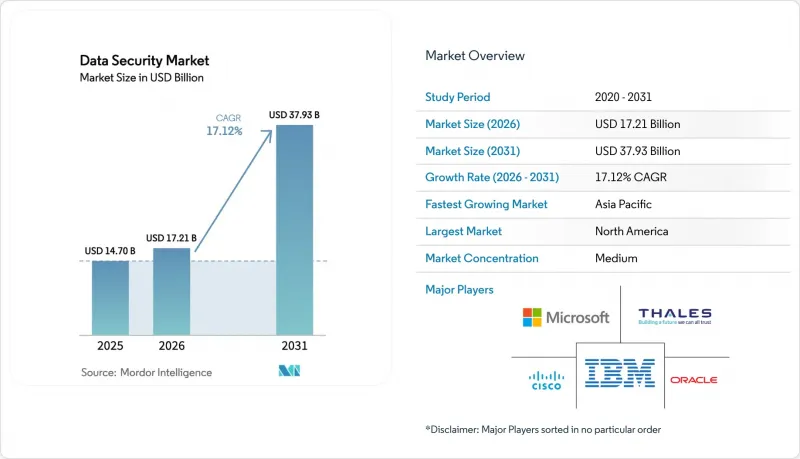
Mordor Intelligence에 의하면, 데이터 보안 시장 규모는 2025년에 147억 달러로 평가되었고, 2026년 172억 1,000만 달러에서 2031년까지 379억 3,000만 달러에 이를 것으로 예측되며, 예측 기간(2026-2031년) CAGR은 17.12%를 나타낼 전망입니다.
본 보고서는 구성 요소별(솔루션, 서비스), 배포 형태별(온프레미스, 클라우드), 조직 규모별(중소기업(SME), 대기업), 용도별(엔드포인트·이동식 미디어 보호, 기타), 최종 사용자 산업별(은행 및 금융 서비스·보험(BFSI), 기타), 지역별로 분류되어 있습니다. 시장 예측은 금액(달러) 기준으로 제시되어 있습니다.
세계의 데이터 보안 시장 동향 및 인사이트
멀티클라우드 도입 가속화가 클라우드 네이티브 데이터 중심 보안 도구에 대한 수요를 견인
현재 데이터 침해 사고의 82%가 클라우드에 호스팅된 데이터와 관련되어 있으며, 사고 1건당 평균 비용은 488만 달러에 달할 전망입니다. 기존의 경계 방어 방식으로는 AWS, Azure, Google Cloud 전반에 걸친 가시성이 부족하기 때문에 기업들은 하이브리드 환경 전체에 통일된 정책을 적용하는 플랫폼으로 제어 기능을 통합하고 있습니다. 마이크로소프트의 2024년 멀티On-Cloud험 조사에서는 공유 책임 모델로 인해 발생하는 거버넌스 사각지대가 부각되면서, 통합된 제로 트러스트 아키텍처로의 전환이 더욱 가속화되고 있습니다. 조직들이 기존 포인트 제품을 확장하는 것만으로는 클라우드 네이티브 워크로드를 보호할 수 없습니다는 사실을 인식함에 따라, 지속적인 보안 상태 관리, 암호화 키 오케스트레이션, ID 중심의 세분화을 제공하는 벤더들이 우선적으로 선택되고 있습니다. 그 결과, 분산형 및 API 기반 환경에 최적화된 솔루션에 대한 예산 배분이 결정적인 전환을 맞이하고 있습니다.
개인정보 보호 규제의 강화로 데이터 탐색 및 분류 솔루션이 필수화
현재 80%의 국가가 종합적인 데이터 보호법을 시행하고 있으며, 2025년에는 미국 8개 주에서 새로운 개인정보 보호법이 시행되었습니다. 유럽의 NIS2 지침만 보더라도 보안 의무 적용 대상이 약 30만 개 사업체로 확대되었으며, 위반 시 최대 1,000만 유로의 벌금이 부과되게 되었습니다. 이러한 광범위한 규제로 인해 기업들은 사후 대응형 ‘체크리스트 방식’의 규정 준수를 넘어, 자동화된 감지, 분류, 마스킹을 기반으로 한 실시간 거버넌스로 전환할 수밖에 없게 되었습니다. 심각한 인력 부족이 이 과제를 더욱 악화시키고 있습니다. 기업의 73%가 경험이 풍부한 개인정보 보호 엔지니어 채용에 어려움을 겪고 있으며, 이로 인해 수고가 덜 드는 머신러닝 분류기 및 정책 엔진에 대한 수요가 급증하고 있습니다. 구조화 및 비구조화 리포지토리 전반에 걸쳐 고정밀 스캔을 구현하고 속성의 출처를 매핑할 수 있는 벤더는 개인정보 보호 중심의 지출 급증을 포착할 수 있는 유리한 위치에 있습니다.
프라이버시 엔지니어링 및 동형 암호화 분야의 기술 격차가 도입을 저해
사이버 보안 인력 부족은 여전히 400만 명에 육박하며, 양자 내성 및 차등 프라이버시 전문가에 대한 수요는 공급을 크게 웃돌고 있습니다. 조직들은 3년 동안 120만-270만 달러를 프라이버시 프로그램에 투자하고 있지만, 인력 부족으로 인해 고도 암호화 프로젝트를 여전히 미룰 수밖에 없는 상황입니다. 경제적 역풍으로 채용이 정체되면서 역량 격차가 확대되고 있습니다. 인력 부족으로 인해 기업들은 매니지드 서비스에 의존할 수밖에 없게 되었고, 사내 역량 구축이 지연되면서 최첨단 보호 대책의 도입 주기가 길어지고 있습니다.
부문 분석
솔루션은 데이터 보안 시장의 방어 핵심을 이루는 암호화, 데이터 유출 방지, 데이터베이스 보호 제품군을 중심으로 2025년 매출의 56.25%를 계속 차지했습니다. 그럼에도 불구하고, 이사회가 심각한 인력 부족에 직면하여 성과 기반 계약 모델로 전환하는 가운데, 매니지드 서비스와 전문 서비스는 연평균 성장률(CAGR) 18.23%로 성장하고 있습니다. NIS2 등의 규제 도입으로 인해 준비 상태 평가 및 연중무휴 24시간 보안 운영 체제에 대한 수요가 높아지고 있으며, 서비스 제공업체는 전략적 파트너로서의 입지를 확고히 하고 있습니다. 클라우드 중심 플랫폼, 실시간 결제를 위한 토큰화, 양자 내성 암호화 번들 등이 매니지드 서비스의 범위를 확대하고 있으며, 이로 인해 순수 소프트웨어 제품의 점유율은 더욱 하락하고 있습니다.
제품에서 서비스로의 전환은 확장성이 높고 운영 비용(OpEx)을 고려한 이용 형태를 선호하는 구매자의 경향도 반영하고 있습니다. 각 벤더사는 사고 대응 정액제 계약, 규정 준수 자동화, 지속적인 보안 태세 관리를 구독 모델에 통합하고 있습니다. 고성장 하위 부문으로는 매니지드 감지를 통해 침해 체류 시간을 43% 단축하는 ‘데이터 보안 태세 관리(DSPM)’나, 암호화 기술의 현대화를 지도하는 자문 서비스 등이 있습니다. 그 결과, 데이터 보안 시장에서는 도구, 전문 지식, 프로그램 거버넌스를 통합한 SLA로 수렴되는 다층적인 서비스 제공이 나타나고 있습니다.
2025년에도 온프레미스 모델은 매출의 66.62%를 차지했으며, 이는 엄격한 데이터 주권 규제와 이전이 어려운 미션 크리티컬 워크로드의 존재를 반영한 것입니다. 그러나 클라우드 점유율은 연평균 성장률(CAGR) 18.62%로 확대되고 있으며, 이는 SaaS, PaaS, 컨테이너 파이프라인에서 신뢰 경계를 넘어선 통합적인 보호 계층이 요구되는 하이브리드 환경의 현실을 여실히 보여주고 있습니다. 사용 중인 데이터에 대한 암호화 요구 사항을 충족하는 기밀 컴퓨팅 보호 조치에 힘입어, 클라우드 배포 분야의 데이터 보안 시장 규모는 현저하게 확대될 전망입니다.
기업들은 아키텍처 분리를 채택하고 있습니다. 기밀성이 높은 분석 처리는 프라이빗 클라우드나 물리적 데이터센터에서 실행되는 반면, 고객용 마이크로서비스에서는 확장 가능한 퍼블릭 클라우드의 제어 기능을 활용하고 있습니다. 통합된 키 관리 및 정책 오케스트레이션 도구가 환경 간 가교 역할을 수행하여 운영상의 사일로를 완화합니다. NIS2와 같은 규제 프레임워크는 실시간 모니터링을 입증할 수 있는 사업자에게 유연성을 허용하고 있으며, 이는 클라우드 네이티브 분석 대시보드를 뒷받침하고 있습니다. 그 결과, 벤더의 로드맵에서는 데이터가 어디에 존재하든 추적 가능한 벤더 독립적인 제어 플레인 및 호스트 기반 인증이 점점 더 중요시되고 있습니다.
지역별 분석
북미는 고급 분석 기술의 조기 도입, 견조한 벤처 자금 조달, 연방 및 주 규제를 아우르는 치밀한 규제 체계에 힘입어 2025년 매출의 40.74%를 차지했습니다. 포춘 500대 기업에서의 제로 트러스트의 광범위한 도입과 적극적인 클라우드 전환 로드맵으로 인해 시장의 깊이가 더욱 강화되고 있습니다. 하이퍼스케일러들의 포스트 양자암호화 및 기밀 컴퓨팅에 대한 전략적 투자는 해당 지역의 기술적 리더십을 공고히 하는 한편, 틈새 보안 벤더들로 구성된 지역 생태계의 활성화를 촉진하고 있습니다.
아시아태평양은 2031년 연평균 성장률(CAGR)이 17.88%로 가장 빠른 성장이 전망되는 지역입니다. 중국, 인도, 아세안(ASEAN)의 디지털 전환(DX) 프로그램은 방대한 데이터 생성을 촉진하고 있지만, 엄격한 데이터 상주 요건으로 인해 현지화된 암호화 및 키 관리 솔루션이 요구되고 있습니다. 중국의 ‘개인정보 보호법’이나 베트남의 사이버 보안에 관한 정령 등 국내 규제는 온쇼어형 데이터 보호 시설 및 소버린 클라우드 아키텍처에 대한 수요를 뒷받침하고 있습니다. 지역의 은행 및 대형 전자상거래 기업들은 국경을 넘는 결제 흐름을 보호하기 위해 토큰화 및 DSPM 도입을 추진하고 있습니다.
유럽에서는 GDPR(EU 개인정보보호규정)에 더해, 최근 적용 범위가 확대되어 유틸리티, 의료기기 제조업체, 중규모 서비스 제공업체도 대상이 된 NIS2 지침에 힘입어 꾸준한 성장이 나타나고 있습니다. 기업들은 해당 지침의 24시간 내 보고 의무를 이행하기 위해 사고 대응 매뉴얼을 강화하고, 암호화 키 에스크로에 투자하며, AI를 활용한 정보 유출 알림 도구 도입을 추진하고 있습니다. 한편, 중동 및 아프리카 시장에서는 사우디아라비아의 ‘개인 데이터 보호법’에 따라 최대 2,500만 사우디아라비아 리얄의 벌금이 부과됨에 따라, 통신 사업자 및 에너지 사업자가 관리 체제 강화에 나서면서 시장의 성장세가 가속화되고 있습니다. 남미에서는 브라질의 LGPD(일반 데이터 보호법) 개정 및 아르헨티나의 제재 수준 재검토에 따라 모니터링 체제가 강화되고 있으며, 이에 따라 데이터 감지 엔진 및 개인정보 보호 대시보드에 대한 예산이 점차 증가하고 있습니다. 이러한 지역별 특징이 결합되어 데이터 보안 시장의 전 세계적인 확대를 두드러지게 하고 있습니다.
기타 혜택
- 엑셀 형식 시장 예측(ME) 시트
- 3개월간의 애널리스트 지원
자주 묻는 질문
목차
제1장 서론
제2장 조사 방법
제3장 개요
제4장 시장 구도
제5장 시장 규모 및 성장 예측
제6장 경쟁 구도
제7장 시장 기회 및 향후 전망
AJY 26.09.01According to Mordor Intelligence, the data security market size was valued at USD 14.70 billion in 2025 and estimated to grow from USD 17.21 billion in 2026 to reach USD 37.93 billion by 2031, at a CAGR of 17.12% during the forecast period (2026-2031).
This report is Segmented by Component (Solutions and Services), Deployment Mode (On-Premises and Cloud), Organization Size (Small and Medium Enterprises (SMEs) and Large Enterprises), Application (Endpoint and Removable-Media Protection, and More), End-User Industry (Banking, Financial Services and Insurance (BFSI), and More), and Geography. The Market Forecasts are Provided in Terms of Value (USD).
Global Data Security Market Trends and Insights
Acceleration of Multi-Cloud Adoption Drives Demand for Cloud-Native Data-Centric Security Tools
Eighty-two percent of breaches now involve cloud-hosted data, with average incident cost standing at USD 4.88 million. Traditional perimeter defenses lack visibility across AWS, Azure, and Google Cloud, prompting enterprises to consolidate controls into platforms that apply uniform policies across hybrid estates. Microsoft's 2024 multicloud risk study highlights governance blind spots created by the shared-responsibility model, intensifying the push toward integrated, zero-trust architectures. Vendors providing continuous posture management, encryption key orchestration, and identity-centric segmentation are gaining preference as organizations recognize that scaling legacy point products will not secure cloud-native workloads. The result is a decisive shift in budget allocation toward solutions optimized for distributed, API-driven environments.
Stricter Privacy Regimes Mandate Data Discovery and Classification Solutions
Eighty percent of countries now enforce comprehensive data-protection statutes, and eight new U.S. state privacy laws took effect in 2025. Europe's NIS2 Directive alone extends security obligations to about 300,000 entities, adding penalties up to EUR 10 million for non-compliance. Such breadth compels enterprises to move from reactive check-box compliance to real-time governance anchored in automated discovery, classification, and masking. Acute talent shortages aggravate the challenge; 73% of firms struggle to hire seasoned privacy engineers, so demand for low-touch machine-learning classifiers and policy engines is soaring. Vendors delivering high-fidelity scanning across structured and unstructured repositories while mapping attribute provenance are positioned to capture the surge in privacy-driven spend.
Skills Gap in Privacy Engineering and Homomorphic Encryption Hampers Deployments
The cybersecurity workforce deficit remains near 4 million roles, with demand for quantum-safe and differential-privacy specialists far outstripping supply. Organizations channel between USD 1.2 million and USD 2.7 million on privacy programs over three years yet still postpone advanced encryption projects due to staffing constraints. Economic headwinds have triggered hiring pauses that widen the capability gap. The scarcity presses enterprises to rely on managed services, delaying internal capacity building and lengthening deployment cycles for cutting-edge protections.
Other drivers and restraints analyzed in the detailed report include:
- Hardware-Based Confidential Computing Matures Beyond Pilots
- AI-Assisted Data Lineage Reduces Breach Dwell Time and Cuts Compliance Audit Costs
- High TCO of Enterprise-Wide Data Discovery for Unstructured "Dark Data"
For complete list of drivers and restraints, kindly check the Table Of Contents.
Segment Analysis
Solutions continued to contribute 56.25% of 2025 revenue, anchored by encryption, data-loss prevention, and database-protection suites that form the defensive core of the data security market. Nevertheless, managed and professional offerings are growing at an 18.23% CAGR as boards confront an acute talent shortage and shift toward outcome-based contracting models. Regulatory rollouts such as NIS2 are amplifying demand for readiness assessments and 24 X 7 security-operations coverage, positioning service providers as strategic partners. Cloud-centric platforms, tokenization for real-time payments, and quantum-ready encryption bundles are broadening the scope of managed portfolios, further diluting pure-software share.
The pivot from product to service also reflects buyer preference for scalable, OpEx-friendly consumption. Vendors embed incident-response retainers, compliance automation, and continuous posture management within subscription constructs. High-growth sub-segments include Data Security Posture Management, where managed detection cuts dwell time by 43%, and Advisory services guiding cryptographic modernization. As a result, the data security market is witnessing layered offerings that converge tooling, expertise, and program governance into unified SLAs.
On-premises models retained 66.62% revenue in 2025, reflecting strict data-sovereignty regimes and mission-critical workloads that resist relocation. Yet the cloud share is expanding at 18.62% CAGR, underscoring hybrid realities where SaaS, PaaS, and container pipelines demand integrated protection layers across trust boundaries. The data security market size for cloud deployments is set to widen markedly, helped by confidential-computing safeguards that satisfy encryption-in-use mandates.
Enterprises adopt architecture splits: sensitive analytics run in private clouds or physical data centers, whereas customer-facing microservices leverage scalable public-cloud controls. Unified key-management and policy-orchestration tools bridge environments, reducing operational silos. Regulatory frameworks such as NIS2 award flexibility to entities that can prove real-time monitoring, which favors cloud-native analytics dashboards. Consequently, vendor roadmaps increasingly highlight agnostic control planes and host-based attestation that follow data wherever it resides.
Complete Report Scope:
- By Component
- Solutions
- Data Encryption and Tokenisation
- Data Loss Prevention (DLP)
- Data Masking and Obfuscation
- Database Security
- Cloud Data Protection Platforms
- Services
- Professional Services
- Managed Security Services
- Solutions
- By Deployment Mode
- On-premises
- Cloud
- By Organization Size
- Small and Medium Enterprises (SMEs)
- Large Enterprises
- By Application
- Database Security
- Endpoint and Removable-media Protection
- Big-Data / Analytics Workloads
- DevOps and Container Security
- SaaS and Collaboration Suites
- By End-user Industry
- Banking, Financial Services and Insurance (BFSI)
- Healthcare and Life Sciences
- Retail and E-commerce
- Manufacturing and Industrial
- Government and Defense
- IT and Telecommunications
- Energy and Utilities
- Other End-User Industries
- By Geography
- North America
- United States
- Canada
- Mexico
- Europe
- Germany
- United Kingdom
- France
- Italy
- Spain
- Russia
- Rest of Europe
- Asia-Pacific
- China
- Japan
- India
- South Korea
- Australia and New Zealand
- Rest of Asia-Pacific
- South America
- Brazil
- Argentina
- Rest of South America
- Middle East and Africa
- Middle East
- Saudi Arabia
- United Arab Emirates
- Turkey
- Rest of Middle East
- Africa
- South Africa
- Nigeria
- Rest of Africa
- Middle East
- North America
Geography Analysis
North America retained 40.74% of 2025 revenue, buoyed by early adoption of advanced analytics, strong venture funding, and a dense regulatory tapestry spanning federal and state mandates. Market depth is reinforced by widespread zero-trust rollouts and aggressive cloud-migration roadmaps across Fortune 500 organizations. Strategic investments by hyperscalers in post-quantum encryption and confidential computing are cementing the region's technology leadership while catalyzing local ecosystems of niche security vendors.
Asia-Pacific is the fastest-growing geography at 17.88% CAGR through 2031. Digital transformation programs in China, India, and ASEAN stimulate enormous data creation, but strict residency provisions compel localized encryption and key-management solutions. National regulations, including China's Personal Information Protection Law and Vietnam's cybersecurity decrees, are spurring demand for on-shore data-protection facilities and sovereign-cloud architectures. Regional banks and e-commerce giants are driving tokenization and DSPM adoption to safeguard cross-border payment flows.
Europe records steady expansion, underpinned by the GDPR and, more recently, the NIS2 Directive, whose broadened scope captures utilities, medical device makers, and medium-sized service providers.Firms are bolstering incident-response playbooks, investing in encryption key escrow, and adopting AI-enabled breach-notification tools to meet the directive's 24-hour reporting rule. Meanwhile, Middle East and Africa markets gain momentum as Saudi Arabia's Personal Data Protection Law imposes fines up to SAR 25 million, prompting telcos and energy operators to uplift controls. South America is tightening oversight, with Brazil's LGPD updates and Argentina's revised sanction tiers generating incremental budget for discovery engines and privacy dashboards. These regional nuances together accentuate the global breadth of the data security market.
- IBM Corporation
- Microsoft Corporation
- Cisco Systems Inc.
- Thales Group
- Broadcom (Symantec Enterprise)
- Check Point Software Technologies Ltd.
- Oracle Corporation
- Palo Alto Networks
- Trend Micro Inc.
- McAfee LLC
- Varonis Systems Inc.
- Imperva Inc.
- Forcepoint LLC
- Digital Guardian
- Okta Inc.
- Proofpoint Inc.
- Sophos Ltd.
- Commvault Systems
- Cohesity Inc.
- Rubrik Inc.
Additional Benefits:
- The market estimate (ME) sheet in Excel format
- 3 months of analyst support
TABLE OF CONTENTS
1 INTRODUCTION
- 1.1 Study Assumptions and Market Definition
- 1.2 Scope of the Study
2 RESEARCH METHODOLOGY
3 EXECUTIVE SUMMARY
4 MARKET LANDSCAPE
- 4.1 Market Overview
- 4.2 Market Drivers
- 4.2.1 Acceleration of Multi-Cloud Adoption Drives Demand for Cloud-Native Data-Centric Security Tools
- 4.2.2 Stricter Privacy Regimes Mandate Data Discovery and Classification Solutions
- 4.2.3 Hardware-Based Confidential Computing Matures Beyond Pilots
- 4.2.4 AI-Assisted Data Lineage Reduces Breach Dwell Time and Cuts Compliance Audit Costs
- 4.2.5 Tokenisation Gains Traction in Open-Banking Apis and Real-Time Payments Rails
- 4.2.6 Quantum-Safe Cryptography Pilots in Government and Telecom Sectors Create New Upgrade Cycle
- 4.3 Market Restraints
- 4.3.1 High TCO of Enterprise-Wide Data Discovery for Unstructured "Dark Data"
- 4.3.2 Skills Gap in Privacy Engineering and Homomorphic Encryption Hampers Deployments
- 4.3.3 Legacy Mainframe and OT Systems Incompatible with Modern Zero-Trust Architectures
- 4.3.4 Fragmented Regional Data Residency Laws Inflate Compliance Overhead
- 4.4 Industry Value Chain Analysis
- 4.5 Regulatory Landscape
- 4.6 Technological Outlook
- 4.7 Porter's Five Forces Analysis
- 4.7.1 Bargaining Power of Suppliers
- 4.7.2 Bargaining Power of Buyers
- 4.7.3 Threat of New Entrants
- 4.7.4 Threat of Substitutes
- 4.7.5 Intensity of Competitive Rivalry
- 4.8 Assessment of the Impact of Macroeconomic Trends on the Market
5 MARKET SIZE AND GROWTH FORECASTS (VALUE)
- 5.1 By Component
- 5.1.1 Solutions
- 5.1.1.1 Data Encryption and Tokenisation
- 5.1.1.2 Data Loss Prevention (DLP)
- 5.1.1.3 Data Masking and Obfuscation
- 5.1.1.4 Database Security
- 5.1.1.5 Cloud Data Protection Platforms
- 5.1.2 Services
- 5.1.2.1 Professional Services
- 5.1.2.2 Managed Security Services
- 5.1.1 Solutions
- 5.2 By Deployment Mode
- 5.2.1 On-premises
- 5.2.2 Cloud
- 5.3 By Organization Size
- 5.3.1 Small and Medium Enterprises (SMEs)
- 5.3.2 Large Enterprises
- 5.4 By Application
- 5.4.1 Database Security
- 5.4.2 Endpoint and Removable-media Protection
- 5.4.3 Big-Data / Analytics Workloads
- 5.4.4 DevOps and Container Security
- 5.4.5 SaaS and Collaboration Suites
- 5.5 By End-user Industry
- 5.5.1 Banking, Financial Services and Insurance (BFSI)
- 5.5.2 Healthcare and Life Sciences
- 5.5.3 Retail and E-commerce
- 5.5.4 Manufacturing and Industrial
- 5.5.5 Government and Defense
- 5.5.6 IT and Telecommunications
- 5.5.7 Energy and Utilities
- 5.5.8 Other End-User Industries
- 5.6 By Geography
- 5.6.1 North America
- 5.6.1.1 United States
- 5.6.1.2 Canada
- 5.6.1.3 Mexico
- 5.6.2 Europe
- 5.6.2.1 Germany
- 5.6.2.2 United Kingdom
- 5.6.2.3 France
- 5.6.2.4 Italy
- 5.6.2.5 Spain
- 5.6.2.6 Russia
- 5.6.2.7 Rest of Europe
- 5.6.3 Asia-Pacific
- 5.6.3.1 China
- 5.6.3.2 Japan
- 5.6.3.3 India
- 5.6.3.4 South Korea
- 5.6.3.5 Australia and New Zealand
- 5.6.3.6 Rest of Asia-Pacific
- 5.6.4 South America
- 5.6.4.1 Brazil
- 5.6.4.2 Argentina
- 5.6.4.3 Rest of South America
- 5.6.5 Middle East and Africa
- 5.6.5.1 Middle East
- 5.6.5.1.1 Saudi Arabia
- 5.6.5.1.2 United Arab Emirates
- 5.6.5.1.3 Turkey
- 5.6.5.1.4 Rest of Middle East
- 5.6.5.2 Africa
- 5.6.5.2.1 South Africa
- 5.6.5.2.2 Nigeria
- 5.6.5.2.3 Rest of Africa
- 5.6.5.1 Middle East
- 5.6.1 North America
6 COMPETITIVE LANDSCAPE
- 6.1 Market Concentration
- 6.2 Strategic Moves (MandA, Funding, Alliances)
- 6.3 Market Share Analysis
- 6.4 Company Profiles (includes Global level Overview, Market level overview, Core Segments, Financials as available, Strategic Information, Market Rank/Share for key companies, Products and Services, and Recent Developments)
- 6.4.1 IBM Corporation
- 6.4.2 Microsoft Corporation
- 6.4.3 Cisco Systems Inc.
- 6.4.4 Thales Group
- 6.4.5 Broadcom (Symantec Enterprise)
- 6.4.6 Check Point Software Technologies Ltd.
- 6.4.7 Oracle Corporation
- 6.4.8 Palo Alto Networks
- 6.4.9 Trend Micro Inc.
- 6.4.10 McAfee LLC
- 6.4.11 Varonis Systems Inc.
- 6.4.12 Imperva Inc.
- 6.4.13 Forcepoint LLC
- 6.4.14 Digital Guardian
- 6.4.15 Okta Inc.
- 6.4.16 Proofpoint Inc.
- 6.4.17 Sophos Ltd.
- 6.4.18 Commvault Systems
- 6.4.19 Cohesity Inc.
- 6.4.20 Rubrik Inc.
7 MARKET OPPORTUNITIES AND FUTURE OUTLOOK
- 7.1 White-space and Unmet-Need Assessment