

|
시장보고서
상품코드
2125600
교육 보안 시장 : 시장 점유율 분석, 산업 동향 및 통계 데이터, 성장 예측(2026-2031년)Education Security - Market Share Analysis, Industry Trends & Statistics, Growth Forecasts (2026 - 2031) |
||||||
 Mordor Intelligence
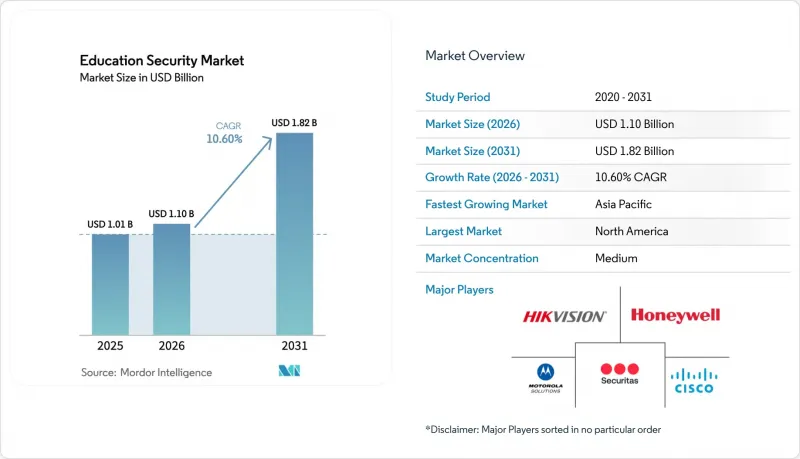
Mordor Intelligence에 의하면, 교육 보안 시장 규모는 2025년에 10억 1,000만 달러로 평가되었고, 2026년에 11억 달러로 추정되고, 2031년까지 18억 2,000만 달러에 이를 것으로 예측되며, 2026-2031년 CAGR 10.6%로 성장할 전망입니다.
본 보고서는 서비스별(경비, 채용 전 심사 등), 구성 요소별(하드웨어, 소프트웨어, 서비스), 보안 솔루션별(영상 감시 시스템, 출입 관리 시스템 등), 배포 방식별(온프레미스, 클라우드, 하이브리드), 시설별(초·중등 교육 시설, 고등 교육 시설 등), 지역별로 분류되어 있습니다. 시장 예측은 금액(달러) 기준으로 제시되어 있습니다.
세계의 교육 보안 시장 동향 및 인사이트
캠퍼스 내 실시간 영상 분석에 대한 수요 급증
각 교육 기관에서는 포렌식 재생 대신, 무기, 경계선 침입, 군중의 이상 징후를 몇 초 만에 식별하는 AI 엔진을 도입하고 있습니다. ZeroEyes는 2025년 말까지 300개 이상의 캠퍼스에 도입을 달성했으며, Omnilert의 VOLT AI는 기존 카메라와 연동하여 경보를 자동화하고 있습니다. 2021-22학년도, 미국 학교에서는 학생 10만 명당 10건의 총기 소지 사례가 기록되었으며, 이는 지난 10년 동안 가장 높은 수준이었습니다. 미시간주와 텍사스주의 학군은 2025년 2월과 7월에 AI 총기 감지 시스템을 도입했으며, 이는 지방 관할 구역에서도 도입이 진행되고 있음을 보여줍니다. 엣지 처리를 통해 대역폭이 제한된 학교에서도 대역폭 소모를 최소화할 수 있으며, 개인정보 보호 알고리즘은 일리노이주 및 워싱턴주의 생체 인식 관련 규정을 준수합니다.
학교 내 폭력 및 기물 파손 발생 건수 증가
총기 난사 사건이나 소셜 미디어를 통해 확산되는 위협으로 인해, 폭력 사건의 총 건수는 정체되어 있음에도 불구하고 정치적 감시는 여전히 엄격한 상황이 지속되고 있습니다. 2021-22학년도에 미국 학교의 45%가 무장한 학교 경비원을 배치했으나, 이는 2년 전의 51%에서 감소한 수치로, 인력보다 기술로의 전환이 진행되고 있음을 보여줍니다. 익명 신고 창구는 현재 학교의 62%를 커버하고 있으며, 2025년에는 행동상의 위협에 관한 컨설팅 업무가 가속화되었습니다. 미시간주의 ZeroEyes 도입과 텍사스주의 Verkada 설치는 경비원 수를 줄이면서 대응 시간을 단축하는 예방적 시스템으로의 전환이 가속화되고 있음을 보여줍니다.
높은 초기 도입 비용과 라이프사이클 비용
유지보수 미루기, 학생 수 감소, 교육 과정용 기술 도입이 안전 대책에 대한 지출과 경쟁하고 있습니다. 보조금으로 초기 카메라 도입 비용을 충당할 수 있는 경우가 많지만, 수년에 걸친 클라우드 구독, 소프트웨어 라이선스, 사이버 보안 모니터링 비용이 총 소유 비용을 끌어올리고 있습니다. 보조금을 활용할 수 없는 학교에서는 분석 기능이 없는 카메라나 사일로화된 접근 제어 등 단편적인 솔루션을 도입하고 있으며, 이는 향후 통합을 복잡하게 만들고 있습니다. 모듈식이며 ‘성장에 따라 지불’ 방식의 플랫폼을 제공하는 벤더들은 예산 현실에 맞추어 제안함으로써 계약을 수주하고 있습니다.
부문 분석
2025년, 교육 보안 시장에서 경비 서비스의 점유율은 37.71%를 차지했습니다. 한편, 컨설팅 수익은 연평균 10.73%의 성장률이 예상되며, 이는 교육위원회의 종합적인 위험 평가, 규정 준수 감사, 그리고 환경 설계를 통한 범죄 예방(CPTED) 청사진에 대한 수요를 반영한 것입니다. 교육 보안 시장 내 컨설팅 규모는 교육 기관이 FERPA(가족 교육 권리 및 개인정보 보호법) 및 생체 인식 관련 법규의 준수를 전문가에게 위탁함에 따라 확대되고 있습니다. 컨설팅 기업들은 AI 카메라, 제로 트러스트 네트워크, 긴급 신고 플랫폼을 통합한 취약점 스캔,테이블톱 훈련, 사이버 보안 로드맵을 패키지로 제공합니다. 아동 안전 관련 법규가 엄격해지는 가운데, 채용 전 신원 조사도 확대되고 있습니다. 경비원의 교대 근무 관리, 경보 모니터링, 사고 보고 분석을 단일 SLA로 통합한 매니지드 서비스 계약은 고객 유지율을 높이고 있습니다. 인력 부족과 임금 상승으로 인해 경비 사업의 이익률이 압박받고 있는 상황에서 Allied Universal사와 Securitas사는 AI 기반 경보를 경비원의 스마트폰으로 직접 전송하는 모바일 대시보드를 활용하여 순찰 체제를 강화하고 있습니다.
컨설팅 수요 증가 추세는 교육 보안 시장이 성숙해졌음을 나타내며, 관리자들은 경비원 수보다 측정 가능한 위험 감소를 더욱 중요시하고 있습니다. 보안 투자의 ROI(투자 대비 효과)-사고 발생률 감소, 봉쇄 시간 단축, 보험 등급 점수 향상-를 입증할 수 있는 서비스 제공업체들이 다년간의 프레임워크 계약을 수주하고 있습니다. 행동 건강 컨설팅 및 ESG 관련 안전 보고서를 제공하는 스타트업 기업들은 대학들이 경영진의 보상을 캠퍼스 보안 KPI와 연동시키는 추세에 발맞추어 미개척 시장 기회를 개척하고 있습니다. 수요가 증가함에 따라 전 세계 시스템 통합사업자들은 평가 및 도입을 패키지화하기 위해 전문성이 높은 자문 기업을 인수하고 있으며, 이를 통해 종단간 관계를 공고히 하고 시장에서 단독 경비 계약을 배제하고 있습니다.
2025년, 교육 보안 시장 규모의 45.64%를 하드웨어가 차지한 것으로 평가되었으며, 이는 신흥국에서의 카메라, 도어 컨트롤러, 센서 도입 확대에 힘입은 것입니다. 그러나 클라우드 기반 영상 관리, AI 분석, 모바일 인증이 NVR 랙 및 플라스틱 ID를 대체함에 따라, 소프트웨어 매출은 2031년까지 연평균 성장률(CAGR) 10.95%로 증가할 것으로 예측됩니다. Kisi의 시리즈 B 및 Genea의 시리즈 A 자금 조달은 관리자가 원격으로 인증 정보를 발급, 만료 및 감사할 수 있는 구독 플랫폼으로의 사업 확장을 뒷받침하고 있습니다. 스마트 카메라에 내장된 엣지 AI는 의사 결정 주기를 단축하고, 대역폭이 제한된 지방 학교에서도 고급 분석을 도입할 수 있게 해줍니다. 또한, 사내에 IT 부서가 없는 학군이 설정, 업데이트, SOC 모니터링을 위해 통합 업체를 고용함에 따라 서비스 수익도 이에 연동하여 증가하고 있습니다.
성숙한 지역에서는 하드웨어의 지속적인 업데이트에서 지속적인 소프트웨어 및 서비스 계약으로 전환되고 있어, 벤더의 평생 가치(LTV)가 향상되고 있습니다. 시스코의 ‘Meraki MV’ 포트폴리오와 존슨 컨트롤즈의 ‘OpenBlue’ 제품군은 카메라와 분석 라이선스를 번들로 제공함으로써 고객을 독자적인 생태계에 묶어두고 있습니다. 한편, 아시아태평양의 정부들은 여전히 대규모 카메라 설치에 예산을 할당하고 있어, 하드웨어 점유율은 급격하게 떨어지지는 않고 서서히 감소할 것으로 예측됩니다. 오픈 API와 개인정보 보호를 위한 엣지 처리를 차별화 요인으로 내세우는 벤더들은 GDPR(EU 개인정보보호규정)의 제약을 받는 유럽 구매자들 사이에서 인지도를 높이고 있습니다.
지역별 분석
교육 보안 시장은 여전히 북미에서 가장 큰 수익원입니다. 이 지역에서는 2025년에 연방 정부의 STOP 및 FEMA 블록 보조금을 합쳐 1억 5,600만 달러가 지원되었으며, 약 4,000건의 학교 프로젝트가 시행되었습니다. 캘리포니아주와 뉴욕주의 도시 지역 학군에서는 채권 발행액의 일부를 AI 영상 시스템 업그레이드에 할당하고 조달 일정을 앞당겼습니다. 캐나다의 각 주도 유사한 보조금 제도를 도입하여 VMS의 암호화 및 데이터 보존 정책에 관한 국경을 초월한 표준화를 가속화했습니다. 멕시코 공교육부는 15개 연방 학교에서 생체 인증이 포함되지 않은 물체 감지 시스템을 시범 운영하여, 라틴아메리카 내 GDPR(EU 개인정보보호규정) 준수 솔루션에 대한 수요를 촉진했습니다.
아시아태평양은 여전히 교육 보안 시장에서 가장 빠르게 성장하고 있으며, 각국 정부는 보안 인프라를 이러닝 및 디지털 리터러시 예산에 포함시키고 있습니다. 중국의 ‘안전한 캠퍼스’ 관련 법령에서는 2027년까지 모든 초·중학교에 AI 지원 영상 시스템을 도입할 것을 의무화하고 있어, 국내 카메라 제조업체들에게 향후 몇 년간 호재가 될 것입니다. 인도의 ‘비디야 락샤(Vidya Raksha)’ 프로그램에서는 주 및 연방 정부의 자금을 활용하여 방문자 관리 키오스크와 전자 잠금장치 설치가 진행되고 있는 반면, 싱가포르에서는 공립·사립을 불문하고 모든 교육 기관에 ‘SafeSchools&SG’ 청사진을 적용하고 있습니다. 일본 문부과학성은 2025년 말까지 대학에 OT 네트워크와 IT 네트워크의 분리를 의무화하는 지침을 발표하여, 사이버 보안 어플라이언스 판매를 촉진하고 있습니다.
유럽의 도입률은 북미의 성숙도와 아시아태평양의 확대 중간 수준에 위치하고 있습니다. GDPR(EU 개인정보보호규정)(일반 데이터 보호 규정) 준수로 인해 생체 인증에 의존하는 도입은 억제되고, 개인정보 보호형 분석이 중시되고 있습니다. 영국에서 조만간 시행될 ‘마틴 법’은 대피 알림 시스템의 통합을 의무화하고 있으며, 대학들은 수동식 PA(공공 방송) 시스템을 지역 경찰과 연계되는 클라우드 연동형 메시징 시스템으로 교체해야 할 압박을 받고 있습니다. 남유럽 국가들에서는 EU의 회복탄력성 기금 보조금을 활용하여 1960년대에 건설된 교사에 IP 카메라와 보강된 현관을 사후 설치하고 있습니다. 스칸디나비아 국가들에서는 대학 캠퍼스 내 공용 공간에서 AI를 활용한 인파 밀도 경보 시스템을 시범 운영하며, 괴롭힘이나 기물 파손을 미연에 방지하려 하고 있습니다.
기타 혜택 :
- Excel 형식 시장 예측(ME) 시트
- 3개월간의 애널리스트 지원
자주 묻는 질문
목차
제1장 서론
제2장 분석 방법
제3장 주요 요약
제4장 시장 구도
제5장 시장 규모 및 성장률 예측
제6장 경쟁 구도
제7장 시장 기회 및 향후 전망
AJY 26.09.15According to Mordor Intelligence, the education security market size is projected to be USD 1.01 billion in 2025, USD 1.10 billion in 2026, and reach USD 1.82 billion by 2031, growing at a CAGR of 10.6% from 2026 to 2031.
This report is Segmented by Services (Guarding, Pre-Employment Screening, and More), Component (Hardware, Software, and Services), Security Solution (Video Surveillance Systems, Access Control Systems, and More), Deployment Mode (On-Premise, Cloud, and Hybrid), Facilities (Primary and Secondary Facilities, and More), and Geography. The Market Forecasts are Provided in Terms of Value (USD).
Global Education Security Market Trends and Insights
Surging Demand for Real-Time Video Analytics on Campuses
Institutions are replacing forensic playback with AI engines that identify weapons, perimeter breaches, and crowd anomalies in seconds. ZeroEyes exceeded 300 campus deployments by late 2025, and Omnilert's VOLT AI integrates with existing cameras to automate alerts. U.S. schools logged 10 firearm possessions per 100,000 students in 2021-22, the highest level in a decade. Districts in Michigan and Texas installed AI gun-detection systems in February and July 2025, showing adoption even in rural jurisdictions. Edge processing minimizes bandwidth consumption for schools with limited bandwidth, while privacy-preserving algorithms comply with biometric restrictions in Illinois and Washington.
Heightened Incidence of School Violence and Vandalism
Active-shooter events and viral social-media threats have kept political scrutiny high despite a plateau in overall violent-incident counts. Forty-five percent of U.S. schools employed armed resource officers in 2021-22, down from 51% two years earlier, indicating a shift toward technology rather than personnel. Anonymous tip lines now cover 62% of schools, and behavioral-threat consulting engagements accelerated in 2025. ZeroEyes deployments in Michigan and Verkada installs in Texas underscore the push toward proactive systems that lower guard headcount while improving response times.
High Upfront Procurement and Lifecycle Costs
Deferred maintenance, declining enrollments, and curriculum technology compete with safety spending. Grants often cover initial cameras, but multi-year cloud subscriptions, software licensing, and cybersecurity monitoring inflate the total cost of ownership. Schools without grant access deploy piecemeal solutions-cameras without analytics or siloed access control-that complicate future integrations. Vendors offering modular, pay-as-you-grow platforms win contracts by matching budget realities.
Other drivers and restraints analyzed in the detailed report include:
- Government Safety Grants Accelerating Technology Refresh Cycles
- Infrastructure Modernisation Programs in Emerging Economies
- Persistent Privacy and Data-Protection Concerns
For complete list of drivers and restraints, kindly check the Table Of Contents.
Segment Analysis
Guarding services accounted for 37.71% of Education Security market share in 2025. However, consulting revenues are forecast to grow 10.73% annually, reflecting boards' demand for holistic risk assessments, compliance audits, and Crime Prevention Through Environmental Design blueprints. The Education Security market size for consulting is rising as institutions outsource FERPA and biometric-law compliance to experts. Consulting firms bundle vulnerability scans, tabletop drills, and cybersecurity roadmaps that integrate AI cameras, Zero Trust networks, and emergency-notification platforms. Pre-employment background checks are expanding amid stricter child-safety statutes. Managed-services contracts that wrap guard scheduling, alarm monitoring, and incident-report analytics into a single SLA deepen client stickiness. Labor shortages and wage inflation squeeze guarding margins, prompting Allied Universal and Securitas to augment patrols with mobile dashboards that route AI alerts directly to officers' smartphones.
The consulting uptrend signifies a maturing Education Security market in which administrators value measurable risk reduction over badge counts. Service providers that demonstrate return on security investment-lower incident rates, faster lockdown times, higher insurance-rating scores-win multi-year frameworks. Start-ups offering behavioral-health consulting and ESG-linked safety reporting tap white-space opportunities as universities tie executive compensation to campus security KPIs. As demand rises, global systems integrators are acquiring boutique advisory firms to package assessments with deployment, cementing end-to-end relationships that crowd out standalone guard contracts.
Hardware held 45.64% of Education Security market size in 2025, supported by camera, door-controller, and sensor rollouts in emerging economies. Yet software revenues are projected to climb at a 10.95% CAGR through 2031 as cloud video management, AI analytics, and mobile credentialing displace NVR racks and plastic IDs. Kisi's Series B and Genea's Series A fund expansion into subscription platforms that let administrators issue, revoke, and audit credentials remotely. Edge AI embedded in smart cameras shortens decision loops, allowing rural schools with limited bandwidth to deploy advanced analytics. Services revenue grows in lock-step because districts lacking in-house IT hire integrators for configuration, updates, and SOC monitoring.
In mature regions, perpetual hardware refresh gives way to recurring software and services contracts, boosting vendor lifetime value. Cisco's Meraki MV portfolio and Johnson Controls' OpenBlue suite bundle cameras with analytics licenses, locking customers into proprietary ecosystems. Conversely, Asia-Pacific governments still earmark budgets for large-scale camera installations, ensuring hardware's share erodes gradually rather than precipitously. Vendors differentiating on open APIs and privacy-preserving edge processing capture mindshare among GDPR-constrained European buyers.
Complete Report Scope:
- By Services
- Guarding
- Pre-Employment Screening
- Security Consulting
- Systems Integration and Management
- Alarm Monitoring Services
- Other Private Security Services
- By Component
- Hardware
- Software
- Services
- By Security Solution
- Video Surveillance Systems
- Access Control Systems
- Emergency Communication Systems
- Cybersecurity Solutions
- By Deployment Mode
- On-Premise
- Cloud
- Hybrid
- By Facilities
- Primary and Secondary Facilities
- Higher Education Facilities
- Other Educational Facilities
- By Geography
- North America
- United States
- Canada
- Mexico
- South America
- Brazil
- Argentina
- Rest of South America
- Europe
- Germany
- United Kingdom
- France
- Italy
- Spain
- Rest of Europe
- APAC
- China
- Japan
- India
- South Korea
- South-East Asia
- Rest of APAC
- Middle East
- Saudi Arabia
- United Arab Emirates
- Turkey
- Rest of Middle East
- Africa
- South Africa
- Nigeria
- Rest of Africa
- North America
Geography Analysis
The Education Security market continues to anchor its highest revenue in North America, where USD 156 million in combined federal STOP and FEMA block grants underwrote nearly 4,000 school projects during 2025. Urban districts in California and New York redeployed a portion of bond issuances toward AI video upgrades, tightening procurement timelines. Canadian provinces replicated grant mechanisms, accelerating cross-border standardization of VMS encryption and data-retention policies. Mexico's Secretariat of Public Education piloted biometric-free object detection in 15 federal schools, catalyzing demand for GDPR-aligned solutions in Latin America.
Asia-Pacific remains the fastest-growing Education Security market, with governments bundling security infrastructure into e-learning and digital-literacy budgets. China's Safe Campus decree mandates AI-enabled video in all primary and secondary schools by 2027, ensuring multi-year tailwinds for domestic camera manufacturers. India's Vidya Raksha program channels state and federal funds to install visitor-management kiosks and electronic locks, while Singapore applies its SafeSchools@SG blueprint across public and private institutions. Japan's Ministry of Education issued guidance in late 2025 requiring universities to segment OT from IT networks, spurring sales of cybersecurity appliances.
Europe's adoption rate sits between North America's maturity and Asia-Pacific's expansion. GDPR compliance tempers rollouts that rely on biometrics, favoring privacy-preserving analytics. The United Kingdom's impending Martyn's Law compels evacuation-notification integrations, pushing universities to replace manual PA systems with cloud-triggered messaging that synchronizes with local constabularies. Southern European economies leverage EU resilience-fund grants to retrofit 1960s-era school buildings with IP cameras and reinforced entry vestibules. Scandinavia experiments with AI-driven crowd-density alerts in university commons to pre-empt harassment and vandalism.
- Cisco Systems Inc.
- Honeywell International Inc.
- Motorola Solutions Inc.
- Securitas AB
- Axis Communications AB
- Genetec Inc.
- Verkada Inc.
- Hangzhou Hikvision Digital Technology Co. Ltd.
- Johnson Controls International plc
- Robert Bosch GmbH
- ADT Inc.
- Allied Universal Topco LLC
- Prosegur Compania de Seguridad S.A.
- Hanwha Vision Co., Ltd.
- Zhejiang Dahua Technology Co. Ltd.
- Gallagher Group Limited
- Silverseal Corporation
- SEICO Inc.
- Kisi Inc.
- AxxonSoft LLC
- Eagle Eye Networks Inc.
Additional Benefits:
- The market estimate (ME) sheet in Excel format
- 3 months of analyst support
TABLE OF CONTENTS
1 INTRODUCTION
- 1.1 Study Assumptions and Market Definition
- 1.2 Scope of the Study
2 RESEARCH METHODOLOGY
3 EXECUTIVE SUMMARY
4 MARKET LANDSCAPE
- 4.1 Market Overview
- 4.2 Market Drivers
- 4.2.1 Surging Demand For Real-Time Video Analytics On Campuses
- 4.2.2 Heightened Incidence Of School Violence And Vandalism
- 4.2.3 Government Safety Grants Accelerating Technology Refresh Cycles
- 4.2.4 Infrastructure Modernisation Programs In Emerging Economies
- 4.2.5 AI-Enabled Behavioural Detection For Early Threat Identification
- 4.2.6 ESG-Linked Safety Kpis Guiding Funding Decisions
- 4.3 Market Restraints
- 4.3.1 High Upfront Procurement And Lifecycle Costs
- 4.3.2 Persistent Privacy And Data-Protection Concerns
- 4.3.3 Disjointed Physical-Cybersecurity Architectures
- 4.3.4 Shortage Of Skilled Campus Security Personnel
- 4.4 Value Chain Analysis
- 4.5 Regulatory Landscape
- 4.6 Technological Outlook
- 4.7 Porter's Five Forces
- 4.7.1 Bargaining Power of Suppliers
- 4.7.2 Bargaining Power of Buyers
- 4.7.3 Threat of New Entrants
- 4.7.4 Threat of Substitutes
- 4.7.5 Intensity of Competitive Rivalry
5 MARKET SIZE AND GROWTH FORECASTS (VALUE)
- 5.1 By Services
- 5.1.1 Guarding
- 5.1.2 Pre-Employment Screening
- 5.1.3 Security Consulting
- 5.1.4 Systems Integration and Management
- 5.1.5 Alarm Monitoring Services
- 5.1.6 Other Private Security Services
- 5.2 By Component
- 5.2.1 Hardware
- 5.2.2 Software
- 5.2.3 Services
- 5.3 By Security Solution
- 5.3.1 Video Surveillance Systems
- 5.3.2 Access Control Systems
- 5.3.3 Emergency Communication Systems
- 5.3.4 Cybersecurity Solutions
- 5.4 By Deployment Mode
- 5.4.1 On-Premise
- 5.4.2 Cloud
- 5.4.3 Hybrid
- 5.5 By Facilities
- 5.5.1 Primary and Secondary Facilities
- 5.5.2 Higher Education Facilities
- 5.5.3 Other Educational Facilities
- 5.6 By Geography
- 5.6.1 North America
- 5.6.1.1 United States
- 5.6.1.2 Canada
- 5.6.1.3 Mexico
- 5.6.2 South America
- 5.6.2.1 Brazil
- 5.6.2.2 Argentina
- 5.6.2.3 Rest of South America
- 5.6.3 Europe
- 5.6.3.1 Germany
- 5.6.3.2 United Kingdom
- 5.6.3.3 France
- 5.6.3.4 Italy
- 5.6.3.5 Spain
- 5.6.3.6 Rest of Europe
- 5.6.4 APAC
- 5.6.4.1 China
- 5.6.4.2 Japan
- 5.6.4.3 India
- 5.6.4.4 South Korea
- 5.6.4.5 South-East Asia
- 5.6.4.6 Rest of APAC
- 5.6.5 Middle East
- 5.6.5.1 Saudi Arabia
- 5.6.5.2 United Arab Emirates
- 5.6.5.3 Turkey
- 5.6.5.4 Rest of Middle East
- 5.6.6 Africa
- 5.6.6.1 South Africa
- 5.6.6.2 Nigeria
- 5.6.6.3 Rest of Africa
- 5.6.1 North America
6 COMPETITIVE LANDSCAPE
- 6.1 Market Concentration
- 6.2 Strategic Moves
- 6.3 Market Share Analysis
- 6.4 Company Profiles (includes Global level Overview, Market level overview, Core Segments, Financials as available, Strategic Information, Market Rank/Share for key companies, Products and Services, and Recent Developments)
- 6.4.1 Cisco Systems Inc.
- 6.4.2 Honeywell International Inc.
- 6.4.3 Motorola Solutions Inc.
- 6.4.4 Securitas AB
- 6.4.5 Axis Communications AB
- 6.4.6 Genetec Inc.
- 6.4.7 Verkada Inc.
- 6.4.8 Hangzhou Hikvision Digital Technology Co. Ltd.
- 6.4.9 Johnson Controls International plc
- 6.4.10 Robert Bosch GmbH
- 6.4.11 ADT Inc.
- 6.4.12 Allied Universal Topco LLC
- 6.4.13 Prosegur Compania de Seguridad S.A.
- 6.4.14 Hanwha Vision Co., Ltd.
- 6.4.15 Zhejiang Dahua Technology Co. Ltd.
- 6.4.16 Gallagher Group Limited
- 6.4.17 Silverseal Corporation
- 6.4.18 SEICO Inc.
- 6.4.19 Kisi Inc.
- 6.4.20 AxxonSoft LLC
- 6.4.21 Eagle Eye Networks Inc.
7 MARKET OPPORTUNITIES AND FUTURE OUTLOOK
- 7.1 White-space and Unmet-need Assessment


