|
시장보고서
상품코드
2117305
섬유 폐기물 관리 : 시장 점유율 분석, 업계 동향과 통계, 성장 예측(2026-2031년)Textile Waste Management - Market Share Analysis, Industry Trends & Statistics, Growth Forecasts (2026 - 2031) |
||||||
 Mordor Intelligence
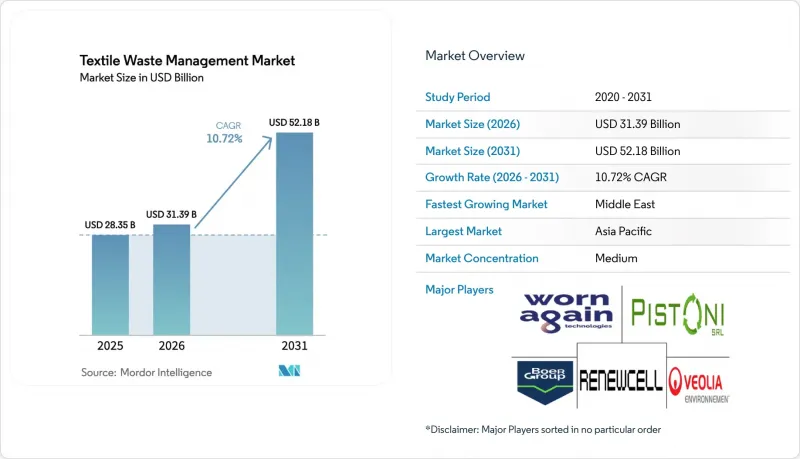
Mordor Intelligence에 따르면 2026년 섬유 폐기물 관리 시장 규모는 313억 9,000만 달러로 추정되며, 2025년 283억 5,000만 달러에서 확대되어 2031년에는 521억 8,000만 달러에 달할 것으로 예측됩니다. 2026년부터 2031년까지 CAGR 10.72%로 성장할 것으로 전망됩니다.
본 보고서는 폐기물 발생원(생산 전, 소비 후), 폐기물 종류(천연섬유, 합성섬유 등), 서비스(수거·물류, 선별·등급 분류 등), 최종사용자(주택, 상업·공공 기관 등), 지역(북미, 유럽 등)별로 분류되어 있습니다. 시장 전망은 금액(달러) 기준으로 제시되어 있습니다.
세계 섬유 폐기물 관리 시장의 동향 및 인사이트
섬유 폐기물 분리수거 의무화 기한
유럽연합(EU), 일본, 한국의 섬유 폐기물 분리 수거 의무화 기한에 따라, 5년 이내에 공식 수거 경로로 유입되는 분리 수거된 섬유 폐기물의 양은 3배로 증가할 것으로 예상됩니다. 초기 단계의 모델 분석에 따르면, 원료 비용의 하락으로 인해 선별 능력을 보유한 사업자와 현물 시장에서 재료를 구매하는 사업자 간의 가격 차이가 급속히 확대될 전망입니다. 그 결과, 현재 시점에서 수거 계약을 체결한 재활용 사업자는 처리 수수료가 재설정되기 전에 이익률 우위를 확보할 가능성이 높을 것입니다. 또한, 지자체에 의한 수거 거점 구축이 가속화됨에 따라 자동 선별 기술에 대한 시급한 수요가 발생하여, 광학식 스캐너 및 로봇 기술에 대한 투자가 우선순위가 될 전망입니다.
남아시아 및 동남아시아 도시 중산층의 급속한 확대
방글라데시, 베트남, 인도네시아의 가처분 소득 증가는 가정 내 섬유 제품 소비를 촉진하고 있으며, 이에 따라 소비 후 발생하는 폐기물 유량도 확대되고 있습니다. 수많은 비공식 수거업자 및 중개업자를 공식적인 체계에 편입시키는 것이 여전히 중요한 과제이지만, 방글라데시의 사례는 체계적인 집약화를 통해 아동 노동의 위험을 줄이면서 새로운 친환경 일자리의 길을 열 수 있음을 보여주고 있습니다. 자재 흐름의 급증에 따라 지방 자치 단체는 매립세 도입을 검토하기 시작했습니다. 이는 재활용 업체들이 선별 기준을 높이지 않을 경우, 수거 마진을 압박할 가능성이 있는 정책 조치입니다. 그 결과, 낮은 자본 지출로 도입 가능한 추적성 앱 개발자는 비공식 수거업자에 대한 지불 흐름을 효율화함으로써 선구자로서의 우위를 확보할 수 있을 것입니다.
지속가능성 연계 금융의 급증
그린본드, 전환 대출, 블렌드 파이낸스 등의 구조를 통해 섬유 폐기물 관리 시장에 진출한 기업들의 가중평균자본비용이 낮아지고 있습니다. 이러한 저비용 자금 조달로 인해, 기존에는 상업적 규모로 확대하는 데 어려움을 겪었던 고가의 화학 반응 장치나 효소 반응 장치에 대한 투자 회수 기간이 단축되고 있습니다. 쿠폰 금리 인상이 폐기물 재활용률이나 배출량 감축 목표와 연동되어 있기 때문에 경영진은 이익률 하락을 막기 위해 실시간 성과 대시보드를 우선적으로 활용하고 있습니다. 투자자들은 이러한 데이터를 활용하여 표명된 의도가 아닌 검증된 영향력을 바탕으로 사업자를 평가하고 있으며, 이러한 추세로 인해 엄격한 모니터링 시스템을 갖추지 않은 기업은 불리한 입장에 처할 가능성이 있습니다.
부문 분석
2025년 현재, 프리컨슈머(생산 전) 부문은 섬유 폐기물 관리 시장의 62.35%를 차지하고 있으며, 이는 아시아의 대규모 의류 공장에서 발생하는 재단실 폐기물의 집중이 주요 요인입니다. 균일한 재단 잔여물은 포장이 용이하고 기계적 재활용 라인으로 직접 보낼 수 있어 단위당 물류 비용을 절감할 수 있습니다. 이러한 폐기물 집적지는 제조 클러스터 근처에 위치해 있어 서비스 제공업체는 집적에 따른 규모의 경제를 누릴 수 있으며, 이는 영업이익률 향상으로 이어집니다. 또한, 단일 지점에 대량의 폐기물이 집중되는 것은 원자재의 원산지를 증명하는 디지털 제품 여권의 조기 도입을 촉진하고 있으며, 이러한 접근 방식은 수출 시장에서 사실상 구매자의 필수 요건이 될 가능성이 높습니다.
사용 후 폐기물은 2031년까지 연평균 성장률(CAGR) 9.55%로 확대될 것으로 예측되며, 분리 수거 의무화로 인해 가정에서의 회수가 제도화됨에 따라 생산 전 폐기물의 성장률을 상회할 것으로 전망됩니다. 미국 여러 지방 자치 단체의 문 앞 수거 프로그램 보급과 EU의 생산자 책임 확대(EPR) 제안은 일상적인 섬유 폐기물이 유리나 종이와 마찬가지로 머지않아 추적 대상이 될 것임을 시사합니다. 이러한 추세는 다양한 섬유의 혼방에 대응하도록 설계된 자동 선별 장치에 있어 더 가파른 학습 곡선을 의미하며, 기술 제공업체들은 근적외선 스캐너와 AI 분류 알고리즘을 미세 조정해야 하는 상황에 직면해 있습니다. 각 브랜드가 재활용 소재 함유율 목표 달성을 위해 경쟁하는 가운데, 소비 후 폐기물의 변동성을 가장 먼저 파악한 기업이 고액의 처리 수수료를 확보하게 될 것입니다.
폴리에스테르를 중심으로 한 합성섬유는 2025년 섬유 폐기물 관리 시장 규모의 47.25%를 차지하고 있으며, 이는 의류 분야에서 폴리에스테르의 중요성을 반영하고 있습니다. 광범위한 PET 병 재활용 인프라는 그 일부의 모범 사례가 되고 있지만, 섬유에서 섬유로 이어지는 폐쇄형 순환 흐름은 아직 초기 단계에 있으며, 섬유 등급 제품의 공급은 여전히 부족한 실정입니다. 병 생산 라인 설비를 개조하여 섬유 폐기물을 처리하는 사업자들은 높은 오염률에 직면하고 있지만, 기존의 탈중합 기술을 활용함으로써 규모 확대 기간을 단축할 수 있습니다. 원유 가격 변동이 빈번하게 발생함에 따라 재생 폴리에스터의 이익률에 대한 민감도가 높아지고 있으며, 재활용 사업자에게는 헤지 수단이 표준 관행이 될 것입니다.
셀룰로오스계 및 재생 섬유는 예측 연평균 성장률(CAGR)이 8.63%로, 폐기물 카테고리 중 가장 빠르게 성장하고 있습니다. 효소 가수분해 기술의 발전으로 현재는 면을 버진 원료에 필적하는 품질 지표를 가진 용해 펄프로 변환할 수 있게 되어, 섬유에서 섬유로의 순환형 재활용이 가능해졌습니다. 파일럿 플랜트 데이터에 따르면, 효소를 온화한 용매 시스템과 병용함으로써 면과 폴리에스터 혼방 원단을 경제적으로 분리할 수 있는 것으로 나타났으며, 이는 혼방 원단의 가치를 끌어낼 수 있는 길을 시사합니다. 이러한 진전은 섬유 품질을 크게 손상시키지 않으면서 다중 소재 의류를 처리할 수 있는 화학적 처리 방식으로 시장 점유율이 점차 이동해 나갈 것임을 예고하고 있습니다.
지역별 분석
2025년, 아시아는 섬유 폐기물 관리 시장에서 45.65%의 점유율을 차지하고 있으며, 중국이 핵심을 이루고 인도와 방글라데시가 주도적인 역할을 하고 있습니다. 중국의 정책 체계가 점차 엄격해지는 반면, 방글라데시에서는 비공식 수거에서 준공식 수거로의 전환이 진행되고 있으며, 소재의 품질 기준이 안정화되면 잠재적인 성장 가속화가 예상됩니다. 다카에서 산관 합동 태스크포스가 결성된 것은 정규 부문의 재활용 업체들이 폐기물 흐름에 대한 우선 접근권을 확보하게 되어, 그 결과 규정 준수 대응 능력이 없는 중개업자들이 시장에서 배제될 것임을 시사합니다. 이러한 변화는 수작업 선별이 기계화된 선별 라인으로 대체됨에 따라 노동 관행의 재편이 일어날 가능성을 시사합니다.
중동은 2026년부터 2031년까지 연평균 성장률(CAGR) 8.15%라는 가장 높은 성장 궤적을 기록하고 있으며, 2040년까지 폐기물의 최대 90%를 매립지에서 전환하는 것을 목표로 하는 정부의 의무화가 원동력이 되고 있습니다. UAE의 ‘랜드마크 서큘라이프(Landmark Circulife)’ 시설과 같은 핵심 프로젝트는 낮은 에너지 비용과 통합된 자유무역지대 물류와 같은 이 지역 특유의 경쟁 우위를 보여주고 있습니다. 각 지역의 규제 당국은 현지에서 생산된 섬유 제품에 대해 재활용 소재의 최소 함유율 기준을 부과하고 있으며, 이를 통해 걸프 지역 국가산 제품에 대한 안정적인 수요가 창출될 가능성이 있습니다. 그 결과로 얻게 되는 공급 안정성은 전 세계 의류 브랜드를 유치하여 해당 지역에 조달 거점을 설립하도록 이끌며, 간접적으로 지정학적 리스크 분산에 기여할 가능성이 있습니다.
유럽은 2025년 1월까지 EU 전역에서 섬유 제품의 분리 수거를 의무화하는 요건을 채택하여 규제 명확화에서 주도적인 역할을 하고 있습니다. 현재 수거율은 15% 전후에 머물러 있어, 인프라가 확대됨에 따라 충분한 성장 여지가 있음을 시사하고 있습니다. 환경 친화적 요금에 관한 병행 논의에 따르면, 재활용성을 고려한 설계를 가장 신속하게 추진하는 생산자가 규정 준수 비용을 낮게 억제할 수 있는 것으로 나타나며, 이는 업스트림 공정에서 섬유 선정에 인센티브를 부여하게 됩니다. 북미에서는 진척도에 편차가 나타납니다. 매사추세츠주 등 일부 주에서는 매립 처분 금지 조치가 시행되고 있어, 지역별로 원료 공급 과잉 현상이 발생하고 있습니다. 이로 인해 정책의 확실성이 있는 지역에서는 재활용 업체들이 처리 능력 확대를 강요받고 있습니다. 라틴아메리카 및 아프리카 시장은 여전히 비공식적인 시스템에 의해 제약을 받고 있지만, 칠레와 가나에서 시행되고 있는 EPR(생산자 책임) 시범 사업은 보다 광범위한 도입을 위한 모델이 될 수 있습니다. 이는 거버넌스가 안정되면 시장 진입 기회가 생길 것임을 시사합니다.
기타 혜택:
- 엑셀 형식의 시장 예측(ME) 시트
- 3개월간의 애널리스트 지원
목차
제1장 소개
제2장 조사 방법
제3장 주요 요약
제4장 시장 구도
제5장 시장 규모 및 성장 예측(금액, 10억 달러)
제6장 경쟁 구도
제7장 시장 기회와 향후 전망
KSMAccording to Mordor Intelligence, textile waste management market size market size in 2026 is estimated at USD 31.39 billion, growing from 2025 value of USD 28.35 billion with 2031 projections showing USD 52.18 billion, growing at 10.72% CAGR over 2026-2031.
This report is Segmented by Waste Source (Pre-Consumer, Post-Consumer), by Waste Type (Natural Fiber, Synthetic Fiber, and More), by Service (Collection & Logistics, Sorting & Grading, and More), by End-User (Residential / Household, Commercial & Institutional, and More), by Geography (North America, Europe and More). The Market Forecasts are Provided in Terms of Value (USD).
Global Textile Waste Management Market Trends and Insights
Mandatory Separate Textile-Waste Collection Deadlines
Mandatory separate collection deadlines in the European Union, Japan, and South Korea are set to triple the volume of sorted textiles entering formal channels within five years. Early-stage modelling indicates that lower feedstock costs will quickly accentuate the spread between operators who own sorting capacity and those who purchase material on the spot market. As a result, recyclers that finalize offtake agreements now will likely lock in margin advantages before processing fees reset. The accelerated build-out of municipal drop-off sites also creates an immediate need for automated sorting technologies, making investment in optical scanners and robotics a likely priority.
Rapid Urban Middle-Class Growth in South & Southeast Asia
Swelling disposable incomes across Bangladesh, Vietnam, and Indonesia are propelling household textile consumption and correspondingly larger post-consumer waste streams. Formalizing the many informal pickers and traders remains the key hurdle, yet evidence from Bangladesh shows that structured aggregation can simultaneously reduce child labor risks and unlock new green-job pathways. The surge in material flow is prompting local authorities to weigh landfill taxes, a policy step that could compress collection margins if recyclers do not upskill sorting standards. Consequently, developers of low-capex traceability apps stand to gain a first-mover advantage by streamlining payment flows to informal collectors.
Surge in Sustainability-Linked Finance
Green bonds, transition loans, and blended-finance vehicles are reducing the weighted average cost of capital for Textile Waste Management market participants. This cheaper funding drives shorter payback periods for expensive chemical or enzymatic reactors, which historically struggled to reach commercial scale. Because coupon step-ups are tied to diversion or emissions targets, executives now prioritize real-time performance dashboards to avoid margin erosion. Investors are using these data layers to differentiate between operators based on verified impact rather than stated intent, a trend that may penalize firms without rigorous monitoring systems.
Other drivers and restraints analyzed in the detailed report include:
- Escalating Landfill & Incineration Levies
- Fragmented Informal Collection in Africa & South America
For complete list of drivers and restraints, kindly check the Table Of Contents.
Segment Analysis
The pre-consumer segment controls 62.35% of the Textile Waste Management market share in 2025, driven by the concentration of cutting-room waste in large Asian garment factories. Homogeneous clippings simplify baling and allow direct channeling into mechanical recycling lines, reducing unit logistics costs. Because these waste nodes are situated near manufacturing clusters, service providers capture economies of density that translate into higher operating margins. The presence of large volumes at single points also encourages early adoption of digital product passports that certify material origin, an approach that is likely to become a de facto buyer requirement in export markets.
Post-consumer waste is forecast to expand at a 9.55% CAGR through 2031, overtaking growth in the pre-consumer stream as separate-collection mandates formalize household take-back. The proliferation of curbside programs in several U.S. municipalities and EPR proposals in the EU suggests that daily textile disposal will soon be tracked much like glass or paper. That momentum implies a steeper learning curve for automated sorting equipment designed to handle variable fiber blends, pushing technology providers to fine-tune near-infrared scanners and AI classifiers. Firms that master post-consumer variability first will secure premium processing fees as brands race to meet recycled-content targets.
Synthetic fibers, mainly polyester, represent 47.25 % of the Textile Waste Management market size in 2025, reflecting polyester's prominence in apparel. Extensive PET bottle recycling infrastructure provides a partial blueprint; however, closed-loop textile-to-textile streams remain embryonic, keeping fiber-grade output in short supply. Operators that retrofit bottle-line assets to digest fabric waste are discovering higher contamination rates, yet can leverage existing depolymerization know-how to shorten scale-up timelines. The incidence of oil-price swings magnifies the sensitivity of recycled-polyester margins, suggesting that hedging instruments will become standard practice for recyclers.
Cellulosic and regenerated fibers exhibit an 8.63 % forecast CAGR, making them the fastest-growing waste cohort. Advances in enzymatic hydrolysis now convert cotton into dissolving pulp with quality metrics comparable to virgin inputs, enabling textile-to-textile circularity. Pilot-plant data indicate that mixed cotton-poly blends can be fractionated economically when enzymes operate in tandem with mild solvent systems, signalling a path to unlock blended-fabric value. This progress foretells a gradual migration of market share toward chemical routes that can process multi-material garments without large fibre-quality sacrifices.
Complete Report Scope:
- By Waste Source
- Pre-consumer (Manufacturing Scrap)
- Post-consumer (Used Garments & Household Textiles)
- By Waste Type
- Natural Fibers
- Cotton
- Wool
- Silk
- Others(Jute, Animal Fibre, etc.)
- Synthetic Fibers
- Polyester
- Nylon
- Others (Acrylic, Rayon, etc.)
- Cellulosic & Regenerated Fibers
- Viscose / Rayon
- Lyocell / Modal
- Blended Fabrics
- Hazardous / Contaminated Textiles
- Natural Fibers
- By Service
- Collection & Logistics
- Sorting & Grading
- Recycling (Mechanical, Chemical/Enzymatic, Reuse)
- Energy Recovery (Incineration & WtE)
- Landfill / Open Dumping
- By End-User
- Residential / Household
- Commercial & Institutional (Retail, Hospitality)
- Industrial Manufacturing (Apparel & Footwear)
- Others (Municipal Garbage, Medical Facilities, etc.)
- By Geography
- North America
- United States
- Canada
- Mexico
- South America
- Brazil
- Argentina
- Rest of South America
- Europe
- Germany
- France
- United Kingdom
- Italy
- Spain
- BENELUX (Belgium, Netherlands, and Luxembourg)
- NORDICS (Denmark, Finland, Iceland, Norway, and Sweden)
- Rest of Europe
- Asia-Pacific
- China
- Japan
- India
- Bangladesh
- South Korea
- ASEAN (Indonesia, Thailand, Philippines, Malaysia, Vietnam)
- Rest of Asia-Pacific
- Middle East and Africa
- Saudi Arabia
- United Arab Emirates
- Turkey
- Egypt
- South Africa
- Rest of Middle East and Africa
- North America
Geography Analysis
Asia holds 45.65% Textile Waste Management market share in 2025, anchored by China and propelled by India and Bangladesh. While China's policy framework gradually tightens, Bangladesh's transition from informal to semi-formal collection reveals a latent acceleration path once material quality standards stabilize. The formation of industry-government taskforces in Dhaka hints that formal sector recyclers will gain privileged access to waste streams, thereby squeezing intermediaries without compliance capabilities. This transformation implies a likely reshaping of labor practices as mechanized sorting lines replace manual grade-outs.
The Middle East records the highest growth trajectory at 8.15% CAGR for 2026-2031, propelled by sovereign mandates that aim to divert up to 90% of waste from landfills by 2040. Anchor projects such as the Landmark CircuLife facility in the UAE showcase region-specific advantages like low energy costs and integrated free-zone logistics. Regional regulators are imposing minimum recycled-content standards on locally produced textiles, which could generate a captive demand pool for Gulf-based output. The ensuing supply stability may attract global apparel brands to establish sourcing bases in the region, implicitly diversifying geopolitical risk.
Europe leads on regulatory clarity after adopting a union-wide requirement for separate textile collection by January 2025. Current capture rates hover near 15%, indicating ample headroom as infrastructure scales. Parallel debate on eco-modulated fees suggests that producers moving fastest on recyclability design will bear lower compliance costs, incentivizing upstream fiber choices. North America shows uneven progress, with states such as Massachusetts implementing landfill bans that create regional pockets of feedstock surplus, pushing recyclers to expand capacity where policy certainty exists. Latin American and African markets remain constrained by informal systems; however, pilot EPR schemes in Chile and Ghana could serve as templates for broader adoption, signaling entry opportunities once governance stabilizes.
- Worn Again Technologies
- Veolia Environnement S.A.
- Boer Group
- Renewcell AB
- Pistoni S.r.l.
- Lenzing AG
- Textile Recycling International
- RETEXTIL Deutschland GmbH
- Hyosung TNC Corporation
- Infinited Fiber Company
- Aquafil S.p.A.
- Indorama Ventures PLC
- SOEX Group
- Suez SA
- Le Relais Group
- Fabscrap Inc.
- Patagonia Inc. (Textile Circularity)
- Gr3n SA
- Recover Textile Systems
- Waste Management Inc.
Additional Benefits:
- The market estimate (ME) sheet in Excel format
- 3 months of analyst support
TABLE OF CONTENTS
1 Introduction
- 1.1 Study Assumptions & Market Definition
- 1.2 Scope of the Study
2 Research Methodology
3 Executive Summary
4 Market Landscape
- 4.1 Market Overview
- 4.2 Market Drivers
- 4.2.1 Mandatory Separate Textile-Waste Collection Deadlines (EU 2025, Japan 2024, South Korea 2025) Expanding Feedstock Supply
- 4.2.2 Rapid Urban Middle-Class Growth in South & Southeast Asia Swelling Post-Consumer Textile Volumes
- 4.2.3 Escalating Landfill & Incineration Levies in Europe and U.S. Driving Municipal Shift to Recycling Contracts
- 4.2.4 GCC Sovereign Circular-Economy Funds Enabling Large-Scale Chemical Recycling Hubs in the Middle East
- 4.2.5 Latin American Extended Producer-Responsibility Laws Formalizing Collection Networks & Stimulating Demand
- 4.2.6 Surge in Sustainability-Linked Finance Lowering Cost of Capital for Global Recycling Infrastructure
- 4.3 Market Restraints
- 4.3.1 Fragmented Informal Collection in Africa & Parts of South America Undermining Feedstock Quality
- 4.3.2 Limited Commercial Readiness of Blended-Fabric Recycling Technologies Restricting Addressable Waste
- 4.3.3 Virgin Polyester Price Volatility Compressing Recycled Fiber Margins Across Asia
- 4.3.4 Patchy EPR Coverage and Policy Uncertainty in North America Hindering Nationwide Scaling
- 4.4 Value / Supply-Chain Analysis
- 4.5 Regulatory & Government Policy Outlook
- 4.6 Technological Outlook
- 4.7 Porter's Five Forces
- 4.7.1 Threat of New Entrants
- 4.7.2 Bargaining Power of Buyers
- 4.7.3 Bargaining Power of Suppliers
- 4.7.4 Threat of Substitutes
- 4.7.5 Intensity of Competitive Rivalry
- 4.8 Impact of Geopolitics on Textile Waste Management
5 Market Size & Growth Forecasts (Value, USD Bn)
- 5.1 By Waste Source
- 5.1.1 Pre-consumer (Manufacturing Scrap)
- 5.1.2 Post-consumer (Used Garments & Household Textiles)
- 5.2 By Waste Type
- 5.2.1 Natural Fibers
- 5.2.1.1 Cotton
- 5.2.1.2 Wool
- 5.2.1.3 Silk
- 5.2.1.4 Others(Jute, Animal Fibre, etc.)
- 5.2.2 Synthetic Fibers
- 5.2.2.1 Polyester
- 5.2.2.2 Nylon
- 5.2.2.3 Others (Acrylic, Rayon, etc.)
- 5.2.3 Cellulosic & Regenerated Fibers
- 5.2.3.1 Viscose / Rayon
- 5.2.3.2 Lyocell / Modal
- 5.2.4 Blended Fabrics
- 5.2.5 Hazardous / Contaminated Textiles
- 5.2.1 Natural Fibers
- 5.3 By Service
- 5.3.1 Collection & Logistics
- 5.3.2 Sorting & Grading
- 5.3.3 Recycling (Mechanical, Chemical/Enzymatic, Reuse)
- 5.3.4 Energy Recovery (Incineration & WtE)
- 5.3.5 Landfill / Open Dumping
- 5.4 By End-User
- 5.4.1 Residential / Household
- 5.4.2 Commercial & Institutional (Retail, Hospitality)
- 5.4.3 Industrial Manufacturing (Apparel & Footwear)
- 5.4.4 Others (Municipal Garbage, Medical Facilities, etc.)
- 5.5 By Geography
- 5.5.1 North America
- 5.5.1.1 United States
- 5.5.1.2 Canada
- 5.5.1.3 Mexico
- 5.5.2 South America
- 5.5.2.1 Brazil
- 5.5.2.2 Argentina
- 5.5.2.3 Rest of South America
- 5.5.3 Europe
- 5.5.3.1 Germany
- 5.5.3.2 France
- 5.5.3.3 United Kingdom
- 5.5.3.4 Italy
- 5.5.3.5 Spain
- 5.5.3.6 BENELUX (Belgium, Netherlands, and Luxembourg)
- 5.5.3.7 NORDICS (Denmark, Finland, Iceland, Norway, and Sweden)
- 5.5.3.8 Rest of Europe
- 5.5.4 Asia-Pacific
- 5.5.4.1 China
- 5.5.4.2 Japan
- 5.5.4.3 India
- 5.5.4.4 Bangladesh
- 5.5.4.5 South Korea
- 5.5.4.6 ASEAN (Indonesia, Thailand, Philippines, Malaysia, Vietnam)
- 5.5.4.7 Rest of Asia-Pacific
- 5.5.5 Middle East and Africa
- 5.5.5.1 Saudi Arabia
- 5.5.5.2 United Arab Emirates
- 5.5.5.3 Turkey
- 5.5.5.4 Egypt
- 5.5.5.5 South Africa
- 5.5.5.6 Rest of Middle East and Africa
- 5.5.1 North America
6 Competitive Landscape
- 6.1 Market Concentration Overview
- 6.2 Strategic Moves by Key Players in the Industry
- 6.3 Market Share Analysis (Key Players)
- 6.4 Company Profiles (includes Global-level Overview, Market-level Overview, Core Segments, Financials as available, Strategic Information, Products & Services, Recent Developments)
- 6.4.1 Worn Again Technologies
- 6.4.2 Veolia Environnement S.A.
- 6.4.3 Boer Group
- 6.4.4 Renewcell AB
- 6.4.5 Pistoni S.r.l.
- 6.4.6 Lenzing AG
- 6.4.7 Textile Recycling International
- 6.4.8 RETEXTIL Deutschland GmbH
- 6.4.9 Hyosung TNC Corporation
- 6.4.10 Infinited Fiber Company
- 6.4.11 Aquafil S.p.A.
- 6.4.12 Indorama Ventures PLC
- 6.4.13 SOEX Group
- 6.4.14 Suez SA
- 6.4.15 Le Relais Group
- 6.4.16 Fabscrap Inc.
- 6.4.17 Patagonia Inc. (Textile Circularity)
- 6.4.18 Gr3n SA
- 6.4.19 Recover Textile Systems
- 6.4.20 Waste Management Inc.