

|
시장보고서
상품코드
2099159
플라스틱 폐기물 관리 및 재활용 시장 : 점유율 분석, 업계 동향 및 통계, 성장 예측(2026-2031년)Plastic Waste Management and Recycling - Market Share Analysis, Industry Trends & Statistics, Growth Forecasts (2026 - 2031) |
||||||
 Mordor Intelligence
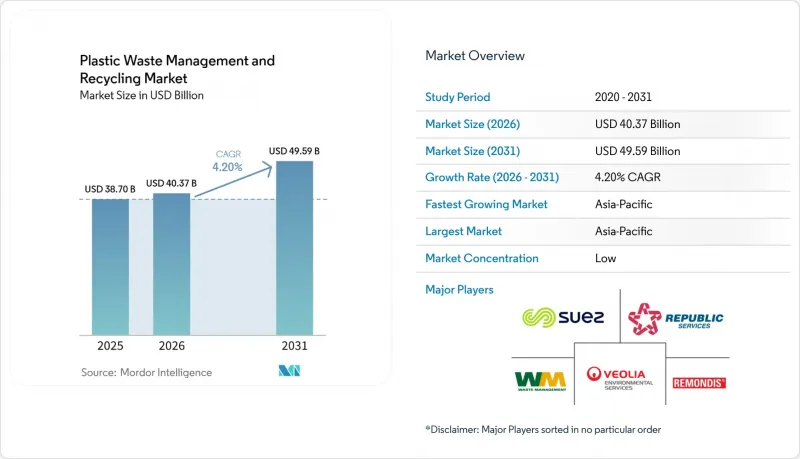
Mordor Intelligence에 의하면, 플라스틱 폐기물 관리 및 재활용 시장 규모는 2025년에 387억 달러, 2026년에 403억 7,000만 달러가 되고, 2031년까지 495억 9,000만 달러에 이를 것으로 예측되며, 2026년부터 2031년까지 CAGR 4.20%로 성장할 전망입니다.
본 보고서는 발생원별(주거, 상업, 산업, 기타), 폴리머 유형별(폴리에틸렌, 기타), 서비스 유형별(수집, 운송, 선별·분리, 기타), 최종 사용 산업별(포장, 기타), 재활용 방법별(기계적 재활용, 기타)로 분류되어 있습니다. 시장 전망은 금액(달러) 및 수량(톤) 단위로 제시되어 있습니다.
전 세계 플라스틱 폐기물 관리 및 재활용 시장 동향과 인사이트
규제 압력 증가: EPR 및 일회용 플라스틱 금지
플라스틱 폐기물 관리 및 재활용 시장은 시범 프로그램에서 법적 구속력이 있는 국가 및 지역 규정으로 전환된 규제에 의해 주도되고 있습니다. 캘리포니아주의 SB 54는 2026년 5월 1일에 시행되며, 2027년부터 생산자에게 연간 5억 달러 규모의 완화 프로그램에 대한 지원을 의무화하고 있습니다. 또한 2032년까지 일회용 플라스틱을 25% 감축하고, 완전히 재활용 가능하거나 퇴비화 가능한 포장재로 전환해야 합니다. 영국의 ‘2024년 생산자 책임 의무 규정’에서는 플라스틱에 대해 2026년 57%, 2027년 59%라는 소재별 재활용 목표가 도입된 것은 물론, 재활용이 어려운 포장 디자인에 대해 과태료를 부과하는 요금 체계도 마련되었습니다. 유럽연합(EU)의 ‘포장 및 포장 폐기물 규정’은 2025년에 발효되어 2026년 8월 12일부터 적용됩니다. 이 규정에서는 재활용 소재 함유율 목표가 설정되었으며, 카테고리를 불문하고 더욱 엄격한 포장 설계 규정이 정해져 있습니다. 캐나다 또한 ‘연방 플라스틱 등록 제도’를 통해 보고 체계를 구축하기 시작했으며, 보고 기준치를 초과하는 생산자에 대해서는 시장에 출시하는 플라스틱 제품의 공개를 의무화하고 있습니다. 이러한 규정이 단계적으로 정착됨에 따라, 플라스틱 폐기물 관리 및 재활용 시장은 일시적이고 단기적인 투자가 아닌, 회수 시스템, 포장 재설계, 재활용 계약, 규정 준수 체제에 대한 지속적인 지출의 혜택을 받고 있습니다.
전 세계 플라스틱 폐기물 발생량의 급증
플라스틱 폐기물 관리 및 재활용 시장이 확대되고 있는 또 다른 이유는 폐기물 발생량이 수거·처리 시스템의 대응 능력을 초과하는 속도로 증가하고 있기 때문입니다. 유엔환경계획(UNEP)은 2025년에 매년 1,900만-2,300만 톤의 플라스틱이 수생 생태계로 유입되고 있다고 지적하며, 이로 인해 정부와 생산자에게 폐기물 관리 시스템 개선을 요구하는 압력이 계속해서 가해지고 있습니다. OECD는 2024년, 정책의 목표 수준이 제한적인 상태로 유지된다면 2040년까지 연간 플라스틱 폐기물량이 70% 증가해 6억 1,700만 톤에 달할 가능성이 있다고 밝혔습니다. 포장재는 사용 주기가 짧고 전 세계 플라스틱 생산에서 차지하는 비중이 높기 때문에 이러한 흐름 속에서 가장 두드러지는 부분이며, 곧바로 사용 후 폐기물로 변합니다. 세계은행은 2026년 보고서에서 전 세계 폐기물 총량이 2050년까지 급증할 전망이며, 그 가장 큰 요인은 급속한 도시화가 진행되고 있는 지역에 있다고 지적했습니다. 이는 분리수거·수집·처리 시스템이 점점 더 큰 부담에 직면하게 될 것임을 의미합니다. 그 결과, 플라스틱 폐기물 관리 및 재활용 시장에서는 가정 쓰레기 수거 프로그램, 자원 회수 시스템의 고도화, 그리고 혼합 폐기물 흐름에 섞이기 전에 더 깨끗한 원료를 확보할 수 있는 보증금 제도에 대한 지지가 높아지고 있습니다.
수거·분리수거 시스템의 과제
플라스틱 폐기물 관리 및 재활용 시장은 여전히 근본적인 공급 제약에 직면해 있습니다. 이는 원료의 품질이 재활용 업체에 도착하기 전의 폐기물 수거 및 분리 방법에 좌우되기 때문입니다. 많은 시장에서 필름 수거는 여전히 제한적이며, 유연한 형태의 폐기물이 기존 시스템을 막고 있고, 지방 자치 단체에는 대규모로 깨끗한 베일을 생산하는 데 필요한 인프라가 여전히 부족합니다. 세계은행은 2026년, 저소득 지역에서 폐기물 수거 및 처리 격차가 특히 심각하여, 그 결과 대량의 원자재가 공식 수거 시스템의 범위를 벗어나 있다고 지적했습니다. 유엔환경계획(UNEP) 또한 부적절하게 관리된 플라스틱 폐기물의 유출 규모를 지적하며, 수거 체계의 취약성은 사소한 문제가 아니라 재활용 성장을 저해하는 핵심적인 제약 요인임을 밝혔습니다. 보증금 환불 제도는 음료 용기에 대해 보다 적절한 처리 경로를 제공하지만, 보편적인 것은 아니며 주요 경제국 간에도 도입 현황에 차이가 있습니다. 수거 체계가 확대되고 분리수거가 개선될 때까지 플라스틱 폐기물 관리 및 재활용 시장은 수율 저하, 운영 비용 상승, 그리고 고순도 재생 수지의 성장 둔화에 계속해서 직면하게 될 것입니다.
부문 분석
2025년, 산업 폐기물은 플라스틱 폐기물 관리 및 재활용 시장의 39.5%를 차지하며 가장 큰 공급원 부문이 되었습니다. 이는 산업 폐기물이 더 예측 가능한 양으로, 또한 더 깨끗한 단일 소재 스트림 형태로 반입되기 때문입니다. 트림 스크랩, 에지 폐기물, 라인사이드 포장 폐기물은 혼합된 가정용 플라스틱에 비해 포장, 선별, 재처리가 용이하기 때문에 재활용 업체에게 여전히 매력적인 소재입니다. 상업 폐기물은 전자상거래 물류, 소매 포장 흐름, 그리고 회수 비용을 기업 측에 전가하는 생산자 책임 규제의 강화에 힘입어 2031년까지 연평균 성장률(CAGR) 5.4%로 확대될 것으로 예측됩니다. 이러한 추세는 재활용 업체에 안정적인 원료 공급원을 제공할 것입니다.
생활폐기물은 장기적인 규모 확대 측면에서 여전히 중요하지만, 혼합 수거로 인한 품질 저하와 식품에 의한 오염으로 인해 활용 가능한 산출량이 감소하므로 수익 창출이 어렵습니다. 보증금 환불 제도는 음료 포장 분야에서 이러한 상황을 개선하고 있으며, 재활용 업체가 일반 쓰레기 수거 프로그램보다 고품질의 PET 및 HDPE 원료 흐름을 확보하는 데 도움이 되고 있습니다. 기관, 농업, 의료 분야의 포장 폐기물을 포함한 기타 발생원에서 나오는 원료 흐름은 여전히 규모는 작지만, 수거가 체계적으로 관리되고 폴리머의 혼합 비율이 낮을 경우 유용한 틈새 기회를 창출할 가능성이 있습니다. 앞으로 물류 네트워크, 소매 체인 및 생산자 부담 방식의 시스템이 재활용 가능한 포장재 회수를 중심으로 조직화됨에 따라, 플라스틱 폐기물 관리 및 재활용 시장에서 상업 폐기물이 산업 폐기물과의 격차를 좁혀갈 가능성이 높다고 볼 수 있습니다.
지역별 분석
아시아태평양은 2025년 플라스틱 폐기물 관리 및 재활용 시장 점유율의 38.4%를 차지하고 있으며, 2031년까지 연평균 성장률(CAGR) 4.9%를 나타낼 것으로 예측되어 가장 크고 가장 빠르게 성장하는 지역 부문으로 남을 전망입니다. 이 지역은 급속한 도시화, 막대한 포장 폐기물량, 폐기물 수입 규제 이후 증가한 국내 처리 수요, 그리고 순환형 소재 이용에 대한 정부의 폭넓은 노력 등의 혜택을 받고 있습니다. 중국의 순환 경제 추진과 포장 폐기물에 대한 규제 강화는 계속해서 국내 재활용 투자를 뒷받침하고 있으며, 또한 인도가 식품 포장에 재생 PET 사용을 허용함에 따라 고부가가치 국내 용도에 대한 전망이 개선되고 있습니다. 또한, 일본이 2030년까지 재활용 자원 확보를 위해 1조 엔(64억 달러)을 투입하겠다는 공약을 내건 것은 재활용 역량이 단순한 환경 문제에 그치지 않고 장기적인 산업 계획의 일부가 되어가고 있음을 보여줍니다. 이러한 요인들로 인해 아시아태평양의 플라스틱 폐기물 관리 및 재활용 시장은 다른 어느 지역보다 견고한 성장 기반을 갖추고 있습니다.
유럽은 여전히 규제 주도형 지역 시장으로서 가장 두드러진 존재입니다. 유럽연합(EU)의 ‘포장 및 포장 폐기물 규정’, 재생 소재 함유율에 관한 규정, 그리고 회수 목표에 따라 더 나은 분리 수거, 병 회수, 그리고 첨단 처리 인프라에 대한 투자가 촉진되고 있습니다. 북미에서는 캘리포니아주의 SB 54 법안과 같은 주 주도 정책을 통해 계속해서 탄력을 받고 있습니다. 그러나 통일된 연방 차원의 체계가 존재하지 않기 때문에 규정 준수 기준이나 투자 신호는 여전히 지역별로 편차를 보이고 있습니다. 그 결과, 북미의 플라스틱 폐기물 관리 및 재활용 시장에서는 활발한 프로젝트 활동이 이루어지고 있는 반면, 유럽에 비해 규제의 일관성은 낮은 상황입니다.
라틴아메리카, 중동 및 아프리카는 현재 시장 규모로는 여전히 작지만, 성장의 초기 단계에 있는 중요한 지역으로서 그 중요성이 커지고 있습니다. 재생 PET 생산 능력에 집중된 투자와 제조자 책임 제도의 단계적 보급을 통해, 규제의 전면 시행에 앞서 현지 처리 거점 구축이 진행되고 있습니다. 따라서 지역별 상황은 제각각이지만, 수요가 완전히 성숙하기 전에 새로운 생산 능력이 구축되고 있다는 점에서 전망은 긍정적입니다. 플라스틱 폐기물 관리 및 재활용 시장 전체를 살펴보면, 아시아태평양은 대규모로 확대되고 있으며, 유럽은 규제 강화를 통해 진전되고, 북미는 주 정부 주도의 프로그램을 통해 전진하고 있으며, 신흥 지역은 예측 기간 후반의 더욱 강력한 성장을 뒷받침할 수 있는 발판이 될 생산 능력을 구축하고 있습니다.
기타 혜택:
- 엑셀 형식 시장 예측(ME) 시트
- 3개월간의 애널리스트 지원
자주 묻는 질문
목차
제1장 서론
제2장 조사 방법
제3장 주요 요약
제4장 시장 구도
제5장 시장 규모와 성장 예측
제6장 경쟁 구도
제7장 시장 기회와 향후 전망
JHS 26.08.07According to Mordor Intelligence, the plastic waste management and recycling market size is projected to be USD 38.70 billion in 2025, USD 40.37 billion in 2026, and reach USD 49.59 billion by 2031, growing at a CAGR of 4.20% from 2026 to 2031.
This report is Segmented by Source (Residential, Commercial, Industrial, and Others), by Polymer Type (Polyethylene, and More), by Service Type (Collection, Transportation, Sorting & Segregation, and More), by End-User Industry (Packaging, and More), and by Recycling Methods (Mechanical Recycling, and More). The Market Forecasts are Provided in Terms of Value (USD) and Volume (Tons).
Global Plastic Waste Management and Recycling Market Trends and Insights
Increasing Regulatory Pressures: EPR and Bans on Single-Use Plastics
The plastic waste management and recycling market is being pushed forward by regulations that have shifted from pilot programs to binding national and regional rules. California's SB 54 became effective on May 1, 2026, and it requires producers to support a USD 500 million annual mitigation program from 2027, with a 25% reduction in single-use plastic by 2032 and a move toward fully recyclable or compostable packaging. The United Kingdom's Producer Responsibility Obligations Regulations 2024 introduced material-specific recycling targets for plastic at 57% in 2026 and 59% in 2027, alongside a fee structure that penalizes packaging designs that are hard to recycle. The European Union's Packaging and Packaging Waste Regulation entered into force in 2025 and applies from August 12, 2026. It sets recycled content targets and stricter packaging design rules across categories. Canada has also started building reporting discipline through the Federal Plastics Registry, which requires producers above the reporting threshold to disclose the plastic they place on the market. As these rules take hold in a staggered manner, the plastic waste management and recycling market is benefiting from sustained spending on collection systems, packaging redesign, recycling contracts, and compliance systems rather than a single, short burst of investment.
Surge in Global Plastic Waste Generation
The plastic waste management and recycling market is also expanding because waste generation is rising faster than collection and treatment systems can keep up. UNEP noted in 2025 that 19-23 million tonnes of plastic enter aquatic ecosystems each year, which continues to put pressure on governments and producers to improve waste management systems. The OECD stated in 2024 that annual plastic waste could rise by 70% to 617 million tonnes by 2040 if policy ambition remains limited. Packaging remains the most visible part of this flow because it has short use cycles and a high share of global plastic production, so it converts quickly into post-consumer waste. The World Bank reported in 2026 that total global waste volumes are on course to rise sharply by 2050, with the steepest pressure coming from fast urbanizing regions, which means sorting, collection, and disposal systems will face growing strain. As a result, the plastic waste management and recycling market is seeing stronger support for curbside programs, material recovery upgrades, and deposit systems that can capture cleaner feedstock before it is lost to mixed waste streams.
Challenges in Collection & Segregation Systems
The plastic waste management and recycling market still faces a basic supply constraint because feedstock quality depends on how waste is collected and separated before it reaches a recycler. In many markets, film collection remains limited, flexible formats clog existing systems, and local authorities still lack the infrastructure needed to produce clean bales at scale. The World Bank highlighted in 2026 that waste collection and treatment gaps remain especially severe in lower-income settings, which keeps large volumes of material outside formal recovery systems. UNEP also pointed to the scale of mismanaged plastic leakage, showing that collection weaknesses are not a marginal issue but a central limit on recycling growth. Deposit return systems offer a cleaner route for beverage containers, but they are not universal, and their rollout is uneven across major economies. Until collection expands and segregation improves, the plastic waste management and recycling market will continue to face lower yields, higher operating costs, and slower growth in high-purity recycled resin.
Other drivers and restraints analyzed in the detailed report include:
- Expansion of Packaging & E-Commerce Waste
- Boosted Investments in Recycling Infrastructure
- Contaminated Plastic Waste Streams
For complete list of drivers and restraints, kindly check the Table Of Contents.
Segment Analysis
Industrial waste accounted for 39.5% of the plastic waste management and recycling market in 2025, making it the largest source segment because it arrives in more predictable volumes and cleaner mono-material streams. Trim scrap, edge waste, and line-side packaging waste remain attractive to recyclers because they are easier to bale, sort, and reprocess than mixed household plastics. Commercial waste is forecast to expand at 5.4% CAGR through 2031, supported by e-commerce distribution, retail packaging flows, and tighter producer responsibility rules that are moving collection costs back to businesses. This pattern provides recyclers with a stable feedstock base.
Residential waste remains important for long-term scale, but it is harder to monetize because quality losses from co-mingled collection and food contamination reduce usable output. Deposit return systems improve this picture for beverage packaging, and they help recyclers secure cleaner PET and HDPE streams than standard curbside programs usually deliver. Other source streams, including institutional, agricultural, and medical packaging waste, remain smaller but can create useful niche opportunities where collection is controlled, and the polymer mix is narrow. Over time, the plastic waste management and recycling market is likely to see commercial waste narrow the gap with industrial waste as logistics networks, retail chains, and producer-funded systems become more organized around the recovery of recyclable packaging.
Complete Report Scope:
- By Source
- Residential
- Commercial (retail, office, etc.)
- Industrial
- Others (institutional, agricultural, etc)
- By Polymer Type
- Polyethylene (PE)
- Polypropylene (PP)
- Polyethylene Terephthalate (PET)
- Polyvinyl Chloride (PVC)
- Polystyrene (PS)
- Others
- By Service Type
- Collection, Transportation, Sorting & Segregation
- Disposal / Treatment
- Landfill
- Recycling & Resource Recovery
- Incineration & Waste-to-Energy
- Others (Chemical Treatment, Composting, etc.)
- Others (Consulting, Audit & Training, etc.)
- By End-User Industry
- Packaging
- Construction & Demolition
- Automotive & Transportation
- Consumer Goods
- Medical & Healthcare
- Electrical & Electronics
- Others
- By Recycling Methods
- Mechanical Recycling
- Chemical Recycling
- Thermal Recycling
- Others
- By Geography
- North America
- United States
- Canada
- Mexico
- South America
- Brazil
- Argentina
- Chile
- Rest of South America
- Europe
- Germany
- United Kingdom
- France
- Italy
- Spain
- Russia
- BENELUX (Belgium, Netherlands, and Luxembourg)
- NORDICS (Denmark, Finland, Iceland, Norway, and Sweden)
- Rest of Europe
- Asia-Pacific
- China
- India
- Japan
- South Korea
- Australia
- Southeast Asia (Indonesia, Vietnam, Thailand, Malaysia, Philippines)
- Rest of Asia-Pacific
- Middle East & Africa
- United Arab Emirates
- Saudi Arabia
- Turkey
- Qatar
- South Africa
- Egypt
- Nigeria
- Rest of Middle East & Africa
- North America
Geography Analysis
Asia-Pacific accounted for 38.4% of the plastic waste management and recycling market share in 2025 and is forecast to grow at 4.9% CAGR through 2031, keeping it both the largest and fastest-growing regional segment. The region benefits from rapid urbanization, high packaging volumes, stronger domestic processing needs after waste-import controls, and wider government focus on circular material use. China's circular economy push and tighter controls on packaging waste continue to support local recycling investment, and India's acceptance of recycled PET for food packaging has improved the outlook for higher-value domestic applications. Japan's commitment to mobilize JPY 1 trillion (USD 6.40 billion) by 2030 for recycled resource security also shows that recycling capacity is becoming part of long-term industrial planning rather than a narrow environmental issue. These factors give the plastic waste management and recycling market a stronger growth base in Asia-Pacific than in any other geography.
Europe remains the most regulation-led regional market. The European Union's Packaging and Packaging Waste Regulation, recycled content rules, and collection targets are forcing investment in better sorting, bottle recovery, and advanced processing infrastructure. North America continues to build momentum through state-led policies such as California SB 54. However, the absence of a single federal framework means compliance standards and investment signals are still fragmented across the region. That leaves the North American plastic waste management and recycling market with solid project activity but less regulatory consistency than in Europe.
Latin America, the Middle East, and Africa remain smaller in current value, but they are becoming more important as early-stage growth corridors. Targeted investments in recycled PET capacity and the gradual spread of producer responsibility rules are helping establish local processing bases ahead of wider enforcement. The regional story is therefore uneven, but directionally positive, because new capacity is being built before demand is fully mature. Across the plastic waste management and recycling market, Asia-Pacific is expanding on scale, Europe is advancing through regulatory depth, North America is progressing through state-led programs, and emerging regions are building beachhead capacity that could support stronger growth later in the forecast period.
- Veolia Environnement S.A.
- SUEZ
- Waste Management Inc.
- Republic Services
- Remondis SE & Co. KG
- Waste Connections
- Clean Harbors
- Biffa
- Reworld (Covanta Holding Corporation)
- FCC Environment
- Eastman
- Urbaser
- KW Plastics
- TerraCycle
- Loop Industries
- Carbios
- GFL Environmental
- Hawkvale Limited
- Hahn Plastics Limited
- Recology Inc.
Additional Benefits:
- The market estimate (ME) sheet in Excel format
- 3 months of analyst support
TABLE OF CONTENTS
1 Introduction
- 1.1 Study Assumptions & Market Definition
- 1.2 Scope of the Study
2 Research Methodology
3 Executive Summary
4 Market Landscape
- 4.1 Market Overview
- 4.2 Market Drivers
- 4.2.1 Increasing Regulatory Pressures: EPR and Bans on Single-Use Plastics
- 4.2.2 Surge in Global Plastic Waste Generation
- 4.2.3 Expansion of Packaging & E-commerce Waste
- 4.2.4 Boosted Investments in Recycling Infrastructure
- 4.2.5 Transition Towards Circular Economy Models
- 4.2.6 Growing Demand for Recycled Plastics (PCR Materials)
- 4.3 Market Restraints
- 4.3.1 Challenges in Collection & Segregation Systems
- 4.3.2 Expensive Advanced Recycling Technologies
- 4.3.3 Contaminated Plastic Waste Streams
- 4.3.4 Fluctuating Prices of Recycled Plastics
- 4.4 Value / Supply-Chain Analysis
- 4.5 Regulatory Landscape
- 4.6 Technological Outlook
- 4.7 Porter's Five Forces
- 4.7.1 Threat of New Entrants
- 4.7.2 Bargaining Power of Suppliers
- 4.7.3 Bargaining Power of Buyers
- 4.7.4 Threat of Substitutes
- 4.7.5 Industry Rivalry
- 4.8 Startup Ecosystem Analysis
- 4.9 Analysis of Recycled Plastics on Virgin Plastics
- 4.10 Global Trade Flows & Import Restrictions (waste plastics)
5 Market Size and Growth Forecasts (Value & Volume)
- 5.1 By Source
- 5.1.1 Residential
- 5.1.2 Commercial (retail, office, etc.)
- 5.1.3 Industrial
- 5.1.4 Others (institutional, agricultural, etc)
- 5.2 By Polymer Type
- 5.2.1 Polyethylene (PE)
- 5.2.2 Polypropylene (PP)
- 5.2.3 Polyethylene Terephthalate (PET)
- 5.2.4 Polyvinyl Chloride (PVC)
- 5.2.5 Polystyrene (PS)
- 5.2.6 Others
- 5.3 By Service Type
- 5.3.1 Collection, Transportation, Sorting & Segregation
- 5.3.2 Disposal / Treatment
- 5.3.2.1 Landfill
- 5.3.2.2 Recycling & Resource Recovery
- 5.3.2.3 Incineration & Waste-to-Energy
- 5.3.2.4 Others (Chemical Treatment, Composting, etc.)
- 5.3.3 Others (Consulting, Audit & Training, etc.)
- 5.4 By End-User Industry
- 5.4.1 Packaging
- 5.4.2 Construction & Demolition
- 5.4.3 Automotive & Transportation
- 5.4.4 Consumer Goods
- 5.4.5 Medical & Healthcare
- 5.4.6 Electrical & Electronics
- 5.4.7 Others
- 5.5 By Recycling Methods
- 5.5.1 Mechanical Recycling
- 5.5.2 Chemical Recycling
- 5.5.3 Thermal Recycling
- 5.5.4 Others
- 5.6 By Geography
- 5.6.1 North America
- 5.6.1.1 United States
- 5.6.1.2 Canada
- 5.6.1.3 Mexico
- 5.6.2 South America
- 5.6.2.1 Brazil
- 5.6.2.2 Argentina
- 5.6.2.3 Chile
- 5.6.2.4 Rest of South America
- 5.6.3 Europe
- 5.6.3.1 Germany
- 5.6.3.2 United Kingdom
- 5.6.3.3 France
- 5.6.3.4 Italy
- 5.6.3.5 Spain
- 5.6.3.6 Russia
- 5.6.3.7 BENELUX (Belgium, Netherlands, and Luxembourg)
- 5.6.3.8 NORDICS (Denmark, Finland, Iceland, Norway, and Sweden)
- 5.6.3.9 Rest of Europe
- 5.6.4 Asia-Pacific
- 5.6.4.1 China
- 5.6.4.2 India
- 5.6.4.3 Japan
- 5.6.4.4 South Korea
- 5.6.4.5 Australia
- 5.6.4.6 Southeast Asia (Indonesia, Vietnam, Thailand, Malaysia, Philippines)
- 5.6.4.7 Rest of Asia-Pacific
- 5.6.5 Middle East & Africa
- 5.6.5.1 United Arab Emirates
- 5.6.5.2 Saudi Arabia
- 5.6.5.3 Turkey
- 5.6.5.4 Qatar
- 5.6.5.5 South Africa
- 5.6.5.6 Egypt
- 5.6.5.7 Nigeria
- 5.6.5.8 Rest of Middle East & Africa
- 5.6.1 North America
6 Competitive Landscape
- 6.1 Market Concentration
- 6.2 Strategic Moves
- 6.3 Market Share Analysis
- 6.4 Company Profiles {(includes Global level Overview, Market level overview, Core Segments, Financials as available, Strategic Information, Market Rank/Share for key companies, Products & Services, and Recent Developments)}
- 6.4.1 Veolia Environnement S.A.
- 6.4.2 SUEZ
- 6.4.3 Waste Management Inc.
- 6.4.4 Republic Services
- 6.4.5 Remondis SE & Co. KG
- 6.4.6 Waste Connections
- 6.4.7 Clean Harbors
- 6.4.8 Biffa
- 6.4.9 Reworld (Covanta Holding Corporation)
- 6.4.10 FCC Environment
- 6.4.11 Eastman
- 6.4.12 Urbaser
- 6.4.13 KW Plastics
- 6.4.14 TerraCycle
- 6.4.15 Loop Industries
- 6.4.16 Carbios
- 6.4.17 GFL Environmental
- 6.4.18 Hawkvale Limited
- 6.4.19 Hahn Plastics Limited
- 6.4.20 Recology Inc.
7 Market Opportunities & Future Outlook
- 7.1 White-space & unmet-need assessment


