

|
시장보고서
상품코드
2117381
아프리카의 광산 기계 : 시장 점유율 분석, 산업 동향 및 통계 데이터, 성장 예측(2026-2031년)Africa Mining Equipment - Market Share Analysis, Industry Trends & Statistics, Growth Forecasts (2026 - 2031) |
||||||
 Mordor Intelligence
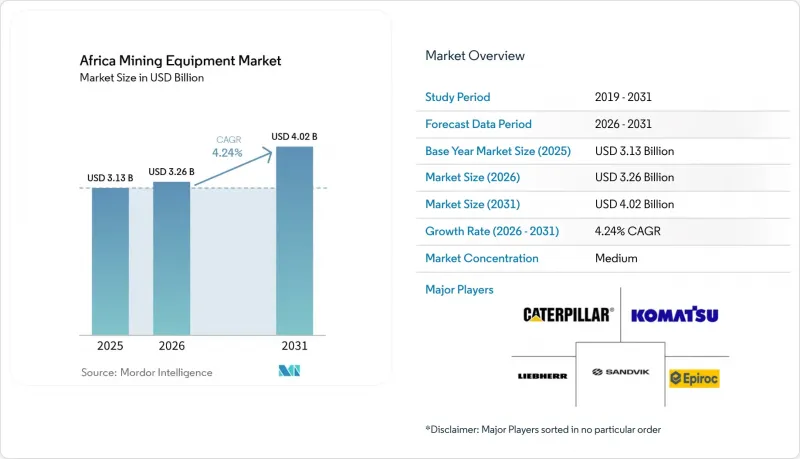
Mordor Intelligence에 의하면, 아프리카의 광산 기계 시장 규모는 2025년에 31억 3,000만 달러로 평가되었습니다. 2026년 32억 6,000만 달러에서 2031년까지 40억 2,000만 달러로 확대되어 2026년부터 2031년까지 연평균 성장률(CAGR)은 4.24%를 나타낼 것으로 예측됩니다.
본 보고서는 기계 유형(노천 채굴용 기계, 지하 채굴용 기계 등), 자동화 수준(수동식 기계, 반자동식 기계 등), 파워트레인 유형(내연기관 차량, 배터리식 전기자동차 등), 출력, 용도 및 국가별로 분류되어 있습니다. 시장 전망은 금액(미 달러) 및 수량(대)으로 제시되어 있습니다.
아프리카의 광산 기계 시장 동향 및 인사이트
아프리카 내 노천 채굴 프로젝트의 급속한 확대
기니의 시만두 철광석 복합 시설이나 콩고 민주 공화국(DRC)의 289억 달러 규모의 MIFOR 개발 프로젝트와 같은 노천 채굴 메가 프로젝트가 울트라급 운반 트럭, 대용량 로프 굴삭기, 파쇄 설비의 수주를 뒷받침하고 있습니다. 코마츠는 2025년 2월, 시만두에 PC5500-11 굴삭기 5대를 납품하는 대형 계약을 발표했습니다. 이는 400톤급 중장비가 운송 비용을 절감하고 생산성을 향상시킨다는 것을 보여줍니다. 또한 모로코에 위치한 Tractafric Equipment 시설 등 현지 재생 거점에서는 주요 부품의 재생 정비를 실시하여 리드 타임 단축과 애프터서비스 체제 강화를 도모하고 있습니다. 따라서 노천 채굴용 기계군은 기계 교체 수요의 기반이 되어, 2031년까지 아프리카의 광산 기계 시장의 거의 절반을 지탱해 나갈 전망입니다.
정부 주도의 인프라 정비 사업이 철광석 및 골재 수요를 끌어올릴 전망
총 연장 1,300km에 달하는 로비토 회랑에 대한 다자간 자금 지원으로 구리 및 철광석의 운송 비용이 절감되어, 철도 적재용 호퍼와 이동식 파쇄기의 조달이 촉진되고 있습니다. 마찬가지로, 2028년까지 총 길이 670km의 철도 노선을 완공하겠다는 기니의 계획 역시 선로 부설 및 골재 처리용 기계가 필요합니다. 남아프리카공화국의 ‘국가개발계획’에서는 인프라 예산의 5분의 1 가까이가 광업 관련 물류 인프라 구축에 배정되어 있어, 그레이더와 페버에 대한 수요를 뒷받침하고 있습니다. 따라서 공공 부문의 인프라 계획 덕분에 상품 가격 변동 주기에도 불구하고 장비 수주는 견조한 추세를 보이고 있습니다.
원자재 가격 변동이 설비 투자 주기에 미치는 영향
최근 구리 가격이 급락함에 따라, 콩고 민주 공화국이나 잠비아 등 지역의 생산자들은 계획했던 확장을 연기하고, 기계 발주를 축소할 수밖에 없는 상황입니다. 이러한 동향은 상품 시장 전반의 침체를 반영하고 있으며, 철광석, 석탄, 비철금속 등 주요 원자재도 가격 압박에 직면해 있습니다. 이러한 변동으로 인해 OEM 각사는 기동성을 유지하고 생산 일정을 조정하는 한편, 중요한 예비 부품 재고를 확보하여 서비스 제공 및 계약 이행이 중단되지 않도록 해야 합니다.
부문별 분석
2025년, 아프리카의 광산 기계 시장에서 노천 채굴용 기계가 46.65%를 차지했습니다. 400톤급 로프 굴삭기 및 220톤급 운반 트럭의 도입으로 철광석 및 구리 채굴 사업에서의 규모의 경제가 강화되고 있습니다. 이 부문은 제로 배출 로더에 대한 세제 혜택의 수혜를 받고 있으며, 백금 광산에서 배터리식 전기 구동기의 시범 도입이 촉진되고 있습니다. 동시에, 로더 및 운반 트럭 시장은 2031년까지 연평균 성장률(CAGR) 5.17%로 확대될 것으로 예측됩니다. 남아프리카의 심부 금광에서 매장량이 고갈되고 있어 지하용 기계 수요는 정체되어 있습니다. 그러나 전동 로더는 열 부하를 줄이고 환기 효율을 높임으로써 수요 감소를 완화하고 있습니다.
파쇄·선별·광물 처리 라인은 노천 채굴 광산과 인프라 정비 모두에 기여하고 있으며, 채석장에서 생산되는 골재는 철도 및 도로 건설을 뒷받침하고 있습니다. 나이지리아와 알제리에서 현지 선광 의무화가 시행됨에 따라, 부유선별기 및 농축기 구매가 촉진되고 있으며, 조달 동향이 처리 회로로 전환되고 있습니다. 드릴과 브레이커는 희토류 탐사의 혜택을 받고 있습니다. 동시에 로더와 운반 트럭은 대용량 및 저배출 차량군으로의 교체 주기를 주도하며, 아프리카의 광산 기계 시장을 견인하고 있습니다.
2025년 시점에서 아프리카의 광산 기계 시장에서 수동식 기계가 66.73%를 차지했습니다. 이는 인건비가 비교적 낮게 유지되고 있으며, 통신 인프라의 격차가 여전히 존재하기 때문입니다. 그럼에도 불구하고, 각 광산 기업들이 심부 채굴 현장의 안전성을 우선시함에 따라, 완전 자동화 시스템은 2031년까지 연평균 성장률(CAGR) 18.38%를 나타낼 것으로 예측됩니다. 또한, 기존 트럭의 비용을 상각하면서 충돌 회피 기능이나 생산성 향상과 같은 이점을 누릴 수 있기 때문에 사후 개조 수요가 증가하고 있습니다. 중국의 OEM 기업들은 저가형 자율주행 키트로 유럽 및 미국의 경쟁사보다 가격 경쟁력을 확보하며, 중견 광산 사업자로의 보급을 확대되고 있습니다.
원격 조작식 드릴을 포함한 반자동형 솔루션은 통신 환경이 불안정하지만 위성 서비스를 통해 점차 개선되고 있는 현장에서 운영상의 기능 격차를 해소하고 있습니다. 현재 규제 체계상 위험 평가가 의무화되어 있으나, 당국이 시범 프로젝트에서 사고 발생률이 감소하고 있음을 확인함에 따라 승인 절차가 가속화되고 있습니다. 이러한 정책적 진전은 아프리카의 광산 기계 시장 전체의 장기적인 자동화 전환을 뒷받침하는 것입니다.
기타 혜택 :
- 엑셀 형식 시장 예측(ME) 시트
- 3개월간의 애널리스트 지원
자주 묻는 질문
목차
제1장 서론
제2장 분석 방법
제3장 개요
제4장 시장 구도
제5장 시장 규모 및 성장률 예측
제6장 경쟁 구도
제7장 시장 기회 및 향후 전망
KTH 26.09.02According to Mordor Intelligence, the Africa mining equipment market size was valued at USD 3.13 billion in 2025 and is projected to expand from USD 3.26 billion in 2026 to USD 4.02 billion by 2031, registering a CAGR of 4.24% between 2026 and 2031.
This report is Segmented by Equipment Type (Surface Mining Equipment, Underground Mining Equipment, and More), Automation Level (Manual Equipment, Semi-Autonomous Equipment, and More), Powertrain Type (Internal-Combustion Engine Vehicles, Battery-Electric Vehicles, and More), Power Output, Application, and Country. The Market Forecasts are Provided in Terms of Value (USD) and Volume (Units).
Africa Mining Equipment Market Trends and Insights
Rapid Expansion of Surface Mining Projects in Africa
Open-pit mega-projects such as Guinea's Simandou iron ore complex and the DRC's USD 28.9 billion MIFOR development are fueling orders for ultra-class haul trucks, high-capacity rope shovels, and crushing circuits . Komatsu announced a major contract to deliver five PC5500-11 excavators to Simandou in February 2025, illustrating how 400-tonne-class machinery lowers haulage costs and boosts productivity. Local rebuild hubs, for example, Tractafric Equipment's facility in Morocco, now refurbish key components to shorten lead times and strengthen after-sales offerings. Surface fleets, therefore, anchor replacement demand and underpin nearly half of the African mining equipment market through 2031.
Government-Led Infrastructure Programs Boosting Iron-Ore and Aggregates Demand
Multilateral financing of the 1,300 km Lobito Corridor compresses transport costs for copper and iron ore, stimulating procurement of rail-loading hoppers and mobile crushers. Guinea's commitment to complete a 670 km rail line by 2028 likewise requires track-laying and aggregate-processing machinery. South Africa's National Development Plan allocates nearly one-fifth of its infrastructure budget to mining-linked logistics upgrades, sustaining demand for graders and pavers. Public-sector infrastructure agendas, therefore, reinforce steady equipment orders despite commodity-price cycles.
Commodity-Price Volatility Affecting CAPEX Cycles
In recent times, copper prices have declined sharply, prompting producers in regions such as the DRC and Zambia to delay planned expansions and scale back equipment orders. This trend reflects a broader downturn in the commodity market, with key materials such as iron ore, coal, and base metals also facing price pressures. These fluctuations force OEMs to remain agile, adjusting production schedules and maintaining inventories of critical spare parts to ensure uninterrupted service delivery and contract fulfillment.
Other drivers and restraints analyzed in the detailed report include:
- Rising Investments in Battery-Electric Mining Trucks
- Growth in Rare-Earth Exploration Driving Specialized Drilling Demand
- High Upfront Cost of Autonomous and Electric Equipment
For complete list of drivers and restraints, kindly check the Table Of Contents.
Segment Analysis
Surface machinery accounted for 46.65% of the African mining equipment market in 2025. The adoption of 400-tonne rope shovels and 220-tonne haul trucks enhances economies of scale in iron ore and copper operations. The segment benefits from tax incentives that favor zero-emission loaders, spurring pilot deployments of battery-electric units at platinum sites. At the same time, loaders and haul trucks are forecasted to expand at a 5.17% CAGR through 2031. Underground equipment trails as reserves in deep-level South African gold mines deplete, yet electrified loaders reduce heat load and improve ventilation efficiency, moderating the decline in demand.
Crushing, screening, and mineral-processing lines serve both open-pit and infrastructure pipelines, where quarry aggregates underpin rail and road corridors. Local beneficiation mandates in Nigeria and Algeria stimulate purchases of flotation cells and thickeners, reshaping procurement toward processing circuits. Drills and breakers benefit from rare-earth exploration. At the same time, loaders and haul trucks lead the substitution cycle toward higher-capacity, lower-emission fleets, driving the African mining equipment market forward.
Manual fleets accounted for 66.73% of the African mining equipment market in 2025, as labor costs remain comparatively low and connectivity gaps persist. Nevertheless, fully autonomous systems are projected to post a 18.38% CAGR to 2031 as mines prioritize safety in deep-level stopes. Retrofits are gaining popularity, allowing operators to amortize the cost of existing trucks while capturing collision-avoidance and productivity benefits. Chinese OEMs undercut Western rivals with lower-priced autonomy kits, widening access for mid-tier miners.
Semi-autonomous solutions, including tele-operated drills, bridge capability gaps in operations where connectivity is intermittent but improving through satellite services. Regulatory frameworks now require risk assessments, yet approvals are accelerating as authorities observe lower accident rates in pilot projects. This policy evolution supports the long-term transition toward autonomy across the African mining equipment market.
Complete Report Scope:
- By Equipment Type
- Surface Mining Equipment
- Underground Mining Equipment
- Mineral Processing Equipment
- Drills and Breakers
- Crushing, Pulverizing and Screening
- Loaders and Haul Trucks
- By Automation Level
- Manual Equipment
- Semi-Autonomous Equipment
- Fully Autonomous Equipment
- By Powertrain Type
- Internal-Combustion Engine Vehicles
- Battery-Electric Vehicles
- Hybrid Vehicles
- By Power Output
- Less than 500 HP
- 500 - 1,000 HP
- Above 1,000 HP
- By Application
- Metal Mining
- Mineral Mining
- Coal Mining
- By Country
- South Africa
- Nigeria
- Algeria
- Democratic Republic of Congo (DRC)
- Libya
- Rest of Africa
List of Companies Covered in this Report:
- Caterpillar Inc.
- Komatsu Ltd.
- Liebherr-International AG
- Sandvik AB
- Epiroc AB
- Hitachi Construction Machinery Co., Ltd.
- Volvo Construction Equipment
- Doosan Infracore
- XCMG Group
- Sany Group
- Bell Equipment
- Manitou Group
- Wirtgen Group
- Terex Corporation
- JCB
- Metso Outotec
- FLSmidth
- Astec Industries
- Hyundai Construction Equipment
Additional Benefits:
- The market estimate (ME) sheet in Excel format
- 3 months of analyst support
TABLE OF CONTENTS
1 Introduction
- 1.1 Study Assumptions & Market Definition
- 1.2 Scope of the Study
2 Research Methodology
3 Executive Summary
4 Market Landscape
- 4.1 Market Overview
- 4.2 Market Drivers
- 4.2.1 Rapid Expansion of Surface Mining Projects in Africa
- 4.2.2 Government-Led Infrastructure Programs Boosting Iron-Ore and Aggregates Demand
- 4.2.3 Rising Investments in Battery-Electric Mining Trucks
- 4.2.4 Growth in Rare-Earth Exploration Driving Specialized Drilling Demand
- 4.2.5 Uptake of Predictive Maintenance via Satellite Connectivity
- 4.2.6 Localization of OEM Assembly and Rebuild Centers Across Africa
- 4.3 Market Restraints
- 4.3.1 Commodity-Price Volatility Affecting CAPEX Cycles
- 4.3.2 High Upfront Cost of Autonomous and Electric Equipment
- 4.3.3 Persistent Supply-Chain Disruptions for Critical Components
- 4.3.4 Counterfeit Spare-Parts Proliferation Eroding OEM Trust
- 4.4 Value / Supply-Chain Analysis
- 4.5 Regulatory Landscape
- 4.6 Technological Outlook
- 4.7 Porter's Five Forces
- 4.7.1 Threat of New Entrants
- 4.7.2 Bargaining Power of Suppliers
- 4.7.3 Bargaining Power of Buyers
- 4.7.4 Threat of Substitutes
- 4.7.5 Industry Rivalry
5 Market Size & Growth Forecasts (Value (USD) & Volume (Units))
- 5.1 By Equipment Type
- 5.1.1 Surface Mining Equipment
- 5.1.2 Underground Mining Equipment
- 5.1.3 Mineral Processing Equipment
- 5.1.4 Drills and Breakers
- 5.1.5 Crushing, Pulverizing and Screening
- 5.1.6 Loaders and Haul Trucks
- 5.2 By Automation Level
- 5.2.1 Manual Equipment
- 5.2.2 Semi-Autonomous Equipment
- 5.2.3 Fully Autonomous Equipment
- 5.3 By Powertrain Type
- 5.3.1 Internal-Combustion Engine Vehicles
- 5.3.2 Battery-Electric Vehicles
- 5.3.3 Hybrid Vehicles
- 5.4 By Power Output
- 5.4.1 Less than 500 HP
- 5.4.2 500 - 1,000 HP
- 5.4.3 Above 1,000 HP
- 5.5 By Application
- 5.5.1 Metal Mining
- 5.5.2 Mineral Mining
- 5.5.3 Coal Mining
- 5.6 By Country
- 5.6.1 South Africa
- 5.6.2 Nigeria
- 5.6.3 Algeria
- 5.6.4 Democratic Republic of Congo (DRC)
- 5.6.5 Libya
- 5.6.6 Rest of Africa
6 Competitive Landscape
- 6.1 Market Concentration
- 6.2 Strategic Moves
- 6.3 Market Share Analysis
- 6.4 Company Profiles (Includes Global Level Overview, Market Level Overview, Core Segments, Financials as Available, Strategic Information, Market Rank/Share for Key Companies, Products and Services, SWOT Analysis, and Recent Developments)
- 6.4.1 Caterpillar Inc.
- 6.4.2 Komatsu Ltd.
- 6.4.3 Liebherr-International AG
- 6.4.4 Sandvik AB
- 6.4.5 Epiroc AB
- 6.4.6 Hitachi Construction Machinery Co., Ltd.
- 6.4.7 Volvo Construction Equipment
- 6.4.8 Doosan Infracore
- 6.4.9 XCMG Group
- 6.4.10 Sany Group
- 6.4.11 Bell Equipment
- 6.4.12 Manitou Group
- 6.4.13 Wirtgen Group
- 6.4.14 Terex Corporation
- 6.4.15 JCB
- 6.4.16 Metso Outotec
- 6.4.17 FLSmidth
- 6.4.18 Astec Industries
- 6.4.19 Hyundai Construction Equipment
7 Market Opportunities & Future Outlook
- 7.1 White-space & Unmet-Need Assessment


