

|
시장보고서
상품코드
2117389
말레이시아의 광산 기계 : 시장 점유율 분석, 산업 동향 및 통계 데이터, 성장 예측(2026-2031년)Malaysia Mining Equipment - Market Share Analysis, Industry Trends & Statistics, Growth Forecasts (2026 - 2031) |
||||||
 Mordor Intelligence
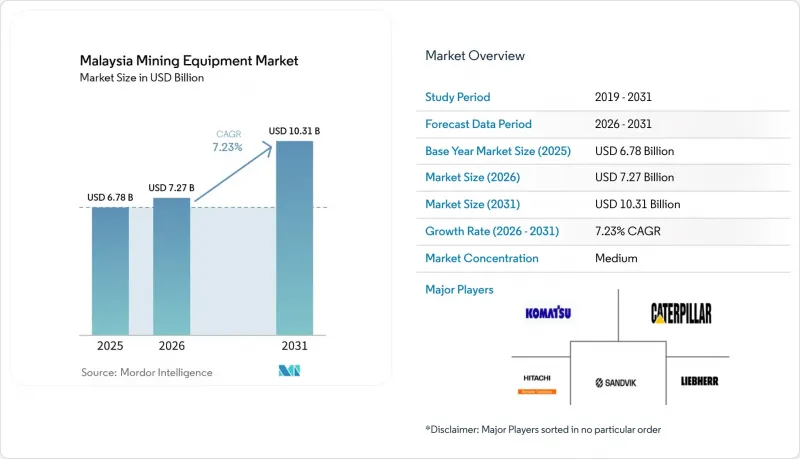
Mordor Intelligence에 의하면, 말레이시아의 광산 기계 시장 규모는 2025년에 67억 8,000만 달러로 평가되었습니다. 2026년 72억 7,000만 달러에서 2031년까지 103억 1,000만 달러에 이를 것으로 추정되고 예측 기간(2026-2031년) CAGR은 7.23%를 나타낼 전망입니다.
본 보고서는 기계 유형(노천 채굴용 기계 등), 자동화 수준(수동 등), 파워트레인 유형(내연기관 등), 출력(500 HP 미만 등), 용도(금속 등) 및 지역별로 분류되어 있습니다. 시장 전망은 금액(미 달러) 및 수량(대) 단위로 제시되어 있습니다.
말레이시아의 광산 기계 시장 동향 및 인사이트
EV 공급망을 위한 중요 광물 수요 급증
말레이시아의 배터리 재료에 대한 노력은 보크사이트와 주석에만 그치지 않습니다. 라이너스(Linus)사는 2025년 상반기에 4,600톤의 NdPr 산화물을 출하하여 전년 동기 대비 12% 증가를 기록하며, 전 세계 자석 공급을 뒷받침했습니다. 포트리스 미네랄스(Fortress Minerals)는 2025년, 부킷 베시와 멘가푸르에 메초(Metso)사의 파쇄기를 발주하여 철광석 및 구리·금 정광의 처리 능력을 확대했습니다. 사바주의 보타니켈(Botanickel)사가 실시한 피토마이닝(phytomining) 시험에서는 초축적 식물을 이용하여 라테라이트 토양에서 니켈을 추출하고 있으며, 이로 인해 대형 토목 기계보다 고가인 고압 분쇄 롤 및 부유 선별 셀 수요가 견인되고 있습니다. 광물 처리 유닛에 물 재활용 시스템을 통합할 수 있는 기계 공급업체는 환경 규제가 강화됨에 따라 높은 이익률을 확보하고 있습니다.
스마트 마이닝 및 자동화 솔루션 도입 가속화
자율 주행 기술은 호주의 메가 광산에서 동남아시아의 중규모 광산으로 확산되고 있습니다. 2026년 3월 에피록(Epilock)사가 수주한 3억 8,000만 스웨덴 크로나 규모의 프로젝트는 호주를 제외한 해당 지역 내 자율 주행 차량 계약 중 최대 규모 중 하나가 되었습니다. 코마츠가 2025년 11월 방콕 모터 웍스와 체결한 합작 사업에서는 적재량 추적 기능과 충돌 회피 기능을 통합한 반자동식 굴삭기를 조립하여, 말레이시아 채석장의 사후 개조 비용을 절감합니다. 히타치가 2024년 1월에 출시한 ‘ZAXIS-7G’ 시리즈는 연료, 유압, 마모에 관한 실시간 데이터를 클라우드 대시보드로 전송하여 가동 중지 시간을 최대 30% 줄입니다. 사라왁 주의 ‘Centexs Lawas Green Mining Academy’는 2025년 12월부터 작업자 교육을 시작하여, 도입의 걸림돌이 되어 온 기술 격차 해소를 도모하고 있습니다. 현재 조달 체계에서는 초기 비용뿐만 아니라 소프트웨어 및 연결성을 포함한 수명 주기 총 소유 비용이 비교되고 있습니다.
환경 허가 강화와 보크사이트 채굴 일시 중단
2016년에 도입되어 2019년에 일부 해제된 보크사이트 수출 금지 조치로 인해, 사업자는 여전히 운반 도로 포장, 스톡파일 피복, 실시간 수질 모니터링 장치 설치를 의무화하고 있으며, 이로 인해 자본 수요가 최대 30% 증가했습니다. 산드빅(Sandvik)과 에피록(Epilog)의 배터리 구동 차량 및 분진 억제 패키지는 규제 요건을 충족하고 있지만, 환경 인증을 취득하지 않은 저가 중국산 수입품은 어려움을 겪고 있습니다. 환경 영향 평가가 장기화됨에 따라 프로젝트 리드타임이 18-24개월로 늘어났으며, 이로 인해 기계 교체 주기가 지연되고 단기적인 기계 발주가 줄어들고 있습니다.
부문별 분석
2025년, 말레이시아의 광산 기계 시장에서 노천 채굴용 기계가 46.17%를 차지했습니다. 이는 파한주 및 페라주에 집중된 보크사이트, 주석, 금의 노천 채굴 사업이 시장을 독점하고 있음을 반영합니다. 이 부문의 도입 실적에서는 라텔라이트 광상에서 낮은 표토 제거율을 유지할 수 있는 대용량 굴삭기, 그레이더, 드래그라인이 주류를 이루고 있습니다. 로더 및 운반 트럭은 세렘반에 위치한 산드빅의 배터리식 전기 생산 라인과 코마츠의 지역 내 반자동 조립 프로그램의 지원에 힘입어, 2026년부터 2031년까지 연평균 성장률(CAGR) 7.27%로 확대될 것으로 예측됩니다. 또한, 포트리스 미네랄스(Fortress Minerals)가 2025년 9월 부킷 베시(Bukit Besi) 및 멩가푸르(Mengapoor)의 처리 능력 향상을 위해 메초(Metso)사의 파쇄기를 발주함에 따라, 광물 처리 시스템에 대한 수요도 증가하고 있습니다. 드릴 및 브레이커의 경우, 페트로나스(Petronas)의 브라운필드 해저 작업이 호재로 작용하고 있습니다. 이 작업에는 광산 기계와 유압 서브어셈블리를 공유하는 유압 브레이커 및 로터리 리그가 필요하기 때문에 공급업체는 여러 부문에 걸쳐 연구개발비용을 상각할 수 있게 됩니다.
이에 따른 2차적 효과로 기술적 전환이 일어나고 있습니다. 실시간 광석 등급 센서가 크러셔에 출고 시 기본으로 장착됨에 따라, 운영자는 폐쇄 루프 제어 설정을 미세 조정하여 재처리에 필요한 에너지를 최대 15%까지 절감할 수 있게 되었습니다. CATL이나 BYD와 같은 중국의 배터리 셀 제조업체들은 모듈식 대용량 배터리 팩으로 OEM 각사에 접근하고 있으며, 이로 인해 기존 디젤 엔진 공급업체들은 전동화와 관련된 제휴를 확보하기 위해 경쟁할 수밖에 없게 되었습니다. 이러한 변화들을 종합적으로 살펴보면, 말레이시아의 광산 기계 시장에서 지상용 기계 출하 대수 측면에서는 여전히 노천 채굴기가 지배적인 위치를 차지하는 반면, 전동화 및 자율 주행을 통한 프리미엄 효과를 배경으로 로더와 운반 트럭이 가장 급격한 가치 성장을 이룰 것이라는 균형 잡힌 전망이 지지받고 있습니다.
2025년에도 말레이시아의 광산 기계 시장 점유율의 56.34%는 여전히 수동식 기계가 차지하고 있었습니다. 이는 유선 제어실을 설치할 규모가 되지 않는 소규모 보크사이트 및 주석 광산에서 2,496명의 작업자가 종사하고 있기 때문입니다. 그러나 중규모 구리·금 및 석회석 채굴 사업자들이 노동력 및 안전 측면의 이점을 추구함에 따라, 완전 자율 주행 차량 시장은 2031년까지 연평균 성장률(CAGR) 7.25%를 나타낼 것으로 예측됩니다. 완전 무인 주행 기능을 갖추지 않은 적재량 모니터링 및 충돌 회피 기능을 결합한 반자동식 기계는 디지털 플랫폼을 처음부터 도입하는 것이 아니라 단계적인 업그레이드가 필요한 채석장에 있어 가교 역할을 할 것입니다.
숙련된 인력 부족은 여전히 가장 큰 장벽으로 남아 있습니다. 연방 정부의 10억 링깃 규모의 기술 향상 기금과 사라왁 주의 ‘Centexs Lawas Green Mining Academy’는 2027년까지 500명의 기술자를 인증하는 것을 목표로 하고 있으며, 도입을 지연시켜 온 데이터 리터러시 격차를 해소하고자 하고 있습니다. 인재 육성 체계가 성숙해짐에 따라 조달 기준은 설비 투자(Capex)에서 소프트웨어 라이선싱, 무선 업데이트, 사이버 보안 대책 등을 포함하는 총 소유 비용(TCO)으로 전환되고 있습니다. 이러한 점진적인 도입 곡선에 따라 말레이시아의 광산 기계 시장에서 수동 조작형 기계 시장 규모는 서서히 축소되는 반면, 자동식 카테고리는 현저한 이익률 확대를 실현하게 될 것입니다.
기타 혜택 :
- 엑셀 형식 시장 예측(ME) 시트
- 3개월간의 애널리스트 지원
자주 묻는 질문
목차
제1장 서론
제2장 분석 방법
제3장 개요
제4장 시장 구도
제5장 시장 규모 및 성장률 예측
제6장 경쟁 구도
제7장 시장 기회 및 향후 전망
KTH 26.09.02According to Mordor Intelligence, the Malaysia mining equipment market size was valued at USD 6.78 billion in 2025 and is estimated to grow from USD 7.27 billion in 2026 to reach USD 10.31 billion by 2031, at a CAGR of 7.23% during the forecast period (2026-2031).
This report is Segmented by Equipment Type (Surface Mining Equipment and More), Automation Level (Manual and More), Powertrain Type (ICE and More), Power Output (Less Than 500 HP and More), Application (Metal and More), and Geography. The Market Forecasts are Provided in Value (USD) and Volume (Units).
Malaysia Mining Equipment Market Trends and Insights
Surging Demand for Critical Minerals for EV Supply Chain
Malaysia's battery-materials ambitions extend beyond bauxite and tin. Lynas shipped 4,600 t of NdPr oxide in H1 2025, up 12% year-on-year, supporting global magnet supply . Fortress Minerals ordered Metso crushers for Bukit Besi and Mengapur in 2025, thereby widening processing capacity for iron ore and copper-gold concentrates . Sabah's Botanickel phytomining trial uses hyperaccumulator plants to lift nickel from laterite soils, driving demand for high-pressure grinding rolls and flotation cells that carry higher ticket prices than bulk earthmovers. Equipment suppliers able to package mineral-processing units with water-recycling systems secure premium margins under stricter environmental rules.
Accelerating Adoption of Smart-Mining & Automation Solutions
Autonomous technology is moving from Australian mega-mines to mid-scale pits in Southeast Asia. Epiroc's SEK 380 million order in March 2026 marked one of the region's largest autonomous-fleet deals outside Australia . Komatsu's joint venture with Bangkok Motor Works, signed in November 2025, will assemble semi-autonomous excavators that bundle payload tracking and collision avoidance, trimming retrofit costs for Malaysian quarries. Hitachi's ZAXIS-7G range, launched in January 2024, sends real-time fuel, hydraulic, and wear data to cloud dashboards, cutting downtime by up to 30%. Sarawak's Centexs Lawas Green Mining Academy began training operators in December 2025, easing the skills gap that has slowed rollouts. Procurement frameworks now compare lifetime ownership cost, including software and connectivity, rather than upfront price alone.
Tougher Environmental Permitting & Bauxite Moratoriums
The 2016 bauxite ban, partly lifted in 2019, still forces operators to pave haul roads, cap stockpiles, and fit real-time water monitors, raising capital needs by up to 30%. Battery-electric fleets and dust-suppression packages from Sandvik and Epiroc meet compliance, but low-cost Chinese imports struggle without environmental certification. Lengthier environmental-impact studies stretch project lead times to 18-24 months, delaying replacement cycles and trimming near-term equipment orders.
Other drivers and restraints analyzed in the detailed report include:
- Government CAPEX in Oil & Gas Brown-Field Extensions
- Phytomining Pilots for Low-Impact Nickel Extraction
- Commodity-Price Volatility Limiting CAPEX Cycles
For complete list of drivers and restraints, kindly check the Table Of Contents.
Segment Analysis
Surface mining equipment accounted for 46.17% of the Malaysian mining equipment market in 2025, reflecting the dominance of open-pit bauxite, tin, and gold operations concentrated in Pahang and Perak. The segment's installed base favors high-capacity shovels, graders, and draglines that maintain low stripping ratios on lateritic orebodies. Loaders and haul trucks are forecast to expand at a 7.27% CAGR between 2026 and 2031, buoyed by Sandvik's battery-electric production line in Seremban and Komatsu's regional semi-autonomous assembly program. Demand for mineral-processing systems is also rising, following Fortress Minerals' September 2025 order of Metso crushers to raise throughput at Bukit Besi and Mengapur. Drills and breakers benefit from PETRONAS's brownfield subsea work, which requires hydraulic breakers and rotary rigs that share hydraulic subassemblies with mining gear, helping suppliers amortize R&D across sectors.
The second-order effect is a technological pivot: real-time ore-grade sensors now arrive factory-installed in crushers, letting operators tweak closed-circuit settings and cut reprocessing energy by up to 15%. Chinese battery-cell makers such as CATL and BYD are courting OEMs with modular, high-capacity packs, forcing incumbent diesel-engine suppliers to race to secure electrification partnerships. Taken together, these shifts support a balanced outlook in which the Malaysian mining equipment market size for surface machines continues to dominate in terms of volumes, but loaders and haul trucks capture the steepest value growth on the back of electrification and autonomy premiums.
Manual equipment still controlled 56.34% of the Malaysian mining equipment market share in 2025 because 2,496 workers operate small bauxite and tin pits that lack the scale for wired control rooms. Yet fully autonomous fleets are projected to post a 7.25% CAGR through 2031 as mid-scale copper-gold and limestone operators chase labor and safety dividends. Semi-autonomous machines, which bundle payload monitoring and collision avoidance without full driverless capability, offer a bridge for quarries that need incremental upgrades rather than greenfield digital platforms.
Skills shortages remain the chief friction point. The federal RM 1 billion up-skilling fund and Sarawak's Centexs Lawas Green Mining Academy aim to certify 500 technicians by 2027, closing the data-literacy gap that has slowed deployments. As training pipelines mature, procurement criteria are shifting from capex to total cost of ownership, including software licensing, over-the-air updates, and cybersecurity safeguards. This tiered adoption curve ensures the Malaysia mining equipment market size for manual units erodes gradually, while autonomous categories capture outsized margin expansion.
Complete Report Scope:
- By Equipment Type
- Surface Mining Equipment
- Underground Mining Equipment
- Mineral Processing Equipment
- Drills & Breakers
- Crushing, Pulverizing & Screening
- Loaders & Haul Trucks
- By Automation Level
- Manual Equipment
- Semi-Autonomous Equipment
- Fully Autonomous Equipment
- By Powertrain Type
- Internal-Combustion Engine Vehicles
- Battery-Electric Vehicles
- Hybrid Vehicles
- By Power Output
- Less than 500 HP
- 500 - 1,000 HP
- Above 1,000 HP
- By Application
- Metal Mining
- Mineral Mining
- Coal Mining
- Rare Earth Mining
- By Geography
- Peninsular Malaysia
- Perak
- Pahang
- Terengganu
- Johor
- Selangor
- East Malaysia
- Sabah
- Sarawak
- Federal Territory of Labuan
- Peninsular Malaysia
List of Companies Covered in this Report:
- Caterpillar Inc.
- Komatsu Ltd.
- Sandvik AB
- Epiroc AB
- Hitachi Construction Machinery Co. Ltd.
- Liebherr Group
- Volvo Construction Equipment
- Sany Heavy Equipment Intl. Holdings
- Zoomlion Heavy Industry Sci. & Tech.
- Terex Corporation
- HD Hyundai Infracore Co. Ltd.
- Goscor Group
- XCMG Group
- Atlas Copco AB
- FLSmidth
- UMW Holdings Berhad
- Sime Darby Industrial Sdn Bhd
- Sunway Construction Group Berhad
- Yinson Holdings Berhad
- Bahvest Resources Berhad
Additional Benefits:
- The market estimate (ME) sheet in Excel format
- 3 months of analyst support
TABLE OF CONTENTS
1 Introduction
- 1.1 Study Assumptions & Market Definition
- 1.2 Scope of the Study
2 Research Methodology
3 Executive Summary
4 Market Landscape
- 4.1 Market Overview
- 4.2 Market Drivers
- 4.2.1 Surging Demand for Critical Minerals for EV Supply Chain
- 4.2.2 Accelerating Adoption of Smart-Mining & Automation Solutions
- 4.2.3 Government CAPEX in Oil & Gas Brown-Field Extensions
- 4.2.4 Tax Incentives for Locally-Assembled Heavy Machinery
- 4.2.5 Boom in Small-Scale Bauxite & Ilmenite Operations
- 4.2.6 Phytomining Pilots for Low-Impact Nickel Extraction
- 4.3 Market Restraints
- 4.3.1 Tougher Environmental Permitting & Bauxite Moratoriums
- 4.3.2 Commodity-Price Volatility Limiting CAPEX Cycles
- 4.3.3 Skills Gap for Autonomous Equipment Deployment
- 4.3.4 Scarcity of High-Capacity Battery Packs for BEV Fleets
- 4.4 Value / Supply-Chain Analysis
- 4.5 Regulatory Landscape
- 4.6 Technological Outlook
- 4.7 Porter's Five Forces
- 4.7.1 Threat of New Entrants
- 4.7.2 Bargaining Power of Suppliers
- 4.7.3 Bargaining Power of Buyers
- 4.7.4 Threat of Substitutes
- 4.7.5 Competitive Rivalry
5 Market Size & Growth Forecasts (Value (USD) and Volume (Units))
- 5.1 By Equipment Type
- 5.1.1 Surface Mining Equipment
- 5.1.2 Underground Mining Equipment
- 5.1.3 Mineral Processing Equipment
- 5.1.4 Drills & Breakers
- 5.1.5 Crushing, Pulverizing & Screening
- 5.1.6 Loaders & Haul Trucks
- 5.2 By Automation Level
- 5.2.1 Manual Equipment
- 5.2.2 Semi-Autonomous Equipment
- 5.2.3 Fully Autonomous Equipment
- 5.3 By Powertrain Type
- 5.3.1 Internal-Combustion Engine Vehicles
- 5.3.2 Battery-Electric Vehicles
- 5.3.3 Hybrid Vehicles
- 5.4 By Power Output
- 5.4.1 Less than 500 HP
- 5.4.2 500 - 1,000 HP
- 5.4.3 Above 1,000 HP
- 5.5 By Application
- 5.5.1 Metal Mining
- 5.5.2 Mineral Mining
- 5.5.3 Coal Mining
- 5.5.4 Rare Earth Mining
- 5.6 By Geography
- 5.6.1 Peninsular Malaysia
- 5.6.1.1 Perak
- 5.6.1.2 Pahang
- 5.6.1.3 Terengganu
- 5.6.1.4 Johor
- 5.6.1.5 Selangor
- 5.6.2 East Malaysia
- 5.6.2.1 Sabah
- 5.6.2.2 Sarawak
- 5.6.2.3 Federal Territory of Labuan
- 5.6.1 Peninsular Malaysia
6 Competitive Landscape
- 6.1 Market Concentration
- 6.2 Strategic Moves
- 6.3 Market Share Analysis
- 6.4 Company Profiles (Includes Global Level Overview, Market Level Overview, Core Segments, Financials as Available, Strategic Information, Market Rank/Share for Key Companies, Products and Services, SWOT Analysis, and Recent Developments)
- 6.4.1 Caterpillar Inc.
- 6.4.2 Komatsu Ltd.
- 6.4.3 Sandvik AB
- 6.4.4 Epiroc AB
- 6.4.5 Hitachi Construction Machinery Co. Ltd.
- 6.4.6 Liebherr Group
- 6.4.7 Volvo Construction Equipment
- 6.4.8 Sany Heavy Equipment Intl. Holdings
- 6.4.9 Zoomlion Heavy Industry Sci. & Tech.
- 6.4.10 Terex Corporation
- 6.4.11 HD Hyundai Infracore Co. Ltd.
- 6.4.12 Goscor Group
- 6.4.13 XCMG Group
- 6.4.14 Atlas Copco AB
- 6.4.15 FLSmidth
- 6.4.16 UMW Holdings Berhad
- 6.4.17 Sime Darby Industrial Sdn Bhd
- 6.4.18 Sunway Construction Group Berhad
- 6.4.19 Yinson Holdings Berhad
- 6.4.20 Bahvest Resources Berhad
7 Market Opportunities & Future Outlook
- 7.1 White-space & Unmet-Need Assessment


