|
시장보고서
상품코드
2117453
전동 SUV 시장 : 점유율 분석, 산업 동향 및 통계 데이터, 성장 예측(2025-2030년)Electric SUV - Market Share Analysis, Industry Trends & Statistics, Growth Forecasts (2025 - 2030) |
||||||
 Mordor Intelligence
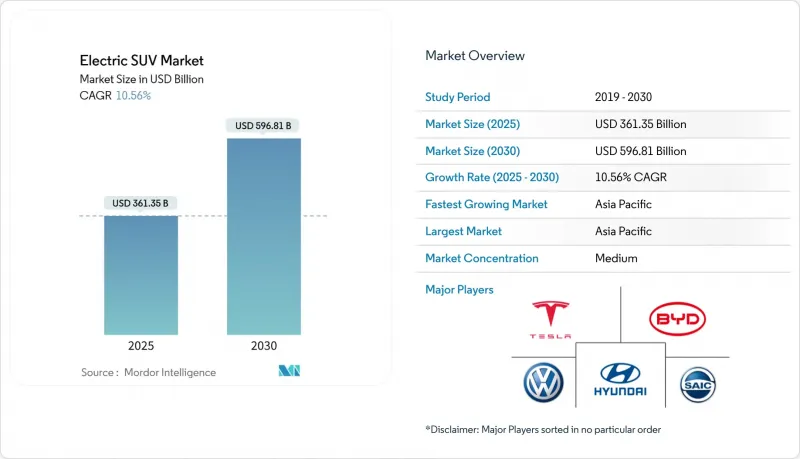
Mordor Intelligence에 의하면, 전동 SUV 시장 규모는 2025년에 3,613억 5,000만 달러, 2030년까지 5,968억 1,000만 달러에 이를 전망으로, 2025-2030년 CAGR 10.56%를 기록하는 것이라고 전망되고 있습니다.
본 보고서는 차체 크기(컴팩트, 중형, 기타), 추진 방식(배터리 전기차(BEV), 연료전지차(FCEV), 기타), 구동 방식(2WD, 4WD, 기타), 최종 사용자(개인용, 상업용),승차 인원(5인승, 7인승), 지역(북미, 기타)별로 분류되어 있습니다. 시장 전망은 금액(미 달러) 및 수량(대수)의 관점에서 제시되어 있습니다.
세계 전동 SUV 시장 동향 및 인사이트
배터리 가격 하락과 장거리 주행이 가능한 화학 조성
리튬 이온 배터리 팩 가격은 2024년에 115달러/kWh까지 하락하여, 대형 SUV가 보조금 없이도 가솔린 차량의 정가와 맞먹을 수 있게 되는 ‘100달러’라는 전환점에 가까워지고 있습니다. 2020년대 중반으로 예정된 고체 배터리 및 고니켈계 배터리의 시범 도입을 통해 질량의 50% 감축과 에너지 밀도의 배증이 예상되며, 그동안 풀사이즈 SUV의 보급을 제한해 왔던 무게 측면의 제약이 완화될 전망입니다. CATL의 1,000km 주행 거리를 자랑하는 ‘Qilin’ 팩이나 테슬라의 비용 최적화형 4680 셀은 화학 기술의 진보로 주행 거리 한계가 확대되는 동시에, 팩 수준의 비용을 14% 절감하고 있음을 여실히 보여주고 있습니다. 각 자동차 제조업체들은 현재 주류인 5인승 모델에 저비용 LFP 셀을 채택하여 판매 가격을 대폭 낮추면서도 실제 주행 거리 300마일을 실현하고 있습니다. 이러한 시너지 효과로 인해 OEM의 이익률이 유지되는 동시에, 가격에 민감한 가구를 대상으로 한 전동 SUV 시장의 확산이 가속화되고 있습니다.
기업의 차량 함대 전기화 의무화로 SUV 수주 가속화
리스 업체들은 2024년에 전동 SUV에 대한 견적 요청(RFQ)이 대폭 증가했음을 확인하고 있습니다. 이는 총소유비용(TCO) 기준 4년 내 손익분기점 달성이 배경에 있습니다. 이러한 동향은 기업들이 지속가능성과 비용 효율성을 점점 더 중시하는 가운데, 임원용 차량이나 하이루프형 배송 밴 파생 모델에서 SUV에 대한 선호도가 높아지고 있음을 반영합니다. 법인 대상 판매 대수의 급증은 잔존 가치의 예측 가능성을 높이고, 전기차 보급 확대를 뒷받침하는 데 필수적인 충전소 확충을 촉진합니다. 이러한 동향은 전동 SUV 시장의 진화하는 역동성과, 차량 관리의 미래를 형성하는 데 있어 그 역할을 부각시키고 있습니다.
내연기관(ICE) SUV와 동급 모델에 비해 높은 초기 가격 프리미엄
배터리 비용은 낮아지고 있지만, 전기차(EV)에는 여전히 높은 가격 프리미엄이 부과되고 있습니다. 예를 들어, 포드 F-150 라이트닝의 경우 가격은 4만 9,995달러부터 시작하지만, 가솔린 차량의 동급 모델은 더 저렴한 3만 7,970달러부터 시작합니다. 구매자들은월납입액을 비슷한 수준으로 맞추기 위해 대출 기간을 72개월로 연장하고 있습니다. 게다가 리스 이용이 확산되는 가운데, 소비자들은 감가상각 위험을 줄이고자 합니다. 독일에서는 보조금 반환 조치가 도입되고, 미국에서는 소득 제한이 있는 세액 공제가 적용되는 등 할인 폭이 축소되면서 일부 일반 구매자들은 구매를 주저하고 있습니다. 공급이 부족한 상황에서 자동차 제조업체(OEM)가 이익률 유지를 우선시하고 있어, 전동 SUV 시장에서 전기차 가격이 가솔린차와 완전히 동등해지는 것은 2027년까지 실현되지 않을 가능성이 있다고 볼 수 있습니다.
부문 분석
2024년 인도 대수 기준으로, 소형 모델이 전동 SUV 시장 점유율의 48.15%를 차지하며 1위를 기록했습니다. 이는 대도시권에서 테슬라 ‘모델 Y’와 BYD ‘Yuan Plus’의 성공에 힘입은 결과입니다. 한편, 풀사이즈 모델은 BMW, 메르세데스-벤츠, 캐딜락이 고급차 구매자의 기대에 부응하는 장거리 주행이 가능한 플래그십 모델을 출시함에 따라 2030년까지 연평균 성장률(CAGR)이 11.56%로 가장 급격한 성장세를 기록하고 있습니다. 미드사이즈 모델은 도시 지역에서의 기동성과 가족을 위한 실용성의 균형을 유지하며 안정적인 추이를 보이고 있습니다.
컴팩트 클래스의 선두는 유럽과 중국의 도시 지역에서 주차 공간 제약 및 인프라 집중을 반영하는 반면, 풀사이즈 클래스의 성장은 로드 트립의 실용성을 높이는 400마일급 배터리 팩에 대한 신뢰가 높아지고 있음을 보여줍니다. 포드의 ‘라이트닝’과 향후 출시 예정인 ‘에스컬레이드 IQ’는 견인 및 적재에 대한 요구가 이제 무공해 차량으로도 충족될 수 있게 되었음을 보여줍니다. 지역별 경향은 여전히 뚜렷하여, 소형 클래스는 유럽과 일본에서 주류를 이루는 반면, 미국 수요는 더 넉넉한 사양으로 기울고 있습니다.
2024년, 배터리식 전기차(BEV)는 전동 SUV 시장 점유율의 72.33%를 차지했습니다. 이는 잘 갖춰진 충전 인프라와 배터리 팩 비용 하락이 구매자들의 신뢰를 확고히 했기 때문입니다. 수소연료전지전기차(FCEV)는 현대 ‘넥소’의 출시와 독일·한국의 수소 회랑 프로젝트를 계기로 연평균 성장률(CAGR) 13.17%를 나타낼 것으로 전망됩니다. 하이브리드차 및 플러그인 하이브리드차는 과도기 기술로서 여전히 틈새 시장을 차지하고 있습니다.
시장 동향은 인프라 구축 상황에 따라 좌우됩니다. 캘리포니아주, 노르웨이, 상하이에서는 BEV가 주류를 이루고 있는 반면, 일본, 한국 및 독일의 일부 지역에서는 물류 및 장거리 택시를 위한 FCEV 실증 사업이 진행되고 있습니다. 상용차 차량군에서는 경로가 예측 가능한 경우 BEV가 검토되고 있지만, 가동 시간이 중요한 업무에서는 수소도 계속해서 선택지로 고려되고 있습니다.
지역별 분석
아시아태평양은 2024년에도 전동 SUV 시장에서 54.28%라는 압도적인 점유율을 유지하며, 중국의 대량 생산과 수직 통합된 밸류체인의 우위에 힘입어 2030년까지 연평균 성장률(CAGR) 11.13%로 가장 빠르게 성장하는 지역으로 남을 것입니다. 2024년 평균 판매 가격을 낮춘 보조금에 더해, 한국의 배터리 분야 리더십과 인도의 PLI(생산 연계형 인센티브)에 힘입은 생산 능력 확대가 이 지역의 비용 우위를 유지하고 있습니다. 북미 역시 인플레이션 억제법(Inflation Reduction Act)의 국내 조달 요건에 따라 포드, 제너럴 모터스, 테슬라가 인센티브 적용 요건을 충족하기 위해 기가팩토리를 확장하고 있어 큰 잠재력을 지니고 있습니다. 캘리포니아주와 뉴욕주에서 시행되는 주 차원의 구매 보조금은 합리적인 가격을 실현하고 있으며, 2026년까지 ZEV(무공해 차량) 비율을 20%로 하겠다는 캐나다의 목표는 해당 지역의 정책적 뒷받침을 강화하고 있습니다.
유럽은 규제 측면에서 주도권을 유지하고 있지만, 중국으로부터의 수입 압력이 높아지고 있습니다. 2025년에 발효되는 EU의 차량 평균 CO₂ 배출량 상한선 95g/km에 따라, 규제 준수의 열쇠는 전동 SUV 판매에 달려 있습니다. 남미는 전략적 성장 거점으로 부상하고 있으며, BYD와 SAIC는 현지 조립을 활용해 유럽 및 미국의 경쟁사보다 25,000-35,000달러,혹은 15,000-2만 달러 저렴한 가격에 모델을 판매하고 있어, 브라질 및 인근 국가들의 전기차 SUV 시장 규모를 급성장하고 있습니다.
중동 및 아프리카는 절대 판매 대수 면에서는 뒤처져 있지만, 장기적인 성장 잠재력을 지니고 있습니다. 아랍에미리트(UAE)는 무료 충전 및 관세 면제를 통해 2050년까지 전기차 보급률 50%를 목표로 하고 있는 반면, 사우디아라비아의 NEOM 프로젝트는 완전히 전동화된 교통 생태계 구축을 구상하고 있습니다. 남아프리카의 광물 자원은 상호 이익이 되는 공급망의 가능성을 지니고 있지만, 전력망의 신뢰성 문제와 초기 비용 부담이 여전히 보급을 저해하고 있습니다. 정부의 경제 다각화 노력과 재생에너지 투자로 인해 이러한 격차는 줄어들 것으로 예상되며, 인프라가 정비됨에 따라 해당 지역에서 전기차 보급이 가속화될 전망입니다.
기타 혜택:
- Excel 형식 시장 예측(ME) 시트
- 3개월간의 애널리스트 지원
자주 묻는 질문
목차
제1장 서론
제2장 분석 방법
제3장 주요 요약
제4장 시장 구도
제5장 시장 규모·성장률 예측
제6장 경쟁 구도
제7장 시장 기회와 향후 전망
JHS 26.09.03According to Mordor Intelligence, the electric SUV market size stood at USD 361.35 billion in 2025 before climbing to USD 596.81 billion by 2030, reflecting a 10.56% CAGR over 2025-2030.
This report is Segmented by Vehicle Size (Compact, Mid-Size, and More), Propulsion Type (Battery Electric Vehicle (BEV), Fuel-Cell Electric Vehicle (FCEV), and More), Drivetrain (2WD, 4WD, and More), End-User (Personal Use and Commercial Use), Seating Capacity (5-Seater and 7-Seater), and Geography (North America and More). The Market Forecasts are Provided in Terms of Value (USD) and Volume (Units).
Global Electric SUV Market Trends and Insights
Falling Battery Prices and Longer-Range Chemistries
Lithium-ion pack prices slid to USD 115 /kWh in 2024 and are nearing the USD 100 tipping point at which large-format SUVs can match gasoline sticker prices without subsidies. Mid-decade pilots of solid-state and high-nickel chemistries promise 50% mass cuts and double the energy density, easing weight penalties that previously limited full-size SUV adoption. CATL's 1,000-km "Qilin" pack and Tesla's cost-optimized 4680 cells highlight how chemistry advances are expanding range envelopes while shaving 14% pack-level costs . Automakers are now fitting lower-cost LFP cells into mainstream five-seater trims, slicing sticker prices significantly yet still delivering 300-mile real-world range. The cumulative effect cushions OEM margins and accelerates e-SUV market uptake among price-sensitive households.
Corporate Fleet Electrification Mandates Accelerate SUV Orders
Lease companies have noted a significant uptick in requests for quotes (RFQs) for electric SUVs in 2024, driven by a four-year breakeven point in total cost of ownership. This trend reflects the growing preference for SUVs in executive transport and high-roof delivery van derivatives, as businesses increasingly prioritize sustainability and cost efficiency. The surge in institutional volumes bolsters predictable residuals and facilitates the expansion of charging depots, which are critical for supporting the scaling of electric vehicle adoption. These developments highlight the evolving dynamics of the e-SUV market and its role in shaping the future of fleet management.
High Upfront Price Premium Versus ICE SUV Equivalents
Despite declining battery costs, electric vehicles (EVs) carry hefty premiums. Take the Ford F-150 Lightning, for instance: it kicks off at USD 49,995, while its gasoline counterpart starts at a more modest USD 37,970. Buyers are extending their financing terms to 72 months to achieve comparable monthly payments. Additionally, with rising lease penetration, consumers want to mitigate depreciation risks. In Germany, subsidy claw-backs and income-capped credits in the United States are tightening discounts, leaving some mainstream buyers hesitant. As original equipment manufacturers (OEMs) prioritize margin retention amidst constrained supply, it suggests that a full price parity for EVs within the e-SUV market might remain elusive until 2027.
Other drivers and restraints analyzed in the detailed report include:
- Tighter Global CO2 and ZEV Fleet-Average Targets for SUVs
- Rapid Build-Out of Highway DC Fast-Charging Corridors
- Sparse Rural Charging Infrastructure
For complete list of drivers and restraints, kindly check the Table Of Contents.
Segment Analysis
Compact models led 2024 deliveries with a 48.15% slice of the Electric SUV market share, anchored by Tesla Model Y and BYD Yuan Plus' success in dense cities. Full-size entries, however, record the sharpest 11.56% CAGR to 2030 as BMW, Mercedes-Benz, and Cadillac unleash long-range flagships meeting luxury buyer expectations. Mid-size offerings remain stable, striking a balance between urban maneuverability and family utility.
The compact lead reflects parking constraints and infrastructure concentration in Europe and urban China, while full-size gains show rising faith in 400-mile packs for road-trip practicality. Ford's Lightning and upcoming Escalade IQ exemplify how towing and cargo demands are now addressable in zero-emission guise. Regional splits stay pronounced: compacts dominate Europe and Japan, whereas U.S. demand tilts toward roomier trims.
Battery Electric Vehicles (BEVs) secured 72.33% of the Electric SUV market share in 2024, as robust charging ecosystems and falling pack costs cemented buyer confidence. Fuel-cell Electric Vehicle (FCEVs) post a 13.17% CAGR outlook, catalyzed by Hyundai Nexo launches and German-Korean hydrogen corridor projects. Hybrid and plug-in hybrid niches persist as bridge technologies.
Market preference tracks infrastructure. California, Norway, and Shanghai propel BEV dominance, whereas Japan, South Korea, and parts of Germany foster FCEV pilots for logistics and long-haul taxis. Commercial fleets weigh BEV for predictable routes but keep hydrogen on radar for uptime-critical operations.
Complete Report Scope:
- By Vehicle Size
- Compact
- Mid-size
- Full-size
- By Propulsion Type
- Battery Electric Vehicle (BEV)
- Fuel-cell Electric Vehicle (FCEV)
- Hybrid Electric Vehicle (HEV)
- Plug-in Hybrid Electric Vehicle (PHEV)
- By Drivetrain
- 2WD
- 4WD
- AWD
- By End-User
- Personal Use
- Commercial Use
- By Seating Capacity
- 5-Seater
- 7-Seater
- By Geography
- North America
- United States
- Canada
- Rest of North America
- South America
- Brazil
- Argentina
- Rest of South America
- Europe
- United Kingdom
- Germany
- Spain
- Italy
- France
- Russia
- Rest of Europe
- Asia-Pacific
- India
- China
- Japan
- South Korea
- Rest of Asia-Pacific
- Middle East and Africa
- United Arab Emirates
- Saudi Arabia
- Turkey
- Egypt
- South Africa
- Rest of Middle East and Africa
- North America
Geography Analysis
Asia-Pacific retained its commanding 54.28% Electric SUV market share in 2024 and continues as the fastest-growing region at 11.13% CAGR through 2030, led by China's high production and vertically integrated value chain advantages. Subsidies that trimmed 2024 average selling prices and South Korea's battery leadership and India's PLI-backed capacity build-outs sustain the region's cost edge. North America also holds a significant potential, as the Inflation Reduction Act content rules, with Ford, General Motors, and Tesla scaling gigafactories to qualify for incentives. State-level rebates in California and New York deepen affordability, while Canada's ZEV quota of 20% by 2026 reinforces the regional policy pull.
Europe maintains regulatory leadership yet faces rising Chinese import pressure; the EU's 95 g/km fleet-average CO2 cap, effective 2025, makes Electric SUV sales pivotal for compliance. South America is emerging as a strategic growth pod where BYD and SAIC leverage local assembly to retail models at USD 25,000-35,000-USD 15,000-20,000 below Western rivals-rapidly expanding the Electric SUV market size in Brazil and neighboring economies.
The Middle East and Africa trail in absolute units yet present long-run upside: the United Arab Emirates targets 50% electric adoption by 2050 through free charging and duty exemptions, while Saudi Arabia's NEOM project envisions a fully electric transport ecosystem. South Africa's mineral resources offer reciprocal supply-chain prospects, though grid reliability and upfront affordability still restrain uptake. Government diversification agendas and renewable energy investments are expected to narrow these gaps, positioning the region for accelerated penetration as infrastructure densifies.
- Tesla, Inc.
- BYD Auto Co. Ltd.
- Volkswagen AG
- Hyundai Motor Group
- SAIC Motor Corp., Ltd.
- Kia Corporation
- Ford Motor Company
- General Motors Company
- BMW Group
- Mercedes-Benz Group AG
- AB Volvo
- Stellantis N.V.
- Toyota Motor Corporation
- NIO Inc.
- XPeng Inc.
- Rivian Automotive Inc.
- Lucid Group
- Geely Holding Group Co. Ltd.
- Great Wall Motor Company Limited
- Tata Motors Limited
- Li Auto Inc.
- Maruti Suzuki Ltd.
- Mitusbishi Motors Corporation
Additional Benefits:
- The market estimate (ME) sheet in Excel format
- 3 months of analyst support
TABLE OF CONTENTS
1 Introduction
- 1.1 Study Assumptions & Market Definition
- 1.2 Scope of the Study
2 Research Methodology
3 Executive Summary
4 Market Landscape
- 4.1 Market Overview
- 4.2 Market Drivers
- 4.2.1 Falling Battery Prices and Longer-Range Chemistries
- 4.2.2 Corporate Fleet Electrification Mandates Accelerate SUV Orders
- 4.2.3 Tighter Global CO2 and ZEV Fleet-Average Targets for SUVs
- 4.2.4 Rapid Build-Out of Highway DC Fast-Charging Corridors
- 4.2.5 Chinese Low-Cost E-SUV Export Wave to the Global South
- 4.2.6 Dedicated Skateboard Platforms for Speeding SUV Variant Launches
- 4.3 Market Restraints
- 4.3.1 High Upfront Price Premium Versus ICE SUV Equivalents
- 4.3.2 Sparse Rural Charging Infrastructure
- 4.3.3 Critical-Minerals ESG Pushback Delaying New Battery Projects
- 4.3.4 Residual-Value Uncertainty Curbing Fleet Leasing Uptake
- 4.4 Value / Supply-Chain Analysis
- 4.5 Regulatory Landscape
- 4.6 Technological Outlook
- 4.7 Porter's Five Forces
- 4.7.1 Bargaining Power of Suppliers
- 4.7.2 Bargaining Power of Buyers
- 4.7.3 Threat of New Entrants
- 4.7.4 Threat of Substitutes
- 4.7.5 Competitive Rivalry
5 Market Size & Growth Forecasts (Value (USD) and Volume (Units))
- 5.1 By Vehicle Size
- 5.1.1 Compact
- 5.1.2 Mid-size
- 5.1.3 Full-size
- 5.2 By Propulsion Type
- 5.2.1 Battery Electric Vehicle (BEV)
- 5.2.2 Fuel-cell Electric Vehicle (FCEV)
- 5.2.3 Hybrid Electric Vehicle (HEV)
- 5.2.4 Plug-in Hybrid Electric Vehicle (PHEV)
- 5.3 By Drivetrain
- 5.3.1 2WD
- 5.3.2 4WD
- 5.3.3 AWD
- 5.4 By End-User
- 5.4.1 Personal Use
- 5.4.2 Commercial Use
- 5.5 By Seating Capacity
- 5.5.1 5-Seater
- 5.5.2 7-Seater
- 5.6 By Geography
- 5.6.1 North America
- 5.6.1.1 United States
- 5.6.1.2 Canada
- 5.6.1.3 Rest of North America
- 5.6.2 South America
- 5.6.2.1 Brazil
- 5.6.2.2 Argentina
- 5.6.2.3 Rest of South America
- 5.6.3 Europe
- 5.6.3.1 United Kingdom
- 5.6.3.2 Germany
- 5.6.3.3 Spain
- 5.6.3.4 Italy
- 5.6.3.5 France
- 5.6.3.6 Russia
- 5.6.3.7 Rest of Europe
- 5.6.4 Asia-Pacific
- 5.6.4.1 India
- 5.6.4.2 China
- 5.6.4.3 Japan
- 5.6.4.4 South Korea
- 5.6.4.5 Rest of Asia-Pacific
- 5.6.5 Middle East and Africa
- 5.6.5.1 United Arab Emirates
- 5.6.5.2 Saudi Arabia
- 5.6.5.3 Turkey
- 5.6.5.4 Egypt
- 5.6.5.5 South Africa
- 5.6.5.6 Rest of Middle East and Africa
- 5.6.1 North America
6 Competitive Landscape
- 6.1 Market Concentration
- 6.2 Strategic Moves
- 6.3 Market Share Analysis
- 6.4 Company Profiles (Includes Global Level Overview, Market Level Overview, Core Segments, Financials as Available, Strategic Information, Market Rank/Share for Key Companies, Products and Services, SWOT Analysis, and Recent Developments)
- 6.4.1 Tesla, Inc.
- 6.4.2 BYD Auto Co. Ltd.
- 6.4.3 Volkswagen AG
- 6.4.4 Hyundai Motor Group
- 6.4.5 SAIC Motor Corp., Ltd.
- 6.4.6 Kia Corporation
- 6.4.7 Ford Motor Company
- 6.4.8 General Motors Company
- 6.4.9 BMW Group
- 6.4.10 Mercedes-Benz Group AG
- 6.4.11 AB Volvo
- 6.4.12 Stellantis N.V.
- 6.4.13 Toyota Motor Corporation
- 6.4.14 NIO Inc.
- 6.4.15 XPeng Inc.
- 6.4.16 Rivian Automotive Inc.
- 6.4.17 Lucid Group
- 6.4.18 Geely Holding Group Co. Ltd.
- 6.4.19 Great Wall Motor Company Limited
- 6.4.20 Tata Motors Limited
- 6.4.21 Li Auto Inc.
- 6.4.22 Maruti Suzuki Ltd.
- 6.4.23 Mitusbishi Motors Corporation
7 Market Opportunities & Future Outlook
- 7.1 White-space & Unmet-Need Assessment