|
시장보고서
상품코드
2117469
오토바이 시장 : 점유율 분석, 업계 동향과 통계, 성장 예측(2025-2030년)Motorcycle - Market Share Analysis, Industry Trends & Statistics, Growth Forecasts (2025 - 2030) |
||||||
 Mordor Intelligence
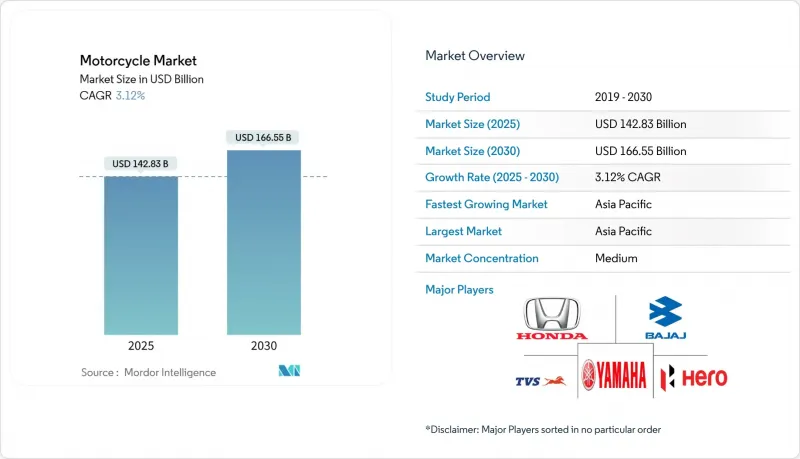
Mordor Intelligence에 의하면, 세계의 오토바이 시장 규모는 2025년에 1,428억 3,000만 달러에 이르고, 2030년까지 1,665억 5,000만 달러에 이를 것으로 예측되며, 기간 중 CAGR은 3.12%가 될 전망입니다.
본 보고서는 오토바이의 유형(스탠다드, 크루저, 스포츠, 어드벤처, 투어링, 오프로드), 배기량(200cc 이하, 200-400cc, 400-800cc, 800cc 이상), 구동 방식(내연기관, 전기),용도(개인용, 상업용), 지역(북미, 남미, 유럽, 아시아태평양, 중동 및 아프리카)별로 분류되어 있습니다. 시장 전망은 금액(미 달러) 및 수량(대)으로 제시되어 있습니다.
세계 오토바이 시장 동향 및 인사이트
남아시아 및 동남아시아 도시 지역의 중산층 급속한 확대
동남아시아에서는 도시 중산층 인구의 확대에 따라 오토바이 보급이 가속화되고 있습니다. 태국은 2030년까지 온실가스 배출량을 20-25% 감축하는 것을 목표로 하고 있으며, 자동차 생산량의 30%를 무공해 차량으로 생산하도록 의무화하고 있습니다. 이러한 인구 통계학적 변화로 인해 기존의 이동 패턴과 환경 의식이 교차하는 독특한 시장 역학이 형성되어, 기존 및 전기 이륜차에 대한 수요를 견인하고 있습니다. 인도네시아는 중국, 인도에 이어 세계 3위의 오토바이 시장입니다. 2024년, 인도네시아의 오토바이 판매 대수는 640만 대를 기록했습니다. 이 지역의 인프라 구축은 차량 보급 속도를 따라가지 못하고 있어, 혼잡한 도시 환경을 주행하면서도 새로운 환경 기준을 충족하고, 합리적인 가격에 신뢰성 높은 이동 수단을 제공할 수 있는 제조업체에게는 큰 비즈니스 기회가 열리고 있습니다.
정부의 전기차 지원 정책이 전기 오토바이 보급을 가속화
직접적인 구매 보조금 및 인프라 투자를 통해 정책 체계는 전기 이륜차의 보급을 점점 더 뒷받침하고 있습니다. 인도네시아에서는 이륜차 시장의 확산을 가속화하기 위해 2024년 8월, 수혜 자격 기준을 확대한 700만 루피아 규모의 보조금 프로그램을 시행했습니다. 유럽 시장에서는 유로 5+ 배기가스 규제를 준수해야 할 의무가 있으며, 제조업체들이 규제 대응을 위한 투자와 전동화 개발 프로그램 간의 균형을 맞추는 과정에서 의도치 않게 전동화 보급을 가속화하는 비용 압박이 발생하고 있습니다. 이러한 전략적 영향은 당장의 판매에 그치지 않습니다. 정부는 본질적으로 장기적인 시장 주도권을 결정짓는 과도기적 인프라에 보조금을 지원하고 있는 것입니다. 태국의 Oyika사를 통한 배터리 교환 시범 프로그램은 정책 지원이 밀집된 도시 환경에서 기존 충전 인프라로는 실현할 수 없는 생태계의 발전을 어떻게 가능하게 하는지 보여주고 있습니다.
라스트 마일 긱 경제 배송 차량의 성장
이커머스 플랫폼과 음식 배달 서비스의 사업 규모가 확대됨에 따라 상업용 오토바이 도입이 급증하고 있습니다. 인도네시아의 비즈니스 사용자는 일반 사용자의 주행 거리인 15-70킬로미터에 비해, 보통 하루에 150-200킬로미터를 주행합니다. 이러한 높은 이용 밀도로 인해 독자적인 시장 역학이 형성되고 있습니다. 초기 비용은 높지만, 특히 배터리 교체 인프라를 통해 신속한 업무 회전이 가능해져 수익성을 극대화할 수 있는 경우, 총 소유 비용(TCO) 계산상 전기자동차가 유리해집니다. 포스 말레이시아의 차량 확충은 기관 투자자가 대량 도입을 주도하고, 이것이 인프라 개발을 가속화하며, 규모의 경제를 통해 단위당 비용을 절감하는 구조를 보여줍니다. 상업 부문의 연평균 성장률(CAGR) 11.26%는 오토바이가 개인의 이동 수단에서 오토바이 시장에서 서로 다른 성능, 신뢰성, 서비스 특성을 필요로 하는 필수적인 비즈니스 도구로 전환되고 있다는 근본적인 변화를 반영하고 있습니다.
부문 분석
스탠다드 오토바이는 42.73%의 점유율을 차지하고 있지만, 어드벤처 부문은 2024년에 연평균 성장률(CAGR) 10.12%로 가장 높은 성장률을 보이고 있으며, 이는 도시 내 통근이나 레크리에이션 목적의 투어링 등 다양한 용도에 대응할 수 있는 다목적 플랫폼에 대한 소비자의 선호도를 반영하고 있습니다. 이 부문의 확대는 고성능과 프리미엄 포지셔닝을 통해 고가대를 정당화하는 다목적 차량을 찾는 부유한 밀레니얼 세대 및 X세대 라이더들의 인구 통계학적 동향과 일치합니다. 크루저 바이크는 할리 데이비슨의 전략적 재포지셔닝의 혜택을 받고 있으며, 이 회사는 기존 애호가와 젊은 층 모두를 타겟으로 한 ‘스트리트 글라이드 울트라’와 ‘팬아메리카 ST’를 포함한 2025년형 모델의 리뉴얼 버전을 출시하고 있습니다.
스포츠 바이크는 주요 시장에서 보험료 및 규제상의 제약이라는 역풍에 직면하고 있는 반면, 투어링 모델은 성능보다 편안함을 우선시하는 고령층 수요 증가를 주도하고 있습니다. 오프로드 바이크는 레크리에이션 용도나 지방 시장에서의 실용적인 활용에 힘입어 안정적인 수요를 유지하고 있습니다. 그러나 전기 모델은 주행 거리 제한과 외진 지역의 충전 인프라 제약으로 인해 여전히 발전 단계에 머물러 있습니다. 어드벤처 및 투어링 카테고리로의 부문 전환은 시장의 성숙도가 높아지고 있음을 나타내며, 차별화 요인은 순수한 이동 수단으로서의 실용성보다 라이프스타일 내에서의 위치에 점점 더 의존하고 있습니다.
2024년에도 200cc 이하 부문은 50.86%의 시장 점유율을 유지하고 있지만, 전기 모델이 주류를 이루고 있는 200-400cc 카테고리는 각 제조업체가 기존에 도시권 통근 용도로 사용되어 온 배기량 카테고리에 전기 파워트레인을 도입한 결과,연평균 성장률(CAGR) 12.38%로 급성장하고 있습니다. 이러한 전략적 포지셔닝은 전기 오토바이가 지닌 토크 특성을 반영한 것입니다. 이를 통해 배기량이 더 큰 내연기관(ICE) 엔진에 필적하는 성능을 발휘하면서도, 규제 요건과 도시 내 모빌리티에 대한 소비자의 기대에 부응할 수 있게 되었습니다. 400-800cc 부문에서는 제조업체들이 성능 요구와 연비 효율 요건 간의 균형을 맞추고 있어 완만한 성장이 나타나고 있습니다. 한편, 800cc를 초과하는 카테고리는 틈새 애호가 시장을 대상으로 하고 있어 판매 대수에 미치는 영향은 제한적입니다.
전기 오토바이 제조업체들은 배터리 기술이 일반적인 사용 패턴에서 허용 가능한 주행 거리와 충전 특성을 제공하는 200-400cc 상당의 성능 범위를 점점 더 목표로 삼고 있습니다. Hero MotoCorp사의 전기 스쿠터 ‘VIDA Z’ 출시와 TVS Motor사의 커넥티드 기능은 기존 제조업체들이 독립된 전기 브랜드를 론칭하기보다는 기존 제품 포트폴리오에 전기 모델을 통합하고 있음을 보여줍니다. 배기량 분류에서의 이러한 변화는 전기화 보급이 가속화됨에 따라, 향후 시장 구조가 기존의 배기량 분류가 아닌 성능 특성을 더욱 강하게 반영해 나갈 것임을 시사합니다.
지역별 분석
아시아태평양은 2024년에 71.68%의 시장 점유율을 유지하며, 2025년부터 2030년까지 연평균 성장률(CAGR) 8.09%를 유지할 것으로 전망됩니다. 이는 인도의 오토바이 생산 급증과 2024년에 7%의 판매 성장률을 기록하며 168만 대에 달한 필리핀(아세안에서 가장 높은 성장률)에 의해 주도된 것입니다. 이 지역의 우위는 도시화 추세, 중산층 인구의 확대, 그리고 혼잡한 도시 환경에서 사륜차보다 이륜차의 보급을 촉진하는 인프라 구축을 반영하고 있습니다. 동남아시아에서 PowerPod 및 Mamotor와 같은 파트너십을 통한 배터리 교환 인프라 구축은 기존 시장에서는 쉽게 재현할 수 없는 경쟁 우위를 가져다주며, 전동화가 가속화됨에 따라 아시아태평양의 주도적 지위를 더욱 공고히 할 가능성이 있습니다.
북미와 유럽은 성장률이 완만하긴 하지만 성숙한 시장 특징을 보이고 있으며, 한편으로는 프리미엄 부문의 확대와 기술 혁신을 주도하며 전 세계 제품 개발 동향에 영향을 미치고 있습니다. 유럽 시장은 유로 5+ 배기가스 규제로 인한 규제 압박에 직면해 있으며, 이는 전동화 도입을 가속화하는 한편 기존 제조업체들에게는 규정 준수 비용을 발생시키고 있습니다. 할리 데이비슨이 이러한 시장에서 2025년형 모델 출시 및 딜러 네트워크 확장을 통해 추진하고 있는 전략적 재포지셔닝은 프리미엄 제조업체들이 브랜드 포지셔닝을 유지하면서 변화하는 인구 통계 및 규제 요건에 어떻게 적응하고 있는지를 보여줍니다. 아시아태평양의 판매 대수 기반 성장과 유럽·미국 시장의 매출액 기준 성장이라는 지역 간 대비는 세계적 규모 확대를 목표로 하는 제조업체와 프리미엄 포지셔닝을 추구하는 제조업체 사이에 서로 다른 전략적 과제를 야기하고 있습니다.
라틴아메리카는 성장 기회로 부상하고 있으며, 멕시코의 오토바이 시장은 배송 서비스와 도시 지역의 모빌리티 수요가 보급을 뒷받침하는 가운데, 2029년까지 연간 판매 대수가 600만 대에 달하고, 현재 수준보다 3배 증가할 것으로 예측됩니다. 이 지역의 성장 잠재력은 경제 발전, 도시화 추세, 그리고 기존 자동차 대체 수단보다 이륜차 솔루션을 유리하게 만드는 인프라 제약을 반영하고 있습니다. 2025년 1분기 페루의 12.4% 성장률은 이 지역의 성장 모멘텀을 보여주고 있으며, 2024년 상반기 브라질 스쿠터 부문의 30.02% 확대는 이 카테고리 특유의 기회를 부각시키고 있습니다. 중동 및 아프리카는 경제 발전과 인프라 수요가 저렴하고 신뢰할 수 있는 교통 수단에 대한 수요를 창출하고 있는 신흥 시장이지만, 시장 성장은 여전히 경제 변동성과 인프라 제약으로 인해 제한받고 있습니다.
기타 혜택:
- 엑셀 형식 시장 예측(ME) 시트
- 3개월간의 애널리스트 지원
목차
제1장 서론
제2장 조사 방법
제3장 개요
제4장 시장 구도
제5장 시장 규모와 성장 예측
제6장 경쟁 구도
제7장 시장 기회와 향후 전망
JHSAccording to Mordor Intelligence, the global motorcycle market size stands at USD 142.83 billion in 2025 and is forecast to touch USD 166.55 billion by 2030, reflecting a 3.12% CAGR over the period.
This report is Segmented by Motorcycle Type (Standard, Cruiser, Sports, Adventure, Touring, Off-Road), Engine Capacity (Up To 200cc, 200-400cc, 400-800cc, Above 800cc), Propulsion Type (ICE, Electric), Application (Personal, Commercial), and Geography (North America, South America, Europe, Asia-Pacific, Middle East and Africa). The Market Forecasts are Provided in Terms of Value (USD) and Volume (Units).
Global Motorcycle Market Trends and Insights
Rapid Urban Middle-Class Expansion in South and Southeast Asia
Southeast Asia's motorcycle adoption accelerates as urban middle-class populations expand, with Thailand targeting a 20-25% greenhouse gas reduction by 2030 while mandating that zero-emission vehicles comprise 30% of automotive production. This demographic shift creates a unique market dynamic where traditional mobility patterns intersect with environmental consciousness, driving demand for conventional and electric two-wheelers. Indonesia is the th ird-largest motorcycle market globally, following China and India. In 2024, motorcycle sales in Indonesia were recorded at 6.4 million units. The region's infrastructure development lags behind vehicle adoption, creating opportunities for manufacturers who can deliver affordable, reliable transportation solutions that navigate congested urban environments while meeting emerging environmental standards.
Government EV Incentives Accelerating E-Motorcycle Uptake
Policy frameworks increasingly favor electric motorcycle adoption through direct purchase subsidies and infrastructure investments, with Indonesia implementing a Rp 7 million subsidy program that expanded eligibility criteria in August 2024 to accelerate motorcycle market penetration. European markets face mandatory Euro 5+ emissions compliance, creating cost pressures that inadvertently accelerate electric adoption as manufacturers balance compliance investments against electric development programs. The strategic implication extends beyond immediate sales impact-governments are essentially subsidizing the transition infrastructure that will determine long-term market leadership. Thailand's battery-swapping pilot programs through Oyika demonstrate how policy support enables ecosystem development that traditional charging infrastructure cannot match in dense urban environments.
Growth of Last-Mile Gig-Economy Delivery Fleets
Commercial motorcycle adoption surges as e-commerce platforms and food delivery services scale operations, with business users in Indonesia typically covering 150-200 kilometers daily compared to private users' 15-70 kilometer range. This usage intensity creates distinct market dynamics where total cost of ownership calculations favor electric alternatives despite higher upfront costs, particularly when battery-swapping infrastructure enables rapid turnaround times that maximize earning potential. Pos Malaysia's fleet expansion demonstrates how institutional buyers drive volume adoption that accelerates infrastructure development and reduces per-unit costs through economies of scale. The commercial segment's growth at 11.26% CAGR reflects this fundamental shift where motorcycles transition from personal transportation to essential business tools that require different performance, reliability, and service characteristics in the motorcycle market.
Other drivers and restraints analyzed in the detailed report include:
- Integration of ADAS and Connected Tech (IoT/Telematics)
- After-Sales Subscription Revenue Models by OEMs
- ICE Phase-Out Regulations in Europe Raising Compliance Costs
- Raw-Material Price Volatility for Li-ion Batteries
For complete list of drivers and restraints, kindly check the Table Of Contents.
Segment Analysis
Standard motorcycles command a 42.73% share, while the Adventure segment has the fastest growth at 10.12% CAGR in 2024, reflecting consumer preferences for versatile platforms that accommodate urban commuting and recreational touring applications. This segment expansion aligns with demographic trends where affluent millennials and Gen X riders seek multipurpose vehicles that justify higher price points through enhanced capability and premium positioning. Cruiser motorcycles benefit from Harley-Davidson's strategic repositioning, with the company launching updated 2025 models, including the Street Glide Ultra and Pan America ST, that target both traditional enthusiasts and younger demographics.
Sports motorcycles face headwinds from insurance costs and regulatory restrictions in key markets, while touring variants capture growth from aging demographics who prioritize comfort over performance. Off-road motorcycles experience steady demand driven by recreational usage and utility applications in rural markets. However, electric variants remain nascent due to range limitations and charging infrastructure constraints in remote areas. The segmentation shift toward adventure and touring categories signals broader market maturation where differentiation increasingly depends on lifestyle positioning rather than pure transportation utility.
The up to 200cc segment maintains 50.86% market share in 2024, yet the electric-dominant 200-400cc category accelerates at 12.38% CAGR as manufacturers position electric powertrains in displacement categories traditionally serving urban commuting applications. This strategic positioning reflects electric motorcycles' torque characteristics that deliver performance comparable to larger displacement ICE engines while meeting regulatory requirements and consumer expectations for urban mobility. The 400-800cc segment experiences moderate growth as manufacturers balance performance demands with fuel efficiency requirements, while the above 800cc categories serve niche enthusiast markets with limited volume impact.
Electric motorcycle manufacturers increasingly target the 200-400cc equivalent performance range where battery technology delivers acceptable range and charging characteristics for typical usage patterns. Hero MotoCorp's VIDA Z electric scooter launch and TVS Motor's connected features demonstrate how traditional manufacturers integrate electric alternatives within existing product portfolios rather than creating separate electric brands. The capacity segmentation evolution suggests future market structure will increasingly reflect performance characteristics rather than traditional displacement categories as electric adoption accelerates.
Complete Report Scope:
- By Motorcycle Type
- Standard
- Cruiser
- Sports
- Adventure
- Touring
- Off-road
- By Engine Capacity
- Up to 200 cc
- 200 to 400 cc
- 400 to 800 cc
- Above 800 cc
- By Propulsion Type
- Internal Combustion Engine (ICE)
- Electric
- By Application
- Personal
- Commercial
- By Geography
- North America
- United States
- Canada
- Rest of North America
- South America
- Brazil
- Argentina
- Rest of South America
- Europe
- United Kingdom
- Germany
- Spain
- Italy
- France
- Russia
- Rest of Europe
- Asia-Pacific
- India
- China
- Japan
- South Korea
- Rest of Asia-Pacific
- Middle East and Africa
- United Arab Emirates
- Saudi Arabia
- Turkey
- Egypt
- South Africa
- Rest of Middle-East and Africa
- North America
Geography Analysis
Asia-Pacific maintains 71.68% market share in 2024 while sustaining 8.09% CAGR through 2025-2030, driven by India's motorcycle production surge and the Philippines' 7% sales growth in 2024 to 1.68 million units-the highest growth rate in ASEAN. The region's dominance reflects urbanization trends, expanding middle-class populations, and infrastructure development favoring two-wheeler adoption over four alternatives in congested urban environments. Battery-swapping infrastructure development through partnerships like PowerPod-Mamotor in Southeast Asia creates competitive advantages that traditional markets cannot easily replicate, potentially extending Asia-Pacific's leadership position as electrification accelerates.
North America and Europe exhibit mature market characteristics with moderate growth rates yet drive premium segment expansion and technological innovation that influences global product development trends. European markets face regulatory pressures from Euro 5+ emissions standards that accelerate electric adoption while creating compliance costs for traditional manufacturers. Harley-Davidson's strategic repositioning in these markets, with 2025 model launches and expanded dealer networks, illustrates how premium manufacturers adapt to changing demographics and regulatory requirements while maintaining brand positioning. The regional contrast between Asia-Pacific's volume growth and Western markets' value growth creates different strategic imperatives for manufacturers seeking global scale versus premium positioning.
Latin America emerges as a growth opportunity with Mexico's motorcycle market projected to reach 6 million annual sales by 2029, tripling from current levels as delivery services and urban mobility needs drive adoption. The region's growth potential reflects economic development, urbanization trends, and infrastructure constraints that favor two-wheeler solutions over traditional automotive alternatives. Peru's 12.4% Q1 2025 growth demonstrates the region's momentum while Brazil's scooter segment expansion at 30.02% in H1 2024 illustrates category-specific opportunities. Middle East and Africa represent emerging opportunities where economic development and infrastructure needs create demand for affordable, reliable transportation solutions, though market development remains constrained by economic volatility and infrastructure limitations.
- Honda Motor Co., Ltd.
- Yamaha Motor Co., Ltd.
- Hero MotoCorp Ltd.
- Bajaj Auto Ltd.
- TVS Motor Company
- Harley-Davidson, Inc.
- BMW AG
- KTM AG
- Suzuki Motor Corporation
- Kawasaki Heavy Industries, Ltd.
- Ducati Motor Holding S.p.A.
- Piaggio and C. SpA
- Triumph Motorcycles Ltd.
- Royal Enfield (Eicher Motors)
- CFMoto
- Husqvarna Motorcycles
- Zero Motorcycles, Inc.
- Energica Motor Company
- NIU Technologies
- Yadea Technology Group
- Benelli
- Mahindra (Classic Legends)
Additional Benefits:
- The market estimate (ME) sheet in Excel format
- 3 months of analyst support
TABLE OF CONTENTS
1 Introduction
- 1.1 Study Assumptions and Market Definition
- 1.2 Scope of the Study
2 Research Methodology
3 Executive Summary
4 Market Landscape
- 4.1 Market Overview
- 4.2 Market Drivers
- 4.2.1 Rapid urban middle-class expansion in South and Southeast Asia
- 4.2.2 Government EV incentives accelerating e-motorcycle uptake
- 4.2.3 Integration of ADAS and connected tech (IoT/telematics)
- 4.2.4 After-sales subscription revenue models by OEMs
- 4.2.5 Growth of last-mile gig-economy delivery fleets
- 4.2.6 Low-cost battery-swap networks in emerging markets
- 4.3 Market Restraints
- 4.3.1 ICE phase-out regulations in Europe raising compliance costs
- 4.3.2 Raw-material price volatility for Li-ion batteries
- 4.3.3 Micro-mobility alternatives cannibalising 0 to 200 cc demand
- 4.3.4 Limited resale value of first-gen e-motorcycles
- 4.4 Value/Supply-Chain Analysis
- 4.5 Regulatory Landscape
- 4.6 Technological Outlook
- 4.7 Porter's Five Forces
- 4.7.1 Bargaining Power of Suppliers
- 4.7.2 Bargaining Power of Buyers
- 4.7.3 Threat of New Entrants
- 4.7.4 Threat of Substitutes
- 4.7.5 Competitive Rivalry
5 Market Size and Growth Forecasts (Value (USD) and Volume (Units))
- 5.1 By Motorcycle Type
- 5.1.1 Standard
- 5.1.2 Cruiser
- 5.1.3 Sports
- 5.1.4 Adventure
- 5.1.5 Touring
- 5.1.6 Off-road
- 5.2 By Engine Capacity
- 5.2.1 Up to 200 cc
- 5.2.2 200 to 400 cc
- 5.2.3 400 to 800 cc
- 5.2.4 Above 800 cc
- 5.3 By Propulsion Type
- 5.3.1 Internal Combustion Engine (ICE)
- 5.3.2 Electric
- 5.4 By Application
- 5.4.1 Personal
- 5.4.2 Commercial
- 5.5 By Geography
- 5.5.1 North America
- 5.5.1.1 United States
- 5.5.1.2 Canada
- 5.5.1.3 Rest of North America
- 5.5.2 South America
- 5.5.2.1 Brazil
- 5.5.2.2 Argentina
- 5.5.2.3 Rest of South America
- 5.5.3 Europe
- 5.5.3.1 United Kingdom
- 5.5.3.2 Germany
- 5.5.3.3 Spain
- 5.5.3.4 Italy
- 5.5.3.5 France
- 5.5.3.6 Russia
- 5.5.3.7 Rest of Europe
- 5.5.4 Asia-Pacific
- 5.5.4.1 India
- 5.5.4.2 China
- 5.5.4.3 Japan
- 5.5.4.4 South Korea
- 5.5.4.5 Rest of Asia-Pacific
- 5.5.5 Middle East and Africa
- 5.5.5.1 United Arab Emirates
- 5.5.5.2 Saudi Arabia
- 5.5.5.3 Turkey
- 5.5.5.4 Egypt
- 5.5.5.5 South Africa
- 5.5.5.6 Rest of Middle-East and Africa
- 5.5.1 North America
6 Competitive Landscape
- 6.1 Market Concentration
- 6.2 Strategic Moves
- 6.3 Market Share Analysis
- 6.4 Company Profiles (Includes Global level Overview, Market level overview, Core Segments, Financials as available, Strategic Information, Market Rank/Share for key companies, Products and Services, and Recent Developments)
- 6.4.1 Honda Motor Co., Ltd.
- 6.4.2 Yamaha Motor Co., Ltd.
- 6.4.3 Hero MotoCorp Ltd.
- 6.4.4 Bajaj Auto Ltd.
- 6.4.5 TVS Motor Company
- 6.4.6 Harley-Davidson, Inc.
- 6.4.7 BMW AG
- 6.4.8 KTM AG
- 6.4.9 Suzuki Motor Corporation
- 6.4.10 Kawasaki Heavy Industries, Ltd.
- 6.4.11 Ducati Motor Holding S.p.A.
- 6.4.12 Piaggio and C. SpA
- 6.4.13 Triumph Motorcycles Ltd.
- 6.4.14 Royal Enfield (Eicher Motors)
- 6.4.15 CFMoto
- 6.4.16 Husqvarna Motorcycles
- 6.4.17 Zero Motorcycles, Inc.
- 6.4.18 Energica Motor Company
- 6.4.19 NIU Technologies
- 6.4.20 Yadea Technology Group
- 6.4.21 Benelli
- 6.4.22 Mahindra (Classic Legends)
7 Market Opportunities and Future Outlook
- 7.1 White-space and Unmet-Need Assessment