
|
시장보고서
상품코드
2117474
인도의 자동차용 리드 센서 스위치 시장 : 시장 점유율 분석, 업계 동향 및 통계, 성장 예측(2026-2031년)India Automotive Reed Sensors Switches - Market Share Analysis, Industry Trends & Statistics, Growth Forecasts (2026 - 2031) |
||||||
 Mordor Intelligence
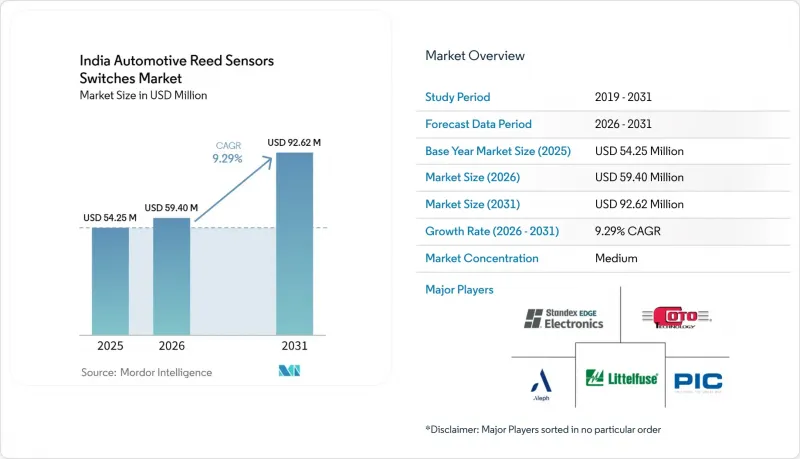
인도의 자동차용 리드 센서 스위치 시장은 2025년 5,435만 달러로 평가되었습니다. 2026년에는 5,940만 달러로 확대되어 2026년부터 2031년에 걸쳐 CAGR 9.3%로 성장을 지속하여, 2031년에는 9,262만 달러에 이를 것으로 예측됩니다.
본 보고서는 제품 유형(리드 스위치 및 리드 센서), 용도(차체 전자기기, 배터리 및 충전 시스템, 기타), 차종(승용차 및 상용차), 판매 채널(OEM 및 애프터마켓), 구동 방식(내연기관 차량 및 기타)별로 분류되어 있습니다. 시장 예측은 금액(달러) 단위로 표시되어 있습니다.
인도의 자동차용 리드 센서 스위치 시장 동향 및 인사이트
전동화에 힘입어 증가하는 배터리 및 충전용 감지 지점
인도의 자동차용 리드 센서 스위치 시장에서는 EV 배터리 팩 및 차량용 충전기 내부의 고전압 감지 지점이 증가함에 따라 수요가 가장 크게 증가하고 있습니다. 고전압 배터리 버스와 저전압 측정 전자 기기 사이에 배치된 리드 릴레이는 400 VDC에서 1,500 VDC의 절연 파괴 전압을 제공하므로, 절연과 패키지 효율이 모두 요구되는 용도에서 여전히 중요한 역할을 하고 있습니다. 인도에서는 최근 몇 년간 전기차 판매 대수가 현저히 증가하고 있으며, 전기차 판매량은 전년 대비 크게 확대되고 있습니다. 이는 이러한 기능을 필요로 하는 플랫폼의 수가 급속히 증가하고 있음을 보여줍니다. 새로운 EV 아키텍처가 도입될 때마다 리드식 기반의 절연 및 커넥터 감지 지점이 몇 군데 추가되므로, 차량 대수가 증가함에 따라 각 플랫폼 내 부품 수요도 배가됩니다. 그 결과, 인도의 자동차용 리드 센서 스위치 시장 전체와 비교했을 때, 배터리 및 충전 시스템 시장은 더욱 빠르게 성장하고 있습니다. 다만, 현재로서는 이러한 분야의 적용 범위가 차체용 전자 기기에 비해 여전히 좁은 것이 현실입니다.
차체 모듈 및 편의·접근 기능에 탑재되는 전자 부품 증가
차체용 전자기기는 금액 기준으로 가장 큰 용도 부문을 차지하고 있습니다. 이러한 성장은 도어, 보닛, 트렁크의 상태 모니터링, 래치 모듈, 액추에이터의 위치 감지 등 전자식 개폐 장치 및 접근 시스템의 보급률 상승에 힘입고 있습니다. 각 OEM 업체들은 비용 효율을 중시하는 차종 카테고리에서도 편의성 및 안전성을 높이는 기능을 지속적으로 도입하고 있으며, 그 결과 상태 감지 지점의 수는 꾸준히 증가하고 있습니다.
리드 스위치는 예측 가능한 스위칭 특성, 입증된 내구성, 그리고 기존 모듈 설계에의 쉬운 통합 덕분에 이러한 용도에서 여전히 실용적인 솔루션으로 자리 잡고 있습니다.
솔리드 스테이트 기술에 의한 대체
솔리드 스테이트식 감지 기술과의 경쟁은 여전히 주요 제약 요인으로 남아 있습니다. 특정 자기 감지 및 근접 감지 용도에서 OEM 업체들은 IC 주도형 아키텍처에 부합하거나 추가적인 진단 기능을 구현하기 위해 반도체 기반 솔루션을 선호하는 경우가 있습니다. 이러한 동향이 리드 기술의 사용을 완전히 배제하는 것은 아니지만, 연속적인 센싱이나 복잡한 신호 처리가 요구되는 서브시스템으로의 보급을 제한할 가능성이 있습니다.
부문별 분석
2025년, 리드 스위치는 매출의 59.41%를 차지하며 인도의 자동차용 리드 센서 스위치 시장에서 계속해서 가장 큰 제품 카테고리로 자리매김했습니다. 그 규모는 도어 래치 위치 감지, 트렁크 개폐 기구, 시트 위치 기능, 액체 레벨 감지 어레이 등 폭넓은 용도로 사용되고 있기 때문이며, 이러한 용도들은 합쳐서 일반적인 양산차에서 25개 이상의 적용 지점을 커버하고 있습니다. 이러한 도입 실적을 바탕으로 리드 스위치는 확고한 입지를 구축하고 있습니다. 이는 차량 플랫폼용으로 이미 인증된 설계는 플랫폼 수명 주기의 중반에 쉽게 대체될 수 없기 때문입니다. 리드 센서는 여전히 가장 빠르게 성장하는 부문이며, 전기차(EV)의 배터리 시스템 및 충전 회로에서 절연 측정 및 커넥터 감지에 활용됨에 따라 2031년까지 연평균 성장률(CAGR) 11.42%를 나타낼 것으로 예측됩니다. 이는 현재 자동차용 리드 센서 스위치 시장에서 여전히 기존 스위치가 점유율을 차지하고 있지만, 제품 구성이 변화하고 있음을 의미합니다.
소형화가 이러한 전환을 뒷받침하고 있습니다. 최신 차량 모듈에서는 신뢰성을 저해하지 않으면서 기판 레이아웃 내에 더 조밀하게 배치될 수 있는 소형 패키지가 요구되고 있기 때문입니다. 스탠덱스 일렉트로닉스는 공간이 제한된 PCB 레이아웃을 위해 설계된 베어 글라스 표면 실장형 리드 스위치 ‘MK33 SMD 시리즈’를 출시했습니다. 인도의 OEM 및 1차 공급업체들이 더 많은 기능을 통합 모듈에 탑재하고 PCB와의 직접적인 호환성을 요구하고 있기 때문에 이 제품의 방향성은 자동차용 리드 센서 스위치 시장에 중요한 의미를 지닙니다. 이와 유사한 동향은 리드 센서에도 적용되며, 콤팩트하고 진단하기 쉬운 형태라면 실적를 크게 희생하지 않고도 전기차(EV)나 편의성 향상을 위한 전자 모듈에 쉽게 통합할 수 있습니다.
2025년, 인도의 자동차용 리드 센서 스위치 시장에서 차체 전자 장치는 31.08%를 차지하며 매출 기준 최대의 용도 부문이 되었습니다. 이러한 위상은 인도의 SUV 중심 제품 구성에서 기인합니다. 기후 제어 시스템, 액세스 모듈, 소프트 클로즈 기능, 루프 등 모두 리드 부품이 담당할 수 있는 센싱 위치를 필요로 하기 때문입니다. 배터리 및 충전 시스템은 2031년까지 연평균 성장률(CAGR) 14.42%를 나타낼 것으로 예측되며, 이는 시장 전체보다 현저히 빠른 속도입니다. 이는 새로운 BEV 프로그램마다 추가되는 절연, 프리차지 및 커넥터 연결부의 센서 설치 위치를 반영한 것입니다.
용도 구성은 차체 관련 수요가 중심이었던 상태에서 시간이 지남에 따라 EV 관련 기능의 비중이 높아지는 보다 폭넓은 분포로 전환되고 있습니다. 안전 및 보안, 인포테인먼트 및 편의 시스템, 그리고 변속기 및 브레이크 시스템은 계속해서 안정적인 수요를 뒷받침하고 있습니다. 안전을 중시하는 채택 추세는 일반 승용차의 보호 기능에 대한 소비자의 관심이 높아짐에 따라 더욱 가속화되고 있으며, 안전벨트, 에어백 및 접근 관련 기능 분야에서 비용 경쟁력이 있는 스위칭 소자에 대한 수요가 유지되고 있습니다. 엔진 및 파워트레인용 수요는 여전히 제한적이지만, 이는 많은 주요 내연기관(ICE)의 센싱 기능에서 리드 제품이 아닌 홀 효과를 이용한 대체품이 이미 채택되고 있기 때문입니다.
기타 혜택 :
- 엑셀 형식 시장 예측(ME) 시트
- 3개월간의 애널리스트 지원
자주 묻는 질문
목차
제1장 서론
제2장 조사 방법
제3장 개요
제4장 시장 구도
제5장 시장 규모 및 성장 예측
제6장 경쟁 구도
제7장 시장 기회 및 향후 전망
KTH 26.09.02According to Mordor Intelligence, the automotive reed sensors and switches market in India is expected to grow from USD 54.35 million in 2025 to USD 59.40 million in 2026, and is forecast to reach USD 92.62 million by 2031, at a CAGR of 9.3% over 2026-2031.
This report is Segmented by Product Type (Reed Switches, and Reed Sensors), Application (Body Electronics, Battery and Charging Systems, and Others), Vehicle Type (Passenger Cars, and Commercial Vehicles), Sales Channel (OEMs, and Aftermarket), and Propulsion Type (Internal Combustion Engine Vehicles, and More). The Market Forecasts are Provided in Terms of Value (USD).
India Automotive Reed Sensors Switches Market Trends and Insights
Electrification-Driven Growth in Battery and Charging Sensing Points
The automotive reed sensor switches market in India is seeing its strongest demand from the rise in high-voltage sensing points inside EV battery packs and onboard chargers. Reed relays placed between the high-voltage battery bus and low-voltage measurement electronics offer breakdown voltages from 400 VDC to 1,500 VDC, keeping them relevant in applications where isolation and package efficiency are both required. India has recorded significant EV sales growth in recent years, with electric car sales expanding substantially on a year-on-year basis, indicating that the number of platforms requiring these functions is rising rapidly. Each new EV architecture adds several reed-based isolation and connector detection points, so volume growth in vehicles also multiplies component demand within each platform. As a result, battery and charging systems are growing faster than the rest of the automotive reed sensor switches market in India, even though they still represent a narrower application base than body electronics today.
Increasing Electronics Content in Body Modules and Comfort/Access Features
Body electronics represents the largest application segment by value. Growth is supported by rising penetration of electronic closures and access systems, including door, hood, and trunk status monitoring, latch modules, and actuator position detection. OEMs continue to introduce additional comfort and safety features even in cost-sensitive vehicle categories, resulting in a steady increase in the number of state-detection points.
Reed switches remain a practical solution in these applications due to predictable switching behavior, proven durability, and ease of integration into established module designs.
Substitution by Solid-State Alternatives
Competition from solid-state sensing technologies remains a key restraint. In certain magnetic or proximity sensing applications, OEMs may prefer semiconductor-based solutions to align with IC-driven architectures or enable additional diagnostics. While this trend does not eliminate the use of reed technologies, it can limit penetration in subsystems where continuous sensing or complex signal processing is required.
Other drivers and restraints analyzed in the detailed report include:
- Preference for Sealed, Reliable Switching Solutions in Harsh Automotive Environments
- OEM Localization and Scale-Up of Supply
- Cost-Down Pressure and Design-to-Cost
For complete list of drivers and restraints, kindly check the Table Of Contents.
Segment Analysis
Reed switches accounted for 59.41% of revenue in 2025, keeping them the largest product category within the Automotive reed sensor switches market in India. Their scale is tied to broad use across door-latch position detection, trunk release mechanisms, seat-position functions, and fluid-level sensing arrays that together cover more than 25 application points in a typical production vehicle. This installed base gives reed switches a durable position because a design already qualified for a vehicle platform is not easily replaced mid-platform life. Reed sensors remain the fastest-growing category, projected to grow at a 11.42% CAGR through 2031 as EV battery systems and charging circuits use them for isolation measurement and connector detection. This means the product mix is shifting even though the current Automotive reed sensors switches market share still sits with conventional switches.
Miniaturization is reinforcing this transition, as newer vehicle modules require smaller packages that fit more tightly within board layouts without compromising reliability. Standex Electronics launched the MK33 SMD series, a bare-glass, surface-mount reed switch designed for space-constrained PCB layouts. This product direction is relevant to the automotive reed sensors and switches market, as Indian OEMs and Tier-1 suppliers are integrating more functions into consolidated modules and require direct PCB compatibility. The same trend applies to reed sensors, where compact, diagnostics-friendly formats are easier to incorporate into EV and comfort electronics modules without a significant footprint penalty.
Body electronics accounted for 31.08% of the automotive reed sensor switches market in India in 2025, making it the largest application segment by revenue. This position is driven by India's SUV-heavy product mix, where climate systems, access modules, soft-close functions, and roof mechanisms all require sensing positions that reed components can serve. Battery and charging systems are projected to grow at a 14.42% CAGR through 2031, materially faster than the overall market, reflecting additional isolation, pre-charge, and connector-engagement positions created by each new BEV program.
The application mix is shifting from body-heavy demand toward a broader distribution that gives EV-related functions greater weight over time. Safety and security, infotainment and comfort systems, and transmission and braking systems continue to provide stable supporting demand. Safety-oriented adoption is further supported by growing consumer focus on protective features in mainstream passenger vehicles, keeping cost-competitive switching elements relevant in seatbelt, airbag, and access-linked functions. Engine and powertrain demand remains limited, as Hall-effect alternatives rather than reed products already serve many core ICE sensing functions.
Complete Report Scope:
- Segmentation by Product Type (Value, USD)
- Reed Sensors
- Reed Switches
- Segmentation by Application (Value, USD)
- Engine and Powertrain Systems
- Body Electronics
- Safety and Security Systems
- Infotainment and Comfort Systems
- Transmission and Braking Systems
- Battery and Charging Systems
- Other Applications
- Segmentation by Vehicle Type (Value, USD)
- Passenger Cars
- Commercial Vehicles
- Segmentation by Sales Channel (Value, USD)
- OEMs
- Aftermarket
- Segmentation by Propulsion Type (Value, USD)
- Internal Combustion Engine (ICE) Vehicles
- Hybrid Electric Vehicles (HEV)
- Plug-in Hybrid Electric Vehicle (PHEV)
- Battery Electric Vehicles (BEV)
- Fuel Cell Electric Vehicles (FCEV)
List of Companies Covered in this Report:
- Standex Electronics (Standex Detect)
- Littelfuse Inc. (Hamlin)
- Coto Technology
- TE Connectivity Ltd (Sensors)
- Honeywell International Inc.
- PIC GmbH (PIC Group)
- Nippon Aleph (Aleph Group)
- HSI Sensing
- Comus International
- Pickering Electronics
- Reed Switch Developments Corp.
- KUS Group
- Zhejiang Xurui Electronic (XURUI)
- Kunshan Golden Light Electronic (GLE)
- Misensor Tech (Shanghai)
- Dongguan Bailing Electronics
- Ningbo Mingrui Zhongxing Electronics
- Ningbo Huaxing Sensor Tech
- Shenzhen CiAn Electronics
- Dongguan Yuanfeng Electronics
Additional Benefits:
- The market estimate (ME) sheet in Excel format
- 3 months of analyst support
TABLE OF CONTENTS
1 Introduction
- 1.1 Study Assumptions and Market Definition
- 1.2 Scope of the Study
2 Research Methodology
3 Executive Summary
4 Market Landscape
- 4.1 Market Overview
- 4.2 Market Drivers
- 4.2.1 Electrification-Driven Growth in Battery and Charging Sensing Points
- 4.2.2 Increasing Electronics Content in Body Modules and Comfort/Access Features
- 4.2.3 Preference for Sealed, Reliable Switching Solutions in Harsh Automotive Environments
- 4.2.4 Platform Refresh Cycles and Feature-Led Modularization by OEMs/Tier-1s
- 4.2.5 OEM Localization and Scale-Up of Supply
- 4.2.6 Compact Module Miniaturization in Electronics
- 4.3 Market Restraints
- 4.3.1 Substitution by Solid-State Alternatives
- 4.3.2 Cost-Down Pressure and Design-to-Cost
- 4.3.3 Incentive Policy Uncertainty
- 4.3.4 OEM Qualification Lead-Time Delays
- 4.4 Value / Supply-Chain Analysis
- 4.5 Regulatory Landscape
- 4.6 Technological Outlook
- 4.7 Porter's Five Forces
- 4.7.1 Threat of New Entrants
- 4.7.2 Bargaining Power of Suppliers
- 4.7.3 Bargaining Power of Buyers
- 4.7.4 Threat of Substitutes
- 4.7.5 Competitive Rivalry
5 Market Size & Growth Forecasts (Value, USD)
- 5.1 Segmentation by Product Type (Value, USD)
- 5.1.1 Reed Sensors
- 5.1.2 Reed Switches
- 5.2 Segmentation by Application (Value, USD)
- 5.2.1 Engine and Powertrain Systems
- 5.2.2 Body Electronics
- 5.2.3 Safety and Security Systems
- 5.2.4 Infotainment and Comfort Systems
- 5.2.5 Transmission and Braking Systems
- 5.2.6 Battery and Charging Systems
- 5.2.7 Other Applications
- 5.3 Segmentation by Vehicle Type (Value, USD)
- 5.3.1 Passenger Cars
- 5.3.2 Commercial Vehicles
- 5.4 Segmentation by Sales Channel (Value, USD)
- 5.4.1 OEMs
- 5.4.2 Aftermarket
- 5.5 Segmentation by Propulsion Type (Value, USD)
- 5.5.1 Internal Combustion Engine (ICE) Vehicles
- 5.5.2 Hybrid Electric Vehicles (HEV)
- 5.5.3 Plug-in Hybrid Electric Vehicle (PHEV)
- 5.5.4 Battery Electric Vehicles (BEV)
- 5.5.5 Fuel Cell Electric Vehicles (FCEV)
6 Competitive Landscape
- 6.1 Market Concentration
- 6.2 Strategic Moves
- 6.3 Market Share Analysis
- 6.4 Company Profiles (Includes Global Level Overview, Market Level Overview, Core Segments, Financials as Available, Strategic Information, Market Rank/Share for Key Companies, Products & Services, and Recent Developments)
- 6.4.1 Standex Electronics (Standex Detect)
- 6.4.2 Littelfuse Inc. (Hamlin)
- 6.4.3 Coto Technology
- 6.4.4 TE Connectivity Ltd (Sensors)
- 6.4.5 Honeywell International Inc.
- 6.4.6 PIC GmbH (PIC Group)
- 6.4.7 Nippon Aleph (Aleph Group)
- 6.4.8 HSI Sensing
- 6.4.9 Comus International
- 6.4.10 Pickering Electronics
- 6.4.11 Reed Switch Developments Corp.
- 6.4.12 KUS Group
- 6.4.13 Zhejiang Xurui Electronic (XURUI)
- 6.4.14 Kunshan Golden Light Electronic (GLE)
- 6.4.15 Misensor Tech (Shanghai)
- 6.4.16 Dongguan Bailing Electronics
- 6.4.17 Ningbo Mingrui Zhongxing Electronics
- 6.4.18 Ningbo Huaxing Sensor Tech
- 6.4.19 Shenzhen CiAn Electronics
- 6.4.20 Dongguan Yuanfeng Electronics
7 Market Opportunities & Future Outlook
- 7.1 White-space & unmet-need assessment