
|
시장보고서
상품코드
2117475
중국의 자동차용 리드 센서 및 스위치 : 시장 점유율 분석, 업계 동향 및 통계, 성장 예측(2026-2031년)China Automotive Reed Sensors/Switches - Market Share Analysis, Industry Trends & Statistics, Growth Forecasts (2026 - 2031) |
||||||
 Mordor Intelligence
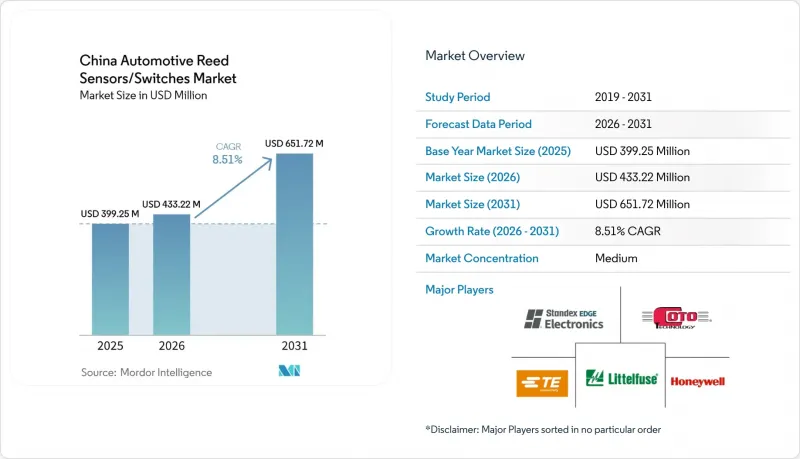
중국의 자동차용 리드 센서 및 스위치 시장 규모는 2025년 3억 9,925만 달러로 평가되었습니다. 2026년에는 4억 3,322만 달러로 확대되어 2031년까지 6억 5,172만 달러에 이를 것으로 예상되고 2026년부터 2031년에 걸쳐 CAGR 8.51%로 성장할 전망입니다.
본 보고서는 제품 유형(리드 스위치 및 리드 센서), 용도(차체 전자기기, 배터리 및 충전 시스템 등), 차종(승용차 및 상용차), 판매 채널(OEM 및 애프터마켓), 구동 방식(내연기관 차량 등)별로 분류되어 있습니다. 시장 전망은 금액(달러) 기준으로 제시되어 있습니다.
중국의 자동차용 리드 센서 및 스위치 시장 동향 및 인사이트
NEV 보급률 증가가 EV 관련 센싱 포인트 증가를 촉진
중국 내 NEV의 높은 보급률은 특히 배터리 시스템 및 고전압 서브시스템에서 차량 1대당 센싱 포인트 수를 증가시키고 있습니다. NEV 아키텍처에서는 일반적으로 안전 루프 및 가동 준비 상태를 확보하기 위해 팩 커버 상태, 서비스 디스커넥트 감지, 충전 포트 상태 감지, 고전압 인터록 확인 등 추가적인 상태 감지 노드가 필요합니다. 이로 인해 개/폐 또는 유무 감지에 사용되는 센서 및 스위치에 대한 잠재적 수요가 증가합니다.
NEV의 보급 규모는 조달 측면에서도 중요합니다. 신차 판매에서 NEV의 점유율이 높아짐에 따라, EV 관련 센싱은 틈새 시장에서 대량 생산 플랫폼 설계로 전환되고 있습니다. 이에 따라 EV 서브시스템의 센싱 포인트 표준화가 더욱 진행되어, 배터리 및 충전 용도에 대응하는 부품 공급업체에 대한 지속적인 수요가 증가하고 있습니다.
급속 충전 인프라의 확장이 충전 생태계 수요를 뒷받침합니다.
중국의 충전 인프라 확충은 충전의 편의성과 접근성을 향상시켜 NEV의 보급을 뒷받침하고 있습니다. 공공 및 민간 충전소의 확대에 따라, 감지 기능 및 안전 스위칭에 의존하는 충전 설비와 차량 측 인터페이스의 도입 대수가 증가합니다. 이에 따라 충전 작업과 관련된 커넥터 연결 감지, 액세스 도어 모니터링, 안전 인터록을 위한 센싱 솔루션에 대한 수요가 뒷받침됩니다.
충전 인프라의 확대는 차량 이외의 분야에서도 부품 수요를 견인하고 있습니다. 이용률 향상과 커버리지 확대는 충전 하드웨어 도입 확대를 뒷받침하고 있으며, 이러한 시스템에는 일반적으로 하우징 접근, 커넥터 연결 상태 및 작동 상태를 모니터링하는 안전 상태 모니터링 노드가 포함되어 있습니다. 이로 인해 예측 기간 동안 배터리 및 충전 시스템이 리드 센서와 스위치에 있어 가장 높은 성장률을 보이는 응용 분야라는 점이 더욱 입증됩니다.
일부 용도에서 반도체식 자기 센서로 대체
일부 차량 하위 시스템, 특히 연속 측정, 진단 기능 또는 ECU와의 보다 긴밀한 통합이 요구되는 경우, 반도체 기반 자기 감지 기술이 리드형 솔루션을 대체할 가능성이 있습니다. 차량 아키텍처가 더욱 중앙 집중화된 컴퓨팅 및 소프트웨어 정의 기능을 채택함에 따라, OEM 업체들은 IC 기반 시스템 내의 신호 조정 및 진단을 지원하기 위해 특정 노드에서 홀 효과 방식 또는 TMR 방식의 솔루션을 표준화할 가능성이 있습니다.
이러한 대체 압력이 모든 용도에서 리드 스위치의 사용을 배제하는 것은 아닙니다. 그러나 OEM이 연속적인 감지 및 고급 진단 기능을 필요로 하는 분야, 특히 첨단 전동화 플랫폼에서는 리드 스위치의 보급률이 감소할 가능성이 있습니다. 따라서 공급업체 시장 내 위치는 용도에 대한 적합성, 비용 목표 및 플랫폼이 요구하는 진단 기능 수준에 따라 결정됩니다.
부문별 분석
리드 스위치는 중국의 자동차용 리드 센서 및 스위치 시장에서 가장 큰 제품 유형이며, 2025년에는 74.37%의 시장 점유율을 차지했습니다. 이러한 주도적 지위는 높은 신뢰성과 저렴한 비용으로 이진 상태 감지가 요구되는 대량 생산형 자동차 모듈에 광범위하게 채택됨으로써 뒷받침되고 있습니다. 리드 스위치는 차체 전자 장치 및 분산형 차량 기능에서 여전히 널리 사용되고 있으며, 밀폐형 자기 작동 메커니즘을 통해 진동, 온도 변동 및 긴 듀티 사이클 조건에서도 안정적인 성능을 발휘합니다.
리드 센서는 예측 기간 동안 연평균 성장률(CAGR) 10.27%를 기록하며 가장 높은 성장률을 보일 것으로 전망됩니다. 이러한 급속한 성장은 장착의 일관성과 제조 효율성을 향상시키는 패키징 및 오버몰딩 처리된 센서 어셈블리에 대한 OEM 및 Tier 1 공급업체의 선호도가 높아지고 있음을 반영합니다. 이와 동시에, EV 서브시스템의 확장으로 인해 개별 부품이 아닌 모듈형 구성 요소로 사양화된 센서 형식이 선호되고 있으며, 그 결과 콤팩트하고 통합도가 높은 용도에서 리드 센서의 채택 확대가 촉진되고 있습니다.
차체용 전자장치는 가장 큰 용도 부문을 차지하고 있으며, 2025년에는 45.16%를 차지했습니다. 중국의 거대한 자동차 생산 거점과 승용차 부문 전반에 걸친 기능 보급률의 높이가 도어 및 트렁크 개폐, 접근과 관련된 상태 감지 수요를 크게 뒷받침하고 있습니다. 도어, 트렁크 및 보닛 래치, 시트 메커니즘, 컴포트 모듈 등의 용도는 거의 모든 차량 플랫폼에 탑재되어 있으며, 리드 센서 및 스위치 수요의 기반이 되고 있습니다.
배터리 및 충전 시스템은 2026년부터 2031년까지 연평균 성장률(CAGR) 13.97%를 기록하며 가장 빠른 성장이 예상됩니다. 이러한 성장은 중국의 EV 생태계가 지속적으로 확대됨에 따라 뒷받침되고 있으며, 이로 인해 충전 포트 감지, 커넥터 결합, 고전압 인터록, 배터리 팩 커버 상태, 서비스용 차단 장치 및 기타 안전 상태 모니터링 기능과 관련된 센싱 요구 사항이 증가하고 있습니다. 이러한 전기차 특유의 아키텍처로 인해 차량당 센싱 밀도가 높아지고 있으며, 이는 해당 하위 시스템에서 리드형 솔루션의 평균 성장률을 상회하는 성장을 뒷받침하고 있습니다.
기타 혜택 :
- 엑셀 형식 시장 예측(ME) 시트
- 3개월간의 애널리스트 지원
자주 묻는 질문
목차
제1장 서론
제2장 조사 방법
제3장 개요
제4장 시장 구도
제5장 시장 규모 및 성장 예측
제6장 경쟁 구도
제7장 시장 기회 및 향후 전망
KTH 26.09.02According to Mordor Intelligence, the China automotive reed sensors/Switches market size is expected to increase from USD 399.25 million in 2025 to USD 433.22 million in 2026 and reach USD 651.72 million by 2031, growing at a CAGR of 8.51% over 2026-2031.
This report is Segmented by Product Type (Reed Switches and Reed Sensors), Application (Body Electronics, Battery and Charging Systems, and More), Vehicle Type (Passenger Cars and Commercial Vehicles), Sales Channel (OEMs and Aftermarket), and Propulsion Type (Internal Combustion Engine Vehicles and More). The Market Forecasts are Provided in Terms of Value (USD).
China Automotive Reed Sensors/Switches Market Trends and Insights
High NEV Penetration Increasing EV-Associated Sensing Points
China's high NEV penetration increases the number of sensing points per vehicle, particularly across battery systems and high-voltage subsystems. NEV architectures typically require additional state-detection nodes for safety loops and operational readiness, including pack cover status, service disconnect detection, charge-port state detection, and high-voltage interlock confirmation. This increases the addressable demand for sensors and switches used for binary open/closed and presence/absence detection.
The scale of NEV penetration also matters from a sourcing standpoint. As NEVs represent a larger share of new vehicle sales, EV-linked sensing moves from niche to high-volume platform design. This supports wider standardization of EV subsystem sensing points and increases recurring demand for component suppliers aligned with battery and charging applications .
Rapid Charging Infrastructure Expansion Supporting Charging Ecosystem Demand
China's charging infrastructure build-out supports NEV adoption by improving charging availability and usability. Expanding public and private charging points increases the installed base of charging equipment and vehicle-side interfaces that rely on detection and safety switching. This supports demand for sensing solutions for connector engagement detection, access-door monitoring, and safety interlocks associated with charging operations.
Charging infrastructure expansion also increases component pull-through beyond vehicles. Higher utilization and wider coverage support growth in charging hardware deployments, and these systems typically include safety-state monitoring nodes for enclosure access, connector presence, and operational status. This reinforces battery and charging systems as the highest-growth application area for reed sensors and switches over the forecast period.
Substitution by Semiconductor Magnetic Sensors in Some Applications
In several vehicle subsystems, semiconductor-based magnetic sensing technologies can replace reed-based solutions, particularly where continuous measurement, diagnostic capability, or tighter ECU integration is required. As vehicle architectures adopt more centralized computing and software-defined features, OEMs may standardize Hall or TMR solutions in selected nodes to support signal conditioning and diagnostics within IC-based systems.
This substitution pressure does not eliminate the use of reed switches across all applications. However, it can reduce penetration in areas where OEMs require continuous sensing or enhanced diagnostic functions, particularly in advanced electrified platforms. Supplier positioning, therefore, depends on application fit, cost targets, and the level of diagnostic capability required by the platform.
Other drivers and restraints analyzed in the detailed report include:
- Large Vehicle Production Base Sustaining High-Volume Electronics Demand
- NEV Policy Support Supporting EV Demand Resilience
- Intense Price Competition Compressing Component ASPs and Margins
For complete list of drivers and restraints, kindly check the Table Of Contents.
Segment Analysis
Reed switches are the largest product type in China's automotive reed sensors/switches market, with a 74.37% market share in 2025. Their leadership is driven by broad deployment in high-volume automotive modules, where binary-state detection is required with high reliability and low cost. Reed switches remain widely used in body electronics and distributed vehicle functions, where sealed magnetic actuation provides consistent performance under vibration, temperature variation, and long duty cycles.
Reed sensors are projected to grow at the fastest rate, registering a CAGR of 10.27% during the forecast period. Faster growth reflects increasing OEM and Tier-1 preference for packaged and overmolded sensor assemblies that improve mounting consistency and manufacturing efficiency. In parallel, the expansion of EV subsystems favors sensor formats specified as module-ready components rather than discrete elements, thereby supporting broader adoption of reed sensors in compact and integration-intensive applications.
Body electronics constitute the largest application segment, accounting for 45.16% in 2025. China's large vehicle production base and high feature penetration across passenger vehicle segments sustain significant volumes of state detection related to closures and access. Applications such as doors, trunk and hood latches, seat mechanisms, and comfort modules remain present across nearly all vehicle platforms, anchoring demand for reed sensors and switches.
Battery and charging systems are projected to grow at the fastest pace, registering a CAGR of 13.97% during 2026-2031. Growth is supported by the continued expansion of China's EV ecosystem, which increases sensing requirements related to charge-port detection, connector engagement, high-voltage interlocks, pack cover status, service disconnects, and other safety-state monitoring functions. These EV-specific architectures increase sensing density per vehicle, supporting above-average growth for reed-based solutions in these subsystems.
Complete Report Scope:
- By Product Type
- Reed sensors
- Reed switches
- By Application
- Engine and Powertrain Systems
- Body Electronics
- Safety and Security Systems
- Infotainment and Comfort Systems
- Transmission and Braking Systems
- Battery and Charging Systems
- Other Applications
- By Vehicle Type
- Passenger Cars
- Commercial Vehicles
- By Sales Channel
- OEMs
- Aftermarket
- By Propulsion Type
- Internal Combustion Engine (ICE) Vehicles
- Hybrid Electric Vehicles (HEV)
- Plug-in Hybrid Electric Vehicle (PHEV)
- Battery Electric Vehicles (BEV)
- Fuel Cell Electric Vehicles (FCEV)
List of Companies Covered in this Report:
- Standex Electronics (Standex Detect)
- Littelfuse (Hamlin)
- Nippon Aleph (Aleph Group)
- TE Connectivity (Sensors)
- PIC GmbH (PIC Group)
- HSI Sensing
- Comus International
- Coto Technology
- Reed Switch Developments Corp.
- KUS Group
- Zhejiang Xurui Electronic (XURUI)
- Kunshan Golden Light Electronic (GLE)
- Ge-Ding Information Inc. (ReedSensorTech)
- Misensor Tech (Shanghai)
- Xintechnology Group (ReedSwitchSensor.com)
- Dongguan Bailing Electronics
- Ningbo Mingrui Zhongxing Electronics
- Dongguan Yuanfeng Electronics
- Ningbo Huaxing Sensor Tech
- Shenzhen CiAn Electronics
- Focus Sensing & Control (Focusens)
- PIC China Operations
- Standex Electronics Japan (KOFU brand)
Additional Benefits:
- The market estimate (ME) sheet in Excel format
- 3 months of analyst support
TABLE OF CONTENTS
1 Introduction
- 1.1 Study Assumptions & Market Definition
- 1.2 Scope of the Study
2 Research Methodology
3 Executive Summary
4 Market Landscape
- 4.1 Market Overview
- 4.2 Market Drivers
- 4.2.1 High NEV Penetration Increasing EV-Associated Sensing Points
- 4.2.2 Rapid Charging Infrastructure Expansion Supporting Charging Ecosystem Demand
- 4.2.3 Large Vehicle Production Base Sustaining High-Volume Electronics Demand
- 4.2.4 NEV Policy Support Supporting EV Demand Resilience
- 4.2.5 China VI Emissions Drive AdBlue/Fuel-Level Reed Assemblies in Trucks and Off-Highway
- 4.2.6 EV Charging Build-Out Uses Reed Sensing for Latch Detection, Enclosure Access, and Service Interlocks
- 4.3 Market Restraints
- 4.3.1 Substitution by Semiconductor Magnetic Sensors in Some Applications
- 4.3.2 Intense Price Competition Compressing Component ASPs and Margins
- 4.3.3 Precious-Metal Plating (Rh/Ir) Cost and Volatility Pressures BoM Economics
- 4.3.4 ISO 26262 Diagnostic Coverage Requirements Add Integration Overhead for Passive Reed Solutions
- 4.4 Value / Supply-Chain Analysis
- 4.5 Regulatory Landscape
- 4.6 Technological Outlook
- 4.7 Porter's Five Forces
- 4.7.1 Threat of New Entrants
- 4.7.2 Bargaining Power of Suppliers
- 4.7.3 Bargaining Power of Buyers
- 4.7.4 Threat of Substitutes
- 4.7.5 Competitive Rivalry
5 Market Size & Growth Forecasts (Value, USD)
- 5.1 By Product Type
- 5.1.1 Reed sensors
- 5.1.2 Reed switches
- 5.2 By Application
- 5.2.1 Engine and Powertrain Systems
- 5.2.2 Body Electronics
- 5.2.3 Safety and Security Systems
- 5.2.4 Infotainment and Comfort Systems
- 5.2.5 Transmission and Braking Systems
- 5.2.6 Battery and Charging Systems
- 5.2.7 Other Applications
- 5.3 By Vehicle Type
- 5.3.1 Passenger Cars
- 5.3.2 Commercial Vehicles
- 5.4 By Sales Channel
- 5.4.1 OEMs
- 5.4.2 Aftermarket
- 5.5 By Propulsion Type
- 5.5.1 Internal Combustion Engine (ICE) Vehicles
- 5.5.2 Hybrid Electric Vehicles (HEV)
- 5.5.3 Plug-in Hybrid Electric Vehicle (PHEV)
- 5.5.4 Battery Electric Vehicles (BEV)
- 5.5.5 Fuel Cell Electric Vehicles (FCEV)
6 Competitive Landscape
- 6.1 Market Concentration
- 6.2 Strategic Moves
- 6.3 Market Share Analysis
- 6.4 Company Profiles (Includes Global Level Overview, Market Level Overview, Core Segments, Financials as Available, Strategic Information, Market Rank/Share for Key Companies, Products & Services, and Recent Developments)
- 6.4.1 Standex Electronics (Standex Detect)
- 6.4.2 Littelfuse (Hamlin)
- 6.4.3 Nippon Aleph (Aleph Group)
- 6.4.4 TE Connectivity (Sensors)
- 6.4.5 PIC GmbH (PIC Group)
- 6.4.6 HSI Sensing
- 6.4.7 Comus International
- 6.4.8 Coto Technology
- 6.4.9 Reed Switch Developments Corp.
- 6.4.10 KUS Group
- 6.4.11 Zhejiang Xurui Electronic (XURUI)
- 6.4.12 Kunshan Golden Light Electronic (GLE)
- 6.4.13 Ge-Ding Information Inc. (ReedSensorTech)
- 6.4.14 Misensor Tech (Shanghai)
- 6.4.15 Xintechnology Group (ReedSwitchSensor.com)
- 6.4.16 Dongguan Bailing Electronics
- 6.4.17 Ningbo Mingrui Zhongxing Electronics
- 6.4.18 Dongguan Yuanfeng Electronics
- 6.4.19 Ningbo Huaxing Sensor Tech
- 6.4.20 Shenzhen CiAn Electronics
- 6.4.21 Focus Sensing & Control (Focusens)
- 6.4.22 PIC China Operations
- 6.4.23 Standex Electronics Japan (KOFU brand)
7 Market Opportunities & Future Outlook
- 7.1 White-space & Unmet-need Assessment