
|
시장보고서
상품코드
2117481
아시아태평양의 자동차용 리드 센서 스위치 시장 : 시장 점유율 분석, 업계 동향 및 통계, 성장 예측(2026-2031년)Asia-Pacific Automotive Reed Sensors Switches - Market Share Analysis, Industry Trends & Statistics, Growth Forecasts (2026 - 2031) |
||||||
 Mordor Intelligence
아시아태평양의 자동차용 리드 센서 스위치 시장 규모는 2025년 6억 7,000만 달러로 평가되었습니다. 2026년에는 7억 3,000만 달러로 확대되어 2031년까지 11억 1,000만 달러에 이를 것으로 예측되며, 2026년부터 2031년까지 연평균 복합 성장률(CAGR)은 8.81%를 나타낼 전망입니다.
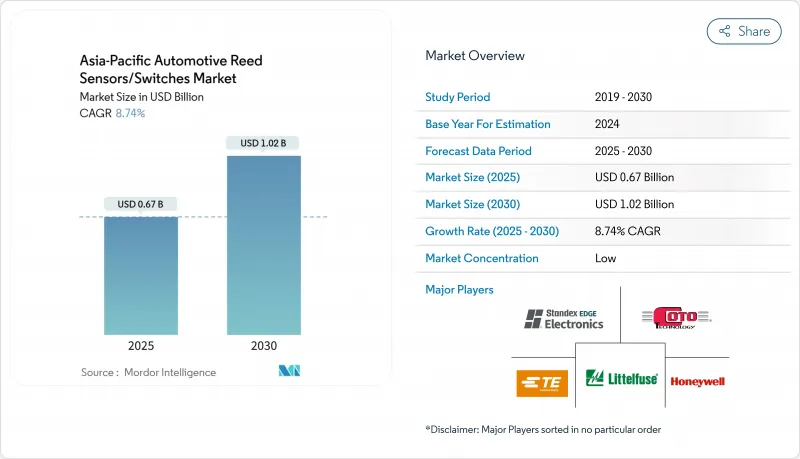
본 보고서는 제품 유형(리드 스위치 및 리드 센서), 용도(차체용 전자기기 등), 차종(승용차 및 상용차), 판매 채널(OEM 및 애프터마켓), 구동 방식(내연기관 차량 등), 그리고 국가(중국, 인도 등)별로 분류되어 있습니다. 시장 전망은 금액(달러) 기준으로 제시되어 있습니다.
아시아태평양 자동차용 리드 센서 스위치 시장 동향 및 인사이트
중국의 NEV(신에너지차) 보급 확대가 EV 관련 센서 수요를 가속화
중국의 신에너지차(NEV) 판매 대수는 상당한 규모에 달하며, 자동차 총 판매 대수의 거의 절반을 차지하고 있습니다. 이러한 규모가 배터리 관리, 절연 감시 및 고전압 차단 시스템 분야의 스위칭 부품 수요를 견인하고 있습니다. 옥스퍼드 에너지 연구소에 따르면, 중국의 NEV 구성 중 배터리식 전기차가 대부분을 차지하고 있습니다. 각 배터리식 전기차 플랫폼에는 기존 차량에서 사용되는 것보다 더 많은 추가 센싱 기능이 필요합니다. 또한, 계속 확대되고 있는 중국의 NEV 수출로 인해, 해당 지역에서 조립된 부품이 해외 차량 프로그램에 채택되는 사례도 늘고 있습니다. 국내 OEM 사업을 목표로 하는 공급업체에게 있어, 자동차 규격 및 IATF 16949 요건 준수는 여전히 중요합니다.
아시아태평양의 신흥 시장에서는 낮은 보급률로 인해 전기차 도입이 급속히 증가하고 있습니다.
국제에너지기구(IEA)에 따르면, 중국을 제외한 아시아태평양의 전기차 판매 대수는 전년 대비 크게 증가했습니다. 이러한 추세는 일부 2차 제조 및 판매 시장에서 전기차 보급이 확대되고 있음을 보여줍니다. 인도에서는 전기차 판매가 크게 증가했으며, 시장 침투율도 꾸준히 높아지고 있습니다.
태국에서는 배터리식 전기차의 등록 대수가 현저히 증가하고 있으며, 신차 판매에서 전기차가 차지하는 비중도 확대되고 있습니다. 국제청정교통협의회(ICCT)에 따르면, 인도네시아의 제로 에미션 승용차 판매 대수도 중요한 이정표를 넘어섰습니다. 이러한 추세로 인해 양산차 플랫폼에 사용되는 저비용 센싱 부품에 대한 수요가 증가하고 있습니다.
일부 이용 사례에서 솔리드 스테이트 센서로 대체되는 압력
홀 효과 및 터널 자기 저항(TMR) 집적 회로는 스티어링 칼럼, 페달 위치, 변속기 속도 감지 분야에서 점점 더 널리 채택되고 있습니다. 이러한 용도에서는 디스크리트형 리드 스위치만으로는 제공할 수 없는 진단 기능과 기능 안전 성능이 요구됩니다. Melexis사는 도어 및 e-래치 시스템에서 여러 위치를 감지할 수 있는 프로그래머블 디바이스를 발표했습니다.
반면, 배터리 슬립 인터록, 고전압 차단 회로 및 액면 감지 분야에서는 대체 기술의 진전이 여전히 제한적입니다. 이러한 설계 환경에서 리드 소자는 높은 전압 임계값에서도 갈바닉 절연을 유지하며, 대기 전류를 소비하지 않고 작동합니다. 아시아태평양의 자동차용 리드 센서 스위치 시장은 특정 차체 전자 장비 분야에서 대체품의 등장으로 인한 압박에 직면하고 있는 반면, 엄격한 절연 요건이 요구되는 용도에서는 여전히 수요가 유지되고 있습니다.
부문별 분석
2025년에는 제품 유형별로 리드 스위치가 가치의 54.89%를 차지했으나, 리드 센서는 2031년까지 연평균 성장률(CAGR) 10.54%를 나타낼 것으로 예측됩니다. 전기차(EV) 시스템에서는 단일 유리관 스위치 대신 통합형 센싱 어셈블리가 요구되기 때문에 리드 센서의 사용이 확대되고 있습니다.
아시아태평양의 자동차용 리드 센서 스위치 시장에서는 대량 생산되는 차체 전자 기기 용도에서 여전히 리드 스위치가 주류를 이루고 있습니다. 중국, 인도, 일본, 한국에는 이러한 용도를 뒷받침하는 대규모의 기존 차량 보유 대수가 있습니다. 대기 전류가 제로라는 점과 기밀 밀봉성은 습기의 영향을 받기 쉬운 도어 및 액면 레벨 측정 용도에서 여전히 중요한 가치를 지닙니다. 리드 센서는 일반적으로 배터리 상태 감지, 냉각 모니터링 및 더 엄격한 신뢰성 사양이 요구되는 절연 회로에 사용됩니다. 이러한 구성은 기본적인 스위치에 대한 수요를 저해하지 않으면서도 고부가가치 부품으로의 전환을 뒷받침하고 있습니다. 일본 아레프(Aleph)사는 안전 관련 용도를 포함한 자동차 용도를 위한 IATF 16949 품질 관리 인증을 확보하고 있습니다. 확립된 인증 요건은 단가만으로 경쟁하는 공급업체의 진입을 제한할 가능성이 있습니다.
배터리 및 충전 시스템은 2026년부터 2031년까지 연평균 성장률(CAGR) 14.2%를 나타낼 것으로 예측됩니다. 이 부문은 각 신형 배터리식 전기차 플랫폼의 배터리 상태 감지, 절연 모니터링 및 충전 포트 인터록의 혜택을 받고 있습니다. 2025년에는 차체용 전자기기가 27.6%로 가장 큰 응용 분야 점유율을 차지했습니다. 여기에는 도어, 시트, 윈도우, 래치, 안전 회로 등 익숙한 설치 위치가 포함됩니다. 또한, e-래치 및 멀티 포지션 도어 기능 분야에서 솔리드 스테이트 디바이스에 의한 보다 직접적인 대체 위험에 직면해 있습니다. 아시아태평양의 자동차용 리드 센서 스위치 시장 규모는 차량의 전동화에 따라 고전압 감지 수요가 증가함에 따라 배터리 및 충전 용도에서 확대되고 있습니다.
엔진 및 파워트레인 시스템, 안전 및 보안 시스템, 변속기 및 브레이크 시스템은 여전히 확고한 중핵 응용 분야입니다. 이러한 기능에서는 가격, 설계 이력, 인증 요건 측면에서 기존 솔루션이 유리하기 때문에 리드 스위치 부품이 계속 채택되고 있습니다. 인포테인먼트 및 편의 시스템은 비교적 규모가 작은 응용 분야이며, 그 수요는 차량의 사양 수준에 연동되어 있습니다. 배터리 및 충전 시스템은 성숙한 차체 전자 장비 분야에 비해 더 긍정적인 성장 추세를 보이고 있습니다. 차체 전자 장비에 중점을 두는 공급업체는 솔리드 스테이트 대체품이 리드 스위치를 대체함에 따라 가격 및 판매량 측면에서 압박을 받을 가능성이 있습니다. 배터리 및 충전 시스템 인증을 받은 공급업체는 새로운 플랫폼 프로그램에 대응하는 데 유리한 입장에 있습니다. ICCT에 따르면, 중국에서는 배터리식 대형 트럭이 판매 점유율에서 상당한 비중을 차지하고 있으며, 그 보급은 계속 확대되고 있습니다. 대형 트럭용 배터리 팩에는 절연 및 상태 모니터링용 부품이 필요하며, 이로 인해 차량 1대당 센서 탑재량이 증가합니다. 따라서 용도 구성이 아시아태평양 자동차용 리드 센서 스위치 시장에서 공급업체의 사업 전개를 좌우하게 됩니다.
기타 혜택 :
- 엑셀 형식 시장 예측(ME) 시트
- 3개월간의 애널리스트 지원
자주 묻는 질문
목차
제1장 서론
제2장 조사 방법
제3장 개요
제4장 시장 구도
제5장 시장 규모 및 성장 예측
제6장 경쟁 구도
제7장 시장 기회 및 향후 전망
KTH 26.09.02According to Mordor Intelligence, the Asia-Pacific automotive reed switches market size is projected to expand from USD 0.67 billion in 2025 to USD 0.73 billion in 2026, and to USD 1.11 billion by 2031, registering a CAGR of 8.81% between 2026 and 2031.
This report is Segmented by Product Type (Reed Switches and Reed Sensors), Application (Body Electronics, and More), Vehicle Type (Passenger Cars and Commercial Vehicles), Sales Channel (OEMs and Aftermarket), Propulsion Type (Internal Combustion Engine Vehicles, and More), and Country (China, India, and More). The Market Forecasts are Provided in Terms of Value (USD).
Asia-Pacific Automotive Reed Sensors Switches Market Trends and Insights
China's NEV Scale Accelerates EV-Linked Sensing Demand
China's new-energy vehicle sales have reached significant volumes, representing nearly half of total vehicle sales. This scale is driving demand for switching components in battery management, isolation monitoring, and high-voltage disconnect systems. Battery-electric vehicles account for the majority of China's NEV mix, according to the Oxford Institute for Energy Studies. Each battery-electric platform requires additional sensing functions beyond those used in conventional vehicles. China's expanding NEV exports are also extending the use of regionally assembled components into overseas vehicle programs. Qualification against automotive standards and IATF 16949 requirements remains important for suppliers seeking domestic OEM business.
Emerging APAC Markets Are Posting High-Growth EV Adoption From a Smaller Base
Electric car sales outside China in the Asia-Pacific region have risen significantly year over year, according to the International Energy Agency. This pace indicates that electric vehicle adoption is expanding across several secondary manufacturing and sales markets. India has reported substantial EV sales growth, with market penetration increasing steadily .
Thailand has registered a notable number of battery-electric vehicles, with electric vehicles accounting for a growing share of new-car sales. Indonesia's zero-emission passenger-car sales have also crossed a significant threshold, according to the International Council on Clean Transportation. These trends are increasing demand for low-cost sensing components used in volume vehicle platforms.
Substitution Pressure From Solid-State Sensors in Some Use Cases
Hall-effect and tunneling magnetoresistance integrated circuits are increasingly used in steering-column, pedal-position, and transmission-speed sensing. These applications require diagnostics and functional-safety performance that discrete reed switches cannot provide on their own. Melexis introduced a programmable device capable of detecting multiple positions in door and e-latch systems.
Substitution remains limited in battery-sleep interlocks, high-voltage disconnect circuits, and fluid-level sensing. Reed components maintain galvanic isolation at high-voltage thresholds and operate without quiescent current draw in the cited design context. The Asia-Pacific automotive reed switches market faces pressure in select body-electronics nodes while demand remains in applications with strict isolation requirements.
Other drivers and restraints analyzed in the detailed report include:
- Charging Infrastructure Programs Strengthen the EV Ramp and Charging-Module Ecosystem
- Large Passenger-Vehicle Base Sustains Body-Electronics Demand While EV Grows
- Policy and Market Corrections Can Re-Sequence Near-Term Ramps
For complete list of drivers and restraints, kindly check the Table Of Contents.
Segment Analysis
Reed switches held 54.89% of product-type value in 2025, while reed sensors are forecast to grow at a 10.54% CAGR through 2031. Reed sensors are gaining use because electric vehicle systems require integrated sensing assemblies rather than bare glass-tube switches.
The Asia-Pacific automotive reed switches market continues to rely on reed switches for high-volume body-electronics positions. China, India, Japan, and South Korea have large conventional vehicle fleets that support this use. Zero standby current and hermetic sealing remain valuable in moisture-prone door and fluid-level applications. Reed sensors are generally used in battery-state detection, cooling monitoring, and isolation circuits with tighter reliability specifications. This mix supports a shift toward higher-value components without eliminating demand for basic switches. Nippon Aleph identifies IATF 16949 quality management credentials for automotive applications, including safety-related uses. Established qualification requirements can limit access for suppliers that compete only on unit price.
Battery and charging systems are forecast to grow at a 14.2% CAGR from 2026 to 2031. The segment benefits from battery-state sensing, isolation monitoring, and charging-inlet interlocks on each new battery-electric platform. Body electronics held the largest application share at 27.6% in 2025. It includes familiar positions in doors, seats, windows, latches, and safety circuits. It also faces more direct replacement risk from solid-state devices in e-latch and multi-position door functions. The Asia-Pacific automotive reed switches market size for battery and charging applications rises as vehicle electrification adds high-voltage sensing needs.
Engine and powertrain systems, safety and security systems, and transmission and braking systems remain established mid-tier applications. These functions retain reed switch components where price, design history, and qualification requirements favor existing solutions. Infotainment and comfort systems represent a smaller application area, with demand linked to vehicle equipment levels. Battery and charging systems offer a more favorable growth profile compared to mature body electronics positions. A supplier focused on body electronics may face pressure on pricing and volume as solid-state alternatives displace reed switches. A supplier qualified for battery and charging systems is better positioned to serve new platform programs. According to the ICCT, battery-electric heavy trucks have captured a significant sales share in China, with adoption continuing to grow. Heavy-truck battery packs require isolation and condition-monitoring components that increase sensing content per vehicle. Application mix, therefore, shapes supplier exposure within the Asia-Pacific automotive reed switches market.
Complete Report Scope:
- Segmentation by Product Type (Value, USD)
- Reed Sensors
- Reed Switches
- Segmentation by Application (Value, USD)
- Engine and Powertrain Systems
- Body Electronics
- Safety and Security Systems
- Infotainment and Comfort Systems
- Transmission and Braking Systems
- Battery and Charging Systems
- Other Applications
- Segmentation by Vehicle Type (Value, USD)
- Passenger Cars
- Commercial Vehicles
- Segmentation by Sales Channel (Value, USD)
- OEMs
- Aftermarket
- Segmentation by Propulsion Type (Value, USD)
- Internal Combustion Engine (ICE) Vehicles
- Hybrid Electric Vehicles (HEV)
- Plug-in Hybrid Electric Vehicle (PHEV)
- Battery Electric Vehicles (BEV)
- Fuel Cell Electric Vehicles (FCEV)
- Segmentation by Country (Value, USD)
- China
- India
- Japan
- South Korea
- Australia
- Thailand
- Indonesia
- Rest of Asia-Pacific
List of Companies Covered in this Report:
- Standex Electronics
- Littelfuse Inc.
- Coto Technology
- TE Connectivity Ltd
- Honeywell International Inc.
- PIC GmbH
- HSI Sensing
- Comus International
- Pickering Electronics
- Nippon Aleph Corporation
- OKI Sensor Device
- Sanyu Switch Co., Ltd.
- KUS Group
- Zhejiang Xurui Electronic (XURUI)
- Kunshan Golden Light Electronic (GLE)
- Misensor Tech (Shanghai)
- Dongguan Bailing Electronics
- Ningbo Huaxing Sensor Tech
- Shenzhen CiAn Electronics
- Dongguan Yuanfeng Electronics
Additional Benefits:
- The market estimate (ME) sheet in Excel format
- 3 months of analyst support
TABLE OF CONTENTS
1 Introduction
- 1.1 Study Assumptions & Market Definition
- 1.2 Scope of the Study
2 Research Methodology
3 Executive Summary
4 Market Landscape
- 4.1 Market Overview
- 4.2 Market Drivers
- 4.2.1 China's NEV Scale Accelerates EV-Linked Sensing Demand
- 4.2.2 Emerging APAC Markets Are Posting High-Growth EV Adoption From a Smaller Base
- 4.2.3 Charging Infrastructure Programs Strengthen the EV Ramp and Charging-Module Ecosystem
- 4.2.4 Large Passenger-Vehicle Base Sustains Body-Electronics Demand While EV Grows
- 4.2.5 Commercial Vehicle Electrification Momentum
- 4.2.6 Localization And Cost-Down Programs
- 4.3 Market Restraints
- 4.3.1 Substitution Pressure From Solid-State Sensors in Some Use Cases
- 4.3.2 Policy and Market Corrections Can Re-Sequence Near-Term Ramps
- 4.3.3 Uneven Charging Reliability Across Markets
- 4.3.4 Localization Compliance Burden
- 4.4 Value / Supply-Chain Analysis
- 4.5 Regulatory Landscape
- 4.6 Technological Outlook
- 4.7 Porter's Five Forces
- 4.7.1 Threat of New Entrants
- 4.7.2 Bargaining Power of Suppliers
- 4.7.3 Bargaining Power of Buyers
- 4.7.4 Threat of Substitutes
- 4.7.5 Competitive Rivalry
5 Market Size & Growth Forecasts (Value, USD)
- 5.1 Segmentation by Product Type (Value, USD)
- 5.1.1 Reed Sensors
- 5.1.2 Reed Switches
- 5.2 Segmentation by Application (Value, USD)
- 5.2.1 Engine and Powertrain Systems
- 5.2.2 Body Electronics
- 5.2.3 Safety and Security Systems
- 5.2.4 Infotainment and Comfort Systems
- 5.2.5 Transmission and Braking Systems
- 5.2.6 Battery and Charging Systems
- 5.2.7 Other Applications
- 5.3 Segmentation by Vehicle Type (Value, USD)
- 5.3.1 Passenger Cars
- 5.3.2 Commercial Vehicles
- 5.4 Segmentation by Sales Channel (Value, USD)
- 5.4.1 OEMs
- 5.4.2 Aftermarket
- 5.5 Segmentation by Propulsion Type (Value, USD)
- 5.5.1 Internal Combustion Engine (ICE) Vehicles
- 5.5.2 Hybrid Electric Vehicles (HEV)
- 5.5.3 Plug-in Hybrid Electric Vehicle (PHEV)
- 5.5.4 Battery Electric Vehicles (BEV)
- 5.5.5 Fuel Cell Electric Vehicles (FCEV)
- 5.6 Segmentation by Country (Value, USD)
- 5.6.1 China
- 5.6.2 India
- 5.6.3 Japan
- 5.6.4 South Korea
- 5.6.5 Australia
- 5.6.6 Thailand
- 5.6.7 Indonesia
- 5.6.8 Rest of Asia-Pacific
6 Competitive Landscape
- 6.1 Market Concentration
- 6.2 Strategic Moves
- 6.3 Market Share Analysis
- 6.4 Company Profiles (Includes Global Level Overview, Market Level Overview, Core Segments, Financials as Available, Strategic Information, Market Rank/Share for key Companies, Products & Services, and Recent Developments)
- 6.4.1 Standex Electronics
- 6.4.2 Littelfuse Inc.
- 6.4.3 Coto Technology
- 6.4.4 TE Connectivity Ltd
- 6.4.5 Honeywell International Inc.
- 6.4.6 PIC GmbH
- 6.4.7 HSI Sensing
- 6.4.8 Comus International
- 6.4.9 Pickering Electronics
- 6.4.10 Nippon Aleph Corporation
- 6.4.11 OKI Sensor Device
- 6.4.12 Sanyu Switch Co., Ltd.
- 6.4.13 KUS Group
- 6.4.14 Zhejiang Xurui Electronic (XURUI)
- 6.4.15 Kunshan Golden Light Electronic (GLE)
- 6.4.16 Misensor Tech (Shanghai)
- 6.4.17 Dongguan Bailing Electronics
- 6.4.18 Ningbo Huaxing Sensor Tech
- 6.4.19 Shenzhen CiAn Electronics
- 6.4.20 Dongguan Yuanfeng Electronics
7 Market Opportunities & Future Outlook
- 7.1 White-space & Unmet-need Assessment