

|
시장보고서
상품코드
2117500
유전체학 및 생명과학 컴퓨팅용 PIM : 시장 점유율 분석, 업계 동향 및 통계, 성장 예측(2026-2031년)PIM For Genomics and Life Science Computing - Market Share Analysis, Industry Trends & Statistics, Growth Forecasts (2026 - 2031) |
||||||
 Mordor Intelligence
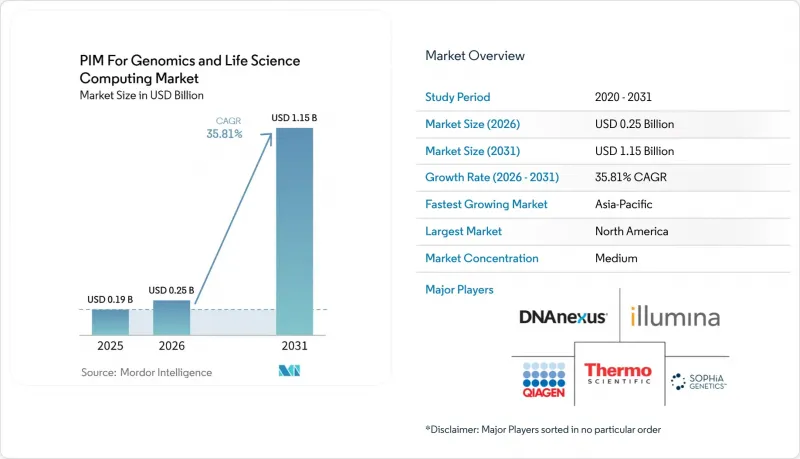
유전체학 및 생명과학 컴퓨팅용 PIM 시장 규모는 2025년 1억 9,000만 달러로 평가되었습니다. 2026년 2억 5,000만 달러에서 2031년까지 11억 5,000만 달러로 확대되며 2026년부터 2031년까지 연평균 성장률(CAGR)은 35.81%를 나타낼 전망입니다.
본 보고서는 도입 형태(클라우드 기반, On-Premise형, 하이브리드형), 구성 요소(하드웨어 등), 최종 사용자(제약·바이오기술 기업, 학술·연구 기관 등), 용도(서열 정렬 및 매핑, 변이 감지 및 해석 등), 지역별로 분류되어 있습니다. 시장 전망은 금액(달러) 기준으로 제시되어 있습니다.
유전체학 및 생명과학 컴퓨팅용 PIM 시장 동향 및 인사이트
AI를 활용한 유전체 데이터 큐레이션 및 변이 해석
인공지능(AI)은 유전체학 및 생명과학 컴퓨팅용 PIM의 역할을 수동적인 저장에서 능동적인 큐레이션 및 해석으로 변화시키고 있습니다. DNAnexus는 2026년 5월, 노코드 방식의 코호트 생성 및 종단적 쿼리를 실현하는 ‘Omics Data Agent’와 모델 프로토타이핑 시간을 최대 80% 단축하는 ‘AutoML Assistant’를 출시하며 이러한 변화를 더욱 가속화했습니다. 일루미나(Illumina) 역시 2026년, DRAGEN v4.5를 통해 생식세포계 및 체세포계 이용 사례 전반에 걸친 구조적 변이 감지에 대한 머신러닝 지원을 확대하고, 5염기 멀티오믹스 분석 지원을 추가함으로써 유사한 방향으로 나아갔습니다. 『Journal of Translational Medicine』지에 게재된 2026년 연구에 따르면, AI를 활용한 유전체 분석을 통해 희귀질환 진단 과정에서 표현형의 표준화, 병인성 등급 매기기, 구조화된 보고서 작성을 추적 가능한 워크플로우 내에서 통합할 수 있음이 입증되었습니다. 이러한 진전이 중요한 이유는 엄선된 증거가 일관된 메타데이터, 보고서 작성 로직 및 버전 관리와 연계됨으로써 재사용이 용이해지기 때문입니다. 유전체학 및 생명과학 컴퓨팅용 PIM 시장에서 이는 AI 기반 큐레이션이 실험실, 바이오의약품 팀, 그리고 규제 대상 임상 사용자에게 있어 단순한 프리미엄 기능에서 구매의 필수 요건으로 전환되고 있음을 의미합니다.
LIMS, EHR, PIM 스택 전반에 걸친 상호 운용 가능한 데이터 거버넌스에 대한 수요 증가
상호 운용성은 유전체학 및 생명과학 컴퓨팅용 PIM 시장에서 핵심 요구 사항으로 자리 잡고 있습니다. 이는 실험실, 임상 시스템 및 제품 데이터 환경에서 단순한 파일 교환이 아닌 공유된 거버넌스가 필요하기 때문입니다. QIAGEN Digital Insights는 2025년 11월 QCI Interpret 업데이트를 통해 이러한 요구를 반영했습니다. 이번 업데이트에서는 전문가 큐레이션 대상을 약 1,100개의 유전자로 확대하고, 전 세계 임상 유전체학 업무를 위한 다국어 보고서 기능을 추가했습니다. 일루미나(Illumina)의 ‘Emedgene’ 소프트웨어 역시 LIMS, EHR 및 기타 IT 시스템과 통합되면서, 관리된 방식으로 해석 템플릿에 데이터를 입력할 수 있는 실험실 내 큐레이션 저장소를 유지하고 있습니다. ISO/TS 21405 : 2026은 IDMP 온톨로지의 개발 및 의미론적으로 상호 운용 가능한 의약품 데이터를 위한 공식적인 프레임워크를 확립함으로써 또 다른 계층을 추가하고 있습니다. 이로 인해 시스템 변경에 따라 메타데이터 모델, 보고서 구조, 거버넌스 규칙을 지속적으로 일관되게 유지해야 하므로, 상호 운용성이 일회성 통합 작업에 그치는 것을 방지합니다. 따라서 유전체학 및 생명과학 컴퓨팅용 PIM은 감사 가능성을 저해하지 않으면서 연구, 임상, 규제 각 환경에 걸친 데이터의 컨텍스트를 관리할 수 있는 플랫폼에 대한 수요로 인해 혜택을 받고 있습니다.
레거시 생명과학 시스템과의 통합 비용 부담
유전체학 및 생명과학 컴퓨팅용 PIM 시장에서 레거시 생명과학 시스템의 도입이 더디게 진행되는 이유는 새로운 도구가 이미 규제 대상 업무를 지원하고 있는 검증된 환경에 부합해야 하기 때문입니다. 2025년 3월 Veeva와 공동으로 출범한 베링거 인겔하임의 ‘One Medicine Platform’은 이 회사의 전 세계 연구 개발 조직 전반에 걸친 임상 데이터, 규제 관련 데이터, 품질 데이터를 연계했습니다. 이는 가치를 실현하기 위해서는 이러한 변혁 프로그램이 얼마나 광범위해야 하는지를 보여줍니다. 일루미나(Illumina)의 ‘Emedgene’에 관한 자료 역시 관련된 인터페이스의 다양성을 여실히 드러내고 있습니다. 이 소프트웨어는 LIMS, EHR 및 기타 IT 시스템과 연동하면서도 해석 워크플로의 안전성과 구조화를 유지하고 있기 때문입니다. DNAnexus는 검증된 클라우드 협업을 기반으로 한 ‘Trusted Regulatory Spaces’를 제안하고 있으며, 이는 벤더들이 현재 플랫폼 자체에 규정 준수 지원 기능을 통합해야 함을 시사합니다. 이로 인해, 특히 조직이 고립된 단일 도구를 추가하는 것이 아니라 오랫동안 정착된 워크플로를 대체하는 경우, 각 도입에 수반되는 시간, 계획 및 서비스상의 부담이 증가합니다. 따라서 유전체학 및 생명과학 컴퓨팅용 PIM 분야에서 구매자가 전환에 드는 노력과 단기적인 생산성 향상을 비교 검토하는 가운데, 도입 시 발생하는 마찰을 줄일 수 있는 벤더가 더 유리한 입장에 서게 될 것입니다.
부문별 분석
2025년, 유전체학 및 생명과학 컴퓨팅용 PIM 시장 점유율 중 On-Premise 배포가 61.13%를 차지했습니다. 이는 규제 대상 환경에서 검증된 환경의 중요성과 보다 엄격한 관리에 대한 기대를 반영한 것입니다. 이러한 우위는 오랜 기간에 걸친 GxP 관행, 내부 검토 절차, 그리고 기밀성이 높은 과학 기록을 엄격하게 관리되는 인프라 내에 보관해야 할 필요성과 밀접한 관련이 있습니다. 규정 준수, 추적성 및 데이터 처리 정책이 수년에 걸쳐 구축되어 왔음에도 불구하고, 많은 구매자들은 여전히 로컬 관리를 더 안전한 선택으로 간주하고 있습니다. 또한, 이 부문은 기존의 LIMS, 품질 시스템 및 임상 용도를 단번에 교체하는 것보다 유지하는 것이 더 쉽다는 사실로부터도 혜택을 받고 있습니다. 따라서 도입 추세에 변화가 나타나기 시작했음에도 불구하고, 유전체학 및 생명과학 컴퓨팅용 PIM 시장 현재 매출 구성에서 On-Premise형은 여전히 확고한 입지를 유지하고 있습니다.
클라우드 기반 도입은 2031년까지 연평균 성장률(CAGR) 36.48%로 확대될 것으로 예측되며, 유전체학·생명과학 컴퓨팅용 PIM 시장에서 가장 빠르게 성장하는 도입 모델이 되고 있습니다. DNAnexus가 2026년 5월에 ‘Omics Data Catalog’와 ‘Omics Data Agent’를 출시한 것은 거버넌스가 확립된 데이터 탐색, 재사용 가능한 메타데이터, AI와의 직접적인 연동을 중심으로 클라우드 플랫폼이 구축되고 있음을 보여줍니다. ‘Trusted Regulatory Spaces’는 규제 대상 협업, 감사 지원 및 클라우드 액세스를 이제 단일 관리 환경 내에서 통합할 수 있음을 보여줌으로써 이러한 추세를 뒷받침하고 있습니다. 하이브리드 도입은 조직이 기밀성이 높은 기록을 기존 On-Premise 시스템에 보관하면서, 더 광범위한 분석 및 협업을 클라우드상에서 수행할 수 있게 해주기 때문에 실용적인 중간 대안으로 부상하고 있습니다. 앞으로 검증 절차가 개선되고 지속적인 플랫폼 업데이트에 익숙해지는 구매자가 늘어남에 따라, 유전체학 및 생명과학 컴퓨팅용 PIM 시장에서는 클라우드 및 하이브리드 모델이 더욱 확산될 것으로 예측됩니다.
2025년 매출 기준 중 하드웨어가 78.62%를 차지해, 유전체학 및 생명과학 컴퓨팅용 PIM 시장 지출 대부분이 시퀀서, 고성능 컴퓨팅 자산, 스토리지 및 관련 인프라와 관련되어 있음을 알 수 있습니다. 이러한 추세는 운영 환경에서의 차세대 시퀀싱, 정렬, 그리고 대용량 데이터 마이그레이션에 수반되는 막대한 기술적 부담을 반영하고 있습니다. 일루미나(Illumina)사의 2026년 제품 동향도 이러한 견해를 뒷받침하고 있으며, ‘TruPath Genome’, MRD 연구를 위한 분산형 전체 유전체 시퀀싱,및 ‘fireflyGO’는 모두 데이터 생성 및 실험실 처리 능력에 대한 지속적인 투자를 시사합니다. 원시 시퀀싱 데이터, 연산 성능 및 스토리지의 신뢰성이 불충분하다면 어떠한 거버넌스 계층도 가치를 창출할 수 없기 때문에 하드웨어는 여전히 필수적입니다. 이는 이미 도입된 하드웨어 인프라가 유전체학 및 생명과학 컴퓨팅용 PIM(제품·인프라·모델) 내 현재 구조의 상당 부분을 여전히 뒷받침하고 있음을 의미합니다.
소프트웨어 시장은 연평균 성장률(CAGR) 36.42%를 나타낼 것으로 예측되며, 이러한 성장 속도는 유전체학 및 생명과학 컴퓨팅용 PIM에서 차별화의 초점이 어디로 이동하고 있는지를 보여줍니다. 일루미나(Illumina)사의 DRAGEN v4.5는 이러한 변화를 여실히 보여주고 있는데, 그 가치는 장비 자체보다 더 정확한 콜, 더 광범위한 분석 지원, 그리고 더 신속한 결과 해석과 점점 더 밀접하게 연결되고 있기 때문입니다. DNAnexus도 거버넌스가 적용된 플랫폼에 대화형 검색, 메타데이터 카탈로그화, AutoML 지원을 직접 통합함으로써 다른 각도에서 유사한 점을 강조하고 있습니다. 서비스 점유율은 여전히 작지만, 통합, 검증, 워크플로우 설정이 고객이 소프트웨어 계층을 얼마나 신속하게 활용할 수 있는지를 여전히 좌우하고 있기 때문에 상업적으로는 중요한 위치를 계속 차지하고 있습니다. 유전체학 및 생명과학 컴퓨팅 업계의 PIM에서 가치의 중심은 장비 소유에서 소프트웨어 인텔리전스 및 관리된 데이터 오케스트레이션으로 점차 이동하고 있습니다.
지역별 분석
2025년, 북미는 유전체학 및 생명과학 컴퓨팅용 PIM 시장에서 46.67%를 차지하며 주요 지역으로서의 위상을 유지했습니다. 이 지역은 미국, 특히 매사추세츠주, 캘리포니아주, 노스캐롤라이나주에 밀집된 생명공학 및 제약 클러스터의 혜택을 받고 있으며, 이들 지역의 활발한 연구와 상용화 활동이 플랫폼의 신속한 도입을 뒷받침하고 있습니다. 일루미나(Illumina)가 2026년 2월에 출시한 ‘TruPath Genome’에는 Broad Clinical Labs, GeneDx, Rady Children’s Hospital, 베일러 의과대학 등 30개 이상의 초기 도입 고객사가 있어, 이 지역 내 유전체학 도입의 활발함을 반영하고 있습니다. 캐나다와 멕시코는 연구 네트워크 및 서비스 제공 역량을 통해 지원을 보완하고 있지만, 유전체학 및 생명과학 컴퓨팅용 PIM(성능 정보 관리) 수요의 핵심은 여전히 미국에 있습니다. 유럽은 독일, 영국, 프랑스의 견조한 수요에 더해, EHDS(유럽 건강 데이터 전략) 및 연합 데이터 공유 모델에 의해 형성되는 보다 엄격한 거버넌스에 대한 기대에 힘입어 계속해서 2위 지역 규모를 유지하고 있습니다.
아시아태평양은 2031년까지 연평균 성장률(CAGR) 36.73%를 나타낼 것으로 예측되며, 유전체학 및 생명과학 컴퓨팅용 PIM 분야에서 가장 빠르게 성장하는 지역이 될 전망입니다. 이 지역의 성장은 대규모 국가 유전체학 프로그램, 바이오의약품 산업의 급속한 확장, 그리고 생명과학 분야의 컴퓨팅 및 클라우드 역량에 대한 투자 확대에 힘입고 있습니다. 2026년 『Nature』지에 보고된 중국의 ‘1,000 Chinese Pangenome’ 프로젝트에서는 1,116개의 이배체 유전체 어셈블리와 임퓨테이션 참조 패널이 생성되었습니다. 이는 해당 지역에서 현재 구축되고 있는 거버넌스가 확립된 데이터 인프라의 규모를 보여주는 것입니다. 일본과 인도 역시 규제 현대화, 국내 바이오의약품 산업의 확대, 그리고 정밀의료 워크플로우에 대한 관심 고조를 통해 지역 내 수요를 강화하고 있습니다. 이에 따라 아시아태평양은 북미를 제외한 지역에서 유전체학 및 생명과학 컴퓨팅용 PIM 시장에 있어 가장 확실한 성장 동력이 되고 있습니다.
남미와 중동 및 아프리카는 현재 시장 규모 면에서는 여전히 작지만, 전 세계 후원사들이 임상 프로그램과 정밀의료 인프라를 새로운 지역으로 확대함에 따라 두 지역 모두 중요성이 커지고 있습니다. 남미에서는 브라질이 두드러지며, 공중보건 유전체학 활동이 데이터 관리 요구를 충족하기 위한 보다 견고한 기반 구축에 기여하고 있습니다. 사우디아라비아와 아랍에미리트(UAE) 역시 의료 분야의 다각화 및 정밀의학에 대한 투자 계획을 통해 해당 지역 내 입지를 강화하고 있습니다. 두 지역 모두에서 유전체학 및 생명과학 컴퓨팅용 PIM 시장은 즉각적인 대규모 플랫폼 교체보다는 공동 프로젝트, 임상시험 인프라, 그리고 국경을 초월한 거버넌스 요구를 통해 우선적으로 확대될 것으로 예측됩니다.
기타 혜택 :
- 엑셀 형식 시장 예측(ME) 시트
- 3개월간의 애널리스트 지원
자주 묻는 질문
목차
제1장 서론
제2장 조사 방법
제3장 개요
제4장 시장 구도
제5장 시장 규모 및 성장 예측
제6장 경쟁 구도
제7장 시장 기회 및 향후 전망
KTH 26.09.02According to Mordor Intelligence, the PIM for genomics and life science computing market size is projected to expand from USD 0.19 billion in 2025 and USD 0.25 billion in 2026 to USD 1.15 billion by 2031, registering a CAGR of 35.81% between 2026 and 2031.
This report is Segmented by Deployment Type (Cloud-Based, On-Premises, and Hybrid), Component (Hardware, and More), End User (Pharmaceutical and Biotechnology Companies, Academic and Research Institutes, and More), Application (Sequence Alignment and Mapping, Variant Calling and Interpretation, and More), and Geography. The Market Forecasts are Provided in Terms of Value (USD).
Global PIM For Genomics and Life Science Computing Market Trends and Insights
AI-Driven Genomic Data Curation and Variant Interpretation
Artificial intelligence is changing the role of the PIM in the genomics and life science computing market from passive storage to active curation and interpretation. DNAnexus expanded this shift in May 2026, launching Omics Data Agent for no-code cohort creation and longitudinal queries, along with an AutoML Assistant that reduced model prototyping time by up to 80%. Illumina moved in the same direction in 2026 when DRAGEN v4.5 extended machine learning support for structural variant calling across germline and somatic use cases and added support for 5-base multiomic analyses. A 2026 study in the Journal of Translational Medicine showed that AI-assisted genomic analysis can combine phenotype standardization, pathogenicity ranking, and structured reporting in a traceable workflow for rare-disease diagnosis. These developments matter because curated evidence becomes easier to reuse once it is linked to consistent metadata, reporting logic, and version control. For the PIM for genomics and life science computing market, that means AI curation is moving from a premium feature to a core buying requirement for labs, biopharma teams, and regulated clinical users.
Rising Need For Interoperable Data Governance Across LIMS, EHR, and PIM Stacks
Interoperability is becoming a central demand in the PIM for genomics and life science computing market because laboratories, clinical systems, and product data environments now need shared governance rather than simple file exchange. QIAGEN Digital Insights showed this need in its November 2025 QCI Interpret update, which expanded expert curation coverage to around 1,100 genes and added multilingual reporting for global clinical genomics operations. Illumina's Emedgene software also integrates with LIMS, EHR, and other IT systems while maintaining a lab-curated repository that can populate interpretation templates in a controlled way. ISO/TS 21405:2026 adds another layer by establishing a formal framework for IDMP ontology development and semantically interoperable medicinal product data. This keeps interoperability from being a one-time integration project, since metadata models, reporting structures, and governance rules have to remain aligned as systems change. The PIM for genomics and life science computing market is therefore benefiting from demand for platforms that can manage data context across research, clinical, and regulatory environments without breaking auditability.
High Integration Cost with Legacy Life Science Systems
Legacy life science systems' slow adoption in the PIM for genomics and life science computing market because new tools must fit into validated environments that already support regulated work. Boehringer Ingelheim's One Medicine Platform, launched with Veeva in March 2025, connected clinical, regulatory, and quality data across its global R&D organization, which shows how broad these transformation programs need to be before value can be realized. Illumina's Emedgene material also highlights the number of interfaces involved, as the software connects to LIMS, EHR, and other IT systems while keeping interpretation workflows secure and structured. DNAnexus frames Trusted Regulatory Spaces around validated cloud collaboration, indicating that vendors now have to package compliance support with the platform itself. This increases the time, planning, and service burden associated with each rollout, especially when organizations are replacing long-standing workflows rather than adding isolated point tools. Vendors that reduce implementation friction are therefore in a stronger position as buyers compare migration effort against near-term productivity gains in the PIM for genomics and life science computing market.
Other drivers and restraints analyzed in the detailed report include:
- Regulatory Pressure for Audit-Ready Traceability in Clinical and Product Data
- Increasing Demand for Cloud-Native Collaboration Across Distributed Research Networks
- Data Privacy, Sovereignty, and Compliance Complexity
For complete list of drivers and restraints, kindly check the Table Of Contents.
Segment Analysis
On-premises deployment accounted for 61.13% of the PIM market share in genomics and life science computing in 2025, reflecting the weight of validated environments and stricter control expectations in regulated settings. That lead is tied to long-standing GxP practices, internal review routines, and the need to keep sensitive scientific records inside tightly managed infrastructures. Many buyers still view local control as the safer option, even though compliance, traceability, and data-handling policies have been built over several years. The segment also benefits from the fact that legacy LIMS, quality systems, and clinical applications are often easier to preserve than to replace in a single step. This keeps on-premises strong in the current revenue mix of the PIM for genomics and life science computing market, even as deployment preferences start to change.
Cloud-based deployment is projected to expand at a 36.48% CAGR through 2031, which makes it the fastest-growing deployment model in the PIM for genomics and life science computing market. DNAnexus's May 2026 launch of Omics Data Catalog and Omics Data Agent shows how cloud platforms are being built around governed discovery, reusable metadata, and direct AI interaction. Trusted Regulatory Spaces adds to that case by showing that regulated collaboration, audit support, and cloud access can now be combined in one controlled environment. Hybrid deployment is emerging as a practical middle path because organizations can keep sensitive records in existing local systems while running broader analytics and collaboration in the cloud. Over time, the PIM for genomics and life science computing market is likely to see cloud and hybrid models gain ground as validation playbooks improve and more buyers get comfortable with continuous platform updates.
Hardware accounted for 78.62% of the 2025 revenue base, which shows how much spending in the PIM for genomics and life science computing market has been tied to sequencers, high-performance computing assets, storage, and related infrastructure. That pattern reflects the heavy technical burden of next-generation sequencing, alignment, and high-volume data movement in production environments. Illumina's 2026 product activity supports this view, with TruPath Genome, distributed whole-genome sequencing for MRD research, and fireflyGO all pointing to continued investment in data generation and lab throughput. Hardware remains essential because no governance layer can create value if raw sequencing, compute performance, and storage reliability are weak. This means the installed hardware base still anchors a large part of the current structure of the PIM for genomics and life science computing market.
Software is projected to grow at a 36.42% CAGR, and that pace shows where differentiation is moving in the PIM for genomics and life science computing market. Illumina's DRAGEN v4.5 demonstrates this shift because the value is increasingly tied to better calling, broader assay support, and faster interpretation rather than to the instrument alone. DNAnexus has made the same point from a different angle by adding conversational search, metadata cataloging, and AutoML support directly into its governed platform. Services remain smaller in share, but they stay commercially important because integration, validation, and workflow setup still shape how quickly customers can use the software layer. In the PIM for genomics and life science computing industry, the center of value is gradually shifting from equipment ownership toward software intelligence and managed data orchestration.
Complete Report Scope:
- By Deployment Type
- Cloud-Based
- On-Premises
- Hybrid
- By Component
- Hardware
- Software
- Services
- By End User
- Pharmaceutical and Biotechnology Companies
- Academic and Research Institutes
- Hospitals and Clinical Laboratories
- Contract Research Organizations
- Other End Users
- By Application
- Sequence Alignment and Mapping
- Variant Calling and Interpretation
- Multi-Omics Analysis
- Clinical Genomics
- Drug Discovery and Target Identification
- Population Genomics
- By Geography
- North America
- United States
- Canada
- Mexico
- Europe
- Germany
- United Kingdom
- France
- Italy
- Rest of Europe
- Asia-Pacific
- China
- Japan
- South Korea
- Taiwan
- India
- Rest of Asia-Pacific
- South America
- Middle East and Africa
- North America
Geography Analysis
North America held 46.67% of the PIM for the genomics and life science computing market in 2025, maintaining its position as the leading regional block. The region benefits from dense biotech and pharma clusters in the United States, especially in Massachusetts, California, and North Carolina, where research intensity and commercialization activity support faster platform adoption. Illumina's February 2026 TruPath Genome launch, which had over 30 early-access customers including Broad Clinical Labs, GeneDx, Rady Children's Hospital, and Baylor College of Medicine, reflects the depth of active genomics deployment in the region. Canada and Mexico add support through research networks and service delivery capacity, even though the United States remains the core demand center in the PIM for genomics and life science computing market. Europe remains the second-largest geography, supported by strong demand in Germany, the United Kingdom, and France, as well as by tighter governance expectations shaped by the EHDS and federated data-sharing models.
Asia-Pacific is projected to grow at a 36.73% CAGR through 2031, making it the fastest-growing geography in the PIM for genomics and life science computing market. The regional rise is supported by large national genomics programs, faster biopharma expansion, and growing investment in compute and cloud capacity for life science work. China's 1,000 Chinese Pangenome project, reported in Nature in 2026, generated 1,116 diploid genome assemblies and an imputation reference panel, which shows the scale of governed data infrastructure now being created in the region. Japan and India also strengthen regional demand through regulatory modernization, local biopharma expansion, and broader interest in precision medicine workflows. This makes Asia-Pacific the clearest growth engine for the PIM for genomics and life science computing market outside North America.
South America and the Middle East and Africa remain smaller in current size, but both regions are gaining relevance as global sponsors extend clinical programs and precision medicine infrastructure into new locations. Brazil stands out in South America because public health genomics activity is helping build a more durable base for data management needs. Saudi Arabia and the United Arab Emirates are also raising regional visibility through broader healthcare diversification and precision medicine investment plans. Across both regions, the PIM for genomics and life science computing market is likely to expand first through collaborative projects, clinical trial infrastructure, and cross-border governance needs rather than through immediate large-scale platform replacement.
- Illumina, Inc.
- Thermo Fisher Scientific Inc.
- QIAGEN N.V.
- DNAnexus, Inc.
- SOPHiA GENETICS SA
- IBM Corporation
- Oracle Corporation
- SAP SE
- Informatica LLC
- Stibo Systems A/S
- inriver AB
- Syndigo LLC
- Akeneo SAS
- Contentserv AG
- Pimcore GmbH
- Salsify, Inc.
- Veeva Systems Inc.
- Benchling, Inc.
- Fabric Genomics, Inc.
- Geneva Bioinformatics, Inc.
Additional Benefits:
- The market estimate (ME) sheet in Excel format
- 3 months of analyst support
TABLE OF CONTENTS
1 INTRODUCTION
- 1.1 Study Assumptions And Market Definition
- 1.2 Scope Of The Study
2 RESEARCH METHODOLOGY
3 EXECUTIVE SUMMARY
4 MARKET LANDSCAPE
- 4.1 Market Overview
- 4.2 Market Drivers
- 4.2.1 AI-Driven Genomic Data Curation and Variant Interpretation
- 4.2.2 Rising Need for Interoperable Data Governance Across LIMS, EHR, and PIM Stacks
- 4.2.3 Regulatory Pressure for Audit-Ready Traceability in Clinical and Product Data
- 4.2.4 Increasing Demand for Cloud-Native Collaboration Across Distributed Research Networks
- 4.2.5 Expansion of Multi-Omics and Precision Medicine Workflows
- 4.2.6 Data Standardization and Metadata Enrichment at Scale
- 4.3 Market Restraints
- 4.3.1 High Integration Cost with Legacy Life Science Systems
- 4.3.2 Data Privacy, Sovereignty, and Compliance Complexity
- 4.3.3 Fragmented Scientific Data Models and Workflow Incompatibility
- 4.3.4 Limited In-House Bioinformatics and Data Governance Skills
- 4.4 Industry Value Chain Analysis
- 4.5 Regulatory Landscape
- 4.6 Technological Outlook
- 4.7 Porter's Five Forces Analysis
- 4.7.1 Bargaining Power of Buyers
- 4.7.2 Bargaining Power of Suppliers
- 4.7.3 Threat of New Entrants
- 4.7.4 Threat of Substitutes
- 4.7.5 Intensity of Competitive Rivalry
- 4.8 Impact of Macroeconomic Factors on the Market
5 MARKET SIZE AND GROWTH FORECASTS (VALUE)
- 5.1 By Deployment Type
- 5.1.1 Cloud-Based
- 5.1.2 On-Premises
- 5.1.3 Hybrid
- 5.2 By Component
- 5.2.1 Hardware
- 5.2.2 Software
- 5.2.3 Services
- 5.3 By End User
- 5.3.1 Pharmaceutical and Biotechnology Companies
- 5.3.2 Academic and Research Institutes
- 5.3.3 Hospitals and Clinical Laboratories
- 5.3.4 Contract Research Organizations
- 5.3.5 Other End Users
- 5.4 By Application
- 5.4.1 Sequence Alignment and Mapping
- 5.4.2 Variant Calling and Interpretation
- 5.4.3 Multi-Omics Analysis
- 5.4.4 Clinical Genomics
- 5.4.5 Drug Discovery and Target Identification
- 5.4.6 Population Genomics
- 5.5 By Geography
- 5.5.1 North America
- 5.5.1.1 United States
- 5.5.1.2 Canada
- 5.5.1.3 Mexico
- 5.5.2 Europe
- 5.5.2.1 Germany
- 5.5.2.2 United Kingdom
- 5.5.2.3 France
- 5.5.2.4 Italy
- 5.5.2.5 Rest of Europe
- 5.5.3 Asia-Pacific
- 5.5.3.1 China
- 5.5.3.2 Japan
- 5.5.3.3 South Korea
- 5.5.3.4 Taiwan
- 5.5.3.5 India
- 5.5.3.6 Rest of Asia-Pacific
- 5.5.4 South America
- 5.5.5 Middle East and Africa
- 5.5.1 North America
6 COMPETITIVE LANDSCAPE
- 6.1 Market Concentration
- 6.2 Strategic Moves
- 6.3 Market Share Analysis
- 6.4 Company Profiles (includes Global Level Overview, Market Level Overview, Core Segments, Financials as available, Strategic Information, Market Rank/Share, Products and Services, Recent Developments)
- 6.4.1 Illumina, Inc.
- 6.4.2 Thermo Fisher Scientific Inc.
- 6.4.3 QIAGEN N.V.
- 6.4.4 DNAnexus, Inc.
- 6.4.5 SOPHiA GENETICS SA
- 6.4.6 IBM Corporation
- 6.4.7 Oracle Corporation
- 6.4.8 SAP SE
- 6.4.9 Informatica LLC
- 6.4.10 Stibo Systems A/S
- 6.4.11 inriver AB
- 6.4.12 Syndigo LLC
- 6.4.13 Akeneo SAS
- 6.4.14 Contentserv AG
- 6.4.15 Pimcore GmbH
- 6.4.16 Salsify, Inc.
- 6.4.17 Veeva Systems Inc.
- 6.4.18 Benchling, Inc.
- 6.4.19 Fabric Genomics, Inc.
- 6.4.20 Geneva Bioinformatics, Inc.
7 MARKET OPPORTUNITIES AND FUTURE OUTLOOK
- 7.1 White-Space and Unmet-Need Assessment


