

|
시장보고서
상품코드
2122533
제품 정보 관리(PIM) : 시장 점유율 분석, 업계 동향 및 통계, 성장 예측(2026-2031년)Product Information Management (PIM) - Market Share Analysis, Industry Trends & Statistics, Growth Forecasts (2026 - 2031) |
||||||
 Mordor Intelligence
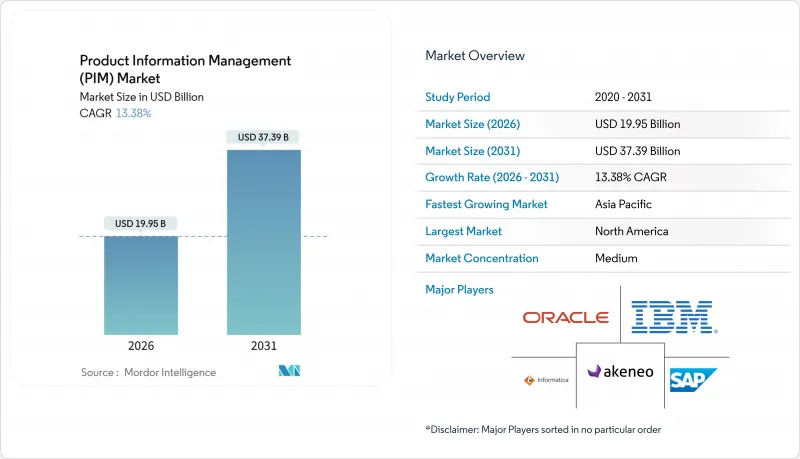
에 의하면, 제품 정보 관리(PIM) 시장 규모는 2026년에 199억 5,000만 달러에 달하고, 2031년까지 373억 9,000만 달러에 이를 것으로 예상되며, 예측 기간 동안 CAGR 13.38%를 기록할 전망입니다.

본 보고서는 배포 모델(클라우드 및 On-Premise), 제공 방식(솔루션 및 서비스), 조직 규모(대기업 및 중소기업), 최종 사용자 산업(소매 및 전자상거래, 은행, 금융서비스 및 보험(BFSI), 제조, 미디어 및 엔터테인먼트, IT 및 통신) 및 지역별로 분류되어 있습니다. 시장 예측은 금액(달러) 기준으로 제시되어 있습니다.
세계의 제품 정보 관리(PIM) 시장 동향 및 인사이트력
전자상거래의 급속한 성장과 SKU의 급증
SKU 수의 폭발적인 증가로 인해 기존의 스프레드시트로는 더 이상 대응할 수 없게 되었으며, 소매업체들은 제품 속성을 클라우드 허브에 통합하고 정확한 데이터를 웹, 모바일, 매장 시스템에 전달하고 있습니다. 1만 건 이상의 SKU를 취급하는 Shopify 가맹점에서는 정보가 불완전할 경우 23%의 수익 손실이 발생했으나, 자동화된 데이터 보강과 마켓플레이스 피드를 통해 이러한 격차가 해소되었습니다. Instacart를 비롯한 퀵 커머스 사업자들은 1시간 이내의 API 업데이트를 요구하고 있어, 공급업체들은 상품 목록을 유지하기 위해 실시간 PIM 웹훅을 통합하고 있습니다. Akeneo의 AI 엔진은 공급업체의 PDF에서 속성을 추출하고 상품 설명을 번역함으로써 수작업량을 60% 줄이고, 온보딩 주기를 몇 주에서 며칠로 단축하고 있습니다. 수요가 정점에 달하고 있는 곳은 Lazada와 Tokopedia가 상품 라인업을 급속히 확대하고 있는 아시아태평양과, 온라인 구매 및 매장 수령(BOPU) 프로그램에서 상품 정보와 재고 정보의 동기화가 요구되는 북미입니다.
클라우드 도입을 통한 TCO 절감
클라우드 플랫폼으로 전환하는 기업은 하드웨어 설비 투자를 피하고, IT 인력을 감축하며, 운영 비용을 계절별 판매량에 맞추어 조정할 수 있습니다. 수동 업그레이드를 없애고 보안 패치를 자동화함으로써 3년 이내에 총소유비용(TCO)을 30-40% 절감할 수 있습니다. 직원 수 1,000명 미만의 중견 기업은 대기업에 비해 2배 빠른 속도로 클라우드 PIM을 도입하고 있습니다. 이는 구독형 요금제와 Shopify 및 Salesforce용 기성 커넥터를 통해 On-Premise 환경에서 도입하는 데 소요되는 12-18개월의 기간을 최단 12주로 단축할 수 있기 때문입니다. GS1 준수 데이터 모델 등의 업계 템플릿을 통해 공급업체와의 통합이 신속해집니다. 이러한 이점들이 클라우드 도입의 연평균 성장률(CAGR) 18.50%를 견인하고 있지만, 한편으로는 데이터 저장 위치 및 주권에 대한 우려도 제기되고 있습니다. 각 벤더사는 지역별 호스팅 옵션과 ISO 27001에 기반한 관리 조치를 통해 이러한 우려를 완화하고 있습니다.
사이버 보안 및 데이터 유출에 대한 우려
중앙 집중화된 클라우드 저장소에는 독자적인 배합, 가격, 공급업체와의 계약 조건 등이 저장되어 있어 랜섬웨어 집단에게 매력적인 표적이 됩니다. 2023년 Meta에 부과된 12억 유로의 GDPR(EU 개인정보보호규정) 벌금은 엄격한 관리 조치 없이 데이터가 국경을 넘을 때 발생할 수 있는 잠재적 위험을 여실히 드러내고 있습니다. 벤더 측은 제로 트러스트 아키텍처, 세밀한 암호화, 그리고 선택 사항인 지역별 호스팅으로 대응하고 있지만, Shopify, Amazon, Instagram에 대한 API 연결이 늘어날 때마다 공격 표면은 확대됩니다. 은행 및 제약과 같은 규제 대상 산업에서는 설정 가능한 마스킹 기능과 동의 획득 모듈이 요구되고 있어, 이는 도입의 장벽이 되고 있습니다. 단기적인 영향이 가장 큰 곳은 정보 공개법에 따라 데이터 유출을 신속히 공표해야 하는 유럽 및 북미입니다.
부문별 분석
2025년에는 클라우드 도입이 매출 점유율의 63.50%를 차지하며, 구독 경제와 쇼핑 시즌의 피크 수요에 대응하는 탄력적인 확장성 덕분에 On-Premise형 솔루션을 능가했습니다. 클라우드 솔루션에 기인한 제품 정보 관리(PIM) 시장 규모는 연평균 성장률(CAGR) 18.50%로 확대될 것으로 예측되며, 클라우드는 가장 크고 가장 빠르게 성장하는 모델이 될 것입니다. 소매업체들은 상시 가동되는 카탈로그 배포를 뒷받침하는 관리형 업그레이드와 24시간 세계 가용성을 높이 평가했습니다. On-Premise 점유율은 계속해서 하락하고 있습니다. 이는 자본 투자, 장기화되는 도입 기간, 그리고 번거로운 패치 적용이 속도와 회복력을 요구하는 경영진의 요청과 더 이상 부합하지 않기 때문입니다.
제약, 항공우주, 방위 산업에서는 데이터 주권과 에어갭 네트워크가 여전히 필수 조건이기 때문에 하이브리드 구성이 정착되어 있습니다. 이러한 기업들은 기밀성이 높은 BOM 데이터를 사내 서버에 보관하면서, 클라우드 기반의 데이터 강화 및 배포 마이크로서비스를 활용하고 있습니다. Salsify, Stibo Systems, Syndigo에 번들로 제공되는 생성형 AI 모듈은 클라우드 규모에서 더 경제적으로 운영되므로, 기능 면에서의 격차는 더욱 확대되고 있습니다. 따라서 시장 동향은 ‘클라우드 대 On-Premise’라는 이분법적 논의에서 벗어나, 일상적인 이용 사례에서는 풀 SaaS가 주류를 이루고, 규제가 엄격한 분야에서는 엣지 배포가 활용되는 연속체로 전환되고 있습니다.
2025년에도 솔루션은 제품 정보 관리(PIM) 시장 매출의 63.14%를 차지했으며, 여기에는 소프트웨어 구독 및 라이선스 유지보수가 포함됩니다. 그러나 서비스(구축, 맞춤형 통합, 교육, 관리형 운영)는 2031년까지 연평균 성장률(CAGR) 23.40%로 증가하여 소프트웨어 자체를 능가하는 속도로 성장하고 있습니다. 많은 조직은 PIM을 운영하기 위해 필요한 분류 체계 설계, 데이터 품질 개선, 이해관계자간 조정을 반복적으로 과소평가했습니다. 컨설팅 기업이 개입하여 레거시 카탈로그 정리, MuleSoft 커넥터 구축, 속성 거버넌스에 관한 카테고리 팀 지도를 수행합니다. 그 결과, 제품 정보 관리(PIM) 시장의 서비스 부문 규모는 라이선스 부문보다 빠르게 확대되고 있습니다.
매니지드 서비스는 PIM 데이터 스튜어드의 만성적인 부족이라는 과제에 대응하고 있습니다. 브랜드 기업들은 정기적인 콘텐츠 건전성 점검, 마켓플레이스 피드 모니터링, 규정 준수 감사를 월정액 요금을 지불하고 전문 업체에 위탁하고 있습니다. 이러한 아웃소싱 추세가 둔화되는 것은 로우코드 워크플로우 빌더, AI 데이터 품질 봇, 셀프 서비스형 매핑을 통해 인적 개입이 줄어들 때뿐입니다. 그 전까지는 디지털 제품 패스포트 의무화나 옴니채널 피드의 경우, 일회성 프로젝트가 아닌 지속적인 업데이트가 필요하기 때문에 서비스 수익이 주요 성장 동력으로 남아 있을 것입니다.
지역별 분석
북미는 집중된 소매 체인, 높은 디지털 도입률, 그리고 마스터 데이터 거버넌스의 조기 도입에 힘입어 2025년 전 세계 매출의 39.80%를 차지했습니다. 많은 대기업은 1세대 PIM 도입을 완료했으며, 현재는 콘텐츠 생성, 설명문 번역, 데이터 품질 자동 평가를 수행하는 AI 네이티브 버전으로의 업그레이드를 진행하고 있습니다. 중견 기업 시장에서는 Shopify를 이용하는 브랜드와 Amazon의 제3자 판매자들이 원활한 도입과 합리적인 가격의 라이선스를 원하고 있어, 벤더 간의 경쟁이 치열해지고 있습니다. 또한, 캘리포니아주 소비자 개인정보 보호법(CCPA) 등 미국의 개인정보 보호 관련 법안으로 인해 PIM 워크플로우 내 데이터 계보 추적 및 동의 감사에 대한 수요도 증가하고 있습니다.
아시아태평양은 성장의 원동력이 되고 있으며, 중국, 인도, 동남아시아에서 무역 및 결제 디지털화가 진행됨에 따라 연평균 성장률(CAGR)은 20.10%로 성장을 지속하고 있습니다. 바이두(Baidu) 검색에 통합된 GS1 표준은 위조품을 배제하면서도 검색 가시성을 향상시켜, 제조업체가 제품 데이터를 엄격하게 구조화하도록 유도하고 있습니다. 인도의 ‘디지털 상거래를 위한 개방형 네트워크(ONDC)’는 소규모 사업자가 참여하기 위해 채택이 의무화된 개방형 카탈로그 형식을 규정하고 있습니다. 일본과 한국에서는 고령화 사회에서의 지속가능성 목표를 지원하기 위해 재활용 절차를 기재한 QR 코드를 제품에 포함시키고 있습니다. 언어의 다양성, Lazada 및 Coupang 고유의 스키마, 그리고 데이터 호스팅에 관한 다양한 법규로 인해 공급업체는 멀티테넌트 방식의 규칙 기반 변환 로직을 제공할 수밖에 없게 되었습니다.
유럽에서는 여전히 규정 준수를 중시하는 태도가 이어지고 있습니다. ‘기업 지속가능성 보고 지침(CSRD)’ 및 ‘디지털 제품 여권’ 제도에 따라 탄소 발자국, 수리 가능성, 순환성에 관한 필드를 추가하는 PIM 업그레이드가 요구되고 있습니다. 튀르키예, 모로코, 베트남의 수출 지향형 제조업체들도 EU 시장 접근성을 유지하기 위해 시스템을 현대화하고 있으며, 이로 인해 2차 수요가 발생하고 있습니다. 남미에서의 도입은 브라질과 아르헨티나에 집중되어 있으며, Mercado Libre와 Falabella가 구조화된 상품 등록 규칙을 철저히 적용하고 있습니다. 중동에서는 UAE와 사우디아라비아에서 성장세가 두드러집니다. 이는 정부 주도의 전자상거래 전략과 급성장하는 지역 마켓플레이스가 뒷받침하고 있는 결과입니다. 아프리카는 아직 발전 단계에 있지만, 나이지리아와 남아프리카공화국의 스마트폰 보급률 상승은 모바일 우선 카탈로그를 타겟으로 하는 PIM 벤더들에게 초기 긍정적 신호를 보내고 있습니다.
기타 혜택 :
- 엑셀 형식 시장 예측(ME) 시트
- 3개월간 애널리스트 지원
자주 묻는 질문
목차
제1장 서론
제2장 조사 방법
제3장 주요 요약
제4장 시장 구도
제5장 시장 규모 및 성장 예측
제6장 경쟁 구도
제7장 시장 기회 및 향후 전망
KTH 26.09.08According to Mordor Intelligence, the product information management market size stands at USD 19.95 billion in 2026 and is projected to reach USD 37.39 billion by 2031, registering a 13.38% CAGR through the forecast period.
This report is Segmented by Deployment Model (Cloud, and On-Premise), Offering (Solutions, and Services), Organization Size (Large Enterprises, and Small and Medium Enterprises), End-User Industry (Retail and E-Commerce, BFSI, Manufacturing, Media and Entertainment, and IT and Telecom), and Geography. The Market Forecasts are Provided in Terms of Value (USD).
Global Product Information Management (PIM) Market Trends and Insights
E-Commerce Boom And SKU Proliferation
Explosive SKU counts strain legacy spreadsheets, prompting retailers to centralize product attributes in cloud hubs that syndicate accurate data to web, mobile, and store systems. Shopify merchants handling more than 10,000 SKUs experienced a 23% revenue loss when information was incomplete, a gap closed by automated enrichment and marketplace feeds. Instacart and other quick-commerce operators require sub-hour API updates, so suppliers integrate real-time PIM webhooks to stay listed. AI engines from Akeneo extract attributes from supplier PDFs and translate descriptions, cutting manual effort 60% and shrinking onboarding cycles from weeks to days. Demand peaks in Asia-Pacific, where Lazada and Tokopedia rapidly expand assortments, and in North America, where buy-online-pick-up-in-store programs require synchronized product and inventory views.
Cloud adoption lowering TCO
Enterprises shifting to cloud platforms avoid hardware capital expense, reduce IT head-count, and match operating cost to seasonal volume. Total cost of ownership falls 30-40% within three years by eliminating manual upgrades and by automating security patches. Mid-market firms with fewer than 1,000 employees adopt cloud PIM twice as fast as large peers because subscription tiers and pre-built Shopify or Salesforce connectors compress deployment from 12-18 months on-premise to as little as 12 weeks. Industry templates such as GS1-compliant data models speed integration with suppliers. These benefits drive the 18.50% CAGR in cloud deployments yet raise data-residency and sovereignty questions that vendors mitigate through regional hosting options and ISO 27001 controls.
Cybersecurity And Data-Breach Concerns
Centralized cloud repositories become attractive to ransomware groups because they store proprietary formulations, prices, and supplier terms. The EUR 1.2 billion GDPR penalty levied on Meta in 2023 underscores potential exposure when data crosses borders without airtight controls. Vendors answer with zero-trust architectures, granular encryption, and optional regional hosting, yet every API link to Shopify, Amazon, or Instagram multiplies the attack surface. Regulated verticals such as banking and pharma demand configurable masking and consent modules, adding deployment friction. The near-term drag is strongest in Europe and North America where disclosure laws force rapid public reporting of breaches.
Other drivers and restraints analyzed in the detailed report include:
- Omnichannel customer-experience mandates
- EU Digital Product Passport Compliance
- Integration complexity with legacy ERPs
For complete list of drivers and restraints, kindly check the Table Of Contents.
Segment Analysis
Cloud deployments generated 63.50% revenue share in 2025, outstripping on-premise alternatives through subscription economics and elastic scale that match peak demand around shopping holidays. The Product Information Management market size attributable to cloud solutions is forecast to rise at an 18.50% CAGR, making cloud both the largest and quickest-growing model. Retailers appreciate managed upgrades and 24-hour global availability that support always-on catalog syndication. On-premise share continues to fall because capital expense, extended implementation, and laborious patching no longer match board-level mandates for speed and resilience.
Hybrid configurations persist in pharmaceuticals, aerospace, and defense where data sovereignty or air-gapped networks remain non-negotiable. These firms keep sensitive BOM data on internal servers while leveraging cloud-based enrichment and distribution micro-services. Generative AI modules now bundled with Salsify, Stibo Systems, and Syndigo run more economically at cloud scale, further widening the capability gap. The market story therefore shifts from a binary cloud versus on-premise debate to a continuum in which full SaaS dominates routine use cases while edge deployments serve regulated corners.
Solutions still delivered 63.14% of Product Information Management market revenue in 2025, covering software subscriptions and license maintenance. However, services - implementation, custom integration, training, and managed operations - are rising at a 23.40% CAGR through 2031, outpacing software itself. Organizations repeatedly underestimate the taxonomy design, data-quality remediation, and stakeholder alignment needed to operationalize PIM. Consulting firms step in to cleanse legacy catalogs, build MuleSoft connectors, and coach category teams on attribute governance. As a result, the Product Information Management market size for services is expanding faster than licenses.
Managed services answer the chronic shortage of PIM data stewards. Brands outsource routine content health checks, marketplace feed monitoring, and compliance audits to specialists for a monthly fee. This outsourcing trend will taper only when low-code workflow builders, AI data-quality bots, and self-service mapping reduce human intervention. Until then, services revenue remains the primary tailwind because Digital Product Passport mandates and omnichannel feeds require ongoing updates rather than one-time projects.
Complete Report Scope:
- By Deployment Model
- Cloud
- On-Premise
- By Offering
- Solutions
- Services
- By Organization Size
- Large Enterprises
- Small and Medium Enterprises (SMEs)
- By End-User Industry
- Retail and E-commerce
- BFSI
- Manufacturing
- Media and Entertainment
- IT and Telecom
- Other End-User Industries
- By Geography
- North America
- United States
- Canada
- Mexico
- Europe
- Germany
- United Kingdom
- France
- Italy
- Spain
- Russia
- Rest of Europe
- Asia-Pacific
- China
- Japan
- India
- South Korea
- Australia
- Rest of Asia-Pacific
- Middle East
- Saudi Arabia
- United Arab Emirates
- Turkey
- Rest of Middle East
- Africa
- South Africa
- Nigeria
- Rest of Africa
- South America
- Brazil
- Argentina
- Rest of South America
- North America
Geography Analysis
North America contributed 39.80% of global revenue in 2025, buoyed by concentrated retail chains, high digital-adoption rates, and early uptake of master data governance. Many large enterprises completed first-generation PIM rollouts and now upgrade to AI-native versions that generate copy, translate descriptions, and score data quality automatically. Vendor competition intensifies in mid-market tiers, where Shopify-based brands and Amazon third-party sellers demand low-friction onboarding and affordable licenses. U.S. privacy proposals, such as the California Consumer Privacy Act, also increase demand for lineage tracking and consent auditing within PIM workflows.
Asia-Pacific is the growth engine, posting a 20.10% CAGR as China, India, and Southeast Asia digitize trade and payments. GS1 standards integrated into Baidu search improve discoverability while filtering counterfeits, driving manufacturers to structure product data rigorously. India's Open Network for Digital Commerce sets open catalog formats that small merchants must adopt to participate. Japan and South Korea embed QR codes with recycling instructions to support sustainability goals for an aging population. Language diversity, proprietary schemas on Lazada or Coupang, and varied data-hosting laws compel vendors to deliver multi-tenant, rules-driven transformation logic.
Europe remains compliance-centric. The Corporate Sustainability Reporting Directive and Digital Product Passport scheme force PIM upgrades that add carbon footprint, repairability, and circularity fields. Export-oriented manufacturers in Turkey, Morocco, and Vietnam also modernize to maintain EU access, creating secondary demand pockets. South America's adoption concentrates in Brazil and Argentina where Mercado Libre and Falabella enforce structured listing rules. The Middle East shows momentum in UAE and Saudi Arabia, catalyzed by state-sponsored e-commerce strategies and fast-growing regional marketplaces. Africa remains nascent but rising smartphone penetration in Nigeria and South Africa signals early green shoots for PIM vendors targeting mobile-first catalogs.
- SAP SE
- IBM Corp.
- Oracle Corp.
- Pimcore GmbH
- Salsify Inc.
- Syndigo LLC
- Stibo Systems A/S
- inRiver AB
- Akeneo SAS
- Contentserv AG
- Bluestone PIM AS
- Precisely Holdings LLC
- Plytix Ltd.
- InsightSoftware LLC
- Riversand (Syndigo)
- Informatica LLC
- Pimberly Ltd.
- Adobe Inc. (Experience Manager Assets)
- Acquia Inc.
- Ergonode Sp. z o.o.
- Productsup GmbH
- Sales Layer SL
Additional Benefits:
- The market estimate (ME) sheet in Excel format
- 3 months of analyst support
TABLE OF CONTENTS
1 INTRODUCTION
- 1.1 Study Assumptions and Market Definition
- 1.2 Scope of the Study
2 RESEARCH METHODOLOGY
3 EXECUTIVE SUMMARY
4 MARKET LANDSCAPE
- 4.1 Market Overview
- 4.2 Market Drivers
- 4.2.1 E-commerce Boom and SKU Proliferation
- 4.2.2 Cloud Adoption Lowering TCO
- 4.2.3 Omnichannel Customer-Experience Mandates
- 4.2.4 EU Digital Product Passport Compliance
- 4.2.5 Gen-AI-Ready Product-Content Pipelines
- 4.2.6 Marketplace Quick-Commerce API Requirements
- 4.3 Market Restraints
- 4.3.1 Cybersecurity and Data-Breach Concerns
- 4.3.2 Integration Complexity with Legacy ERPs
- 4.3.3 Rising ESG Data-Audit Costs
- 4.3.4 Shortage of PIM-Skilled Data Stewards
- 4.4 Industry Value Chain Analysis
- 4.5 Regulatory Landscape
- 4.6 Technological Outlook
- 4.7 Impact of Macroeconomic Factors
- 4.8 Porter's Five Forces Analysis
- 4.8.1 Threat of New Entrants
- 4.8.2 Bargaining Power of Suppliers
- 4.8.3 Bargaining Power of Buyers
- 4.8.4 Threat of Substitutes
- 4.8.5 Competitive Rivalry
5 MARKET SIZE AND GROWTH FORECASTS (VALUE)
- 5.1 By Deployment Model
- 5.1.1 Cloud
- 5.1.2 On-Premise
- 5.2 By Offering
- 5.2.1 Solutions
- 5.2.2 Services
- 5.3 By Organization Size
- 5.3.1 Large Enterprises
- 5.3.2 Small and Medium Enterprises (SMEs)
- 5.4 By End-User Industry
- 5.4.1 Retail and E-commerce
- 5.4.2 BFSI
- 5.4.3 Manufacturing
- 5.4.4 Media and Entertainment
- 5.4.5 IT and Telecom
- 5.4.6 Other End-User Industries
- 5.5 By Geography
- 5.5.1 North America
- 5.5.1.1 United States
- 5.5.1.2 Canada
- 5.5.1.3 Mexico
- 5.5.2 Europe
- 5.5.2.1 Germany
- 5.5.2.2 United Kingdom
- 5.5.2.3 France
- 5.5.2.4 Italy
- 5.5.2.5 Spain
- 5.5.2.6 Russia
- 5.5.2.7 Rest of Europe
- 5.5.3 Asia-Pacific
- 5.5.3.1 China
- 5.5.3.2 Japan
- 5.5.3.3 India
- 5.5.3.4 South Korea
- 5.5.3.5 Australia
- 5.5.3.6 Rest of Asia-Pacific
- 5.5.4 Middle East
- 5.5.4.1 Saudi Arabia
- 5.5.4.2 United Arab Emirates
- 5.5.4.3 Turkey
- 5.5.4.4 Rest of Middle East
- 5.5.5 Africa
- 5.5.5.1 South Africa
- 5.5.5.2 Nigeria
- 5.5.5.3 Rest of Africa
- 5.5.6 South America
- 5.5.6.1 Brazil
- 5.5.6.2 Argentina
- 5.5.6.3 Rest of South America
- 5.5.1 North America
6 COMPETITIVE LANDSCAPE
- 6.1 Market Concentration
- 6.2 Strategic Moves
- 6.3 Market Share Analysis
- 6.4 Company Profiles (includes Global level Overview, Market level overview, Core Segments, Financials as available, Strategic Information, Market Rank/Share for key companies, Products and Services, and Recent Developments)
- 6.4.1 SAP SE
- 6.4.2 IBM Corp.
- 6.4.3 Oracle Corp.
- 6.4.4 Pimcore GmbH
- 6.4.5 Salsify Inc.
- 6.4.6 Syndigo LLC
- 6.4.7 Stibo Systems A/S
- 6.4.8 inRiver AB
- 6.4.9 Akeneo SAS
- 6.4.10 Contentserv AG
- 6.4.11 Bluestone PIM AS
- 6.4.12 Precisely Holdings LLC
- 6.4.13 Plytix Ltd.
- 6.4.14 InsightSoftware LLC
- 6.4.15 Riversand (Syndigo)
- 6.4.16 Informatica LLC
- 6.4.17 Pimberly Ltd.
- 6.4.18 Adobe Inc. (Experience Manager Assets)
- 6.4.19 Acquia Inc.
- 6.4.20 Ergonode Sp. z o.o.
- 6.4.21 Productsup GmbH
- 6.4.22 Sales Layer SL
7 MARKET OPPORTUNITIES AND FUTURE OUTLOOK
- 7.1 White-Space and Unmet-Need Assessment


