|
시장보고서
상품코드
2117525
인텐트 데이터 소프트웨어 시장 : 점유율 분석, 업계 동향과 통계, 성장 예측(2026-2031년)Intent Data Software - Market Share Analysis, Industry Trends & Statistics, Growth Forecasts (2026 - 2031) |
||||||
 Mordor Intelligence
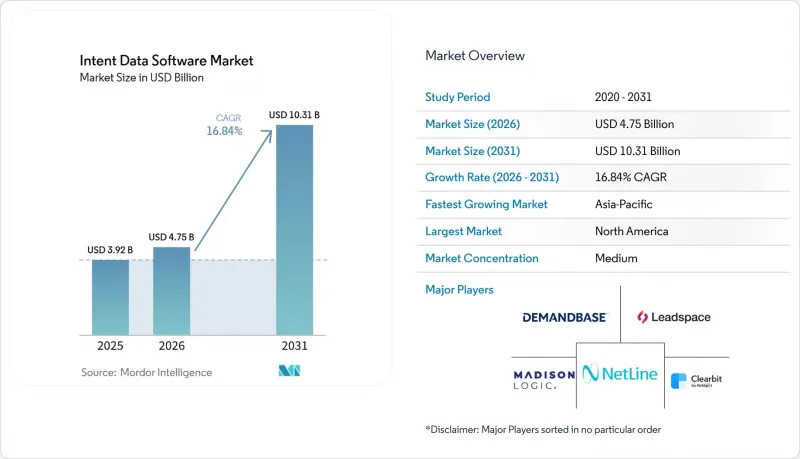
Mordor Intelligence에 의하면, 인텐트 데이터 소프트웨어 시장 규모는 2025년 39억 2,000만 달러에서 2026년에는 47억 5,000만 달러로 확대되어 2031년까지 103억 1,000만 달러에 이를 것으로 예상되고 있어 2026년부터 2031년까지 CAGR 16.84%로 성장할 전망입니다.
본 보고서는 구성 요소(소프트웨어 및 서비스), 도입 형태(클라우드 및 On-Premise), 용도(리드 인텔리전스 및 영업 기회 발굴 등), 조직 규모(대기업 및 중소기업), 최종 사용자 산업(정보 기술 및 통신 등), 지역별로 분류되어 있습니다. 시장 전망은 금액(미화) 기준으로 제시되어 있습니다.
세계 인텐트 데이터 소프트웨어 시장 동향 및 인사이트
AI를 활용한 구매자 신호 스코어링의 채택 확대
AI 기반 신호 스코어링은 인텐트 데이터 소프트웨어 시장에서 단순한 편의 기능에서 핵심 요건으로 전환되었습니다. 현재 구매자들은 플랫폼이 방대한 행동 데이터를 처리하여 영업 팀이 신속하게 조치를 취할 수 있도록 명확한 구매 단계 분류로 변환해 주기를 기대하고 있습니다. 주요 벤더들은 더 이상 계정을 ‘활성’으로 표시할 수 있는지 여부만으로 평가받지 않습니다. 구매자들은 점수가 변한 이유와 어떤 행동이 그 변화를 가져왔는지 이해하고 싶어하기 때문입니다. 이로 인해, 특히 여러 팀이 동일한 계정 우선순위 지정 모델을 신뢰해야 하는 경우, 기업 평가에서 ‘설명 가능성’의 중요성이 더욱 커지고 있습니다. 6sense에 따르면, 2025년 2분기부터 2026년 1분기에 걸쳐 ‘6sense Qualified Accounts’로 우선순위가 지정된 계정은 우선순위가 지정되지 않은 계정에 비해 기회 가치가 29% 높았고, 계약 규모는 33% 더 컸다고 합니다. 따라서 인텐트 데이터 소프트웨어 시장은 사용자에게 논리가 이해하기 쉬운 상태를 유지하면서도, 스코어링의 정확성과 측정 가능한 상업적 성과를 연결할 수 있는 플랫폼으로 전환되고 있습니다.
계정 기반 마케팅(ABM) 프로그램의 확대
계정 기반 마케팅(ABM) 프로그램의 확대는 인텐트 데이터 소프트웨어 시장의 구매, 도입 및 측정 방식을 변화시키고 있습니다. 구매자들은 계정 신호, 타겟 고객 활성화, 아웃리치 계획, 캠페인 조정이 번거로운 수작업 인계 없이도 연계될 수 있는 단일 환경을 점점 더 요구하고 있습니다. 이에 따라, 고립된 인텐트 피드에 대한 지출에서 마케팅 팀과 영업 팀 전반에 걸친 보다 광범위한 수익 창출 프로세스를 지원할 수 있는 플랫폼에 대한 지출로 전환되고 있습니다. 또한, 이는 사내 도입 근거도 변화시키고 있습니다. 의도 데이터가 단일하고 좁은 범위의 리드 선별 작업이 아니라, 연계된 계정 계획을 지원할 때 그 도입을 정당화하기가 더 쉬워지기 때문입니다. 이러한 상황에서 구매자가 계정 기반 마케팅을 일회성 캠페인 접근 방식이 아닌 운영 모델로 인식함에 따라, 인텐트 데이터 소프트웨어 시장은 혜택을 보게 됩니다. 이러한 추세는 더 대규모의 계약 및 플랫폼 활용 심화를 촉진하는 동시에, 활성화 기능을 핵심 워크플로우에 직접 통합하도록 벤더에 대한 압력을 강화하게 될 것입니다.
의도 신호의 노이즈와 오감지 위험
오감지는 여전히 의도 데이터 소프트웨어 시장에서 가장 뚜렷한 위험 요소 중 하나입니다. 플랫폼이 충분한 근거 없이 계정을 ‘활성’으로 식별할 경우, 영업 팀은 실제 구매자의 관심사와 부합하지 않는 접근 방식에 시간을 낭비할 수 있습니다. 문제는 비효율성뿐만이 아닙니다. 품질이 낮은 접근 방식을 반복하면 본격적인 구매 협상이 시작되기도 전에 해당 계정으로부터 신뢰를 잃을 위험이 있습니다. 이는 각 계정의 가치가 높고 구매 그룹에 많은 이해관계자가 관여하는 경우가 많은 엔터프라이즈 부문에서 더욱 중요한 문제가 됩니다. 따라서 인텐트 데이터 소프트웨어 시장에서는 초기 파일럿 단계나 온보딩 주기에서 구매자 자신의 계정 목록과 대조하여 신호의 품질을 입증할 수 있는 벤더가 높이 평가됩니다. 구매자들은 모든 신호 소스가 동등하게 신뢰할 수 있다고 쉽게 생각하는 경향이 줄어들고 있으며, 그 결과 가치 입증에 대한 기준이 높아지고 있습니다.
부문 분석
2025년에는 소프트웨어가 매출의 68.15%를 차지하며, 인텐트 데이터 소프트웨어 시장에서 가장 큰 구성 요소가 되었습니다. 이러한 위상은 기본적인 데이터 피드에서 신호 수집, 계정 스코어링, 활성화, 측정을 단일 운영 계층으로 통합한 소프트웨어 환경으로의 전환을 반영합니다. 구매자들은 동일한 계정 신호를 기반으로 행동하는 마케팅, 영업, 수익 운영 팀 간의 워크플로우 마찰을 줄일 수 있기 때문에 단일 플랫폼을 점점 더 선호하고 있습니다. 또한, 고객은 좁은 범위의 인텐트 파일이나 고립된 토픽 피드가 아닌, 보다 광범위한 실행 시스템에 대해 비용을 지불하고 있기 때문에 평균 계약 금액도 증가하고 있습니다. 벤더들이 인텐트 인텔리전스를 실시간 신호 접근이 필요한 CRM 도구, 마케팅 자동화 시스템, AI 에이전트의 워크플로우와 연동함에 따라 소프트웨어 계층은 더욱 핵심적인 역할을 하고 있습니다.
서비스 시장은 2031년까지 연평균 성장률(CAGR) 19.77%로 확대될 것으로 예측되며, 인텐트 데이터 소프트웨어 시장에서 가장 빠르게 성장하는 분야가 되고 있습니다. 이러한 성장을 뒷받침하는 것은 플랫폼을 구매했으나 도입, 스코어링 설계, 캠페인 활성화, 워크플로우 통합에 있어 여전히 지원이 필요한 조직들입니다. 많은 구매 기업은 인텐트 도구를 효과적으로 활용하기 위해 필요한 사내 운영 모델을 구축하는 것보다 더 빨리 도구를 도입할 수 있기 때문에 지원 서비스에 대한 안정적인 수요가 발생하고 있습니다. 이는 기업이 파일럿 이용 사례에서 여러 팀, 지역, 시스템을 아우르는 전사적 전개로 전환할 때 특히 두드러집니다. 실제로 초기 도입이 완전한 상업적 가치를 발휘할지, 아니면 충분히 활용되지 못한 채 끝날지는 많은 경우 서비스에 따라 결정되는 경우가 많습니다.
2025년에는 클라우드 기반 도입이 매출의 71.33%를 차지하며, 2031년까지 연평균 성장률(CAGR) 19.04%로 성장할 것으로 전망됩니다. 이는 클라우드가 인텐트 데이터 소프트웨어 시장에서 가장 크고 가장 빠르게 성장하는 도입 모델임을 의미합니다. 이러한 추세는 구매자들이 기존의 하이브리드형이나 On-Premise형 환경에서 전환할 여지가 여전히 남아 있음을 반영합니다. 실시간 신호 처리, AI 기반 스코어링, 워크플로우 오케스트레이션은 고속이며 상시 이용 가능한 데이터 교환에 의존하기 때문에 클라우드 도입은 이 범주의 기술적 요구 사항을 충족시킵니다. 또한 구매자들은 로컬 시스템 유지보수보다 빈번한 업데이트와 인프라 관리 부담 경감을 원하기 때문에 이는 조달 행태와도 부합합니다.
On-Premise 배포는 점유율은 작지만, 인텐트 데이터 소프트웨어 시장에서 여전히 중요한 위치를 차지하고 있습니다. 그 역할은 데이터 보관 장소, 보안 심사 또는 사내 정책으로 인해 퍼블릭 클라우드로의 완전한 전환이 어려운 규제 환경에서 가장 두드러집니다. 금융 기관, 정부 관련 기술 구매자 및 일부 의료 기관은 기밀 데이터의 저장 위치나 이동 방식에 대해 여전히 독자적인 관리를 중시하고 있습니다. 이러한 구매자들은 보다 엄격한 거버넌스를 유지하면서 의도 주도형 워크플로우를 가능하게 하는 프라이빗 클라우드나 하이브리드 모델을 채택하는 경우가 많습니다. 이를 통해 보다 체계적인 관리 하에 도입 옵션을 지원할 수 있는 벤더들에게는 지속적이고 고부가가치의 틈새 시장이 유지되고 있습니다.
지역별 분석
2025년, 북미는 매출의 37.41%를 차지하며 인텐트 데이터 소프트웨어 시장에서 가장 큰 점유율을 기록했습니다. 이 37.41%의 점유율이 시장을 주도하는 요인이 된 것은 해당 지역이 가장 성숙한 계정 기반 마케팅 환경을 갖추고 있으며, SaaS 도입률이 높고, B2B 기술 벤더의 기반이 밀집해 있기 때문입니다. 미국은 CRM, 마케팅 자동화 및 수익 운영 도구가 기업의 판매 프로세스에 깊이 침투해 있어 계속해서 핵심 시장으로서의 위상을 유지하고 있습니다. ZoomInfo는 고객의 합리화와 플랫폼 통합에 의해 형성되는 상업 환경을 반영하여, 2026년 연간 매출 전망을 11억 8,000만-12억 달러로 수정했습니다. 따라서 북미의 인텐트 데이터 소프트웨어 시장은 여전히 가장 발전된 지역이지만, 그 성장 경로는 단순한 초기 도입보다는 플랫폼 교체, 워크플로우 심화 및 기여도 입증과 점점 더 밀접하게 연결되어 있습니다.
아시아태평양은 2031년까지 연평균 성장률(CAGR) 18.30%로 확대될 것으로 예상되며, 인텐트 데이터 소프트웨어 시장에서 가장 빠르게 성장하는 지역 부문이 될 전망입니다. 이 지역은 북미에 뒤처져 따라가는 데 그치지 않고, 기술 주도형 시장에서 모바일 우선 판매, 다국어 지원, 그리고 급변하는 비즈니스 주기를 수용하고 있습니다. 인도, 한국, 중국 및 동남아시아는 기업들이 영업 및 마케팅 프로세스의 디지털화를 추진하고 더 우수한 계정 우선순위 지정 도구를 모색함에 따라 주요 수요 거점이 되고 있습니다. 또한, 일본과 한국에서는 언어의 정확성과 현지 규정 준수 요건의 중요성이 두드러지므로, 영어 모델에 지나치게 의존하는 세계 벤더에게는 이것이 장벽이 될 가능성이 있습니다. 호주 및 뉴질랜드는 성숙한 서유럽 국가의 구매 패턴과 유사하며, 구매자들은 정보 유출 대응 및 데이터 취급에 관한 규율에 대한 더 많은 배려를 여전히 요구하고 있습니다.
유럽은 독일, 영국, 프랑스의 지지를 받아 여전히 인텐트 데이터 소프트웨어 시장에서 중요한 비중을 차지하고 있습니다. 이 지역은 확립된 기업 소프트웨어 구매 프로세스와 계정 기반 마케팅(ABM) 프로그램의 의미 있는 도입 실적을 장점으로 누리고 있지만, 구매자들이 데이터 취급 및 자동 스코어링 관행에 대해 신중한 태도를 보이기 때문에 평가 프로세스는 비교적 느린 임베디드니다. 영국에서는 여전히 견조한 자체 수요가 나타나고 있는 반면, 유럽 대륙에서는 현지 적응성 측면에서 미국 기반 플랫폼과 경쟁할 수 있는 지역 밀착형 대안 솔루션에 대한 여지가 생기고 있습니다. Expandi Limited는 2026년 3월 Kompass를 인수하여, 기업 그래픽 인텔리전스와 미디어 기반 행동 신호, 구매 의향 데이터를 결합한 더 대규모의 독립적인 유럽 B2B 데이터·미디어·AI 기반 마케팅 플랫폼을 구축했습니다. 남미, 중동 및 아프리카는 여전히 소규모 지역 시장이지만, 기업의 디지털화, 정부 주도의 기술 투자, 그리고 해당 지역 내 B2B 소프트웨어 도입이 진행되면서 대상 고객 기반이 지속적으로 확대되고 있어 그 존재감이 높아지고 있습니다.
기타 혜택:
- 엑셀 형식 시장 예측(ME) 시트
- 3개월간의 애널리스트 지원
자주 묻는 질문
목차
제1장 서론
제2장 조사 방법
제3장 개요
제4장 시장 구도
제5장 시장 규모와 성장 예측
제6장 경쟁 구도
제7장 시장 기회와 향후 전망
JHS 26.09.01According to Mordor Intelligence, the intent data software market size is expected to increase from USD 3.92 billion in 2025 to USD 4.75 billion in 2026 and reach USD 10.31 billion by 2031, growing at a CAGR of 16.84% over 2026-2031.
This report is Segmented by Component (Software, and Services), Deployment Mode (Cloud, and On-Premises), Application (Lead Intelligence and Opportunity Identification, and More), Organization Size (Large Enterprises, and Small and Medium Enterprises), End User Industry (Information Technology and Telecommunications, and More), and Geography. The Market Forecasts are Provided in Terms of Value (USD).
Global Intent Data Software Market Trends and Insights
Rising Adoption of AI-Driven Buyer Signal Scoring
AI-based signal scoring has moved from a useful feature to a core requirement in the intent data software market. Buyers now expect platforms to process large volumes of behavioral activity and translate them into clear buying-stage classifications that sales teams can act on quickly. The strongest vendors are no longer judged only on whether they can flag an account as active, because buyers also want to understand why the score changed and which behaviors drove the shift. This is making explainability more important in enterprise evaluations, especially when multiple teams need to trust the same account prioritization model. 6sense stated that accounts prioritized as 6sense Qualified Accounts delivered 29% higher opportunity values and 33% larger deal sizes than non-qualified accounts across the Q2 2025 to Q1 2026 period. The intent data software market is therefore moving toward platforms that can connect scoring accuracy with measurable commercial outcomes while still keeping the logic understandable to users.
Expansion of Account-Based Marketing Programs
The expansion of account-based marketing programs is changing how the intent data software market is bought, deployed, and measured. Buyers increasingly want one environment where account signals, audience activation, outreach planning, and campaign coordination can work together without heavy manual handoffs. This shifts spending away from isolated intent feeds and toward platforms that can support a broader revenue motion across marketing and sales teams. It also changes the internal buying case, because intent data is easier to justify when it supports coordinated account planning rather than a single, narrow lead qualification task. In this setting, the intent data software market benefits when buyers treat account-based marketing as an operating model rather than a single-campaign approach. That pattern supports larger contracts, deeper platform usage, and more pressure on vendors to integrate activation features directly into the core workflow.
Intent Signal Noise and False Positive Risk
False positives remain one of the clearest risks in the intent data software market. When a platform identifies an account as active without sufficient evidence, sales teams can waste time on outreach that does not align with real buyer interest. The problem is not only inefficiency; repeated low-quality outreach can weaken account trust before a serious buying conversation begins. This matters even more in enterprise segments, where each account is high-value, and buying groups often involve many stakeholders. The intent data software market, therefore, rewards vendors that can prove signal quality against a buyer's own account list during early pilots and onboarding cycles. Buyers are becoming less willing to assume that all signal sources are equally reliable, and that is raising the standard for proof of value.
Other drivers and restraints analyzed in the detailed report include:
- Need For Real-Time Sales and Marketing Orchestration
- Growth of First-Party Intent Capture across Digital Touchpoints
- Privacy, Consent, and Data Governance Constraints
For complete list of drivers and restraints, kindly check the Table Of Contents.
Segment Analysis
Software accounted for 68.15% of revenue in 2025, making it the largest component of the intent data software market. That position reflects the shift from basic data feeds to integrated software environments that combine signal collection, account scoring, activation, and measurement into a single operating layer. Buyers increasingly prefer a single platform because it reduces workflow friction among marketing, sales, and revenue operations teams that all act on the same account signals. This also increases the average contract value, since customers are paying for a broader execution system rather than a narrow intent file or an isolated topic feed. The software layer has become more central as vendors connect intent intelligence to CRM tools, marketing automation systems, and AI agent workflows that need live signal access.
Services are projected to expand at a 19.77% CAGR through 2031, making them the fastest-growing component of the intent data software market. Growth is being supported by organizations that have bought a platform but still need help with implementation, scoring design, campaign activation, and workflow alignment. Many buyers can purchase intent tools faster than they can build the internal operating model needed to use them well, which creates steady demand for support services. This is especially evident when companies move from a pilot use case to an enterprise rollout spanning multiple teams, geographies, and systems. In practice, services often determine whether an initial deployment reaches full commercial value or remains underused.
Cloud-based deployment accounted for 71.33% of revenue in 2025 and is projected to grow at a 19.04% CAGR through 2031. This means cloud is both the largest and the fastest-growing deployment model in the intent data software market. The pattern reflects a category that still has room for migration as buyers move away from older hybrid and on-premises setups. Cloud deployment fits the technical needs of the category because real-time signal processing, AI-assisted scoring, and workflow orchestration depend on fast, always-available data exchange. It also fits procurement behavior, since buyers want frequent updates and lower infrastructure management burdens rather than local system maintenance.
On-premises deployment remains relevant in the intent data software market even though its share is smaller. Its role is strongest in regulated environments where data residency, security reviews, or internal policies make full public cloud adoption difficult. Financial institutions, government-adjacent technology buyers, and some healthcare organizations still value private control over where sensitive data sits and how it moves. These buyers often turn to private cloud or hybrid models that preserve stricter governance while still allowing intent-driven workflows. That keeps a durable, high-value niche in place for vendors that can support more controlled deployment options.
Complete Report Scope:
- By Component
- Software
- Services
- By Deployment Mode
- Cloud
- On-Premises
- By Application
- Lead Intelligence and Opportunity Identification
- Account-Based Marketing (ABM)
- Sales and Revenue Intelligence
- Customer Experience and Personalization
- Risk, Compliance and Fraud Intelligence
- By Organization Size
- Large Enterprises
- Small and Medium Enterprises
- By End User Industry
- Information Technology and Telecommunications
- Banking, Financial Services, and Insurance (BFSI)
- Retail and E-commerce
- Media and Entertainment
- Healthcare and Life Sciences
- Industrial Manufacturing
- Other End User Industries
- By Geography
- North America
- United States
- Canada
- Mexico
- South America
- Brazil
- Argentina
- Rest of South America
- Europe
- Germany
- United Kingdom
- France
- Italy
- Spain
- Russia
- Rest of Europe
- Asia-Pacific
- China
- Japan
- India
- South Korea
- Australia and New Zealand
- Rest of Asia-Pacific
- Middle East
- Saudi Arabia
- United Arab Emirates
- Turkey
- Rest of Middle East
- Africa
- South Africa
- Nigeria
- Rest of Africa
- North America
Geography Analysis
North America accounted for 37.41% of revenue in 2025, giving the region the largest share of the intent data software market. This 37.41% position represented the leading share of the intent data software market because the region has the most mature account-based marketing environment, high SaaS adoption, and a dense base of B2B technology vendors. The United States remains the anchor market because CRM, marketing automation, and revenue operations tools are deeply embedded across enterprise selling motions. ZoomInfo revised its full-year 2026 revenue guidance to USD 1.18-1.20 billion, reflecting a commercial environment shaped by customer rationalization and platform consolidation. The North American intent data software market, therefore, remains the most developed region, but its growth path is increasingly tied to platform replacement, workflow depth, and proof of contribution rather than simple first-time adoption.
Asia-Pacific is projected to expand at a 18.30% CAGR through 2031, making it the fastest-growing regional segment in the intent data software market. The region is not only following North America with a time lag, but also adopting mobile-first selling, multilingual engagement, and fast-moving commercial cycles in technology-led markets. India, South Korea, China, and Southeast Asia are key demand centers as enterprises digitize their sales and marketing processes and seek better account-prioritization tools. Japan and South Korea also highlight the importance of language precision and local compliance expectations, which can create gaps for global vendors that rely too heavily on English-language models. Australia and New Zealand are closer to mature Western buying patterns, but buyer expectations still include greater attention to breach response and data-handling discipline.
Europe remains a substantial part of the intent data software market, supported by Germany, the United Kingdom, and France. The region benefits from established enterprise software buying processes and a meaningful installed base of account-based marketing programs, but evaluations can move more slowly because buyers are cautious about data handling and automated scoring practices. The United Kingdom continues to show solid independent demand, while continental Europe creates room for regional alternatives that can compete with United States-based platforms on local fit. Expandi Limited acquired Kompass in March 2026 to create a larger independent European B2B data, media, and AI-powered marketing platform that combines firmographic intelligence with media-based behavioral signals and purchase intent data. South America, the Middle East, and Africa remain smaller regional markets, but they are becoming more visible as enterprise digitization, sovereign technology investment, and regional B2B software adoption continue to widen the addressable base.
- 6sense, Inc.
- Bombora, Inc.
- Demandbase, Inc.
- ZoomInfo Technologies Inc.
- TechTarget, Inc.
- G2.com, Inc.
- Madison Logic, Inc.
- Leadspace, Inc.
- DemandScience, LLC
- RollWorks, a NextRoll company
- NetLine Corporation
- Dealfront Group GmbH
- Cognism Limited
- Clearbit, Inc.
- Terminus Software, Inc.
- Aberdeen, Inc.
- Slintel, Inc.
- DemandJump, Inc.
- EverString, Inc.
- LeadSift Inc.
Additional Benefits:
- The market estimate (ME) sheet in Excel format
- 3 months of analyst support
TABLE OF CONTENTS
1 INTRODUCTION
- 1.1 Study Assumptions and Market Definition
- 1.2 Scope of the Study
2 RESEARCH METHODOLOGY
3 EXECUTIVE SUMMARY
4 MARKET LANDSCAPE
- 4.1 Market Overview
- 4.2 Market Drivers
- 4.2.1 Rising Adoption of AI-Driven Buyer Signal Scoring
- 4.2.2 Expansion of Account-Based Marketing Programs
- 4.2.3 Need for Real-Time Sales and Marketing Orchestration
- 4.2.4 Growth of First-Party Intent Capture Across Digital Touchpoints
- 4.2.5 Demand for Verticalized Intent Models in Complex Buying Committees
- 4.2.6 Vendor Consolidation Toward Outcome-Based Revenue Platforms
- 4.3 Market Restraints
- 4.3.1 Intent Signal Noise and False Positive Risk
- 4.3.2 Privacy, Consent, and Data Governance Constraints
- 4.3.3 Integration Complexity Across CRM, MAP, and CDP Stacks
- 4.3.4 Attribution Difficulty in Long and Multi-Stakeholder Buying Cycles
- 4.4 Industry Value Chain Analysis
- 4.5 Regulatory Landscape
- 4.6 Technological Outlook
- 4.7 Impact of Macroeconomic Factors on the Market
- 4.8 Porter's Five Forces Analysis
- 4.8.1 Threat of New Entrants
- 4.8.2 Bargaining Power of Suppliers
- 4.8.3 Bargaining Power of Buyers
- 4.8.4 Threat of Substitutes
- 4.8.5 Competitive Rivalry
5 MARKET SIZE AND GROWTH FORECASTS (VALUE)
- 5.1 By Component
- 5.1.1 Software
- 5.1.2 Services
- 5.2 By Deployment Mode
- 5.2.1 Cloud
- 5.2.2 On-Premises
- 5.3 By Application
- 5.3.1 Lead Intelligence and Opportunity Identification
- 5.3.2 Account-Based Marketing (ABM)
- 5.3.3 Sales and Revenue Intelligence
- 5.3.4 Customer Experience and Personalization
- 5.3.5 Risk, Compliance and Fraud Intelligence
- 5.4 By Organization Size
- 5.4.1 Large Enterprises
- 5.4.2 Small and Medium Enterprises
- 5.5 By End User Industry
- 5.5.1 Information Technology and Telecommunications
- 5.5.2 Banking, Financial Services, and Insurance (BFSI)
- 5.5.3 Retail and E-commerce
- 5.5.4 Media and Entertainment
- 5.5.5 Healthcare and Life Sciences
- 5.5.6 Industrial Manufacturing
- 5.5.7 Other End User Industries
- 5.6 By Geography
- 5.6.1 North America
- 5.6.1.1 United States
- 5.6.1.2 Canada
- 5.6.1.3 Mexico
- 5.6.2 South America
- 5.6.2.1 Brazil
- 5.6.2.2 Argentina
- 5.6.2.3 Rest of South America
- 5.6.3 Europe
- 5.6.3.1 Germany
- 5.6.3.2 United Kingdom
- 5.6.3.3 France
- 5.6.3.4 Italy
- 5.6.3.5 Spain
- 5.6.3.6 Russia
- 5.6.3.7 Rest of Europe
- 5.6.4 Asia-Pacific
- 5.6.4.1 China
- 5.6.4.2 Japan
- 5.6.4.3 India
- 5.6.4.4 South Korea
- 5.6.4.5 Australia and New Zealand
- 5.6.4.6 Rest of Asia-Pacific
- 5.6.5 Middle East
- 5.6.5.1 Saudi Arabia
- 5.6.5.2 United Arab Emirates
- 5.6.5.3 Turkey
- 5.6.5.4 Rest of Middle East
- 5.6.6 Africa
- 5.6.6.1 South Africa
- 5.6.6.2 Nigeria
- 5.6.6.3 Rest of Africa
- 5.6.1 North America
6 COMPETITIVE LANDSCAPE
- 6.1 Market Concentration
- 6.2 Strategic Moves
- 6.3 Market Share Analysis
- 6.4 Company Profiles (includes Global Level Overview, Market Level Overview, Core Segments, Financials as available, Strategic Information, Market Rank/Share, Products and Services, Recent Developments)
- 6.4.1 6sense, Inc.
- 6.4.2 Bombora, Inc.
- 6.4.3 Demandbase, Inc.
- 6.4.4 ZoomInfo Technologies Inc.
- 6.4.5 TechTarget, Inc.
- 6.4.6 G2.com, Inc.
- 6.4.7 Madison Logic, Inc.
- 6.4.8 Leadspace, Inc.
- 6.4.9 DemandScience, LLC
- 6.4.10 RollWorks, a NextRoll company
- 6.4.11 NetLine Corporation
- 6.4.12 Dealfront Group GmbH
- 6.4.13 Cognism Limited
- 6.4.14 Clearbit, Inc.
- 6.4.15 Terminus Software, Inc.
- 6.4.16 Aberdeen, Inc.
- 6.4.17 Slintel, Inc.
- 6.4.18 DemandJump, Inc.
- 6.4.19 EverString, Inc.
- 6.4.20 LeadSift Inc.
7 MARKET OPPORTUNITIES AND FUTURE OUTLOOK
- 7.1 White-space and Unmet-Need Assessment