|
시장보고서
상품코드
2117528
말레이시아의 비료 : 시장 점유율 분석, 업계 동향 및 통계, 성장 예측(2026-2031년)Malaysia Fertilizer - Market Share Analysis, Industry Trends & Statistics, Growth Forecasts (2026 - 2031) |
||||||
 Mordor Intelligence
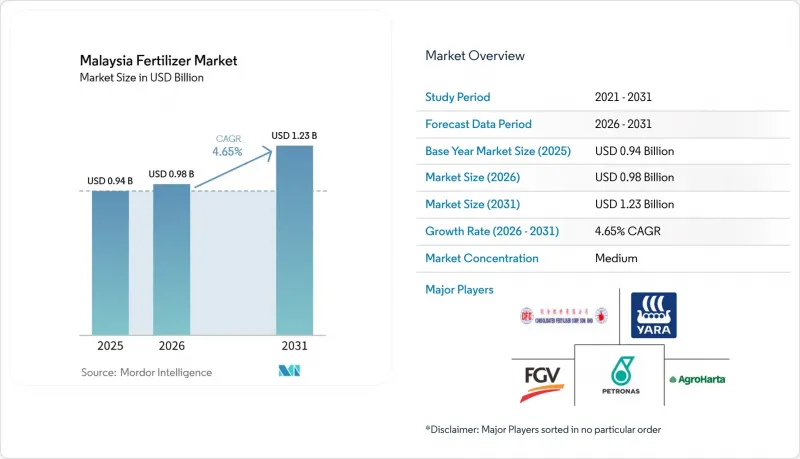
말레이시아의 비료 시장 규모는 2025년 9억 4,000만 달러로 평가되었습니다. 2026년 9억 8,000만 달러에서 2031년까지 12억 3,000만 달러로 확대되어 2026년부터 2031년에 걸쳐 CAGR 4.65%를 기록했습니다.
본 보고서는 유형별(복합비료 및 단일비료), 형태별(기존 및 특수형), 시비 방법별(시비 관개, 엽면 살포, 토양 시비), 작물 품목별(밭작물, 원예작물, 잔디 및 관상용 식물)로 분류되어 있습니다. 시장 전망은 금액(달러) 및 수량(메트릭 톤)으로 제시되어 있습니다.
말레이시아의 비료 시장 동향 및 인사이트
증가하는 야자나무의 영양분 수요
팜유는 성숙한 농장과 재식재된 농장 모두에서 지속적으로 대량의 영양소를 소비하기 때문에 말레이시아의 비료 시장에서 여전히 가장 큰 최종 용도 분야로 자리 잡고 있습니다. 국제비료협회(IFA)에 따르면, 2023년 말레이시아의 염화칼륨 수입량은 총 160만 톤에 달했으며, 2024년 팜 원유 가격 상승은 농장의 현금 흐름을 뒷받침하여 영양소 지출을 예상보다 견조하게 유지했습니다. 팜유 가격이 높은 수준을 유지함에 따라 노후화된 야자나무의 재식재 시급성도 완화되고 있습니다. 생산자들은 일시적으로 토지를 휴경시키는 것보다 오래된 나무에서 생산량을 유지하는 것을 선호하는 경향이 있기 때문입니다. 이러한 경향으로 인해 칼륨계 및 질소계 제품에 대한 수요는 안정적입니다. 성숙한 나무라도 열매 송이 생산량을 유지하려면 유지 시비나 보정 시비가 필요하기 때문입니다. 이로 인해 대규모 재식재 주기가 본격화되기 전부터 말레이시아의 비료 시장에는 농장 중심의 안정적인 수요 기반이 형성되어 있습니다.
정부의 보조금 및 생산 자재 지원
정부의 지원은 말레이시아의 비료 시장에서 가장 명확한 수요 안정화 요인 중 하나로 계속해서 자리 잡고 있습니다. 이는 국내 소비의 일부가 단순히 농가 수준의 구매력뿐만 아니라 정책 지원과도 연결되어 있기 때문입니다. 농업·식량안보부는 2025년, 벼 농가 대상 종자, 비료, 해충 방제를 포괄하는 농업 지원으로 22억 7,900만 링깃(4억 8,490만 달러)을 배정했습니다. 2026년 배정액은 26억 2,000만 링깃(5억 5,740만 달러)으로, 식량 생산자들을 비용 압박으로부터 보호하는 것이 여전히 적극적인 정책적 우선순위임을 보여줍니다. 2026년 1월부터 2027년 12월까지 천연 인광석 및 황산마그네슘에 대한 매출·서비스세 면제 조치가 시행됨에 따라 납품 비용이 더욱 절감되어, 물가 급등기에도 말레이시아의 비료 시장에서 보조금에 의한 수요를 보다 안정적으로 유지하는 데 도움이 될 것입니다.
수입 원자재에 대한 높은 의존도
말레이시아의 비료 시장은 국내 생산이 모든 영양소 범주를 균등하게 커버하지 못하고 있어 여전히 구조적인 취약성이 남아 있습니다. 국내 요소 생산은 질소 공급에 있어 중요한 역할을 하고 있지만, 인산계 비료에 대해서는 이와 같은 보호 조치가 적용되지 않고 있습니다. 2026년 3월, 말레이시아 인산계 비료 수입의 50%는 이집트에서 수입되었으며, 일부 기존 공급원에 대한 의존도는 낮아졌지만 특정 공급 경로에 대한 집중 위험은 여전히 높은 수준을 유지했습니다. 같은 달, 농장·상품부는 대체 공급 파트너 확보와 새로운 공급 경로 개척에 착수하며, 조달처 다각화가 적극적인 정책적 우선 과제가 되었음을 밝혔습니다. 제안된 ‘비료 법안’에 따라 감독 체계가 개선될 가능성은 있으나, 수입처의 다각화가 진행되고 집중도가 낮아질 때까지는 말레이시아의 비료 시장이 취약한 상태를 지속할 것으로 보입니다.
부문별 분석
2025년, 말레이시아의 비료 시장에서 단일 성분 비료가 64.0%라는 최대 점유율을 차지하며, 이 부문은 계속해서 국내 수요의 중심을 이루었습니다. 요소, 염화칼륨, 인산이암모늄은 확립된 영양 관리 프로그램 및 대규모 농지 시비에 적합하기 때문에 야자수, 벼, 고무 농장에서 계속해서 주요 제품으로 사용되었습니다. 질소계 비료 중에서는 2025년에 요소가 하위 부문을 주도했으며, 케다주 및 사바주의 국내 공장이 전 세계적인 공급 차질 속에서도 공급의 연속성을 유지하는 데 일조했습니다.
단일 비료는 2026년부터 2031년까지 연평균 성장률(CAGR) 8.6%로 확대될 것으로 예상되며, 농지의 영양 전략에서 결핍 보정이 점점 더 중요시되고 있음을 반영하여 가장 빠르게 성장하는 부문이 될 전망입니다. 아보라는 야자 농장에서 생과실의 수확량에 악영향을 미칠 수 있는 꽃눈의 낙화나 잎의 변형을 완화하기 위해 사용되기 때문에 수요가 확대될 것으로 예측됩니다. 복합 비료는 잎 조직 분석 및 체계적인 농지 진단을 바탕으로 한 보다 정밀한 영양 관리 프로그램으로의 전환을 추진하는 농장을 지원하고 있습니다. 말레이시아의 비료 시장에서 규모 면에서는 단일 비료가 주도적인 위치를 차지하고 있지만, 성장의 원동력은 점차 영양소 균형 조정 및 결핍 관리 쪽으로 이동하고 있습니다.
2025년에는 형태별 부문에서 기존 비료가 78.0%의 점유율을 차지해, 말레이시아의 비료 시장 규모는 여전히 표준적인 입상 제품의 광범위한 사용에 의해 지탱되고 있음을 알 수 있습니다. 농장 운영자들은 매우 광대한 재배 면적에 걸쳐 영양 관리 프로그램을 운영하고 있기 때문에 많은 구매 결정에서 영양소 단위당 비용은 시비 정확도보다 여전히 더 중요하게 여겨지고 있습니다. 또한, 기존 제품은 확립된 물류 체계, 익숙한 취급 방법, 그리고 현재의 유통업체 네트워크와의 높은 호환성이라는 이점도 누리고 있습니다. 이것이 제품의 고도화가 진행되는 가운데서도 기존 비료가 말레이시아의 비료 시장에서 여전히 큰 점유율을 차지하고 있는 이유입니다.
특수 비료는 2031년까지 연평균 8.1%의 성장이 예상되며, 형태별 구성 중에서 가장 빠르게 성장하는 분야가 될 전망입니다. 야자나무 묘목장에서는 초기 정착 단계에서 영양소 공급 시기가 매우 중요하기 때문에 방출 조절 비료의 인기가 높아지고 있습니다. 서방형 및 수용성 제품 또한 영양소 손실이 커지기 쉬우며, 작물의 반응을 보다 엄격하게 관리해야 하는 열대 환경에 적합합니다. 그 결과, 말레이시아의 비료 시장은 양극화된 구조로 진화하고 있습니다. 기존 비료는 여전히 대규모 농장 농업에서 주류를 이루고 있는 반면, 특수 비료는 원예, 묘목 생산 및 정밀한 영양분 관리 분야에서 그 역할을 확대되고 있습니다.
기타 혜택 :
- 엑셀 형식 시장 예측(ME) 시트
- 3개월간의 애널리스트 지원
자주 묻는 질문
목차
제1장 서론
제2장 본 보고서의 내용
제3장 개요 및 주요 조사 결과
제4장 주요 업계 동향
제5장 시장 규모 및 성장 예측
제6장 경쟁 구도
제7장 비료 업계의 이해관계자에게 있어서 중요한 전략적 과제
KTH 26.09.02According to Mordor Intelligence, the Malaysia fertilizers market size was expanded from USD 0.94 billion in 2025 and USD 0.98 billion in 2026 to USD 1.23 billion by 2031, registering a CAGR of 4.65% between 2026 and 2031.
This report is Segmented by Type (Complex and Straight), by Form (Conventional and Specialty), by Application Mode (Fertigation, Foliar, and Soil), and by Crop Type (Field Crops, Horticultural Crops, and Turf and Ornamental). The Market Forecasts are Provided in Terms of Value (USD) and Volume (Metric Tons).
Malaysia Fertilizer Market Trends and Insights
Rising Oil Palm Nutrient Demand
Oil palm remains the largest end-use anchor for the Malaysia fertilizer market because it consumes large recurring nutrient volumes across mature and replanted acreage. According to the International Fertilizer Association, muriate of potash imports into Malaysia totaled 1.6 million tons in 2023, and higher crude palm oil prices in 2024 supported estate cash flow and kept nutrient spending more resilient than anticipated. Strong palm oil prices also reduce the urgency to replace aging palms, as growers often prefer to sustain output from older trees rather than temporarily take land out of production. That behavior keeps demand steady for potassic and nitrogenous products because mature stands still require maintenance feeding and corrective nutrient application to sustain bunch output. This gives the Malaysia fertilizer market a stable plantation-led demand base even before a larger replanting cycle starts to move faster.
Government Subsidies and Input Support
Government support remains one of the clearest demand stabilizers in the Malaysia fertilizer market because part of national consumption is linked to policy support instead of only farm-level purchasing ability. The Ministry of Agriculture and Food Security allocated MYR 2.279 billion (USD 484.9 million) in 2025 for agricultural support, covering seeds, fertilizers, and pest control for paddy farmers. In 2026, the allocation stands at MYR 2.62 billion (USD 557.4 million), indicating that shielding food producers from cost pressures remains an active policy priority. The Sales and Service Tax exemption for rock phosphate and magnesium sulfate from January 2026 through December 2027 further reduces delivered cost and helps keep subsidized demand in the Malaysia fertilizer market more stable during periods of price stress.
Heavy Dependence on Imported Raw Materials
The Malaysia fertilizer market still carries a structural vulnerability because domestic production does not cover all nutrient categories evenly. Local urea output provides meaningful nitrogen support, but the same protection does not apply to phosphatic inputs. As of March 2026, Malaysia sources 50% of its phosphatic fertilizer imports from Egypt, maintaining significant corridor concentration risk despite having reduced dependence on some earlier origins. In the same month, the Ministry of Plantation and Commodities moved to secure alternative supply partners and activate new channels, indicating that procurement diversification has become an active policy priority task. The proposed Fertilizer Bill may improve oversight, but the Malaysia fertilizer market will remain vulnerable until import sourcing becomes broader and less concentrated.
Other drivers and restraints analyzed in the detailed report include:
- Precision Farming and Fertigation Adoption
- Domestic Production and Stock Buffering Efforts
- Smallholder Price Sensitivity
For complete list of drivers and restraints, kindly check the Table Of Contents.
Segment Analysis
Straight fertilizers held the largest, 64.0% of the Malaysia fertilizer market share in 2025, which kept the segment at the center of national volume demand. Urea, muriate of potash, and di-ammonium phosphate remained the core products used across oil palm, paddy, and rubber plantations because they fit established nutrient programs and large-scale field application. Within nitrogenous fertilizers, urea dominated the sub-segment in 2025, and domestic plants in Kedah and Sabah helped maintain supply continuity during global disruption.
Straight fertilizers are projected to expand at a CAGR of 8.6% from 2026 to 2031, making them the fastest-growing segment, reflecting the increasing focus on correcting deficiencies in field nutrient strategies. Boron is projected to grow as oil palm estates use it to reduce flower abortion and leaf deformation, both of which can negatively affect fresh fruit bunch performance. Complex fertilizers support estates transitioning toward more precise nutrient programs based on leaf tissue analysis and structured field diagnostics. While straight fertilizers lead the Malaysia fertilizer market in terms of scale, growth is increasingly being driven by nutrient balancing and deficiency management.
Conventional fertilizers held 78.0% of the form segment in 2025, which shows that the Malaysia fertilizer market size still rests on the broad use of standard granular products. Plantation operators manage nutrient programs across very large planted areas, so cost per nutrient unit still matters more than delivery precision in many buying decisions. Conventional products also benefit from established logistics, familiar handling practices, and strong compatibility with the current distributor base. This is why conventional fertilizers continue to hold the larger share of the Malaysia fertilizer market even as product sophistication increases.
Specialty fertilizers are projected to grow at 8.1% through 2031, making them the fastest-growing part of the form split. Controlled-release fertilizers are gaining popularity in oil palm nurseries because nutrient timing is critical during early plant establishment. Slow-release and water-soluble products also fit tropical conditions where nutrient loss can be higher, and crop response needs to be tighter. As a result, the Malaysian fertilizer market is evolving toward a dual structure. Conventional fertilizers continue to dominate large-scale plantation agriculture, while specialty fertilizers are expanding their role in horticulture, nursery production, and precision nutrient management.
Complete Report Scope:
- By Type
- Complex
- Straight
- Micronutrients
- Boron
- Copper
- Iron
- Manganese
- Molybdenum
- Zinc
- Others
- Nitrogenous
- Ammonium Nitrate
- Anhydrous Ammonia
- Urea
- Others
- Phosphatic
- Di-ammonium Phosphate
- Mono Ammonium Phosphate
- Single Super Phosphate
- Triple Superphosphate
- Others
- Potassic
- Muriate of Potash
- Sulphate of Potash
- Others
- Secondary Macronutrients
- Calcium
- Magnesium
- Sulfur
- Micronutrients
- By Form
- Conventional
- Specialty
- Controlled-Release Fertilizer
- Liquid Fertilizer
- Slow-Release Fertilizer
- Water Soluble
- By Application Mode
- Fertigation
- Foliar
- Soil
- By Crop Type
- Field Crops
- Horticultural Crops
- Turf and Ornamental
List of Companies Covered in this Report:
- PETRONAS Chemicals Group Berhad
- Yara International ASA
- FGV Holdings Berhad
- Consolidated Fertiliser Corporation Sdn Bhd
- Agroharta Fertilizer Sdn Bhd
- Sinergi Perdana Sdn Bhd
- Hap Seng Trading
- Syngenta Group
- IFFCO
- Nufarm
- NGEAM Engineering Works Sdn Bhd
- Twin Arrow Fertilizer Sdn Bhd
- BIOTECH BLENDS
- UPL Limited
- The Mosaic Company
Additional Benefits:
- The market estimate (ME) sheet in Excel format
- 3 months of analyst support
TABLE OF CONTENTS
1 Introduction
- 1.1 Study Assumptions & Market Definition
- 1.2 Scope of the Study
- 1.3 Research Methodology
2 Report Offers
3 Executive Summary & Key Findings
4 Key Industry Trends
- 4.1 Acreage of Major Crop Types
- 4.1.1 Field Crops
- 4.1.2 Horticultural Crops
- 4.2 Average Nutrient Application Rates
- 4.2.1 Micronutrients
- 4.2.1.1 Field Crops
- 4.2.1.2 Horticultural Crops
- 4.2.2 Primary Nutrients
- 4.2.2.1 Field Crops
- 4.2.2.2 Horticultural Crops
- 4.2.3 Secondary Macronutrients
- 4.2.3.1 Field Crops
- 4.2.3.2 Horticultural Crops
- 4.2.1 Micronutrients
- 4.3 Agricultural Land Equipped For Irrigation
- 4.4 Regulatory Framework
- 4.5 Value Chain & Distribution Channel Analysis
- 4.6 Market Drivers
- 4.6.1 Rising oil palm nutrient demand
- 4.6.2 Government subsidies and input support
- 4.6.3 Precision farming and fertigation adoption
- 4.6.4 Domestic production and stock buffering efforts
- 4.6.5 Fertilizer quality regulation and supply chain oversight
- 4.6.6 Replanting cycles in plantation agriculture
- 4.7 Market Restraints
- 4.7.1 Heavy dependence on imported raw materials
- 4.7.2 Exposure to global price volatility
- 4.7.3 Smallholder price sensitivity
- 4.7.4 Limited specialty fertilizer penetration beyond plantations
5 Market Size and Growth Forecasts (Value And Volume)
- 5.1 By Type
- 5.1.1 Complex
- 5.1.2 Straight
- 5.1.2.1 Micronutrients
- 5.1.2.1.1 Boron
- 5.1.2.1.2 Copper
- 5.1.2.1.3 Iron
- 5.1.2.1.4 Manganese
- 5.1.2.1.5 Molybdenum
- 5.1.2.1.6 Zinc
- 5.1.2.1.7 Others
- 5.1.2.2 Nitrogenous
- 5.1.2.2.1 Ammonium Nitrate
- 5.1.2.2.2 Anhydrous Ammonia
- 5.1.2.2.3 Urea
- 5.1.2.2.4 Others
- 5.1.2.3 Phosphatic
- 5.1.2.3.1 Di-ammonium Phosphate
- 5.1.2.3.2 Mono Ammonium Phosphate
- 5.1.2.3.3 Single Super Phosphate
- 5.1.2.3.4 Triple Superphosphate
- 5.1.2.3.5 Others
- 5.1.2.4 Potassic
- 5.1.2.4.1 Muriate of Potash
- 5.1.2.4.2 Sulphate of Potash
- 5.1.2.4.3 Others
- 5.1.2.5 Secondary Macronutrients
- 5.1.2.5.1 Calcium
- 5.1.2.5.2 Magnesium
- 5.1.2.5.3 Sulfur
- 5.1.2.1 Micronutrients
- 5.2 By Form
- 5.2.1 Conventional
- 5.2.2 Specialty
- 5.2.2.1 Controlled-Release Fertilizer
- 5.2.2.2 Liquid Fertilizer
- 5.2.2.3 Slow-Release Fertilizer
- 5.2.2.4 Water Soluble
- 5.3 By Application Mode
- 5.3.1 Fertigation
- 5.3.2 Foliar
- 5.3.3 Soil
- 5.4 By Crop Type
- 5.4.1 Field Crops
- 5.4.2 Horticultural Crops
- 5.4.3 Turf and Ornamental
6 Competitive Landscape
- 6.1 Key Strategic Moves
- 6.2 Market Share Analysis
- 6.3 Company Landscape
- 6.4 Company Profiles (Includes Global Level Overview, Market Level Overview, Core Segments, Financials as Available, Strategic Information, Market Rank/Share for Key Companies, Products and Services, and Recent Developments)
- 6.4.1 PETRONAS Chemicals Group Berhad
- 6.4.2 Yara International ASA
- 6.4.3 FGV Holdings Berhad
- 6.4.4 Consolidated Fertiliser Corporation Sdn Bhd
- 6.4.5 Agroharta Fertilizer Sdn Bhd
- 6.4.6 Sinergi Perdana Sdn Bhd
- 6.4.7 Hap Seng Trading
- 6.4.8 Syngenta Group
- 6.4.9 IFFCO
- 6.4.10 Nufarm
- 6.4.11 NGEAM Engineering Works Sdn Bhd
- 6.4.12 Twin Arrow Fertilizer Sdn Bhd
- 6.4.13 BIOTECH BLENDS
- 6.4.14 UPL Limited
- 6.4.15 The Mosaic Company